Conditional Probability and the Normal Distribution
Neil Trivedi
Teacher

Conditional Probability and the Normal Distribution
Example 1:
The time, in minutes, for New Yorkers to get into work is modelled by a normal distribution with mean minutes and standard deviation minutes.
a) Find the proportion of New Yorkers that take longer than hour to get to work.
Single Step: By letting , find the probability that is larger than (equivalent to hour).
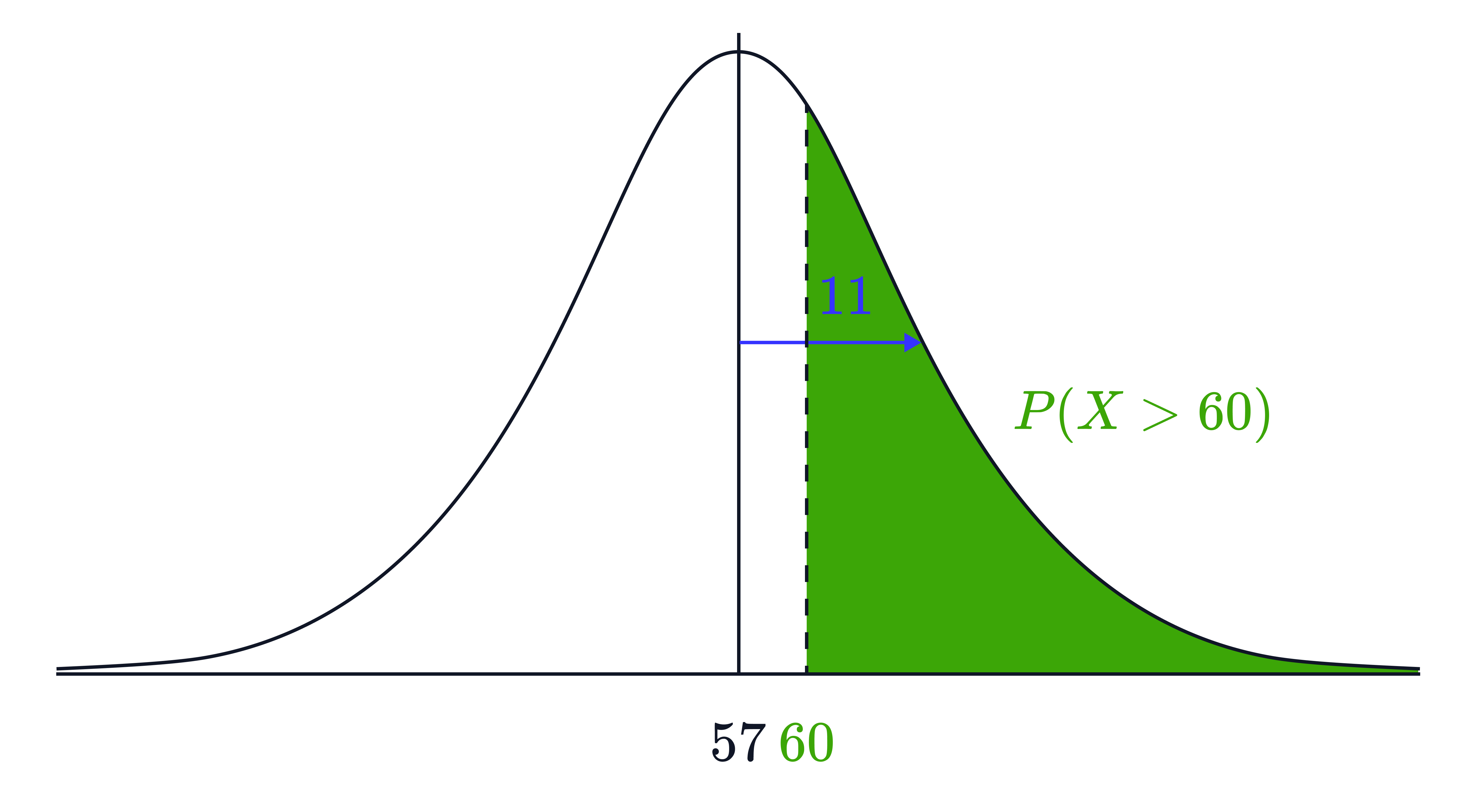
Using our calculator, going to Normal CD and setting , , lower bound , and the upper bound to be any large number, we find:
dp
Dave bought a moped so he can whiz around New York traffic in hopes to reduce his travel time. He aims to get to work in a time that is within the shortest of commuters.
b) Estimate the longest time Dave should take to get to work.
Single Step: Find the percentile using the inverse normal function in your calculator.
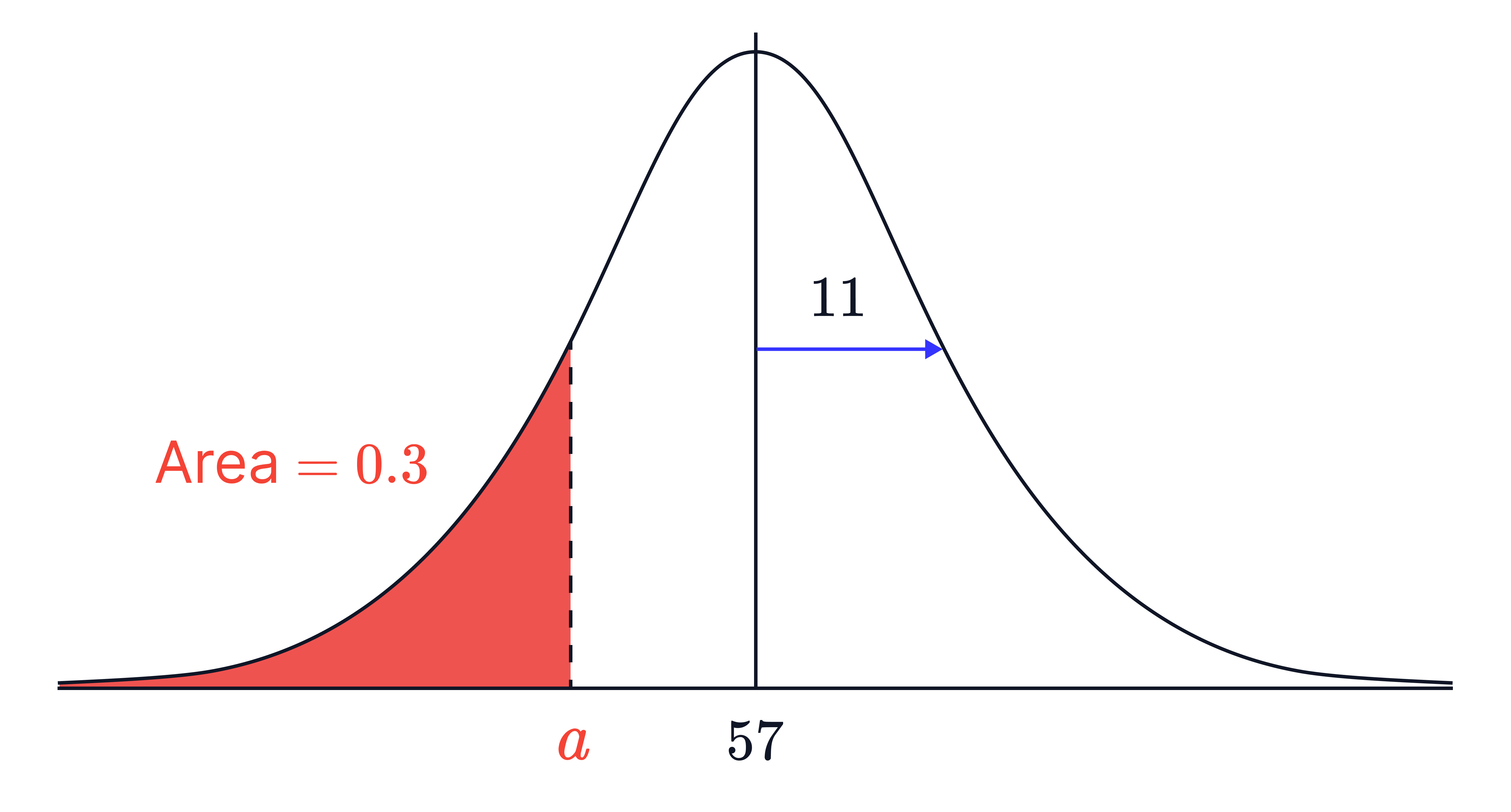
We know that the percentile is the point where .
Then we can input that into the calculator, using the inverse normal function this time, with
area , 𝜇 = 57, and to get to significant figures.
Therefore, Dave should aim to get to work within minutes.
The time, minutes, by commuters from Los Angeles to commute to work is modelled by a normal distribution with mean minutes and standard deviation minutes.
Given that ,
c) Find .
Single Step: First, apply the formula of conditional probability and then draw a diagram(s) so we can observe which probabilities we are interested in. For these questions, symmetry is everything.
We know that . We can think of a number line to see that both events are the same.

Since the interval lies entirely within , the intersection of the two events is simply .
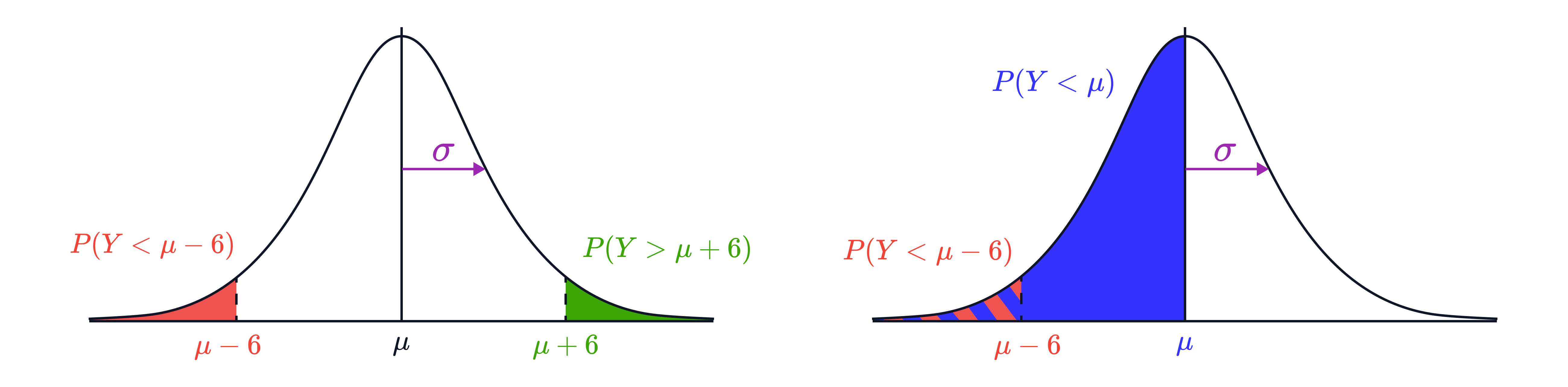
is the mean, so we know from the properties of normal distribution that .
Since is normally distributed with mean , the distribution is symmetric about . Therefore, by the symmetric property of the normal distribution, if then
Combining all the information, we can calculate
No answer provided.
Example 2:
Dom is making homework for MyEdSpace. The time, minutes, it takes him to make a homework is normally distributed with mean minutes and standard deviation minutes.
a) Find the probability that Dom takes longer than minutes to make a homework.
Single Step: By letting , find the probability that is larger than .
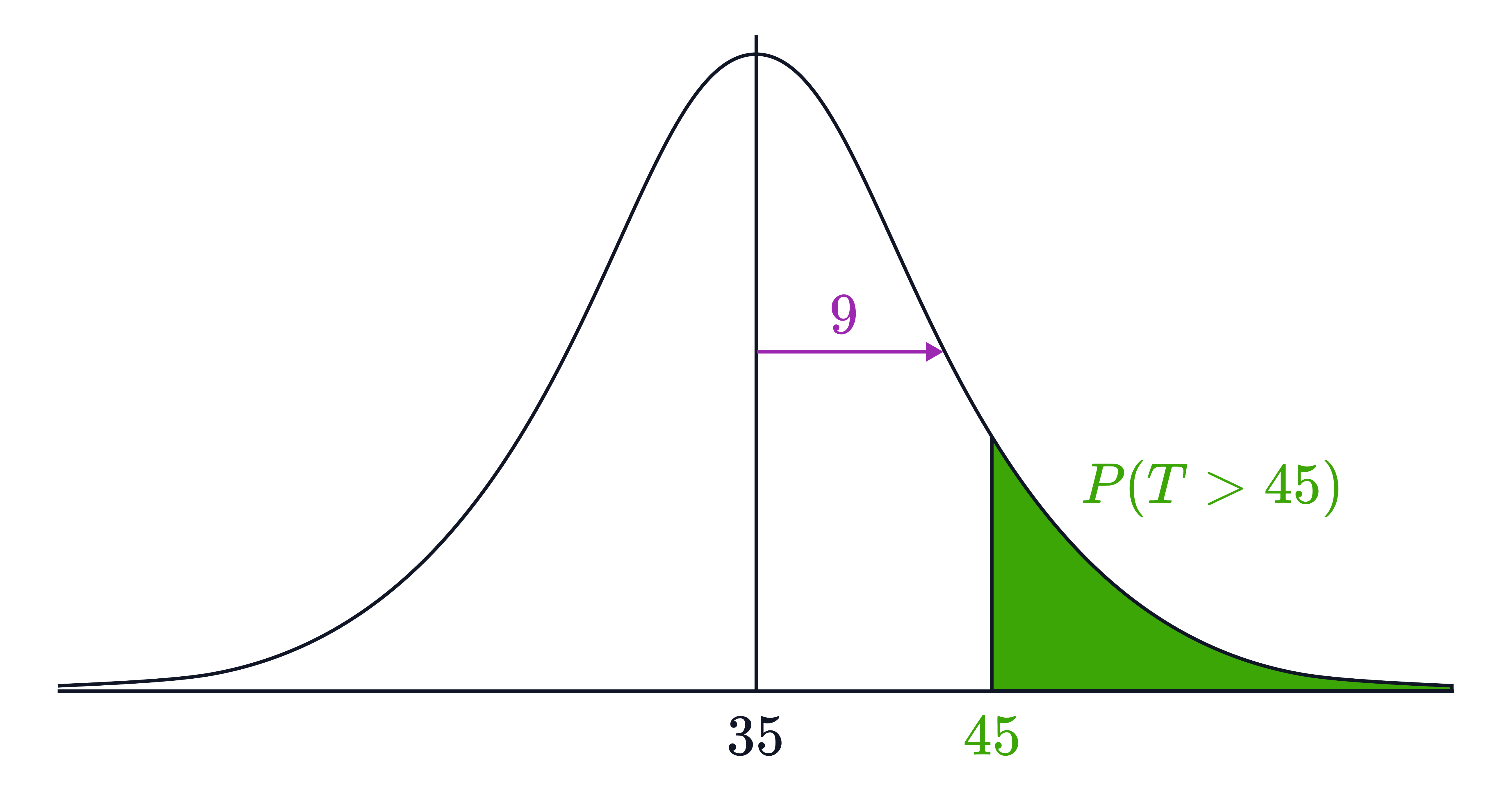
Using our calculator, going to Normal CD and setting , , lower bound , and the upper bound to be any large number, we find:
dp
Neil is surprised by how quick Dom is and wants to check if he is making homework properly. They investigate all homework that took him less than minutes to make.
b) A randomly selected homework took Dom less than minutes to make, find the probability that Dom took less than minutes to make this homework.
Single Step: Find the probability of given .
Like part c) in the previous example, if we were to draw a number line, we can see that
is equal to .

Here is a normal distribution curve with the areas representing and .
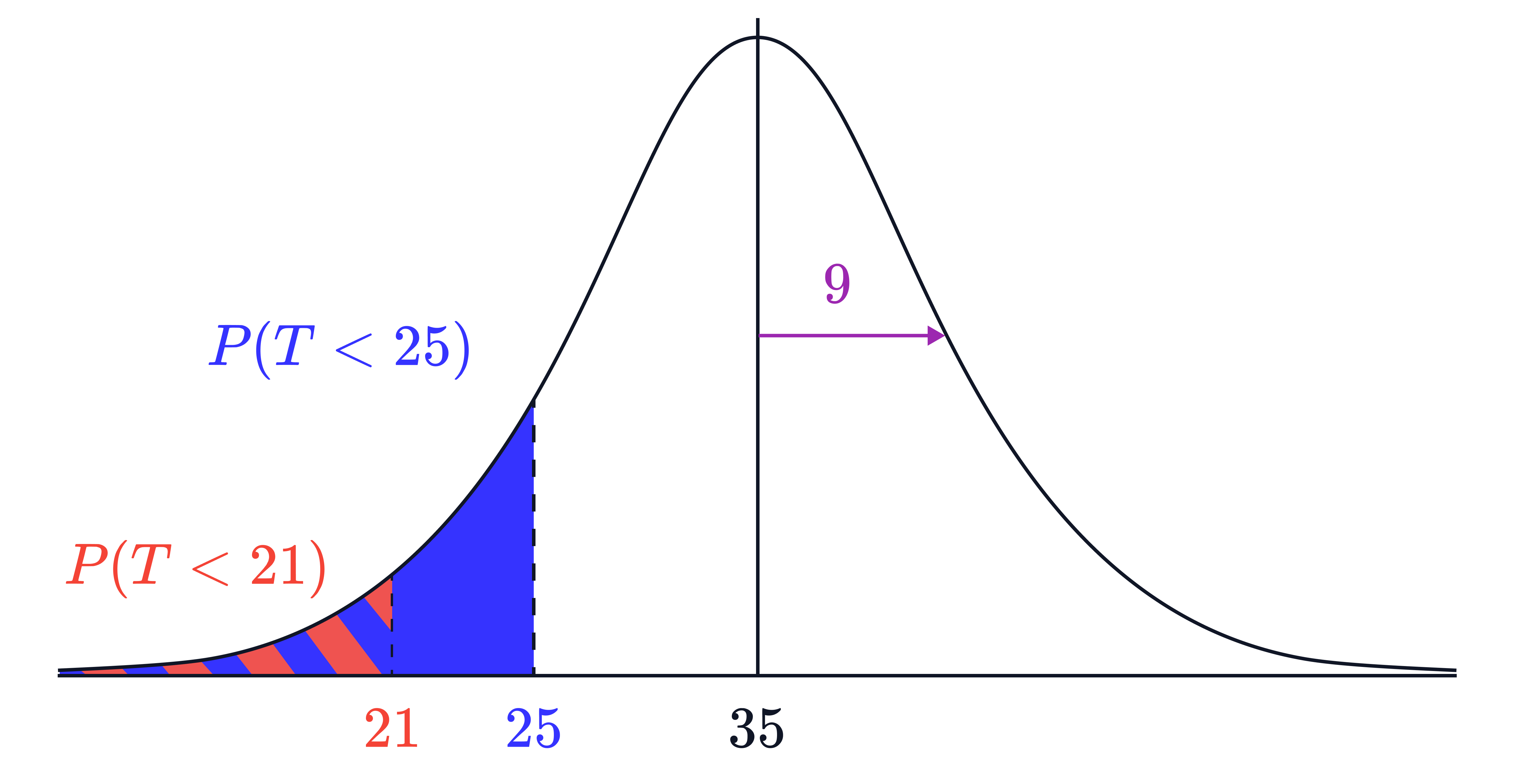
Using our calculator to find both and , we would set the upper bounds to be
and , respectively, and the lower bound to be an appropriately small number like . We find that their respective probabilities are:
Now, applying the conditional probability formula,
dp
Neil can identify in advance, all the homework that take Dom less than minutes to make and will assign them to somebody else.
c) Estimate the median time taken by Dom to analyse samples in the future.
Single Step: Break down the conditional probability to find the median.
Let be the median time of the sample, excluding those that took less than minutes. This is a conditional probability given the time taken for all of our new samples is greater than minutes. We know that the median represents the middle, or the top/bottom of values. So, our situation now is “Given , what is the value of 𝑚 such that is equal to ?“
We could have chosen , but it is easier to have the inequalities facing the same direction. So, our probability statement looks like this now:
We will now use our conditional probability formula to figure out what our new median is.
From part b), we found that and so,
Substituting that back into our equation we have,
Multiplying through by our denominator of we are left with,
Again, thinking about our number line, is just because .

Therefore,
Here’s a diagram illustrating the area representing .
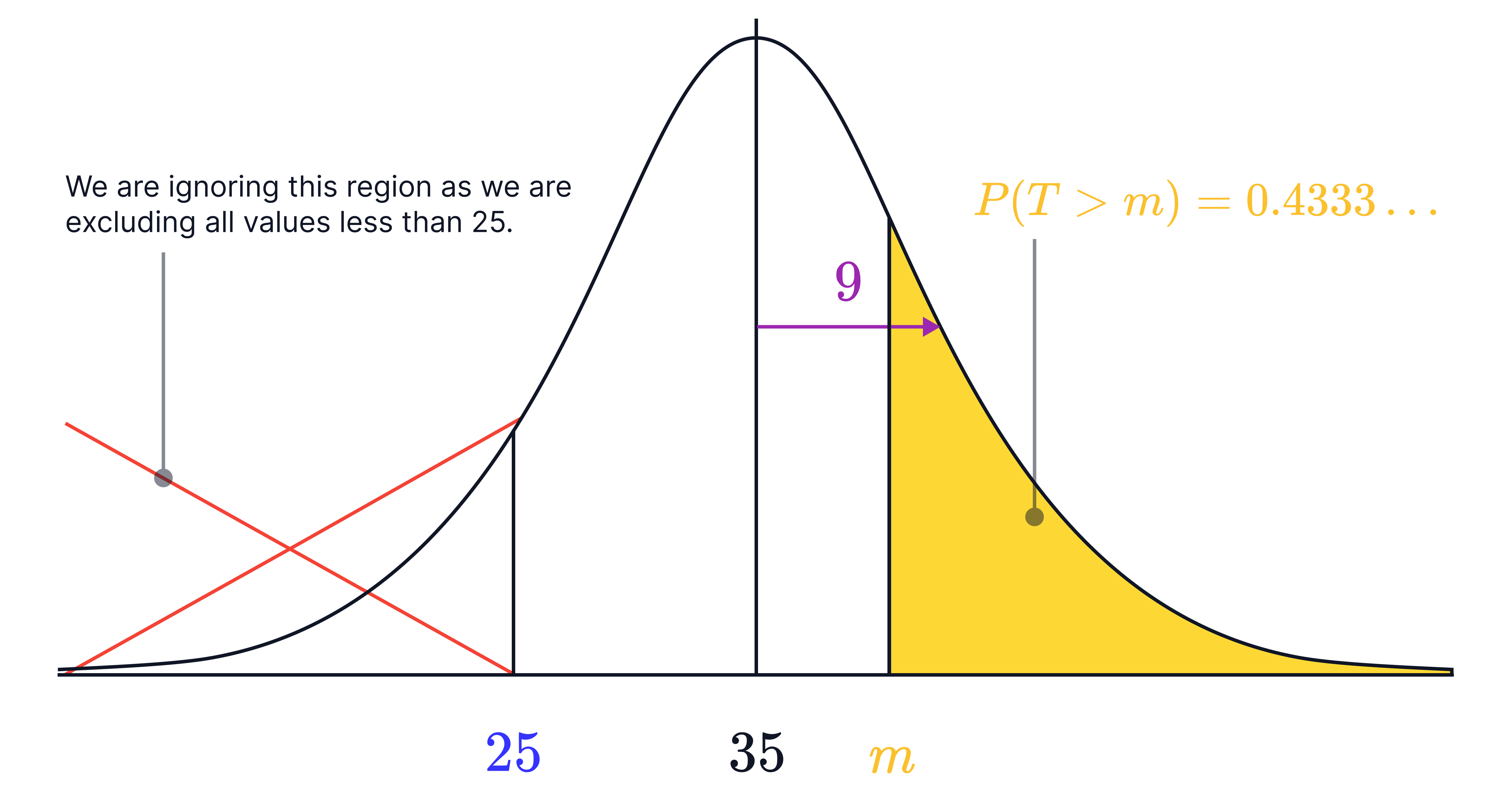
Note: Previously, the median would have equalled as well due to symmetry, but since we are getting rid of those smaller values below , the median has increased.
Now to find , we need to use the inverse normal function on our calculator, but first, it needs to be a cumulative statement.
If , then
Now, we can input our area , and to find that to 3 significant figures.
No answer provided.
Challenging Question