Connected Particles
Neil Trivedi
Teacher

Contents
Connected Particles
Connected particles are two or more particles that are joined by a light, inextensible string, often passing over a smooth pulley.
In Year , connected particles problems typically involve particles moving on a horizontal surface (e.g. a car pulling a trailer) or particles hanging freely under gravity at the ends of a string.
In Year , connected particles problems extend to systems involving at least one inclined plane.
When dealing with connected particles problems, we make the following key assumptions:
1) The string is light, so its mass is negligible (and therefore ignored).
2) The string is inextensible, so its length does not change, meaning the particles move at the same rate of acceleration.
3) The pulley is smooth, so there is no friction at the pulley, which leads to the tension being the same on both sides of the pulley.
Example 1:
A fixed rough plane is inclined at to the horizontal. A small smooth pulley is fixed at the top of the plane. Two particles and of mass kg and kg respectively are attached to ends of a light inextensible string which passes over the pulley. The string from to is parallel to the line of greatest slope and hangs freely. The coefficient of friction between and the slope is . Initially the system is at rest, then the particles are released with moving up the plane.
Find the tension in the string immediately after the particles are released, giving your answer in terms of .
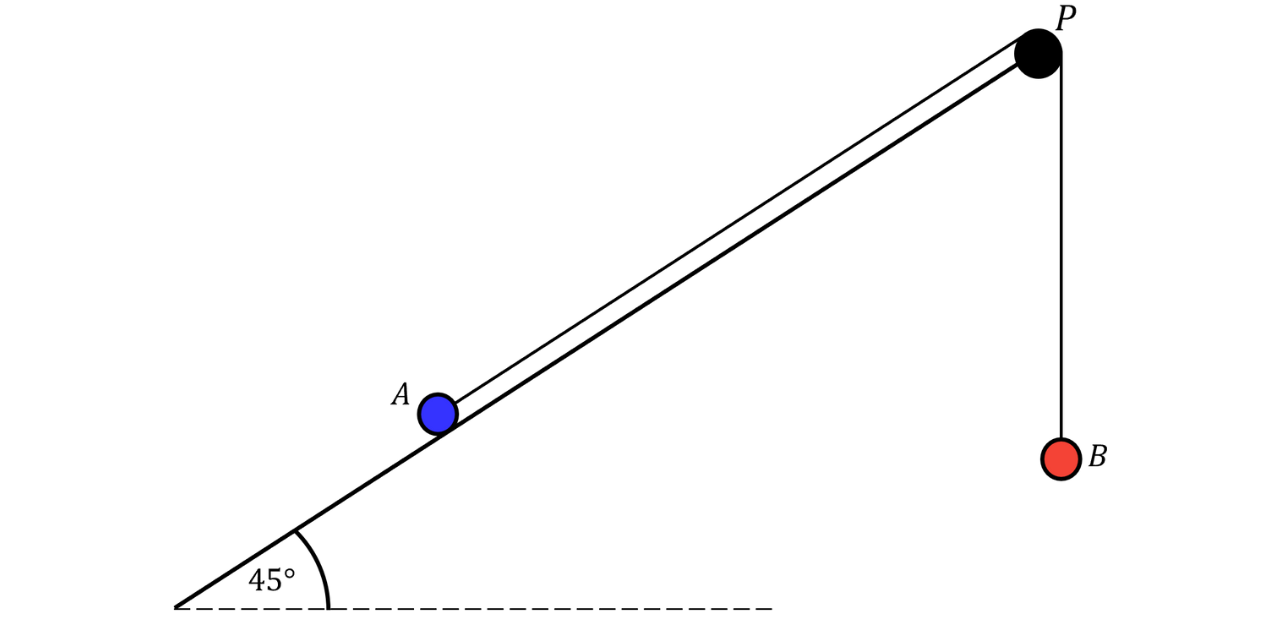
Step 1: Annotate the diagram to show all the forces that are acting on the system.
Since is moving up the plane, the frictional force will point down the plane. The friction will be at its maximum possible value, which is given by , with and being the reaction force exerted on and perpendicular to the plane. This is because the particle is beyond limiting equilibrium where the frictional force stays fixed at . For more on this concept, see our Resolving Forces study note.
The tensions in the string, labelled in the diagram, point away from each particle.
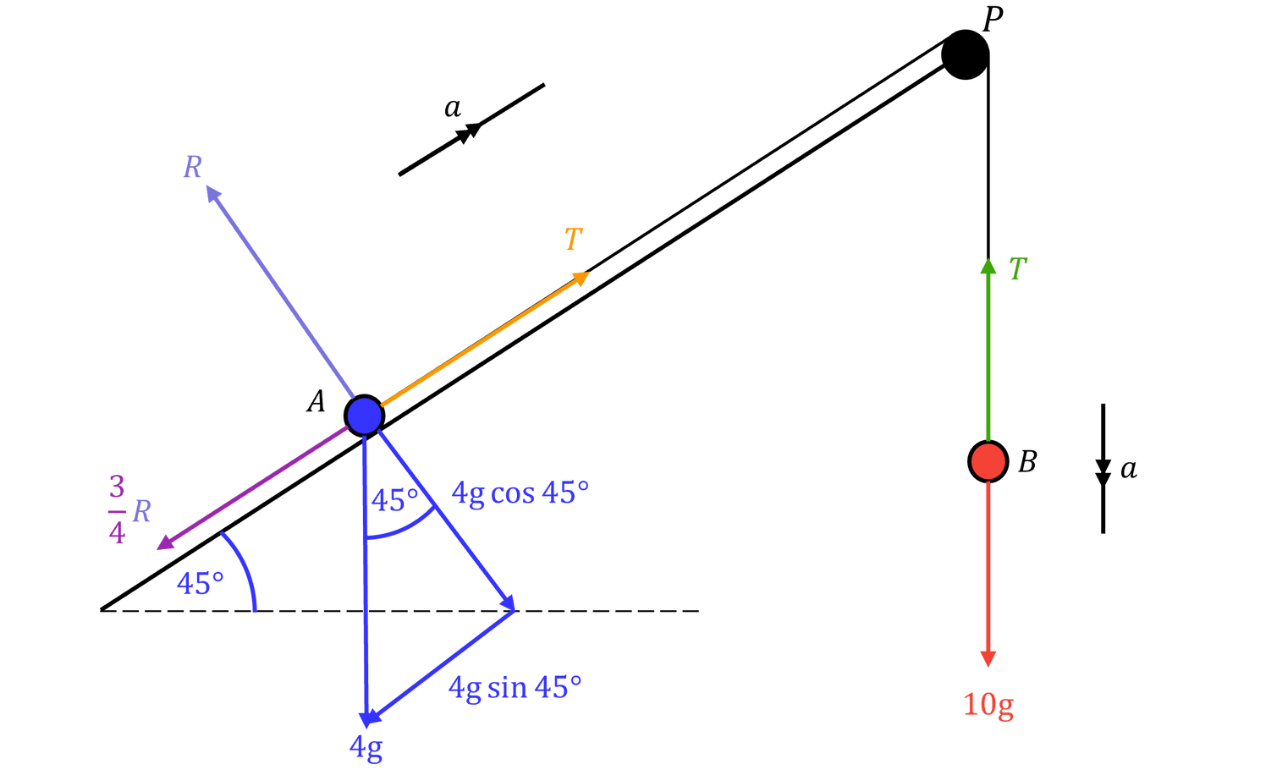
The weight of acts vertically downward, while the plane is inclined at to the horizontal. We resolve it into components that are parallel and perpendicular to the plane and the angle between the force and its perpendicular component is equal to the angle of the incline, which is . For more information on this, please refer to our Resolving Forces study note.
Step 2: For particle , resolve the forces that are acting perpendicular to the plane.
Since the particle remains in contact with the plane while moving, the forces pointing perpendicular to the plane (out of the plane/into the plane) are equal.
Out of the plane into the plane:
Step 3: For particle , apply Newton’s Second Law on forces acting parallel to the plane.
As is moving up the plane, we take the positive direction to be up the plane. Hence, the forces pointing up the plane will be positive whereas the forces pointing down the plane will be negative. Since is moving parallel to the plane, the forces pointing up the plane versus down the plane are not balanced.
Using ,
Substituting equation into equation ,
Step 4: For particle , apply Newton’s Second Law on forces acting up and down.
As is moving downwards, we take downwards to be the positive direction. Hence, the forces pointing downwards will be positive whereas the forces pointing upwards will be negative. The forces pointing up versus down are not balanced.
Using ,
Adding equations and to cancel ,
ms
Substituting into equation and rearranging for ,
N
No answer provided.
Force Exerted on Pulley by the String – One Inclined Plane
Suppose we have a general system where two particles and are connected at the ends of a light, inextensible string, and the string passes over a smooth pulley, . Particle is on an inclined plane and particle is hanging vertically below the pulley freely under gravity.
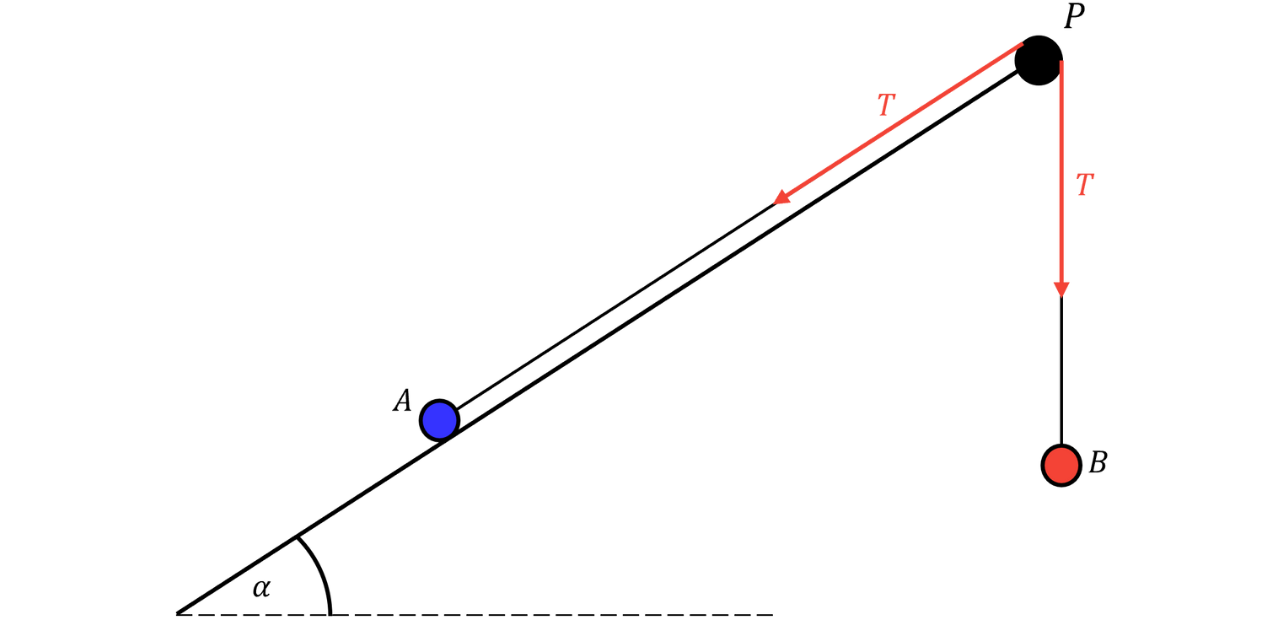
The pulley is acted on by two equal tension forces of magnitude , which are separated by an angle .
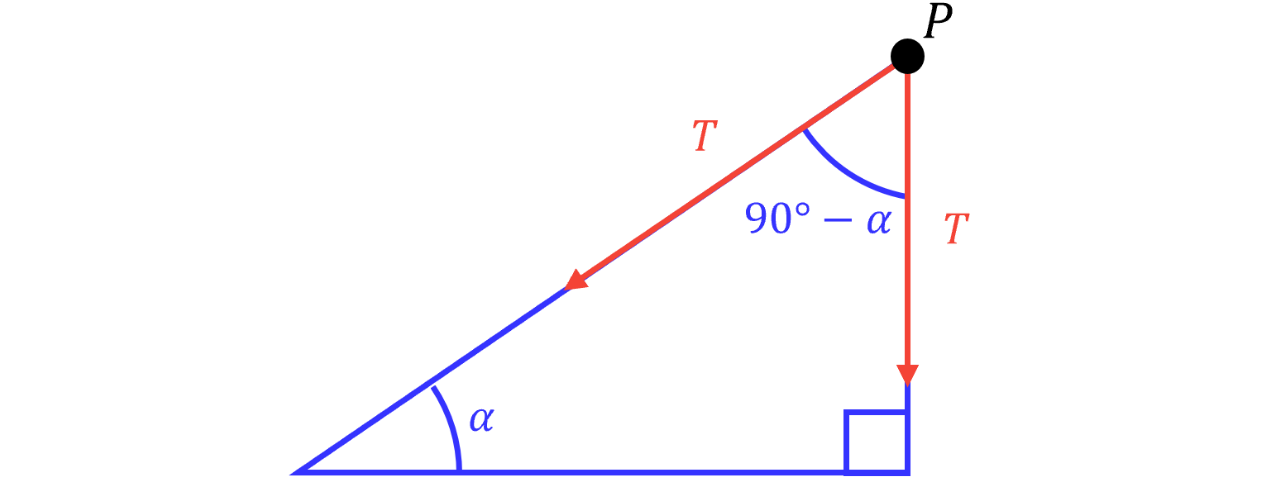
Since the forces are equal, their resultant acts along the bisector of the angle between them. Therefore, each tension makes an angle of , with the direction of the resultant force.
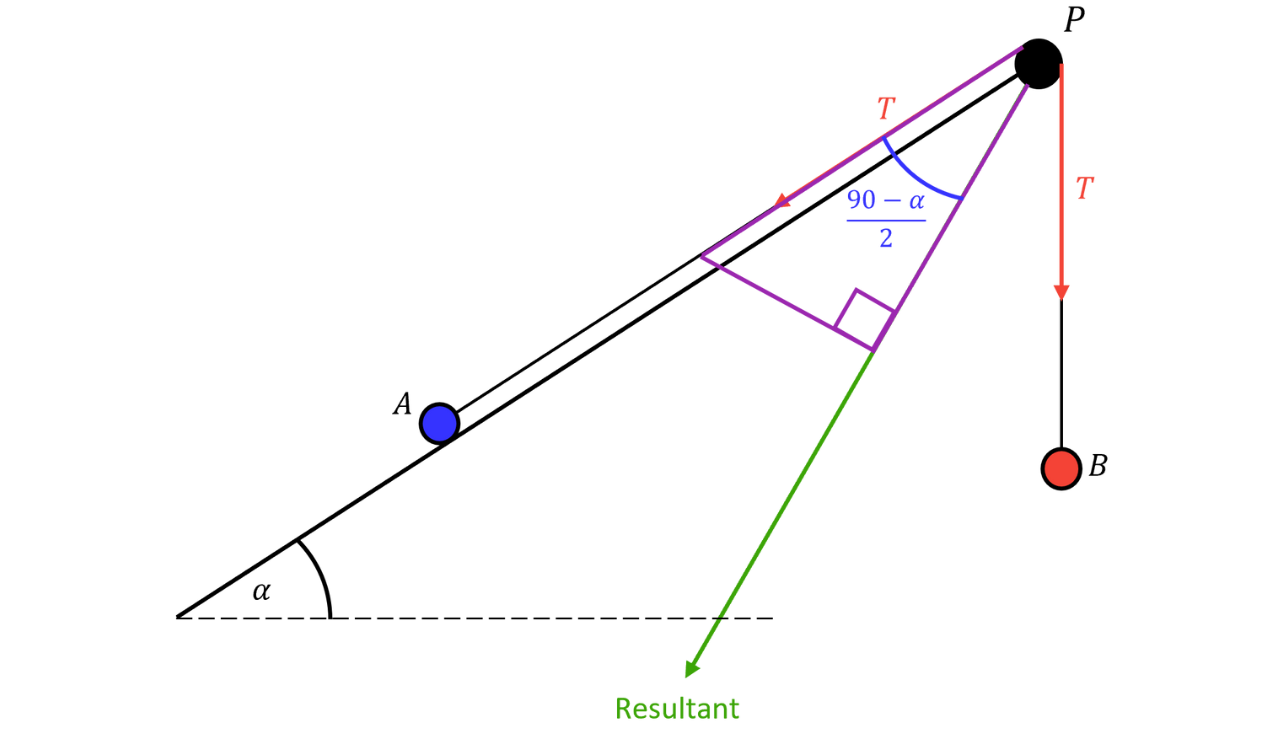
Resolving one of the tensions along the direction of the resultant gives a component using SOHCAHTOA.
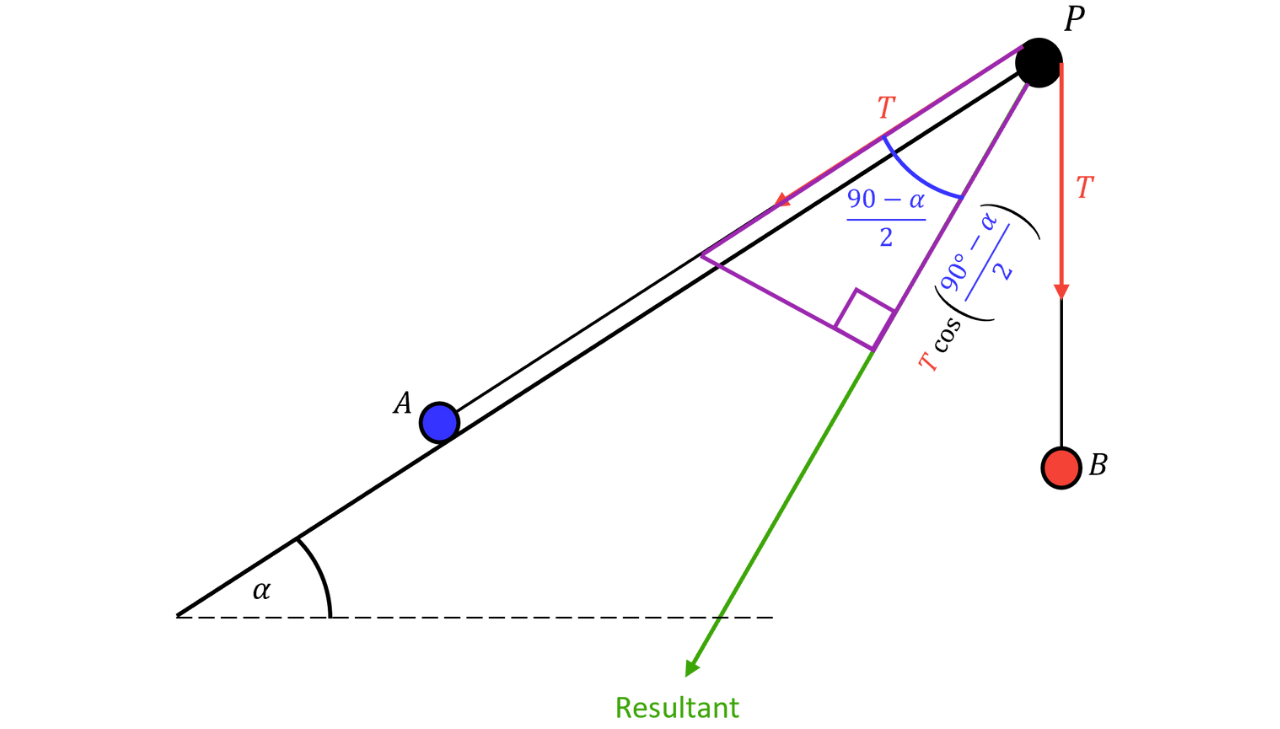
But, since there are two tensions of equal magnitude on each side of the pulley, the resultant force acting on the pulley is
along the bisector of the two string directions away towards the pulley.
Note: In the exam, you can quote this result but it is nice to see where it comes from.
Two Inclined Planes
Example 2:
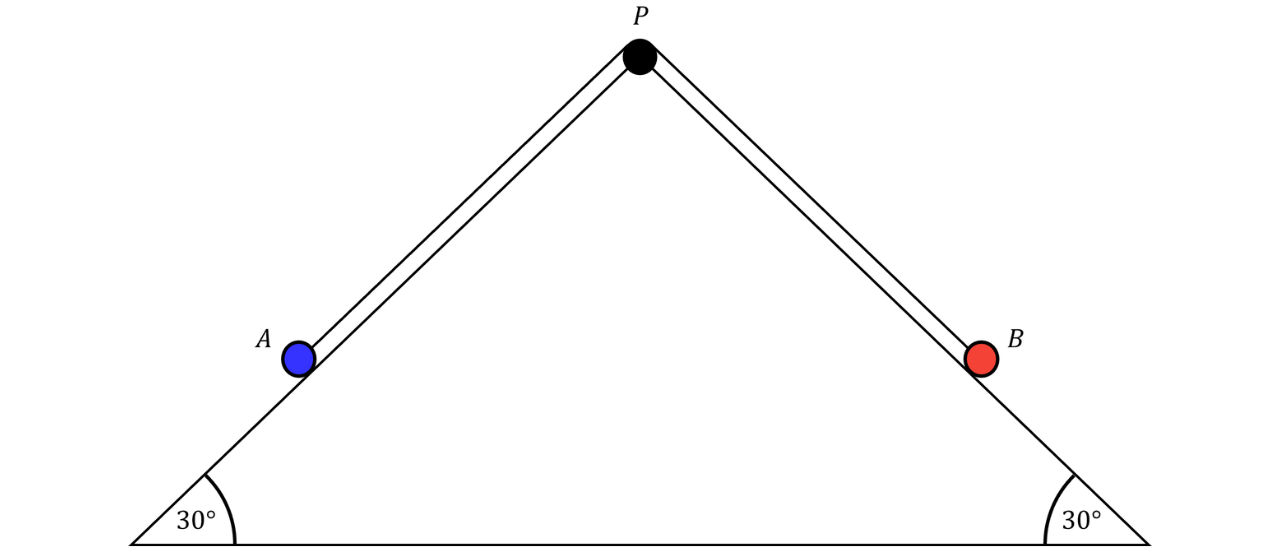
A fixed wedge has two plane faces, each inclined at to the horizontal. Two particles and , of mass and respectively, are attached to the ends of a light inextensible string. The string passes over a smooth light pulley fixed at the top of the wedge. sits on a smooth plane and sits on a rough plane with a coefficient of friction of . The system is held at rest and then released with sliding down its plane. The accelerations of both and have magnitude .
a) By considering the motion of , find the tension in the string in terms of and .
Step 1: Annotate the diagram to show all the forces that are acting on the system.
Since is moving up the plane, the frictional force, given by , will point down the plane.
is moving down a smooth plane so there is no friction between and the plane. The tensions on each side of the pulley will point away from each particle.
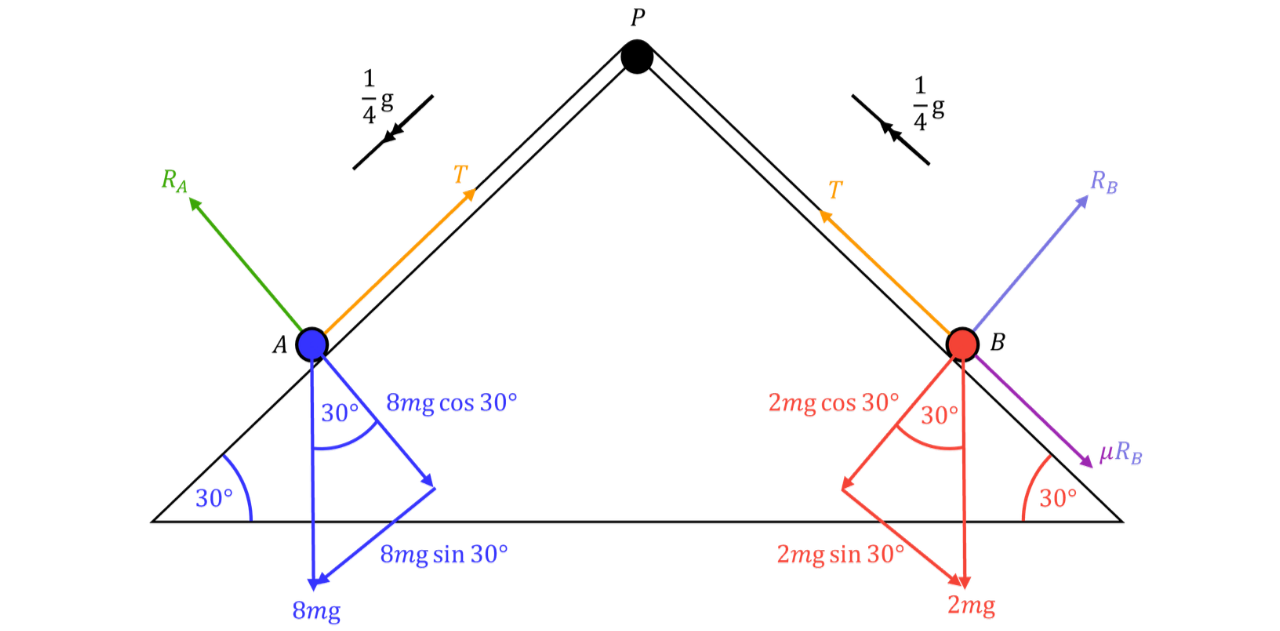
For particle , the weight of acts vertically downward, while the plane is inclined at to the horizontal. We resolve it into components that are parallel and perpendicular to the plane and the angle between the force and its perpendicular component is equal to the angle of the incline, which is .
We can apply the same reasoning for particle and its weight of .
For more information on this, please refer to our Resolving Forces study note.
Step 2: For particle , resolve the forces that are acting perpendicular to the plane.
Since the particle remains in contact with the plane while moving, the forces pointing perpendicular to the plane (out of the plane/into the plane) are equal.
Out of the plane into the plane:
Step 3: For particle , apply Newton’s Second Law on forces acting parallel to the plane.
As is moving down the plane, we take the positive direction to be down the plane. Hence, the forces pointing down the plane will be positive whereas the forces pointing up the plane will be negative. Since is moving parallel to the plane, the forces pointing up the plane versus down the plane are not balanced.
Using ,
b) By considering the motion of , find the value of .
Step 1: For particle , resolve the forces that are acting perpendicular to the plane.
Like with particle , particle remains in contact with the plane while moving, Hence, the forces pointing perpendicular to the plane (out of the plane/into the plane) are equal.
Out of the plane into the plane:
Step 2: For particle , apply Newton’s Second Law on forces acting parallel to the plane.
As is moving up the plane, we take the positive direction to be up the plane. Hence, the forces pointing up the plane will be positive whereas the forces pointing down the plane will be negative. Since is moving parallel to the plane, the forces pointing up the plane versus down the plane are not balanced.
Using ,
Since the string is inelastic, the tension is constant throughout and can therefore replace with found in part a) so we will have
c) Find the resultant force exerted by the string on the pully, giving its magnitude and direction.
The pulley is acted on by two forces due to the string, each of magnitude , acting along the two sections of the string. Each tension makes an angle of with the vertical. The horizontal components of the two tensions are equal and opposite, so they cancel. The vertical components both act downwards. Each vertical component has magnitude as per the same method shown in the single incline example previously.
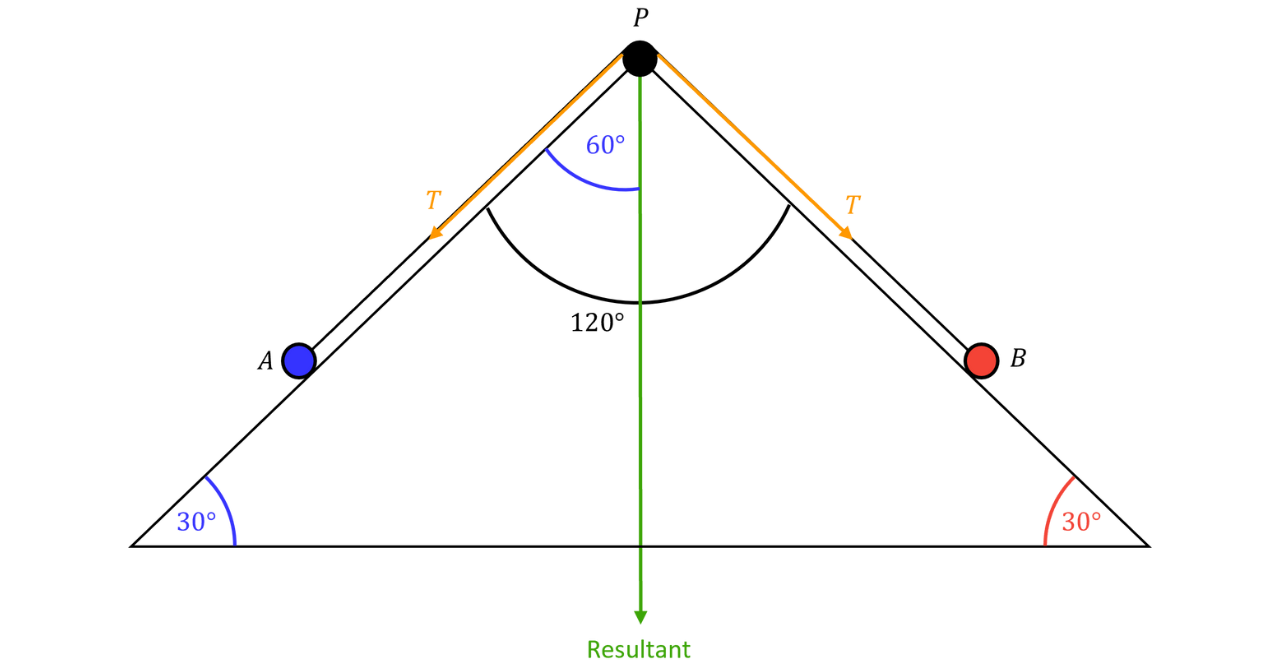
Therefore, the resultant force on the pulley is
N vertically downwards
No answer provided.
Force Exerted on Pulley by the String – Two Inclined Planes
Suppose we have a general system where two particles and are connected on the ends of a light, inextensible string, and the string passes over a smooth pulley, . Particle is on a plane that’s inclined at to the horizontal and particle is on a plane that’s inclined at to the horizontal.
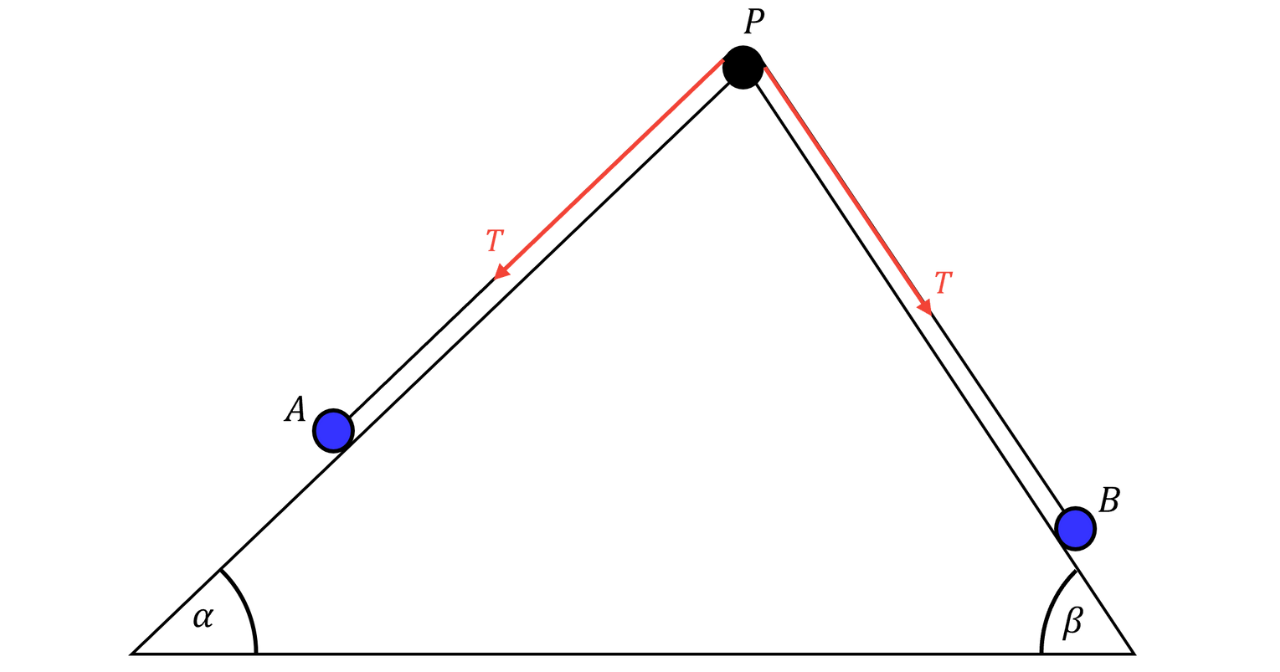
The pulley is acted on by two equal tension forces of magnitude , one from each section of the string. The angle between the two string segments at the pulley is .
Since the two forces have equal magnitude, their resultant acts along the bisector of the angle between them. Therefore, each tension makes an angle of with the direction of the resultant.
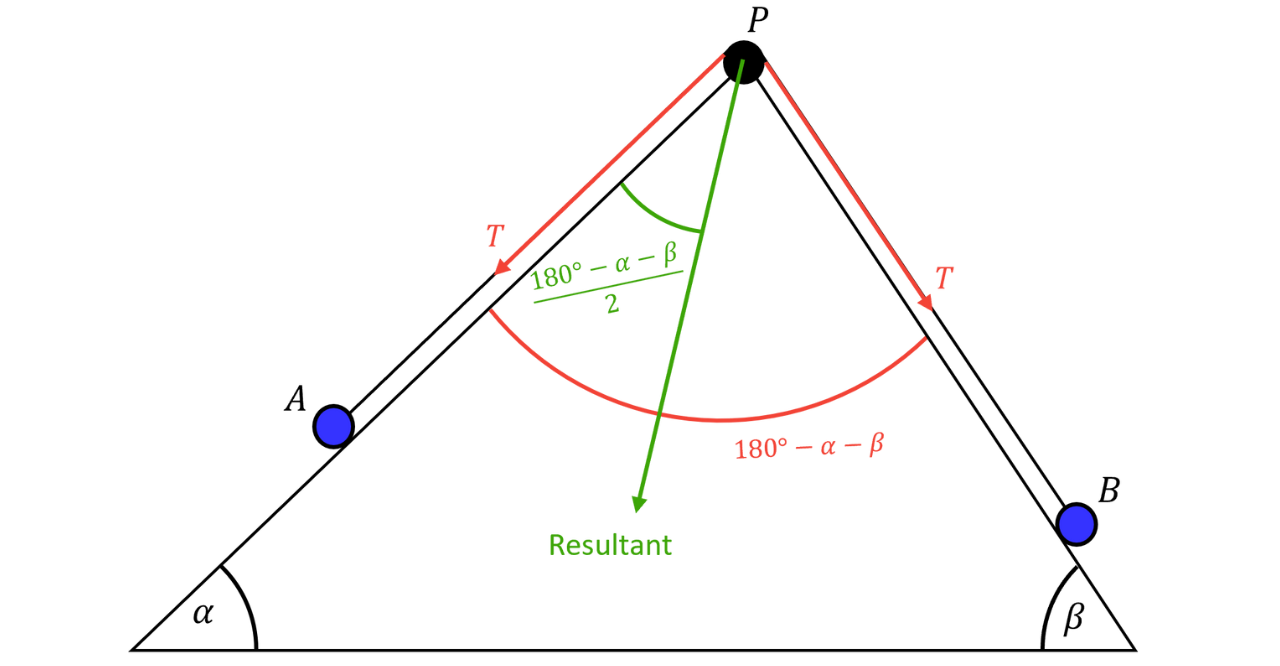
Resolving each tension along the direction of the resultant gives a component of . These components add, and so the magnitude of the resultant force on the pulley is
Along the bisector of the two string directions towards the pulley.
Challenging Question