Corpuscles vs Waves
Brook Edgar & Hannah Shuter
Teachers


Contents
Explainer Video
Newton’s Corpuscular Theory of Light

Newton noticed light travelled in straight lines and created shadows with sharp edges. He also noticed light reflecting was a bit like a ball bouncing off a wall.
He proposed that light is a stream of tiny particles called corpuscles emitted by luminous objects. He imagined corpuscles as small, hard, elastic spheres that obeyed his laws of motion (forces, momentum, reflection, refraction, etc.).
Key ideas:
Light travels in straight lines because the corpuscles move in straight-line paths unless a force acts on it.
Different colours correspond to corpuscles of size.
Explaining Reflection (corpuscles)
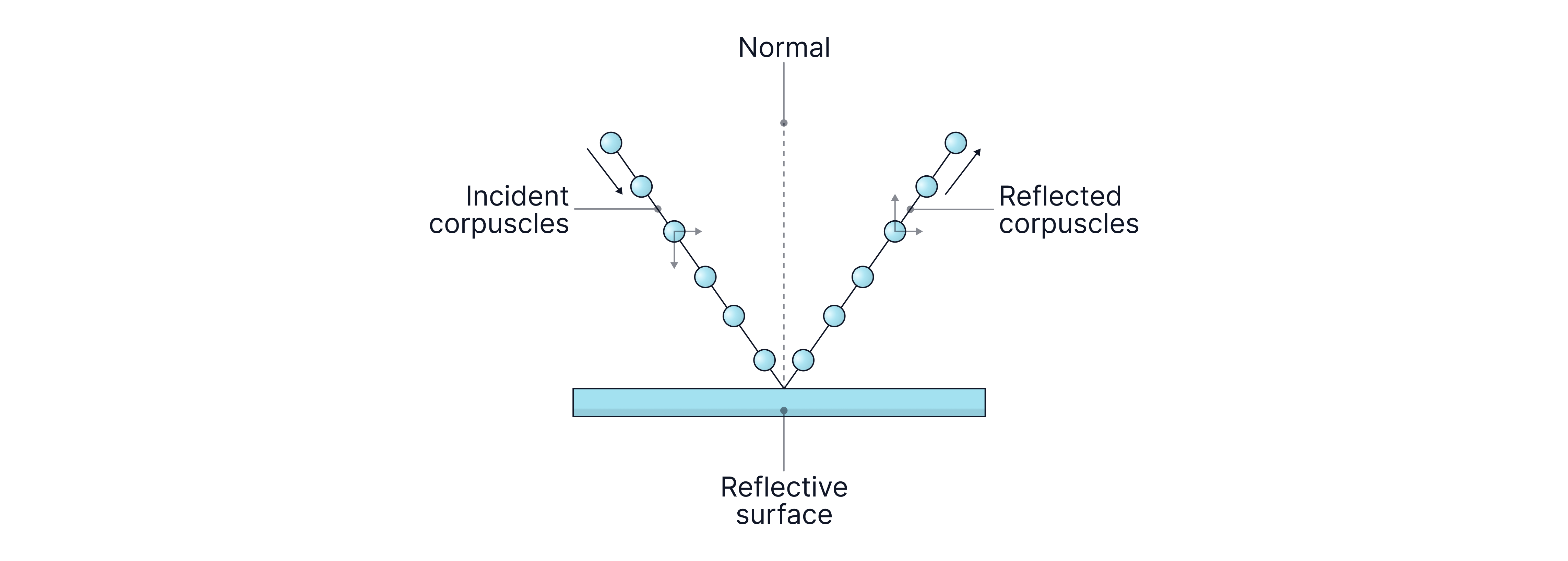
At a smooth reflecting surface (like a mirror):
Corpuscles hit the surface and experience a repulsive force.
The component of momentum parallel to the surface is unchanged.
The component of momentum perpendicular to the surface reverses direction.
This gives the usual law of reflection: angle of incidence = angle of reflection.
Explaining Refraction (corpuscles)
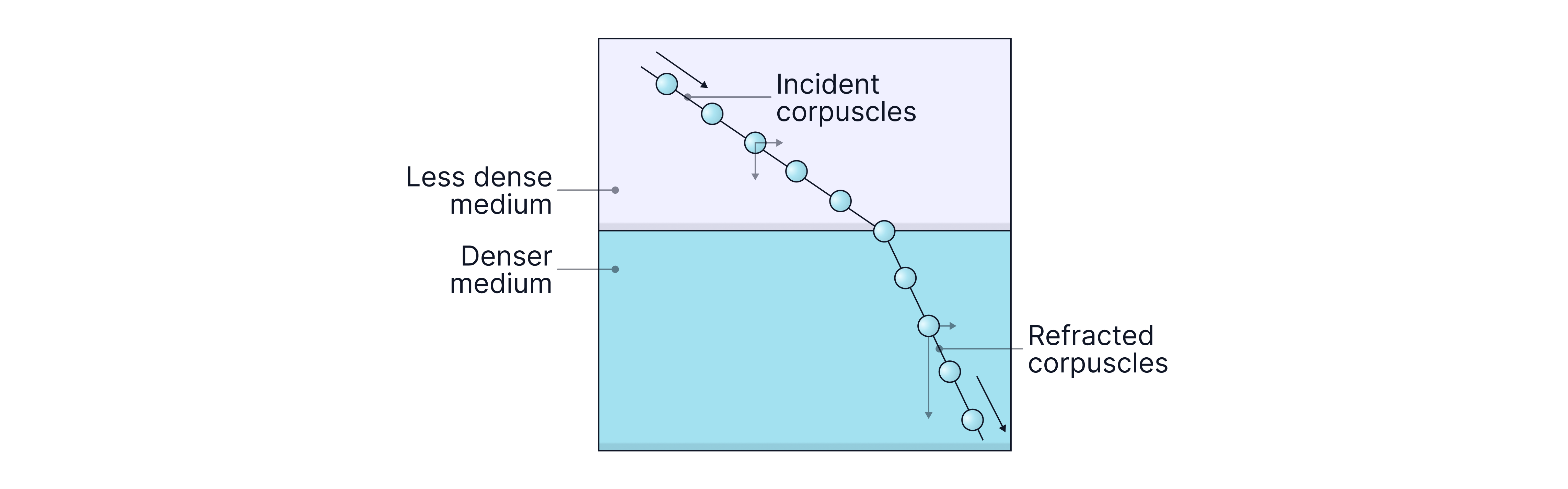
At a boundary from air into a denser, transparent medium (like glass or water): Newton assumed a force of attraction between light and matter at the boundary.
As the corpuscle enters the denser medium, it is pulled towards the new medium. - The component of velocity parallel to the boundary stays the same.
The component of velocity perpendicular to the boundary increases as the corpuscle enters the denser medium.
So Newton explained why light bends towards the normal but he incorrectly believed light travels faster in a denser.
Diffraction (corpuscles)
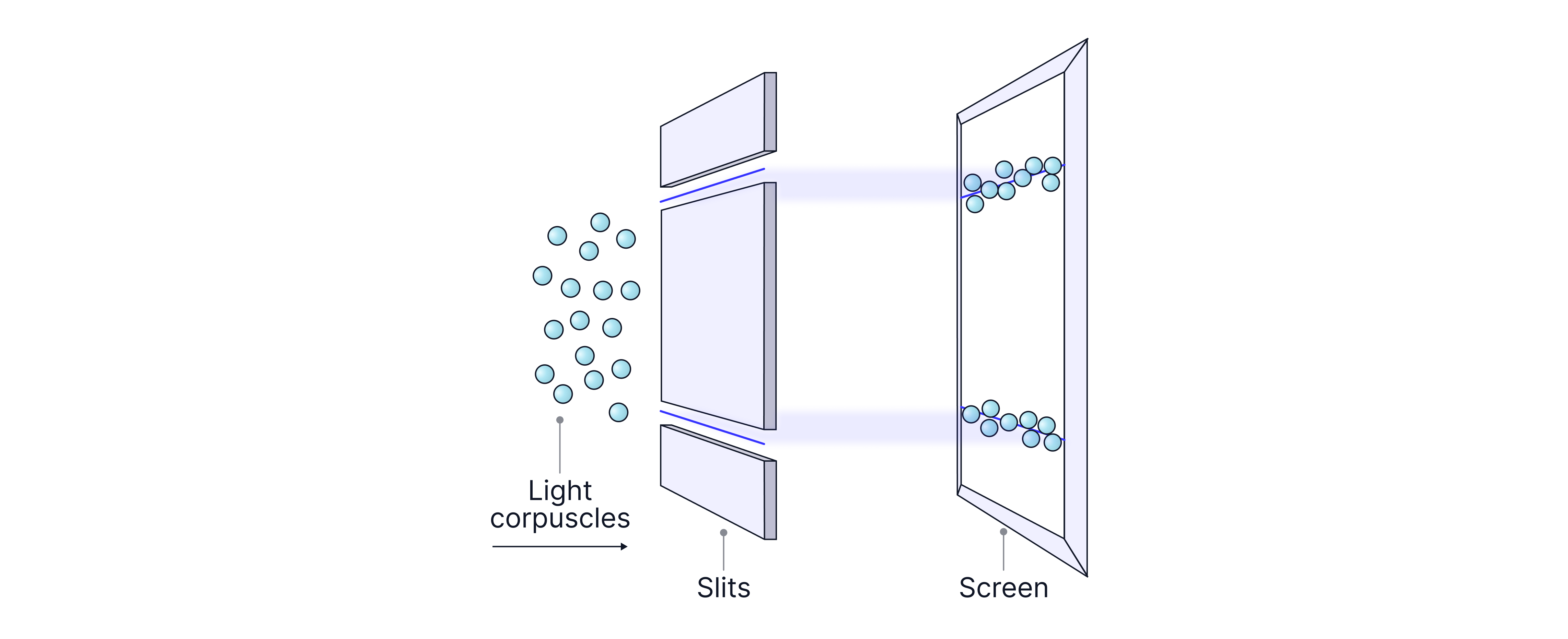
Diffraction is when waves spread out after passing through a narrow gap or around an obstacle.
In Newton’s model: Corpuscles travel in straight lines and only change direction when a force acts.
There is no obvious force at the edges of a slit, so Newton’s model could not explain diffraction, superposition and interference patterns.
Huygens’ wave theory of light (Huygens’ principle)
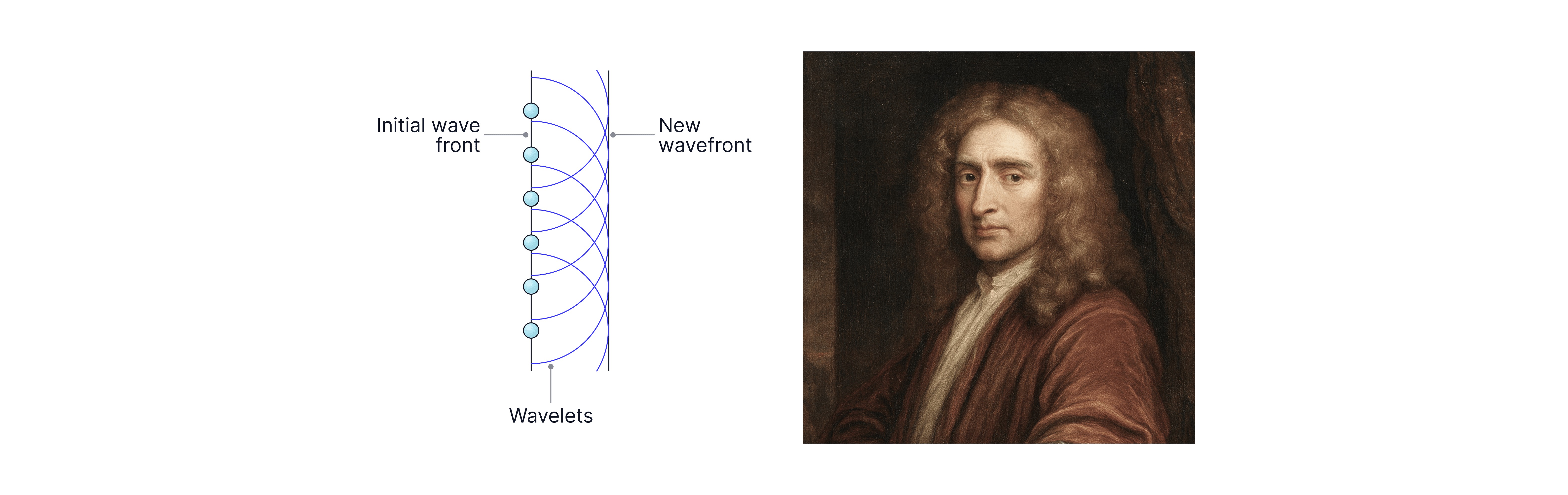
Christiaan Huygens suggested that light is a wave that travels through a medium he called the Ether. (More on this later)
Huygens’ principle, states:
Every point on a wavefront acts as a source of secondary wavelets. These wavelets spread out and the new wavefront is the superposition of all the wavelets.
Reminder:
A wavefront = a surface where the light wave is at the same phase (e.g. all the peaks).
A ray = a line drawn perpendicular to the wavefront showing the direction of energy transfer.
Explaining reflection (waves)

When a wavefront meets a flat mirror:
Each point on the wavefront that touches the mirror becomes a secondary source of new wavelets.
These wavelets reflect off the surface.
The new wavefront is formed by the envelope of all these reflected wavelets.
Geometry of this construction gives angle of incidence = angle of reflection.
Explaining refraction (waves)

When a wavefront passes from air into a denser medium:
Huygens assumed light travels slower in a denser medium.
Different parts of the wavefront reach the boundary at different times.
The part that enters the denser medium first slows down while the rest keeps moving faster in air.
This causes the wavefront to pivot, so the ray bends towards the normal - giving Snell’s law of refraction.
Explaining diffraction (waves)
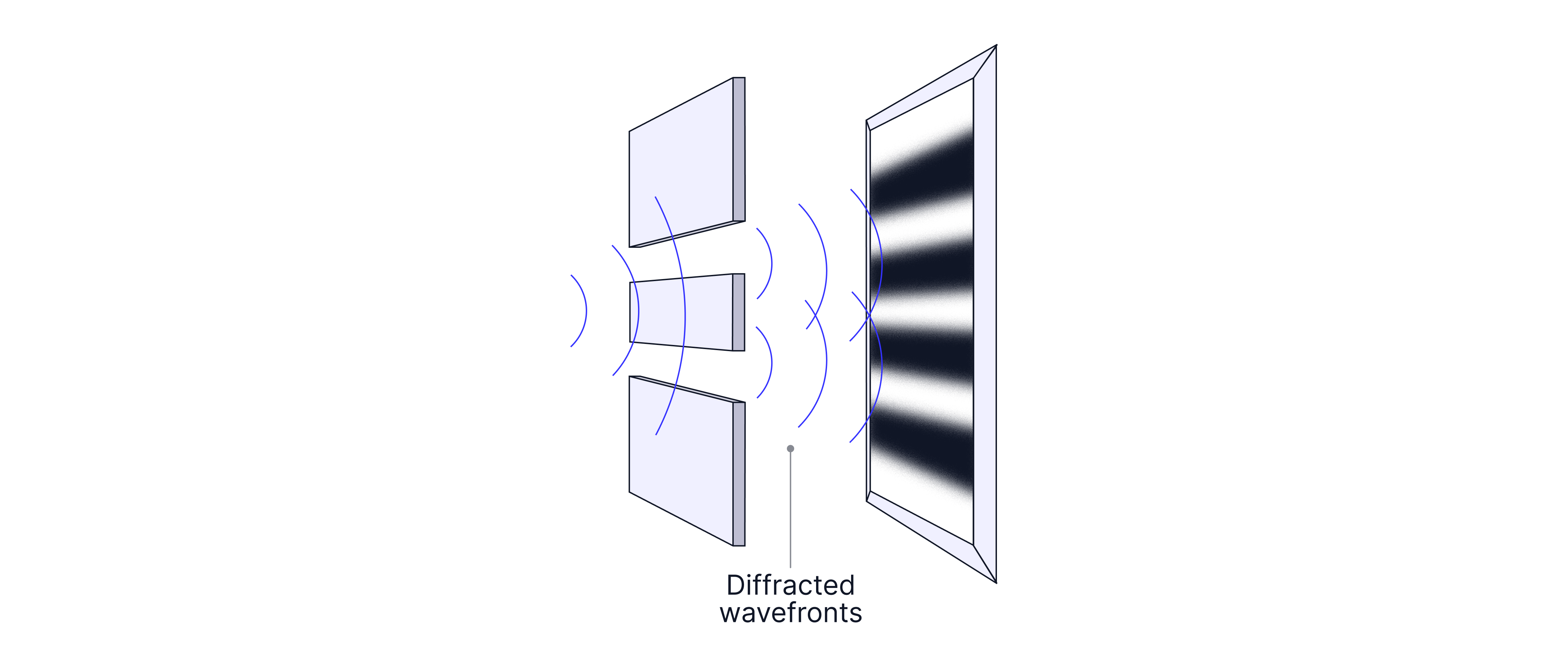
Because every point on a wavefront is a source of new wavelets:
When light passes through a narrow slit, only a small section of the wavefront gets through.
The wavelets from this small section spread out into the space beyond the slit, producing diffraction.
We can also explain interference patterns like those seen in Young’s double-slit experiment, where the overlapping wavelets superpose: they add in phase to give bright maxima (constructive interference) and add in antiphase to give dark minima (destructive interference).
Comparing Newton and Huygens
Let’s compare Newton’s corpuscular theory with Huygens’ wave theory and explain why Newton’s theory was originally preferred.
Similarities
Both theories explain the law of reflection successfully.
Both explain refraction and dispersion (splitting of white light into colours).
Both theories failed to explain polarisation (Huygen thought light of a longitudinal wave which can’t be polarised).
Key differences
Nature of light:
Newton: light is made of particles called corpuscles.
Huygens: light is a wave formed from overlapping & superposing wavelets.
Speed of light in denser media:
Newton: corpuscles are attracted into denser media so speed increases in glass/water.
Huygens: waves travel slower in denser media.
Diffraction & interference:
Newton’s theory has no good explanation.
Huygens’ wave theory naturally explains diffraction and superposition/interference.
Why Newton’s theory was preferred at the time:
Newton’s reputation was huge after his success with his laws of motion and law of gravitation. Huygens was less influential.
It was not yet possible to measure the speed of light in different media, so scientists could not show that light was slower in denser medium.
Diffraction could not be observed because the light sources available at the time were not very coherent (lamps and sunlight). The slit widths needed to produce clear diffraction and interference were extremely small and hard to manufacture.
Worked Example:
Light in travelling air is incident on a glass block (at a non-zero angle of incidence).
(a) Explain how Newton’s corpuscular theory accounts for refraction at the air–glass boundary.
(b) Explain how Huygens’ wave theory accounts for refraction at the same boundary.
(c) Explain why Newton’s theory was preferred at the time it was proposed.
Answer:
(a) Newton’s corpuscular theory
Light consists of corpuscles moving in straight lines.
At the boundary, corpuscles experience an attractive force towards the denser medium (glass).
The component of velocity parallel to the boundary remains unchanged.
The component perpendicular to the boundary increases, so the corpuscle’s path bends towards the normal.
Newton incorrectly predicted speed of the corpuscles is greater in glass than in air.
(b) Huygens’ wave theory
Light is a wave made up of wavefronts.
Every point on a wavefront acts as a secondary source of wavelets (Huygens’ principle).
When the wavefront meets the glass, parts of the wavefront enter first and slow down in the denser medium.
The rest of the wavefront is still moving faster in air, so the wavefront pivots.
The new wavefront inside the glass is at a smaller angle to the normal, so the ray bends towards the normal.
(c) Acceptance
At the time, there was no way to measure the speed of light in different media - Newton’s overall reputation was much stronger.
Therefore, Newton’s corpuscular theory was preferred, even though Huygens’ theory would later be supported by experiments on diffraction, interference and measured speeds of light.
Worked Example:
In Young’s double-slit experiment, a narrow beam of monochromatic light passes through two closely spaced slits and forms a pattern of bright and dark fringes on a screen.
State what pattern Newton’s corpuscular theory would predict on the screen.
Explain how Huygens’ wave theory accounts for the bright and dark fringes observed.
Explain why diffraction patterns were not easily observed in the seventeenth century, when Newton lived.
Answer:
Predicts two bright regions directly in line with the slits / continuous illumination where corpuscles travel in straight lines.
No alternating bright and dark fringes expected, because corpuscles from different slits do not interact / no interference in the model.
Each slit acts as a coherent secondary wave source (same frequency, fixed phase relationship).
Waves from the two slits superpose on the screen.
Constructive interference (bright fringes) where the waves arrive in phase; path difference .
Destructive interference (dark fringes) where the waves arrive in antiphase ;path difference .
No coherent light sources available: sources such as candles / lamps are not monochromatic and consist of many different emitting points, so there is no constant phase difference between light from different parts of the source.
Diffraction and interference effects are most noticeable when the slit separation is of the same order as the wavelength of light, and in the seventeenth century it was very difficult to manufacture and align slits with such tiny separations accurately.
Practice Question
Why was Newton’s corpuscular theory accepted over Huygens’ wave theory?
-> Check out Brook's video explanation for more help
Answer:
Back then, no one could measure the speed of light in glass, so there was no data to choose between them.
Newton’s theory couldn’t explain diffraction ,superposition and interference, but that wasn’t an issue because they didn’t really have coherent light and slits small enough to form a interference pattern.
Plus, Newton was Newton – the superstar of physics – his Laws of motion and Law of gravitation are still used to this day, so scientists trusted his particle model.
What did Newton and Huygens think about light?
-> Check out Brook's video explanation for more help.