Fizeau
Brook Edgar & Hannah Shuter
Teachers


Contents
Explainer Video
Fizeau's experiment - measuring the speed of light
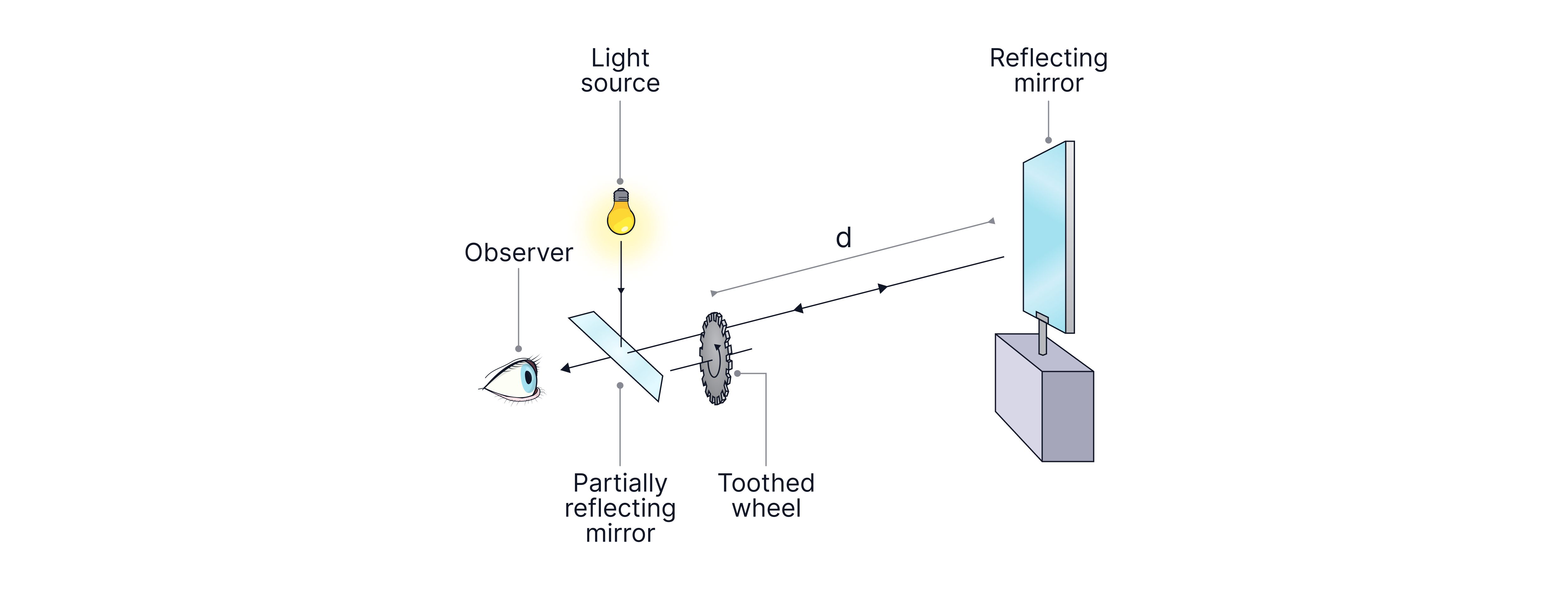
Early scientists often assumed that light travelled infinitely fast. Fizeau made one of the first accurate measurements of the speed of light using a rotating toothed wheel.
Fizeau’s idea was to measure the time it took for a pulse of light to travel from a light source to a distant mirror and back again. Because this time is extremely small, he needed a clever way to “time” the journey without using an ordinary stopwatch.
He placed a rapidly rotating toothed wheel between the light source and the distant mirror. The light passed through one of the gaps in the wheel, travelled a distance d to the mirror, reflected back, and then had to pass through the wheel again to reach the observer’s eye.

At low rotation speeds, the light pulse passed through gap A on the way out and returned in time to pass through the same gap as the wheel had not moved very far. The observer saw a bright beam.
As the wheel rotated faster, there came a particular frequency of rotation at which the returning light pulse was no longer aligned with a gap A. Instead, by the time the light came back, it would be blocked by tooth . The beam "disappeared" - the observer saw darkness.
If the wheel has n teeth and n gaps, the total number of teeth and gaps = 2n.
Let the time period of the wheel’s rotation = T , the time it takes for a gap (or tooth) to pass a point would be . Using we get .
Using , the time taken for the light to travel from the wheel to the mirror and back is
If this time was longer than the time taken for a gap to pass by it would not pass through the gap and would be blocked.
If the wheel was spun at a frequency just above this frequency it would not be able to return through the same gap.
So the light is no longer seen by the observer if .
Thus the frequency at which light disappears first is or the speed of light is given by:
Formula:
In Fizeau’s original experiment, the distance from the wheel to the mirror was d = 8.6 km, and the wheel had 720 teeth and 720 gaps. He found that the returning light first disappeared at a rotation frequency of about f = 12.6 revolutions per second. Substituting these values in:
This value is within about 5% of the accepted modern value for the speed of light in air/vacuum, . Fizeau’s experiment therefore showed clearly that light travels at a very large, but finite, speed.
Significance of Fizeau's measurement
1. It provided one of the first accurate terrestrial measurements of the speed of light, confirming that light does not travel infinitely fast.
2. Later refinements of Fizeau’s method showed that light travels more slowly in water than in air. This result agreed with Huygens’ wave theory of light and contradicted Newton’s corpuscular theory, which predicted that light would travel faster in denser media.
3. Fizeau’s value for the speed of light was later found to agree closely with the value predicted by Maxwell’s electromagnetic theory (using ). This was strong evidence that visible light is an electromagnetic wave.
Worked Example
Describe how Fizeau’s rotating toothed‑wheel experiment can be used to measure the speed of light.
Answer:
A beam of light passes through a gap in a rapidly rotating toothed wheel.
The light travels a distance d to a distant mirror and is reflected back.
On its return, the light must again pass through the wheel to reach the observer’s eye.
At low rotation frequencies, the returning light passes back through the same gap, so the observer sees the light.
As the rotation frequency increases, there is a particular frequency f at which the returning light is blocked by a tooth that has moved into the original gap position, so the light disappears.
If the wheel has n teeth and n gaps, the time for a tooth to replace a gap is .
In this time, light travels to the mirror and back, a distance , so .
By measuring , and the blocking frequency , the speed of light can be calculated.
Worked Example
In one version of Fizeau’s experiment, the distance from the wheel to the mirror is . The wheel has teeth and gaps. The light first disappears when the wheel rotates at revolutions per second.
Show that the speed of light is approximately .
Comment on how this value compares with the currently accepted value for the speed of light.
Answer:
Use .
The accepted value is about ,
so Fizeau’s result is within a few percent. Given the experimental difficulties, this is very good agreement.
Practice Questions
How Fizeau measured the speed of light with a toothed wheel?
-> Check out Brook's video explanation for more help
Answer:
Light passes through a gap in a rotating toothed wheel, travels to a distant mirror, reflects, and returns.
At low rotation speed, the wheel has barely turned, so the returning light passes back through the same gap and is seen.
As the wheel spins faster, the returning light can arrive when a tooth has moved into the position of the gap, so the light is blocked and the beam disappears.
The “beam just disappears” condition lets you determine the rotation frequency , for which the wheel turns by the width of a tooth/gap during the light’s round trip.
With distance to the mirror , number of teeth , and blocking frequency , the speed of light is found using:
Why was Fizeau’s measurement of the speed of light such a big deal?
-> Check out Brook's video explanation for more help
Answer:
It provided evidence that light has a finite speed - it isn't instantaneous.
His value was very close to the modern value, around , which is amazing for 1849 technology.
Experiments based on his method later showed that light travels more slowly in water than in air, which agreed with Huygens’ wave theory and contradicted Newton’s corpuscular theory.
Later on, Maxwell used his equations for electric and magnetic fields to predict the speed of electromagnetic waves – and got essentially the same number.
Fizeau’s toothed‑wheel experiment helped to link together ideas about light, waves, electricity, magnetism and eventually relativity too.