Maxwell
Brook Edgar & Hannah Shuter
Teachers


Contents
Explainer Video
Maxwell’s Electromagnetic waves

Maxwell’s equations (shown above) describe how electric and magnetic fields behave.
Using these equations, Maxwell showed that there must be a kind of wave made from oscillating electric and magnetic fields. He called these electromagnetic waves.
Don’t worry – you do not need to memorise these equations. You already know one of them: the third equation is Faraday’s law.
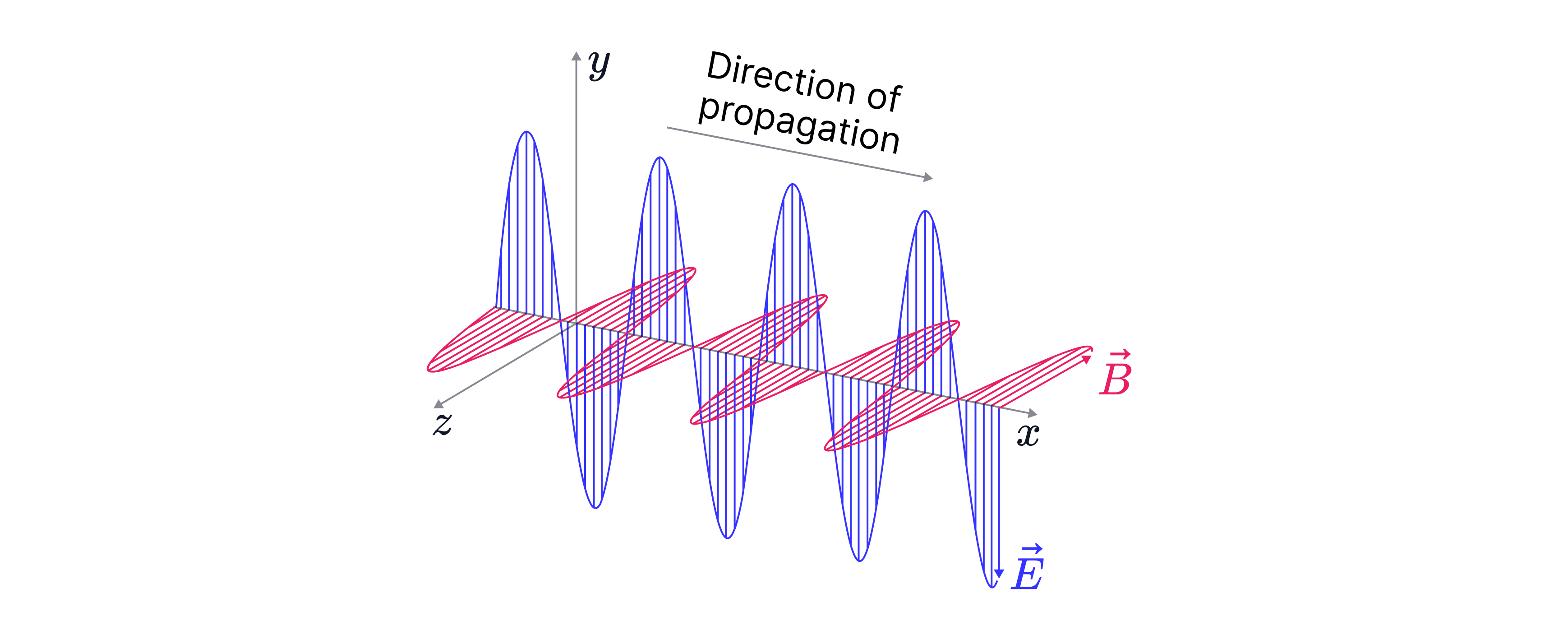
The diagram shows the electromagnetic wave that Maxwell predicted.
Notice that:
The electric field E and magnetic field B oscillate at to the direction of propagation – in other words, EM waves are transverse waves.
The electric and magnetic fields are also at to each other.
The electric and magnetic fields are in phase.
When the magnetic field is at a maximum, so is the electric field.
When the magnetic field is at a minimum, so is the electric field.
Maxwell’s Speed of EM waves
Maxwell used his equations to show that the speed of electromagnetic waves in free space (a vacuum) is given by
Experiments gave the following values:
Substituting these into Maxwell’s equation gives:
The speed of EM waves predicted by Maxwell matched the speed of light measured by Fizeau. This was evidence that visible light is an example of an electromagnetic wave.
Finally, notice that the equation for the speed of light contains only constants, not variables. This is important – we will return to this idea later.
Worked Example
Describe how electromagnetic waves propagate (travel) in free space.
Answer:
Electric and magnetic field oscillate perpendicular to each other and to the direction of energy transfer (transverse).
Electric and magnetic field oscillate in phase.
The speed of EM waves in a vacuum is approximately
Worked Example
What is the significance of Maxwell’s prediction when compared with the outcome of Fizeau’s experiment?
Answer:
Maxwell’s prediction for the speed of electromagnetic waves was equal to the speed of visible light measured by Fizeau.
Therefore, light must be a type of electromagnetic wave.
Practice Questions
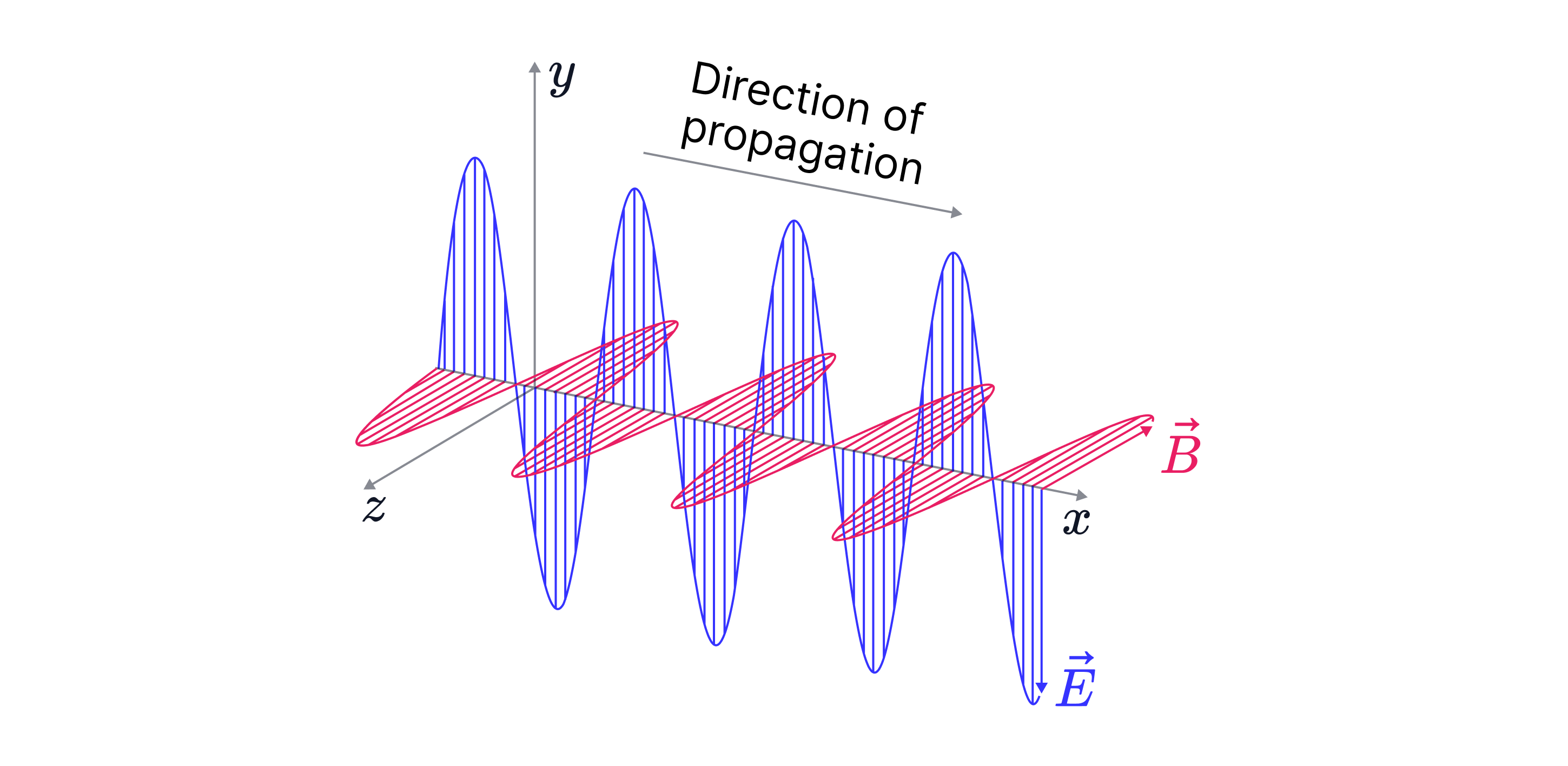
Sketch an electromagnetic wave
-> Check out Brook's video explanation for more help
Answer:
Explain the significance of this equation.
-> Check out Brook's video explanation for more help.
Answer:
It was derived using equations for electric and magnetic fields.
It shows that the speed of electromagnetic waves in free space (vacuum) is constant.
The speed predicted is equal to the speed of light that Fizeau found and the speed of radio waves found by Hertz.
The equation shows that light and radio waves are examples of electromagnetic waves.