Hertz
Brook Edgar & Hannah Shuter
Teacher


Contents
Explainer Video
Producing and detecting radio waves
Today we take it for granted that radio waves and light are electromagnetic waves - but that wasn’t always accepted. Hertz was able to produce radio waves in a laboratory and then design an experiment to measure their speed.
When he calculated the speed, it came out close to - the same speed as the speed of electromagnetic waves predicted by Maxwell, and the speed of light measured earlier by Fizeau.
This supported a huge idea: light and radio waves are part of the same family - the electromagnetic spectrum - with many types of electromagnetic waves that travel at (approximately) the same speed in air/vacuum.
Hertz’s spark-gap method:
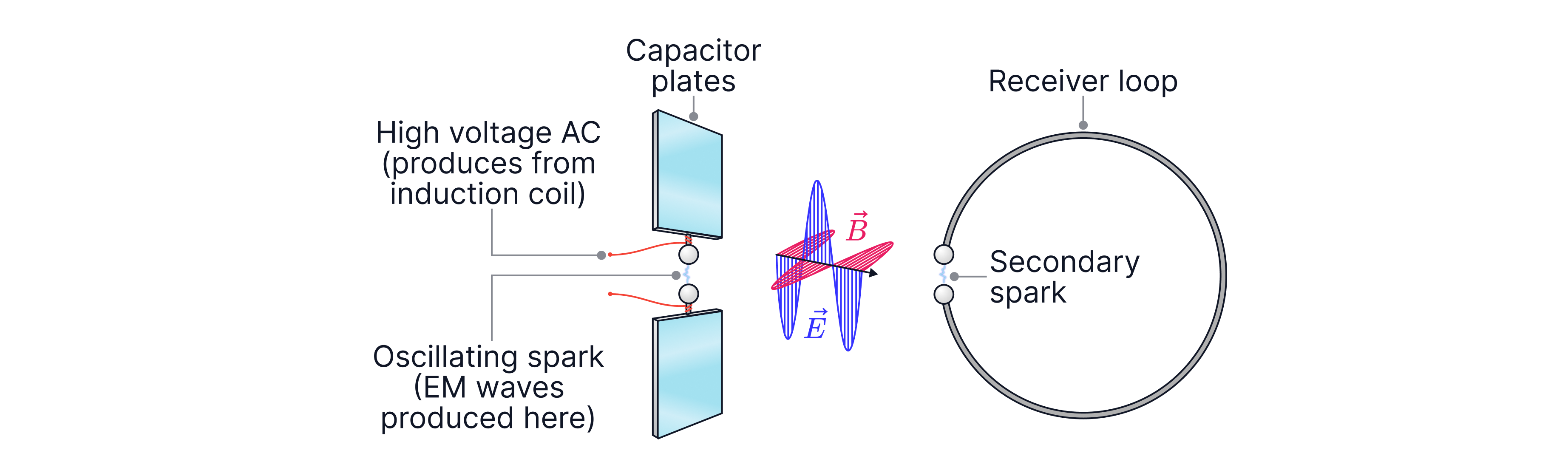
Producing radio waves (transmitter):
An induction coil charges up a pair of metal conductors (plates/spheres), storing charge. The voltage becomes large enough for a spark to jump a small gap. The charge oscillates rapidly during/after the spark. These accelerating charges emit radio waves (electromagnetic radiation).
Detecting radio waves (receiver):
A conducting loop (or small dipole) with a tiny spark gap is placed nearby. The incoming radio waves induce an oscillating emf/current in the loop ( due to the changing magnetic field in the electromagnetic wave). If large enough, a tiny spark appears across the receiver gap (detection).
Antenna method:

Producing radio waves (transmitter antenna):
An alternating current flows in the dipole transmitter (i.e. an antenna), meaning charges accelerate back and forth. Accelerating charges emit electromagnetic waves at the same frequency as the oscillation.
Detecting radio waves (receiver antenna):
The incoming radio waves make charges (electrons) in the receiving antenna oscillate. This produces an induced AC voltage/current, which can be detected.
Determining speed using nodes
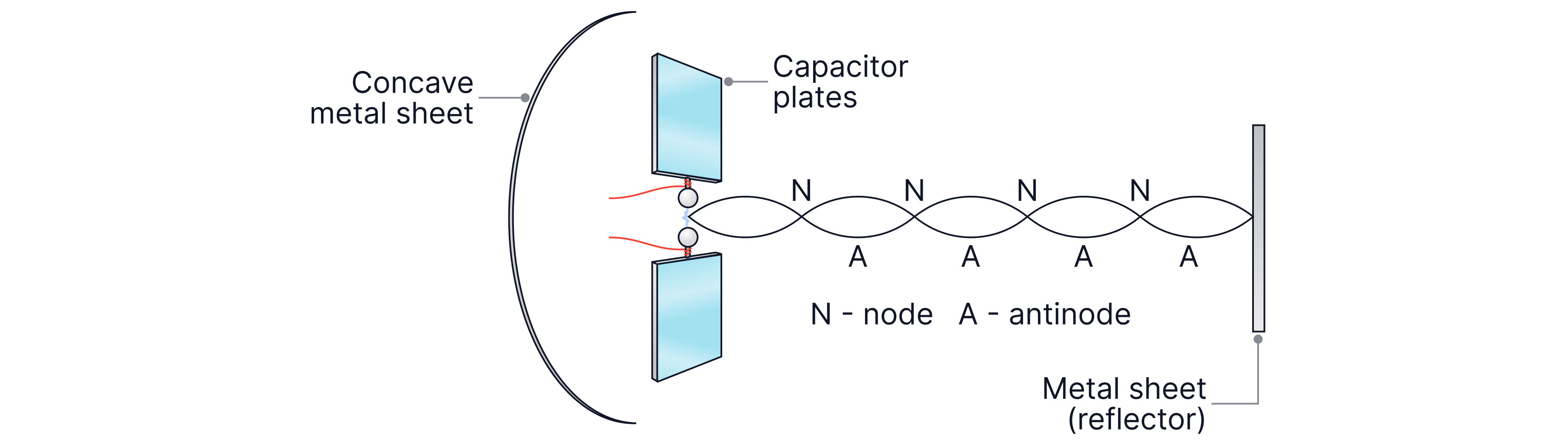 Metal sheets are used to reflect radio waves. The incident and reflected waves superpose to form a standing wave pattern.
The nose were found by moving a receiver along the line between transmitter and reflector.
At some positions the receiver spark/signal is strong (antinodes), at others it disappears/is weakest (nodes).
The distance between adjacent nodes is .
So if distance between adjacent nodes is :
Then:
Formula:
Worked Example:
Describe how Hertz used a transmitter, a receiver, and a metal reflector to determine the speed of radio waves. Your answer should reference: nodes, wavelength, and the wave equation.
Answers:
Produce radio waves (spark-gap transmitter / oscillating charges in an antenna).
Use a receiver (spark loop / antenna) to detect where the signal is strong or weak.
Add a metal reflector so reflected waves superpose with incident waves to form a standing wave.
Move the receiver and locate positions where the signal is weakest/absent (nodes).
Measure distance d between adjacent nodes; so .
Use to calculate speed.
Hertz found , matching light and Maxwell’s prediction → conclusion: radio waves are EM waves.
Rotation and polarisation

Observation:
If the receiver (or transmitter) is rotated, the spark/signal becomes very weak or disappears at certain orientation.
Explanation (polarisation):
A dipole/antenna produces waves with the electric field oscillating in a particular plane. The receiver responds strongly only when it is aligned so the induced current matches the oscillation direction ( or ).
At , … alignment, coupling is minimal → little/no signal.
Conclusion:
This shows radio waves are transverse - meaning they can be polarised, contradicting the earlier idea that these waves were longitudinal. Huygens had also thought light was longitudinal, so this type of polarisation evidence would have contradicted Huygens too.
Significance
This was experimental confirmation of Maxwell’s prediction that electromagnetic waves exist. It showed radio waves behave like light (reflection, standing waves, polarisation). As the measured speed was close to , it linked radio waves and light as the same family, the electromagnetic spectrum.
Worked Example:
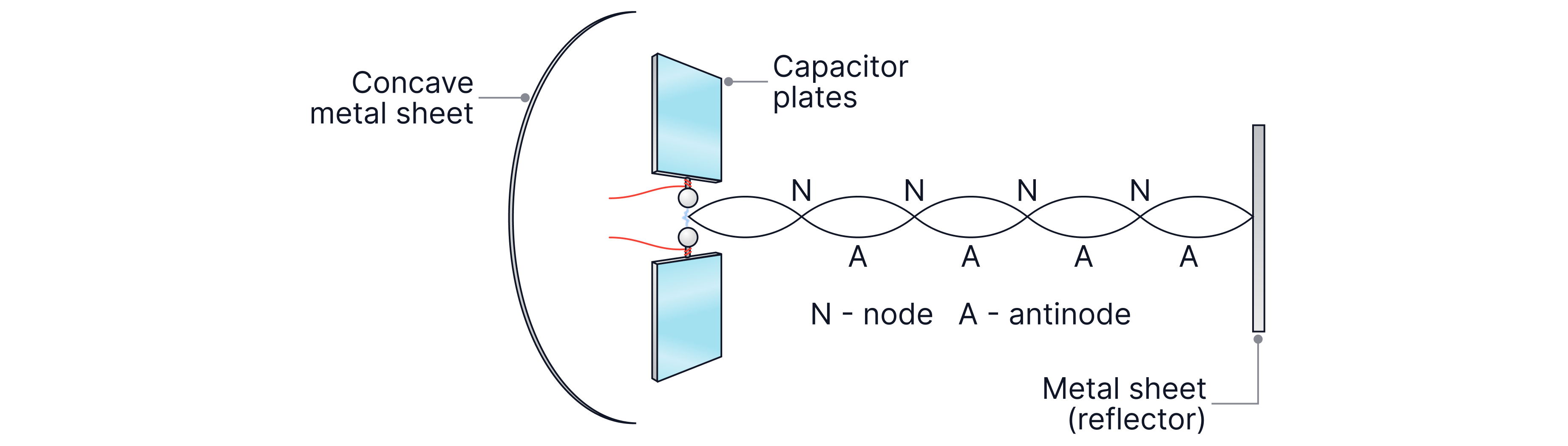
A standing wave is formed between a transmitter and a metal reflector. Adjacent node positions are measured and the separation is . The transmitter frequency is . Calculate the speed of the radio waves.
Comment on your value, given that the speed of light is .
A student rotates the receiver by and finds the signal becomes too weak to detect. What does this suggest about the nature of radio waves?
Answers:
The speed matches c, so radio waves travel at the speed of light → strong evidence that radio waves and light are both types of electromagnetic waves.
Detection depends on orientation → the waves are polarised, so they are transverse, not longitudinal.
Practice Questions
How did Hertz measure the speed of radio waves?
-> Check out Hannah's video explanation for more help
Answer:
He used a spark-gap transmitter to produce radio waves and a loop receiver to detect them (changing magnetic flux through the loop induces an emf and can cause a spark). He added a metal reflector to form a standing wave, moved the receiver to find nodes, used node spacing to get , then calculated . The value matched the speed of light.
How did Hertz show radio waves are transverse?
-> Check out Hannah's video explanation for more help
Answer:
He rotated the receiver and found the signal weakened or disappeared at . Polarised means the wave oscillates in one plane (for EM waves, the electric field). At the receiver doesn’t pick up the correct component, so detection fails. Only transverse waves can be polarised, so radio waves must be transverse electromagnetic waves.