Photons
Brook Edgar & Hannah Shuter
Teachers


Contents
Explainer Video
Black-body radiation & ultraviolet catastrophe
Physicists originally tried to explain light entirely as a wave. But two key experiments showed that wave theory was not enough:
Radiation from hot objects (black bodies): wave theory predicted that as wavelength gets shorter (towards the ultraviolet), the emitted intensity should keep increasing dramatically. Experiments showed the spectrum actually peaks and then falls at short wavelength. This disagreement is the ultraviolet catastrophe.
Photoelectric effect: wave theory could not explain why shining light on a metal only ejects electrons if the light is above a threshold frequency, and why electrons are emitted instantly once that threshold is exceeded (rather than after a time delay).
Planck’s and Einstein’s solutions introduced the idea that light transfers energy in packets (photons), starting quantum physics.
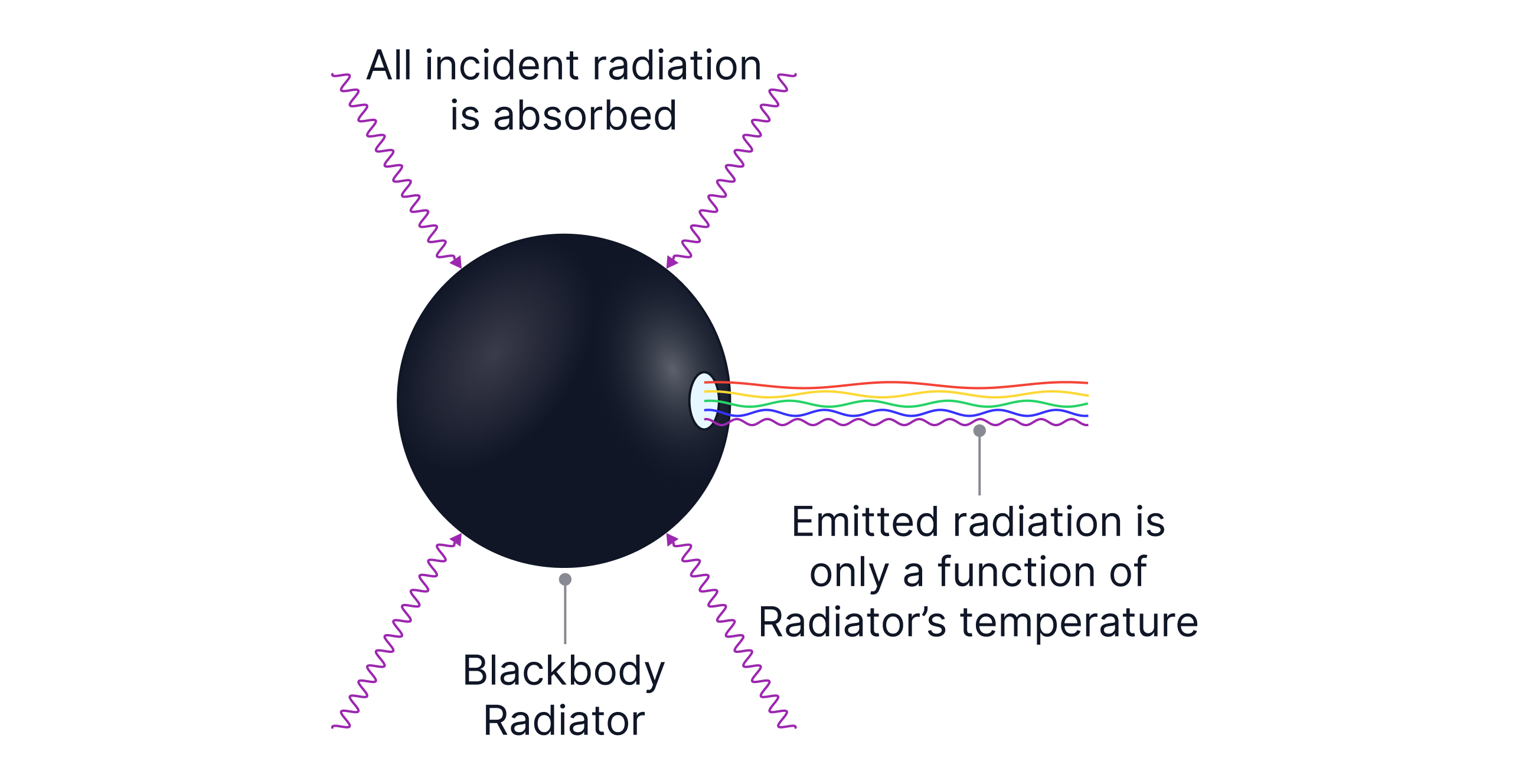
A black body is an ideal object that absorbs all incident electromagnetic radiation and emits radiation across a continuous range of wavelengths.
In practice, a cavity with a small hole is a good approximation: radiation entering is very likely to be absorbed after multiple reflections, and radiation leaving the hole represents the cavity’s thermal spectrum.
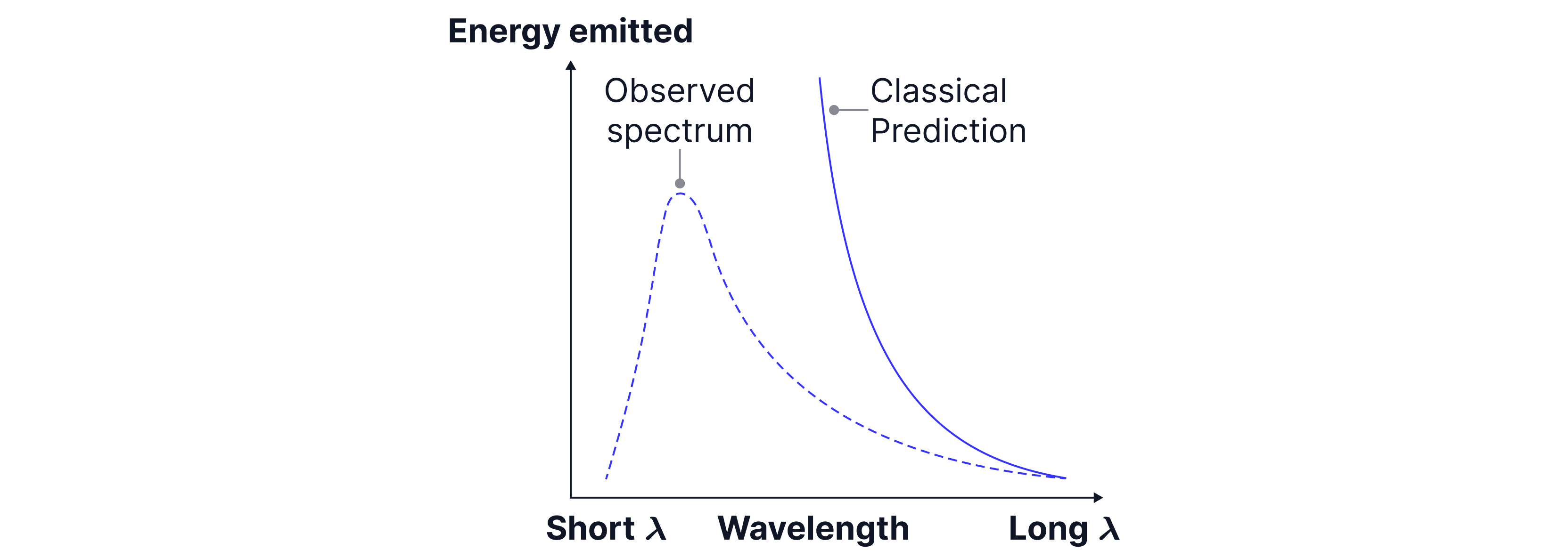
Measurements show a spectrum with a peak intensity at some wavelength, then the intensity falls off at shorter wavelengths. Classical physics ( i.e. wave theory) agreed reasonably well at long wavelengths, but predicted that intensity would rise dramatically at short wavelengths, giving far too much ultraviolet radiation compared with what is observed.
This mismatch at the short-wavelength end is the ultraviolet catastrophe: classical theory predicted an unphysical “blow up” in emitted energy in the ultraviolet region.
Planck's Solution (quantisation)
Planck proposed that electromagnetic energy is not continuous. Instead, it is emitted/absorbed in discrete packets (quanta):
Formula:
This prevents the ultraviolet divergence because high-frequency (short-wavelength) radiation would require emission in large chunks , making high-frequency emission much less likely.
Worked Example:
Using the black-body spectrum graph (observed curve vs classical prediction), explain what is meant by the ultraviolet catastrophe and why this observation was important for our theory of light.
Answer:
In the classical prediction , intensity of radiation rises steeply at short wavelengths (towards UV), implying far too much UV radiation compared with measurements.
The observed spectrum has a peak and then intensity drops at short wavelengths, so classical theory fails in the UV region.
This failure is called the ultraviolet catastrophe: classical physics predicts an unphysical “blow up” of emitted energy at short wavelength.
It was important because it showed classical wave/thermal ideas were incomplete and motivated Planck’s quantisation , leading to the photon concept and quantum theory.
Photoelectric effect

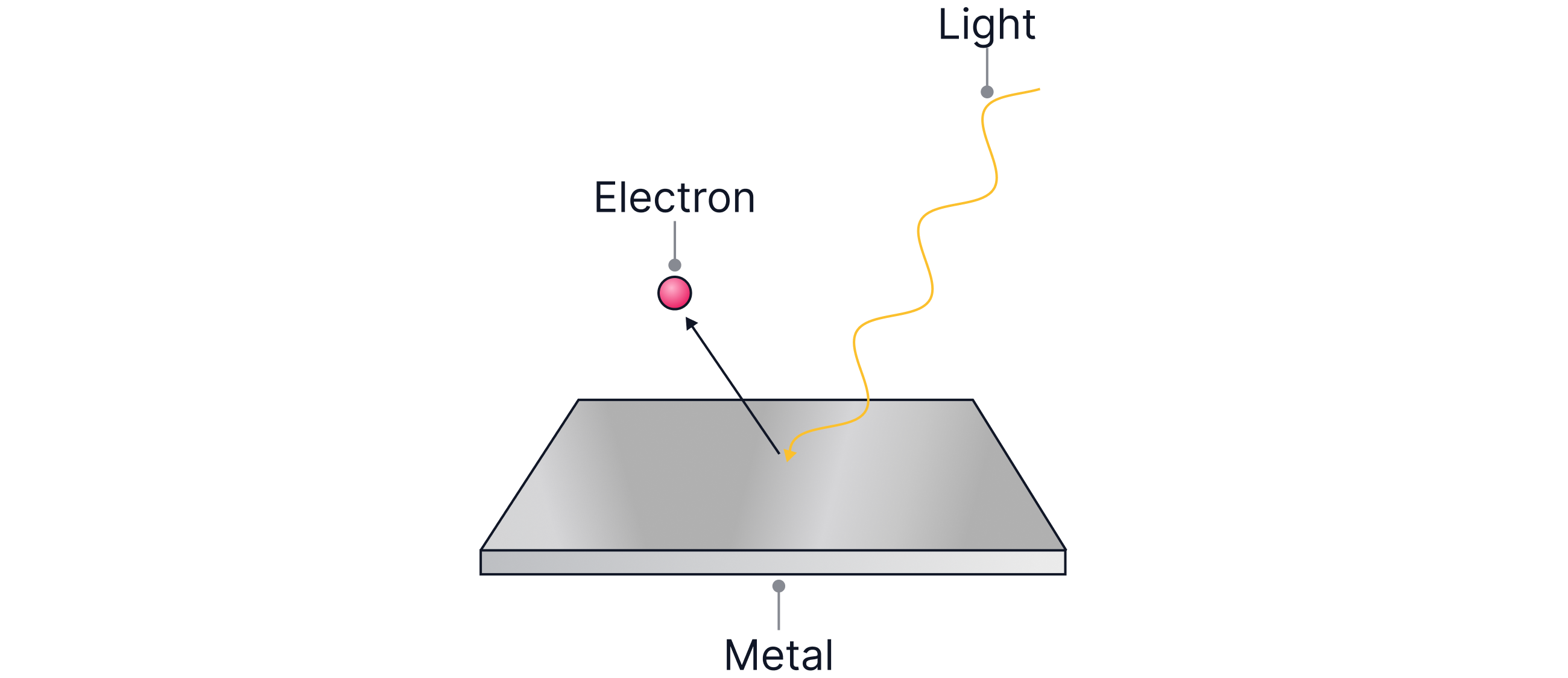
The photoelectric effect is the emission of electrons from a metal surface when electromagnetic radiation of sufficiently high frequency is incident on it.
Threshold frequency and instantaneous emission
Wave expectation: If light is a wave, energy is spread out over the wavefront. With enough time (or enough intensity), electrons at the surface should gradually absorb energy and eventually escape. Wave theory would not predict a sharp threshold frequency, and it would predict a time delay at low intensities while electrons “build up” enough energy.
Observed: Emission does not happen below a threshold frequency , no matter how intense the light is. When , emission is essentially instantaneous.
Photon explanation: In the photon model, light arrives as photons, each with energy . If (work function), no electron can escape, so there is a genuine threshold frequency. If , one photon can transfer energy to one electron, so emission can be instantaneous.
Range of kinetic energies
Observed: The emitted electrons have a range of kinetic energies from near zero up to a maximum value .
Photon explanation: Photons are absorbed one-to-one, but electrons originate from different depths/energy states and may lose varying amounts of energy inside the metal before escaping. That leads naturally to a spread of kinetic energies, with a well-defined maximum.
Effect of changing frequency
Observed: Increasing frequency increases the maximum kinetic energy of the electrons.
Photon explanation: Higher frequency photons carry more energy because . After paying the work function , the remainder becomes kinetic energy:
Formula:
Effect of changing intensity
Wave expectation: If intensity is higher, the wave delivers more energy per second, so wave theory would expect electrons to leave with greater energies (larger ).
Observed: Increasing intensity increases the number of electrons emitted per second (photocurrent), but does not increase the maximum kinetic energy.
Photon explanation: Increasing intensity means more photons per second, so more electrons are emitted per second. But each photon still has energy , so depends on frequency, not intensity.
Worked Example:
Explain why wave theory was unsuccessful in explaining the photoelectric effect, and explain how Einstein’s photon model resolved the key observations (threshold frequency, instantaneous emission, and the effect of intensity).
Answer:
Wave theory expects energy spread across the wavefront, so electrons would accumulate energy gradually → predicts a time delay at low intensity, but emission is instantaneous.
Wave theory would not predict a sharp threshold frequency; sufficiently intense low-frequency light should eventually eject electrons, but it does not.
Wave theory expects higher intensity to increase electron energy, but in reality intensity mainly increases the number emitted per second, not .
Einstein proposed photons with energy , interacting one-to-one with electrons.
Emission occurs only if (threshold), and ; higher intensity means more photons per second, so more electrons per second.
Stopping potential method and the straight-line graph
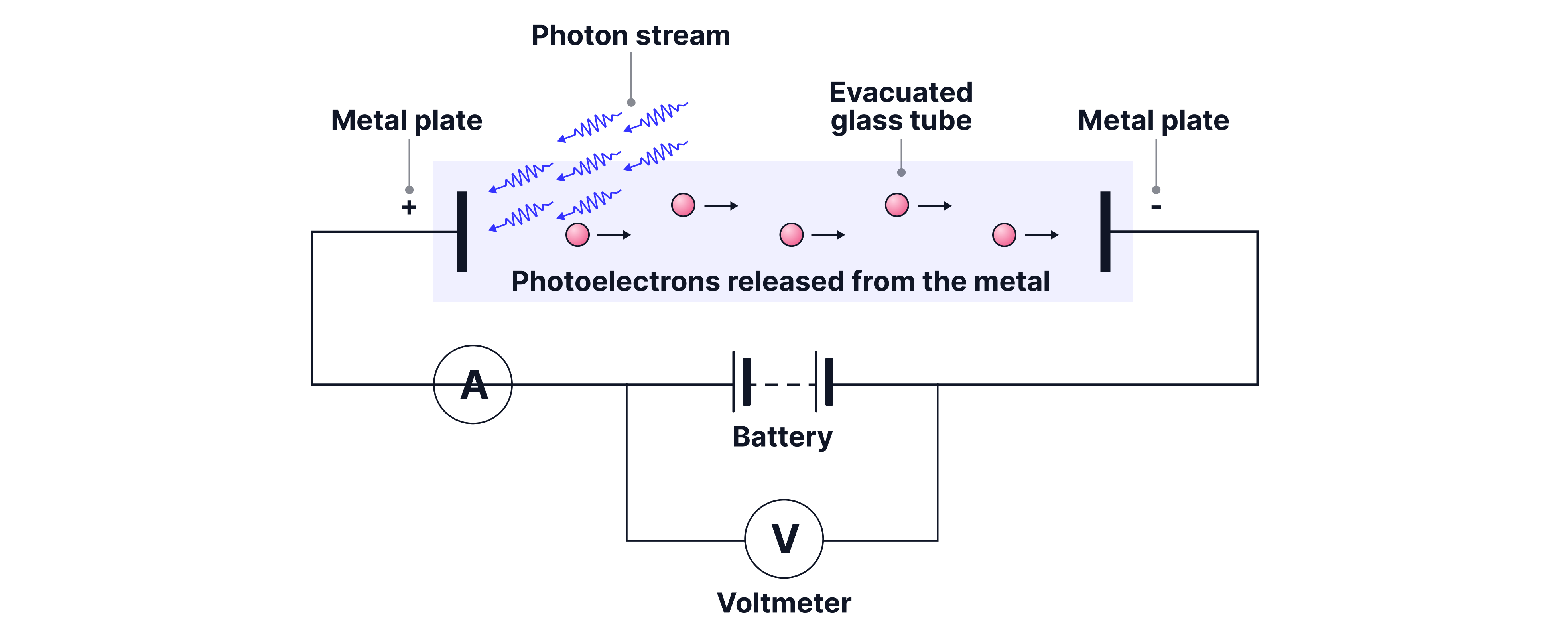
The diagram shows a photocell. Light is directed at a metal and electrons travel to the opposite metal plate.
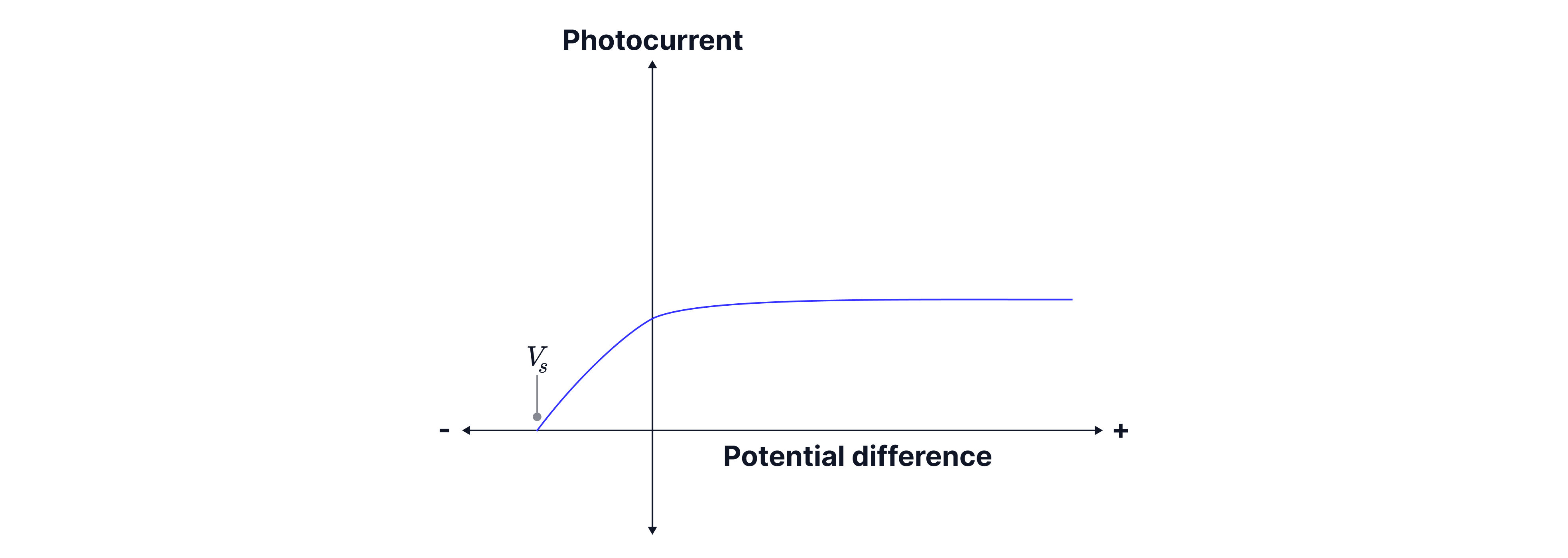
As the applied p.d. is made more negative (a retarding potential), the photocurrent falls because electrons with smaller kinetic energy are stopped first. When the p.d. reaches the stopping potential , even the fastest electrons are stopped and the current falls to zero.
The most energetic electrons are just stopped:
Combine with Einstein’s equation:
So a plot of Vs against is a straight line:

gradient =
y-intercept =
x-intercept = (threshold frequency)
Practice Questions
Physics almost broke because of a glowing black body, why?
-> Check out Brook's video explanation for more help.
Answer:
Black bodies absorb and emit all radiation, but the amount emitted varies, with a peak at a specific wavelength. Classical physics predicted black bodies would emit short-wavelength (UV) radiation at very high intensities, but measurements show that the intensity peaks at shorter wavelengths and then falls. This failure showed classical theory was incomplete and led Planck to propose quantised energy of light , introducing the photon idea.
Why did wave theory fail to explain the photoelectric effect, and how did Einstein’s photon idea fix it?
-> Check out Brook's video explanation for more help.
Answer:
Wave theory suggests energy is delivered continuously, so sufficiently intense light of any frequency should eventually eject electrons and there may be a time delay at low intensity. Experiments show a threshold frequency and instantaneous emission. Einstein’s photon model explains this by giving light discrete energy packets : below threshold photon energy is insufficient, and above threshold one photon can eject one electron immediately.