Electrons in fields
Brook Edgar & Hannah Shuter
Teachers


Contents
Explainer Video
Fine beam tube: electrons in a magnetic field
The specific charge of a particle is its charge-to-mass ratio (e/m). For electrons this value is very large, which was key evidence that electrons are much lighter than ions such as H⁺. We will look at two methods that were used to find the specific charge of electrons.
The Setup
An electron gun fires electrons into a region of uniform magnetic field , produced by coils. The beam follows a circular path of radius , which can be measured directly on the tube.
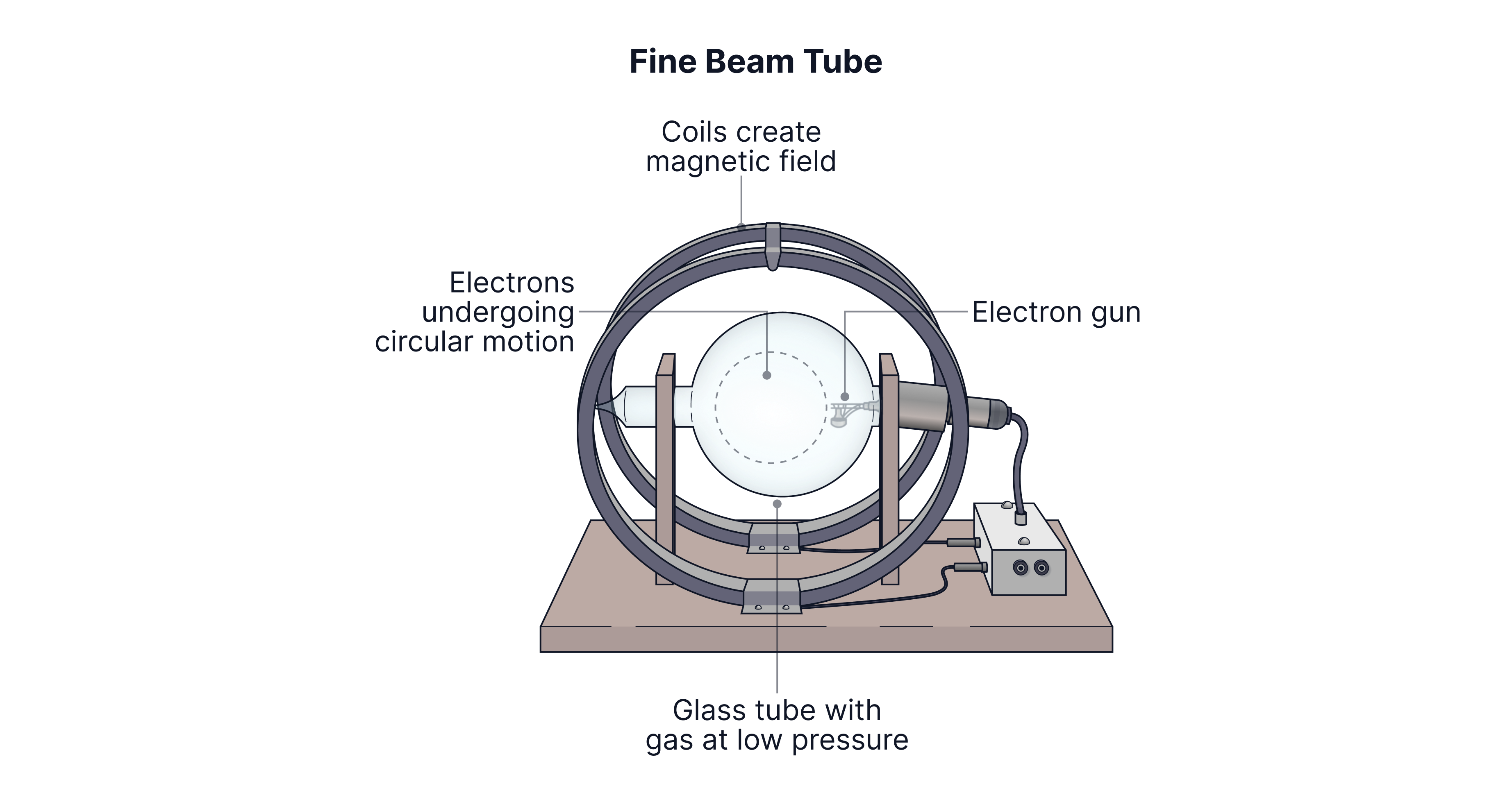
Why the beam is visible: The tube contains low-pressure gas. Electrons collide with gas atoms causing excitation; when atoms de-excite they emit photons, making the beam path glow. The diagram below shows the same set up with all the important quantities that need to be measured.
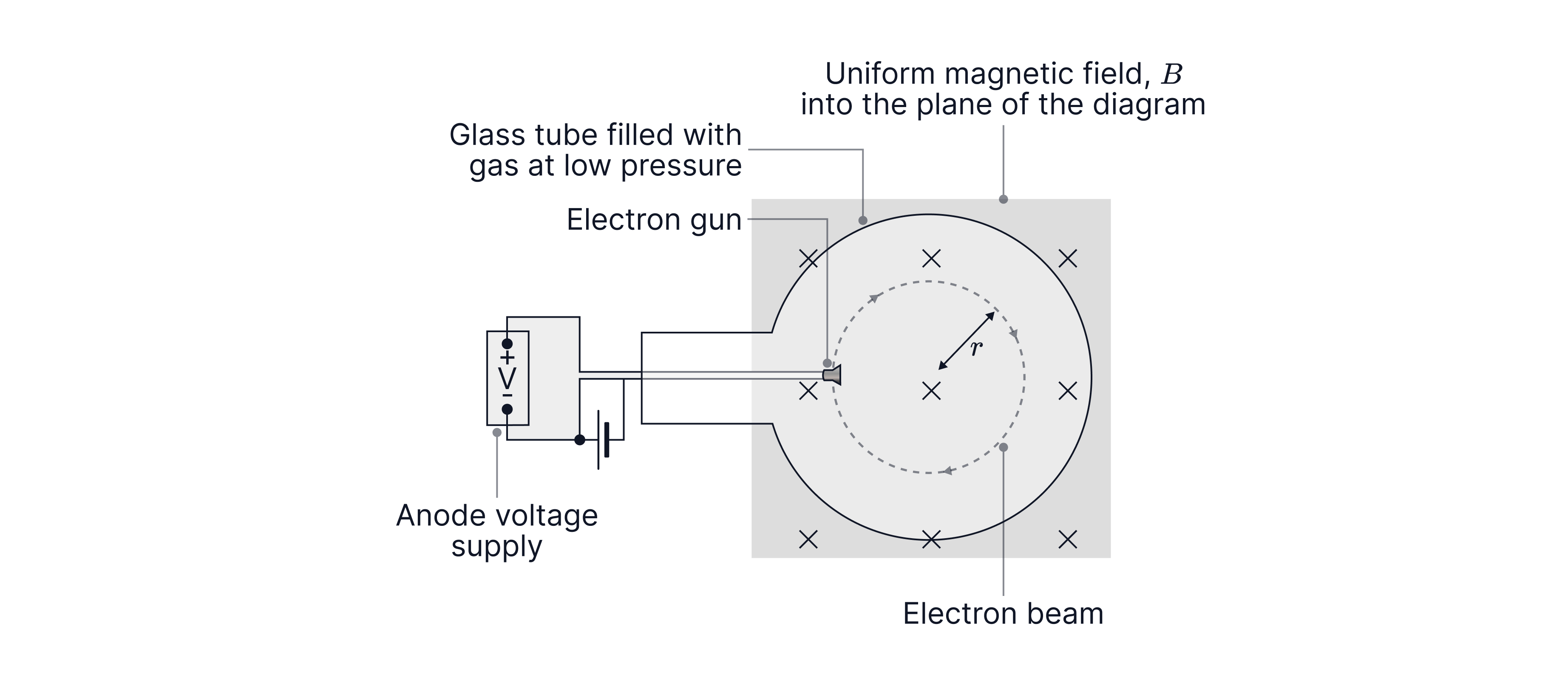
Note the filament voltage is simply to heat the filament inside the electron gun until it can release electrons. The anode voltage is used to make the electric field which accelerates the electron inside the electron gun.
Key measurements:
anode voltage, (accelerating voltage of the electron gun)
magnetic flux density, (from coil current / calibration)
radius of the electron beam,
Deriving the fine beam tube equation for e/m
Energy (acceleration):
Circular motion (magnetic force provides centripetal force):
Rearrange to eliminate v:
Substitute into to get:
Thomson’s comparison with H⁺ ions (what could he conclude?)
Thomson found for cathode ray particles was about larger than the known specific charge of H⁺.
From the numbers alone he could conclude at least one of these must be true:
the particles have a much smaller mass than H⁺, OR
the particles carry a much larger charge than H⁺
The later accepted conclusion: a new fundamental particle exists (the electron), with mass far smaller than a proton.
Worked Example:
A fine beam tube uses:
accelerating voltage V = 1.60 kV
magnetic flux density B = 4.0 mT
radius of beam r = 34 mm
Calculate the specific charge e/m of the electron.
Velocity selector (crossed fields) + electric field deflection
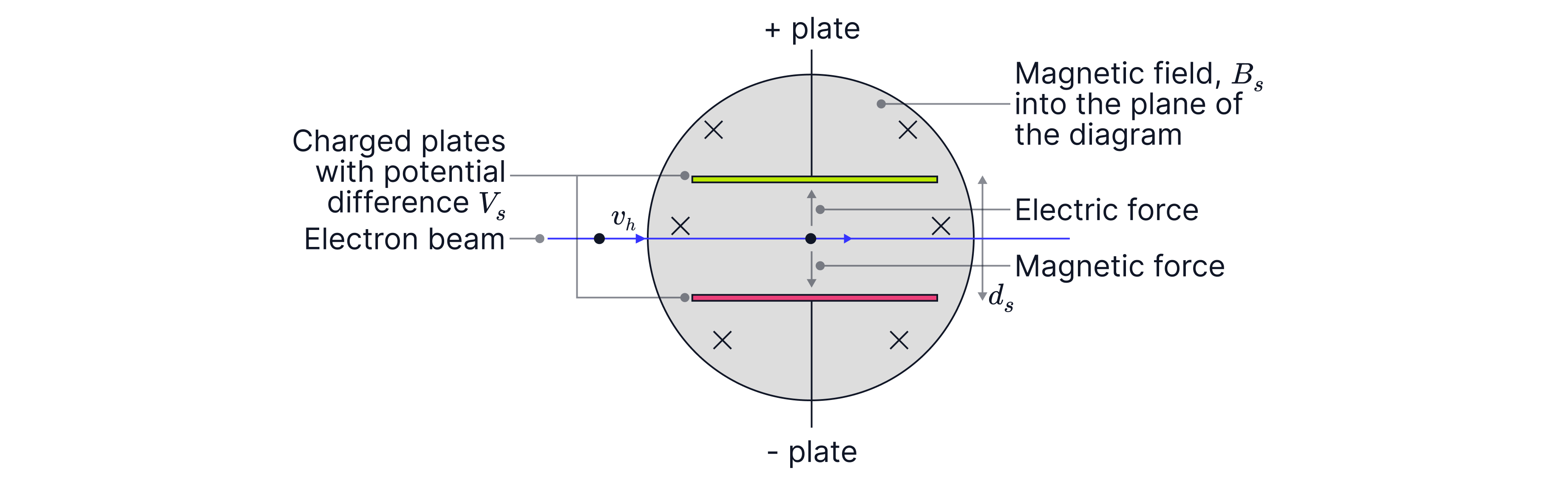
Electrons first pass through a velocity selector (crossed electric and magnetic fields) to select one speed, then they pass into a separate electric field region where they are deflected.
Setup 1:
Velocity selector: selecting a known speed
Variables (selector region):
electric field strength in the selector
magnetic flux density in the selector
pd across selector plates
separation of selector plates
electron speed
Why electrons are undeflected (brief):
The electric and magnetic forces act in opposite directions. For the selected speed, these forces are equal, so the resultant force is zero and the beam goes straight.
Condition for no deflection:
Set-up 2: using deflection in electric field to find :
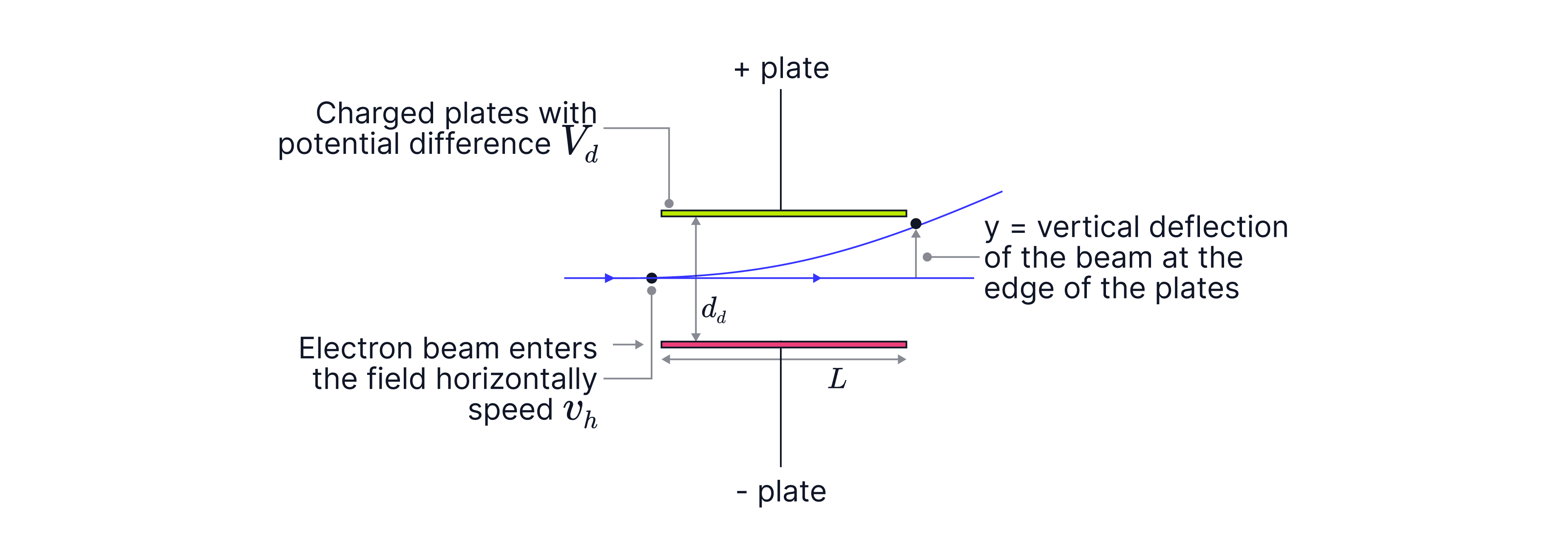
Variables (deflection plates region):
electric field strength between deflection plates
pd across deflection plates
separation of deflection plates
length of deflection plates
vertical deflection (measured at end of plates)
time spent between plates
vertical acceleration in the plates
Derivation:
First, find the electric field strength between the plates:
The electric field causes the electron to accelerate, so:
The time spent between the plates is:
The vertical motion gives:
Substitute into the specific charge equation:
Substitute :
Worked Example
Explain what will happen if the electrons enter the velocity selector too quickly.
Which change will increase the deflection of the electron beam in the electric-field deflection plates region?
Increase the speed of the electrons entering the deflection plates
Decrease the separation between the deflection plates (keep the same)
Decrease the specific charge of the electrons
Decrease the time spent between the plates
Speed doesn’t affect the electric force but it increases the magnetic force. If the electrons are faster than the selected speed (), the magnetic force is too strong compared to the electric force. The beam will be deflected in the direction of the magnetic force, so it will not pass straight through the selector.
Correct answer:
B
Why B is correct:
Decreasing increases the electric field for the same , increasing the force and acceleration, so the deflection increases.
Why A is wrong:
Increasing means the electrons spend less time between the plates, so the deflection is smaller, not larger.
Why C is wrong:
If is smaller, the acceleration in the field is smaller, so the deflection is smaller, not larger.
Why D is wrong:
Deflection increases with the time in the field. Less time means less vertical acceleration time, so deflection decreases.
Significance
J.J.Thomspson compared the specify charge of a H+ ion to the one calculated in these experiments. He concluded that a new fundamental particle ( i.e. the electron) exists which either has a much smaller mass or much greater charge.
Measuring showed cathode ray particles are identical regardless of the gas or electrodes. This helped establish the electron as a fundamental particle and changed the model of the atom
Practice Questions
How did we work out the charge-to-mass ratio (e/m) of the electron when we can't even weigh one?
-> Check out Brook's video explanation for more help.
Answer:
Electrons are fired from an electron gun into a uniform magnetic field.
The electrons curve into a circular path; measure the radius of the circle.
The accelerating voltage gives the electrons kinetic energy: .
The magnetic force provides the centripetal force: .
Combine the two equations to eliminate v and obtain: .
Measure , and , then substitute into the formula to calculate .
How can the charge-to-mass ratio () of the electron be found using a velocity selector and electric deflection?
-> Check out Brook's video explanation for more help.
Answer:
A beam of electrons enters a velocity selector with crossed fields: electric field and magnetic field at 90° to each other.
Only electrons with one speed go straight through because the forces balance: , so .
The selected-speed beam then enters a separate region with an electric field Ed only (between deflection plates).
The electric force produces a vertical acceleration: , so a and therefore .
The time in the deflection region is found from horizontal motion: (length of the plates).
The vertical deflection is given by suvat: .
Substitute into to get .
Hence .
Using (p.d. across deflection plates, plate separation): .