Resistant bacteria and MRSA
Laura Armstrong & Joe Wolfensohn
Teachers


Contents
Recall Questions
This topic requires prior knowledge of natural selection and bacteria.
What is natural selection?
The process where organisms with advantageous traits survive and reproduce, passing their genes to their offspring.
Why do bacteria evolve quickly?
Because they reproduce rapidly (by binary fission), allowing mutations to spread through populations faster.
What is an antibiotic?
A drug / medicine that kills bacteria.
Topic Explainer Video
Check out this @JoeDoesBiology video that explains resistant bacteria and MRSA, then read the study notes. Once you’ve gone through them, don’t forget to try the practice questions!
Evidence for evolution
We have seen evolution in action during our own lifetime! Bacteria develop resistance to antibiotics through the process of evolution.
How Do Bacteria Become Resistant?
-
Bacteria can evolve quickly due to rapid reproduction.
-
Sometimes, a random mutation occurs in a bacterium’s DNA that makes it resistant to an antibiotic.
-
When antibiotics are used:
-
Non-resistant bacteria are killed.
-
Resistant bacteria survive and reproduce.
-
Passing on the gene for resistance.
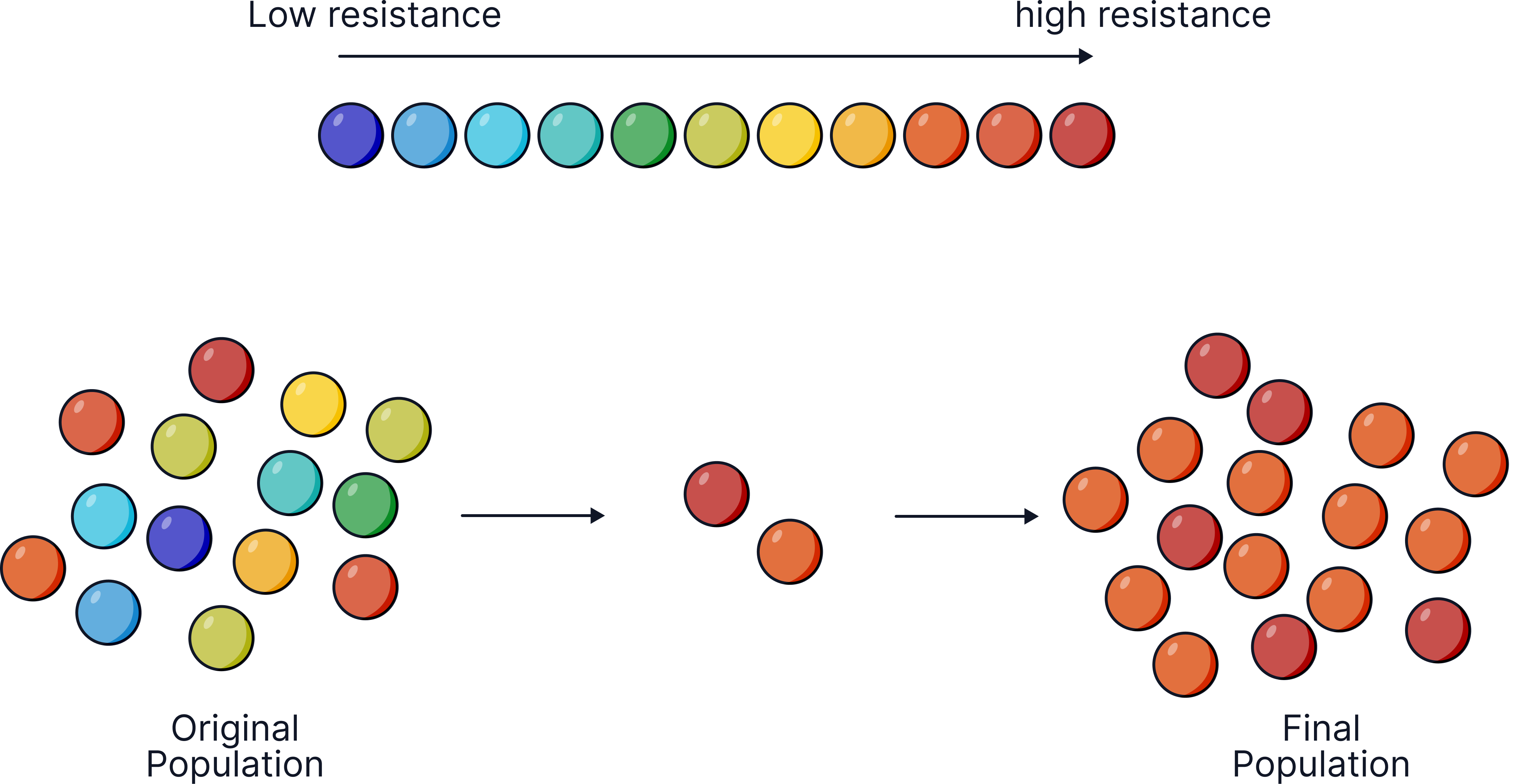
- Over time, the resistant strain spreads, especially if people:
-
-
Are not immune to the new strain.
-
Have no effective treatment available.
-
Have weakened immune systems.
-
Are in close contact, for example, in a hospital.
-
This is a real-world example of natural selection:
-
The antibiotic is the selection pressure.
- Only the resistant bacteria survive and pass on their resistance genes.
What Is MRSA?
-
MRSA stands for Methicillin-Resistant Staphylococcus aureus.
-
It is a type of bacteria resistant to many antibiotics.
-
MRSA infections are difficult to treat and can be life-threatening, especially in hospitals where infections spread quickly and people may have weakened immune systems.
How Can We Reduce Antibiotic Resistance?
To prevent the spread of resistant strains:
-
Doctors should not prescribe antibiotics unnecessarily, such as for viral infections or mild illnesses. The patient's own immune system (white blood cells) should be able to destroy these pathogens without the need for medication.
-
Patients must complete the full course of antibiotics to ensure all bacteria are killed. If not, any surviving bacteria may go on to mutate and develop resistance, before beginning to reproduce again.
-
Limit the use of antibiotics in farming. Farmers may give antibiotics to their animals to keep them disease free. This means they grow faster and are more likely to survive. Overuse of antibiotics in animals can lead to resistant bacterial strains in animals that transfer to humans – posing a risk to human health.
Why Is Antibiotic Resistance such a Problem?
-
New antibiotics take a long time to develop.
-
They're expensive to develop, and resistant strains evolve faster than new drugs are made.
-
This makes it harder to keep up with new resistant infections.
Key Terms
-
Antibiotic – A medicine that kills bacteria.
-
Resistance – When bacteria are no longer killed by an antibiotic.
-
Mutation – A random change in DNA that may lead to new alleles.
-
MRSA – A strain of bacteria resistant to several antibiotics.
-
Natural selection – The survival and reproduction of organisms best suited to their environment.
-
Selection pressure – Any factor in an organism's environment that influences its survival and reproduction.
No answer provided.
Exam Tip
Bacteria do not become ‘immune’ to antibiotics, they become ‘resistant’ make sure to use the correct term here.
Resistance develops as a result of random mutations. Bacteria do not choose to develop resistance, so be careful not to imply that they do!
No answer provided.
Practice Question
Explain how a population of bacteria can become resistant to an antibiotic. (4 marks)
-
A mutation occurs in a bacterium that makes it resistant to an antibiotic.
-
When the antibiotic is used, non-resistant bacteria are killed.
-
The resistant bacteria survive and reproduce.
-
The resistance gene is passed on, and the number of resistant bacteria increases in the population.
More Practice
Try to answer the practice question from the TikTok video on your own, then watch the video to see how well you did!