Concentrations in mol/dm³ (HT only)
Lajoy Tucker
Teacher

Introduction & Definitions
This topic focuses on calculating the amount of substance in a solution and how to use this in chemical reactions.
Concentration = quantity/volume
Mass concentration, g/ = mass dissolved per dm3 of solvent
- Concentration (g/) = mass (g)/volume ()
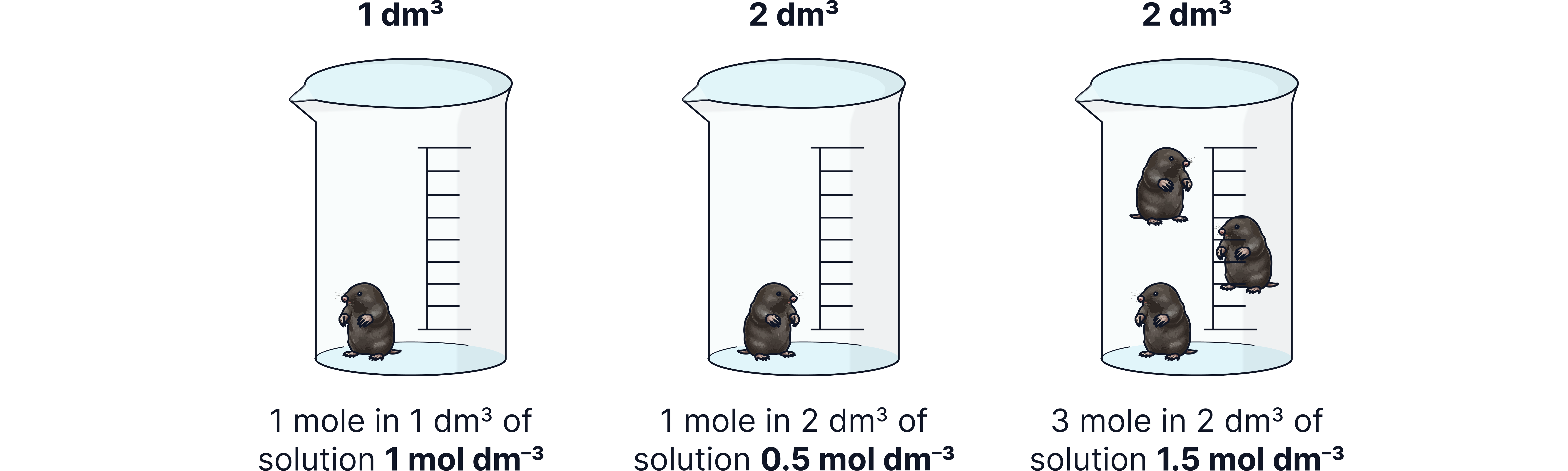
Molar concentration, mol/, number of moles dissolved per of solvent
- Concentration (mol/) = moles (mol) /volume ()
This is often rearranged to calculate the number of moles dissolved in solution:
Moles = concentration × volume
n = c V
n = moles (mol)
c = concentration (mol/dm³)
V = volume (dm³)
Important conversions:
to : divide by 1000.
Examples
1. 3.0 g of were dissolved in 100 of water. Give the concentration in g/
Answer:
Volume = 100 /1000 = 0.1
c = g/V = 3.0/0.1 = 30 g/
2. Calculate the number of moles of in 250cm3 of a 0.010 / solution
Answer:
Volume = 250 /1000 = 0.250
n = cV = 0.010 x 0.250 = 2.50 x mol
Steps for Reacting Solutions
When calculating amount of substance for reacting solutions, the same principle is applied as for reacting masses
Write the balanced chemical equation.
Calculate moles of the known solution (using c × V).
Use mole ratios to find moles of unknown reactant or product.
Use moles to calculate the unknown quantity as required.
Worked Example:
What volume of 0.150 mol dm⁻³ H₂SO₄ is required to react with 35.0 cm³ of 0.300 mol dm⁻³ NaOH? Give the answer in cm3.
Equation: H₂SO₄ + 2NaOH → Na₂SO₄ + 2H₂O
Answer:
Moles of NaOH = 0.300 × (35.0 ÷ 1000) = 0.0105 mol
Ratio NaOH:H2SO4 = 2:1
Moles of H₂SO₄ = 0.0105 ÷ 2 = 0.00525 mol
Volume of H₂SO₄ = n / c = 0.00525 / 0.150 = 0.0350 dm³ = 35.0 cm³
Check for Understanding
Recall
a) State the formula used to calculate molar concentration (mol/dm³).
Answer:
a) Concentration = moles ÷ volume.
b) Write the equation that links moles, concentration and volume.
Answer:
b) n = c × V.
c) State the conversion used to change cm³ to dm³.
Answer:
c) Divide by 1000.
Application
d) Calculate the number of moles in 0.200 dm³ of a 0.50 mol/dm³ solution.
Answer:
d)
n = c × V
n = 0.50 × 0.200
n = 0.10 mol
e) Calculate the concentration (mol/dm³) of a solution containing 0.015 mol dissolved in 0.300 dm³.
Answer:
e)
c = n ÷ V
c = 0.015 ÷ 0.300
c = 0.050 mol/dm³
Challenge (HT)
f) 25.0 cm³ of 0.200 mol/dm³ HCl reacts completely with sodium hydroxide solution (NaOH).
The equation is:
HCl + NaOH → NaCl + H₂O
Calculate the concentration of the NaOH solution if 30.0 cm³ of NaOH was used.
Answer:
f)
Convert volume: 25.0 cm³ = 0.0250 dm³
Moles of HCl = c × V
= 0.200 × 0.0250
= 0.00500 mol
Ratio HCl : NaOH = 1 : 1
Moles of NaOH = 0.00500 mol
Convert volume: 30.0 cm³ = 0.0300 dm³
c = n ÷ V
= 0.00500 ÷ 0.0300
c = 0.167 mol/dm³ (3 s.f.)
Key Tips & Reminders
Always convert cm³ to dm³ (÷1000) before using n = c × V.
Ensure the equation is balanced to get the correct mole ratio.
Use correct significant figures based on data provided.
Label units throughout your working — especially in answers.
Show your working out/calculations! If the final answer is wrong, you can still get some marks.
When in doubt… MOLES
No answer provided.