Formulations
Lajoy Tucker
Teacher

Formulations
What Is a Formulation?
A formulation is a mixture that has been carefully designed to produce a useful product.
Unlike a simple mixture, a formulation has:
- Exactly measured components
- Each chemical included for a specific purpose
- A structure designed to give the required properties
Formulations are used throughout everyday life and industry.
Examples Of Formulations
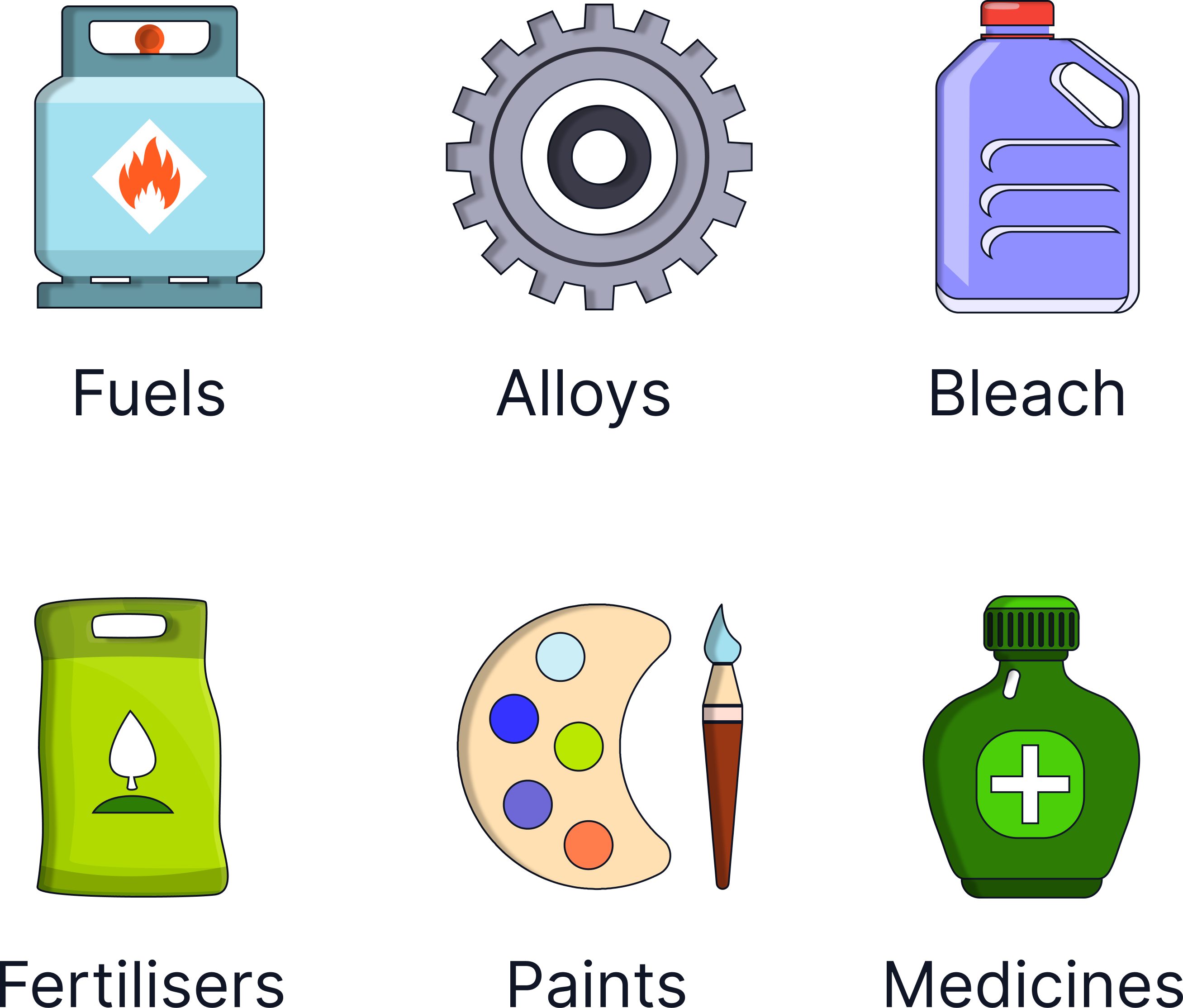
|
Product |
Why It Is a Formulation |
Components (examples) |
|
Fuels |
Designed for energy release and engine performance |
Hydrocarbons of controlled chain lengths |
|
Cleaning agents |
Must dissolve grease, kill bacteria, smell acceptable |
Surfactants, fragrances, enzymes |
|
Paints |
Need correct colour, flow, and drying time |
Pigments, solvents, binders |
|
Medicines |
Must deliver drug safely and effectively |
Active drug, fillers, coatings |
|
Alloys |
Improved hardness, strength or corrosion resistance |
Mixtures of metals |
|
Fertilisers |
Provide correct nutrients in correct amounts |
Compounds of nitrogen, phosphorus, potassium |
|
Foods |
Taste, texture and shelf life controlled |
Additives, flavourings, emulsifiers |
Each component is added to achieve a specific property needed in the final product.
Formulations are used because they:
- Can be tailored for very specific purposes
- Deliver consistent results, because each component’s amount is carefully measured and controlled
- Improve safety, efficiency, taste, durability, or appearance
For example, a medicine without its coating or stabilisers might dissolve too quickly or spoil.
A substance is likely to be a formulation if:
- It contains several ingredients, each with a specific role
- The ingredients are present in precise, measured amounts
- The product is designed to have consistent properties
- If given a product label or list of ingredients, you can usually identify whether it is a formulation.
Examples:
- Cola with water, sugar, colouring and preservatives → formulation
- Crude oil → not a formulation as hydrocarbons are not present in fixed, measured, proportions
Check Your Understanding
Recall
a) What is a formulation?
Answer:
Carefully designed mixture for a specific purpose
b) What is meant by precise proportions?
Answer:
Exact measured amounts
c) Give one example of a formulation.
Answer:
Medicines, fuels, cleaning agents dyes, inks, nail polish, etc (any man-made mixture designed for a specific purpose)
d) Why must formulations be produced consistently?
Answer:
To ensure same properties/performance every time
Application
e) Explain why medicines are formulations rather than simple mixtures.
Answer:
Designed for purpose; exact amounts; consistent results
f) Explain why crude oil is not a formulation.
Answer:
Naturally occurring mixture; not fixed proportions (air is also not a formulation as it is not man-made)
g) Explain why careful measurement is essential when producing fertilisers.
Answer:
Correct nutrient balance for the plants; to maximise effectiveness and trust in performance
Summary
- A formulation is a carefully designed mixture made to produce a useful, consistent product.
- Each component is added in measured quantities for a specific purpose.
- Examples include medicines, paints, fuels, alloys and foods.
No answer provided.
More Practice
Try to answer the practice question from the TikTok video on your own, then watch the video to see how well you did!