The Greenhouse Effect And Global Climate Change
Dr. Davinder Bhachu
Teacher

Contents
Greenhouse Gases & Climate Change
What Are Greenhouse Gases?
Key definition
Greenhouse gases are gases in the atmosphere that trap heat and help keep Earth warm enough for life.
The most important ones are:
- Carbon dioxide (CO₂)
- Methane (CH₄)
- Water vapour (H₂O)
Earth needs a certain amount of these gases; without them the planet would be around 33 °C colder. But when their levels rise too high, extra heat becomes trapped, leading to global warming and climate change.
How the Greenhouse Effect Works
The greenhouse effect is a natural process - but human activity is strengthening it.
Incoming solar energy
- The Sun sends energy to Earth mainly as short-wavelength radiation (mostly visible light).
- This type of radiation passes through the atmosphere easily, because greenhouse gases do not absorb it well.
Absorption by Earth’s surface
- Land and oceans take in this solar energy and warm up.
- Anything that warms up gives out energy - in this case, heat (infrared radiation).
Infrared radiation leaving the surface
- The warmed surface emits long-wavelength infrared radiation upward.
- This is where greenhouse gases make a difference.
Absorption by greenhouse gases
- Greenhouse gases absorb infrared radiation very effectively.
- They then re-emit this heat in all directions, including back down towards Earth’s surface.
Warming effect
- Because some heat is returned to the surface, the lower atmosphere becomes warmer than it would be otherwise.
- This process is called the greenhouse effect.
This keeps Earth at a stable temperature - until human activities add extra greenhouse gases.
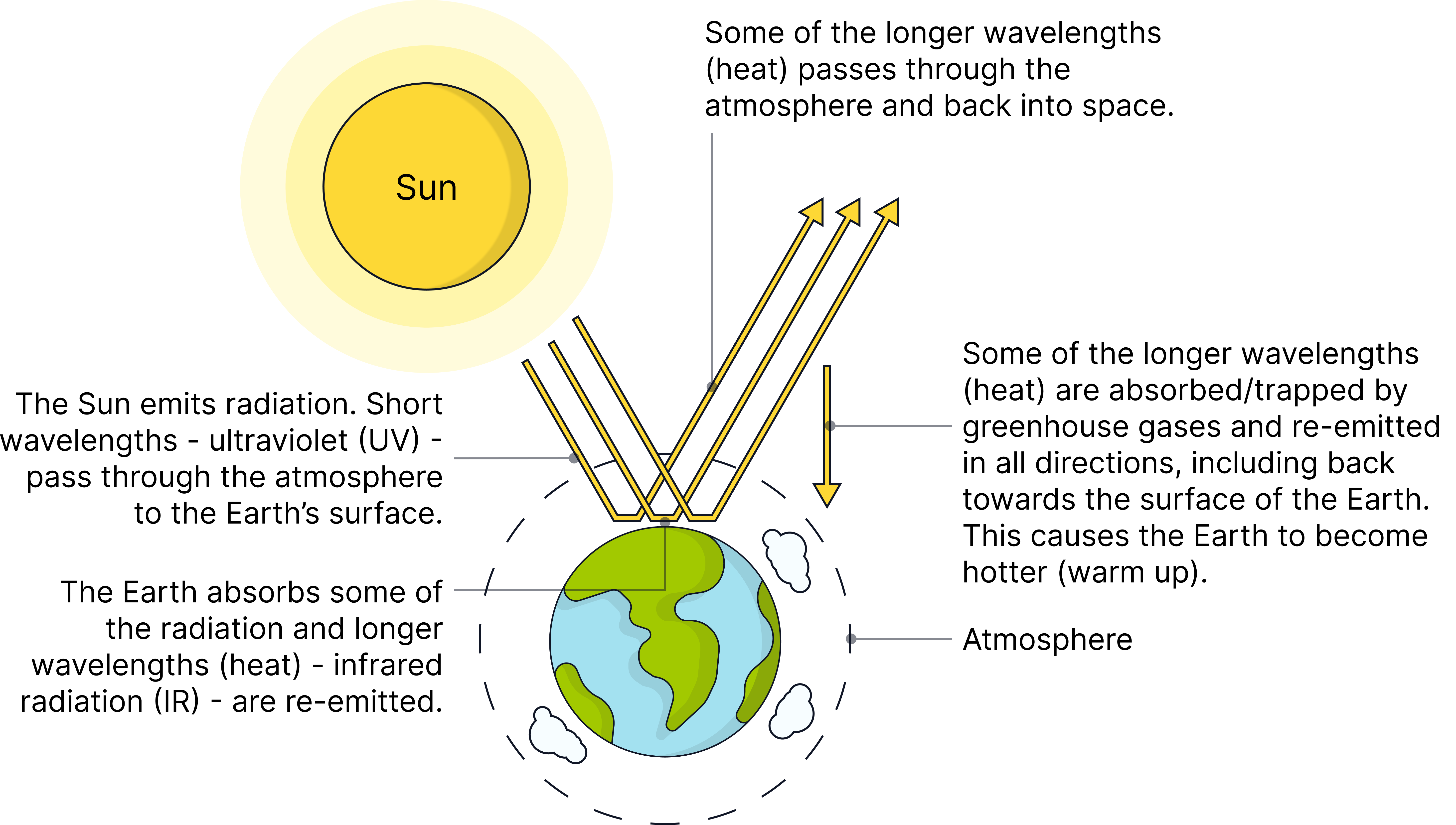 "Energy enters the atmosphere easily as sunlight, but leaves much more slowly as infrared radiation. Greenhouse gases absorb and re-radiate this heat, warming the lower atmosphere.
Where Do Greenhouse Gases Come From?
Natural sources
Greenhouse gases can come from natural processes such as:
- Respiration by animals and plants
- Decomposition of dead organisms
- Volcanic eruptions
- Evaporation producing water vapour
These have existed for millions of years and usually stay in balance.
Human-related (anthropogenic) sources - the part that’s increasing
1. Burning fossil fuels
- Coal, oil, petrol and natural gas release large amounts of CO₂.
- Transport, power stations and heating are major sources.
2. Deforestation
- Trees absorb CO₂ during photosynthesis.
- Cutting forests means:
- Less CO₂ is removed from the atmosphere.
- Burning or decomposing wood adds extra CO₂ back.
3. Agriculture
- Cattle and sheep produce methane during digestion.
- Rice paddies create methane due to bacteria in waterlogged fields.
4. Waste management
- Rubbish in landfill sites produces methane during decomposition.
5. Industrial processes
- Some factories release additional CO₂ and other greenhouse gases.
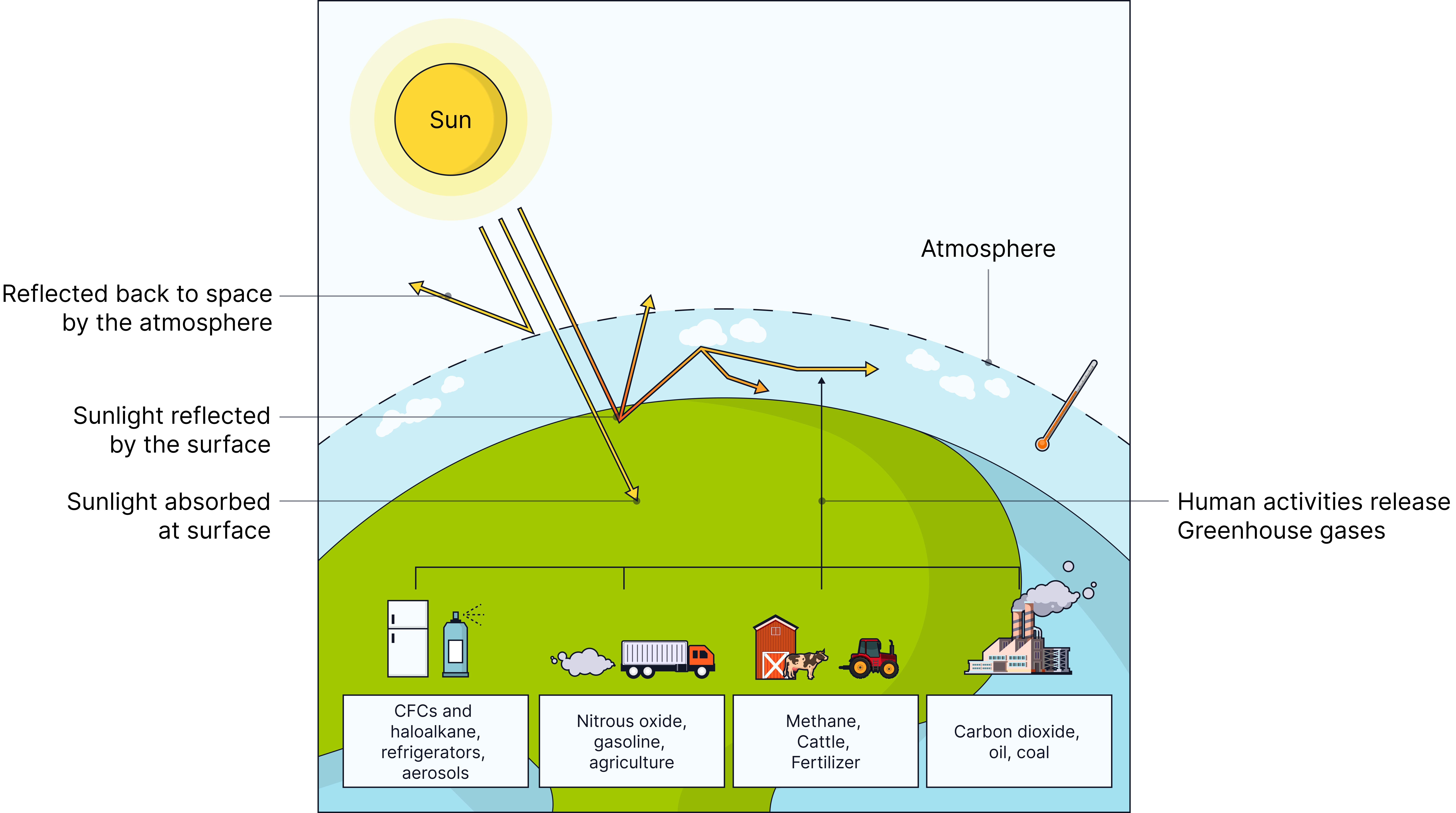
Human activities such as industry, transport, farming and waste breakdown add large amounts of greenhouse gases to the atmosphere.
Enhanced Greenhouse Effect (The Human-Made Version)
The natural greenhouse effect keeps Earth alive.
The enhanced greenhouse effect is the extra warming caused by increased amounts of greenhouse gases from human activity.
More greenhouse gases mean more absorption of infrared radiation, so more heat is trapped, that results in warming of the Earth.
This extra warming drives global warming, which is one part of climate change.
Why Water Vapour Is Important (often forgotten at GCSE)
Water vapour is the most abundant greenhouse gas.
However:
- Its concentration depends on temperature.
- As Earth warms, more water evaporates.
- More water vapour then leads to even more warming - a positive feedback loop.
Humans don’t control water vapour directly, but human-made CO₂ triggers warming that increases water vapour levels.
How Scientists Know Greenhouse Gases Are Increasing
Scientists use various methods, including:
- Ice cores (trapped ancient air shows past CO₂ and temperature)
- Direct air measurements (e.g., the Mauna Loa Observatory)
- Satellite observations
- Computer modelling
All show the same pattern: CO₂ and methane have risen sharply since the mid-1800s, matching the start of industrialisation.
Common Misconceptions
- Greenhouse gases do not “make heat”.
They only trap heat that already exists. - The ozone hole is not the cause of global warming.
It’s a separate issue involving UV radiation. - Earth’s climate naturally changes, but the current rate of change is unusually fast and closely matches human emissions.
Carbon Dioxide And Global Warming
The trend in Earth’s temperature
Measurements from weather stations, satellites and ocean buoys all show the same pattern:
Earth’s average surface temperature has increased over the past century.
Natural changes in climate do occur, but the speed and size of the temperature rise since the late 1800s matches the sharp increase in carbon dioxide and methane from human activity.
Why scientists link CO₂ to warming
Scientists agree that extra CO₂ from human actions is the main cause of the recent warming because:
- CO₂ has been directly measured increasing in the atmosphere.
- Its rise strongly correlates with industrialisation.
- Laboratory studies show CO₂ absorbs infrared radiation very effectively.
- Climate models only match observed warming when human emissions are included.
This is why scientists are confident that human activity is driving global warming, which leads to wider climate change.
Peer review and scientific reliability
Before research is published, it is peer reviewed-checked by other experts for:
- accuracy
- valid methods
- fair conclusions
This makes the data more trustworthy and avoids misinformation.
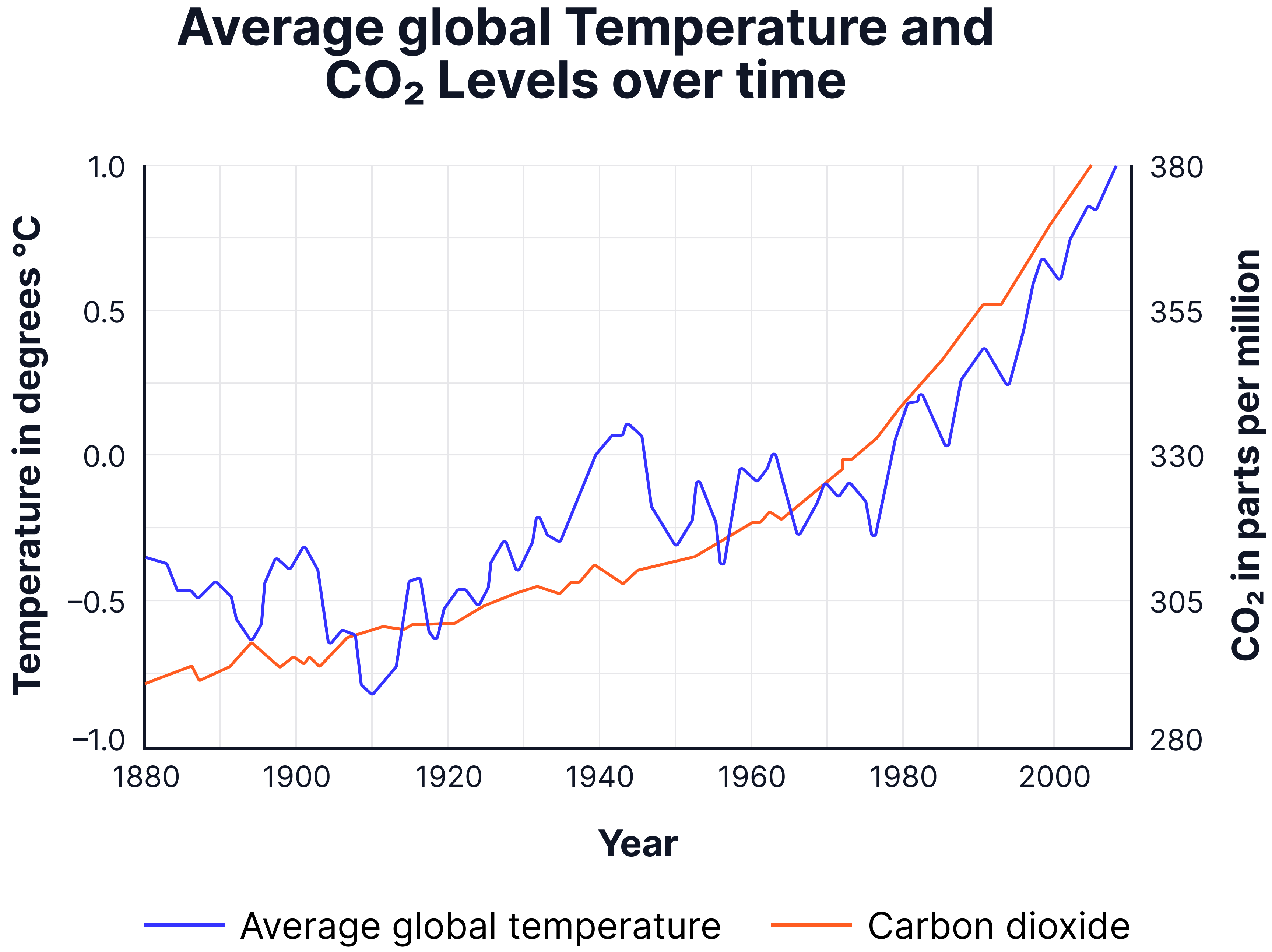
Long-term measurements reveal a steady rise in atmospheric carbon dioxide accompanied by an increase in global average temperature.
Why Climate Predictions Are Difficult
Earth’s climate system includes oceans, ice sheets, atmosphere, organisms and land surfaces - all interacting.
This complexity makes modelling challenging.
Reasons predictions contain uncertainty
- Too many variables (temperature, clouds, ocean currents, volcanic activity, etc.).
- Some processes (e.g., cloud formation) are still not fully understood.
- Models must simplify reality slightly to run on computers.
- Small errors can multiply over long time periods.
Consequences of Climate Change
Even though predicting exact changes is difficult, scientists can confidently describe major trends likely to happen as the world warms:
1. Rising sea levels
Why it happens:
- Melting glaciers and polar ice sheets add extra water to oceans.
- Warmer water expands (thermal expansion).
Possible effects:
- Increased flooding of low-lying areas
- Coastal erosion
- Loss of habitats
- Damage to homes and infrastructure
2. Changes in weather patterns
Climate change can alter:
- Rainfall (where, when, and how much falls)
- Storm frequency and intensity
- Heatwaves
This can lead to:
- Water shortages
- More intense tropical storms
- Crop failures in affected regions
3. Impacts on ecosystems
As temperatures change:
- Animals and plants may need to migrate.
- Some species may struggle to survive or reproduce.
- Coral reefs, mountain species and Arctic wildlife are particularly vulnerable.
- Extreme weather events-such as storms and heatwaves-may become more frequent.
- Wildlife distributions can change as species move to find suitable conditions; some may not be able to move quickly enough.
4. Importance of Communicating Climate Science
Climate change can affect everyone on Earth.
Therefore, scientists need to:
- Share reliable information with the public
- Advise governments and world leaders
- Attend climate conferences
- Explain uncertainties clearly
This helps countries plan how to reduce emissions and adapt to changes.
Assessing the Risks of Climate Change
When deciding which climate-related risks to prioritise, governments look at:
How many people could be affected?
Some impacts, like coastal flooding, mainly affect people who live near the sea.
Others, like crop failure, might influence millions, especially in major food-producing regions.
The severity and reversibility of the impact
- Some changes cause temporary disruption (e.g., unusually severe snowstorms).
- Others could be permanent-such as communities that must relocate because of rising sea levels.
What Is A Carbon Footprint?
A carbon footprint is the total amount of carbon dioxide (CO₂) and other greenhouse gases released into the atmosphere because of an activity, product, service, person or country.
It includes emissions from:
- Production (e.g., making the materials)
- Transport (moving materials and goods)
- Use (energy used while the item is working)
- Disposal (waste breakdown, recycling, landfill)
Examples of things that have carbon footprints:
- A bus journey
- Producing a loaf of bread
- Heating a building
- Manufacturing a laptop
Some are easier to calculate than others. Anything with many parts (e.g., a phone) or long transport routes can be very difficult to measure accurately.
Even rough estimates are useful because they help identify the largest sources of emissions, allowing people to reduce them.
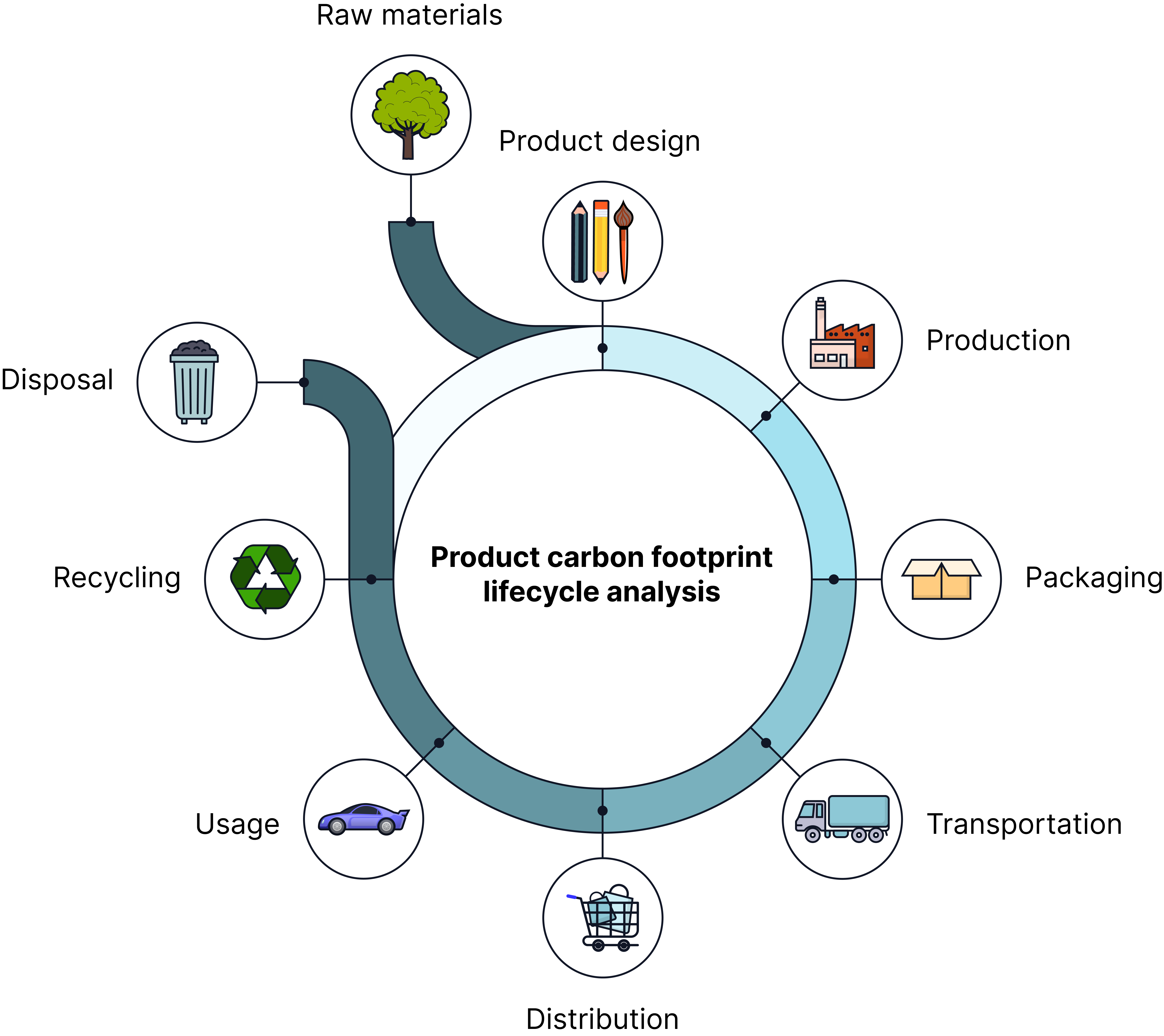
A carbon footprint accounts for every stage of a product's life, from obtaining raw materials to waste disposal.
How To Reduce Carbon Footprints
Many strategies aim to lower CO₂ and methane emissions from human activities.
Switching to cleaner energy
Using renewable energy sources such as wind, solar or hydroelectric power reduces the amount of fossil fuel burned.
Nuclear power also produces very little CO₂ during operation.
Improving efficiency
Processes and appliances that use less energy require fewer fossil fuels overall.
Examples:
- Energy-efficient appliances
- LED lighting
- Better-insulated buildings
- Improved industrial machinery
Changing farming practices
- Reducing the number of methane-producing livestock
- Improving rice farming to reduce methane production
- Better management of manure and fertilisers
Reducing waste
- Recycling materials like metal, plastic and paper
- Composting organic waste
- Reducing food waste
Less material in landfill → less methane released during decomposition.
Government policies
Governments can encourage lower emissions by:
- Taxes on greenhouse gas emissions (carbon tax)
- Limits (caps) on emissions and selling permits to companies
- Laws that promote renewable energy
- Grants for low-carbon technologies
These policies make it more financially worthwhile for individuals and companies to cut emissions.
Carbon capture and storage (CCS)
CCS involves removing CO₂ from power-station waste gases, compressing it, and pumping it deep underground into rock layers where it can be safely stored.
CCS reduces CO₂ entering the atmosphere but is expensive and still developing.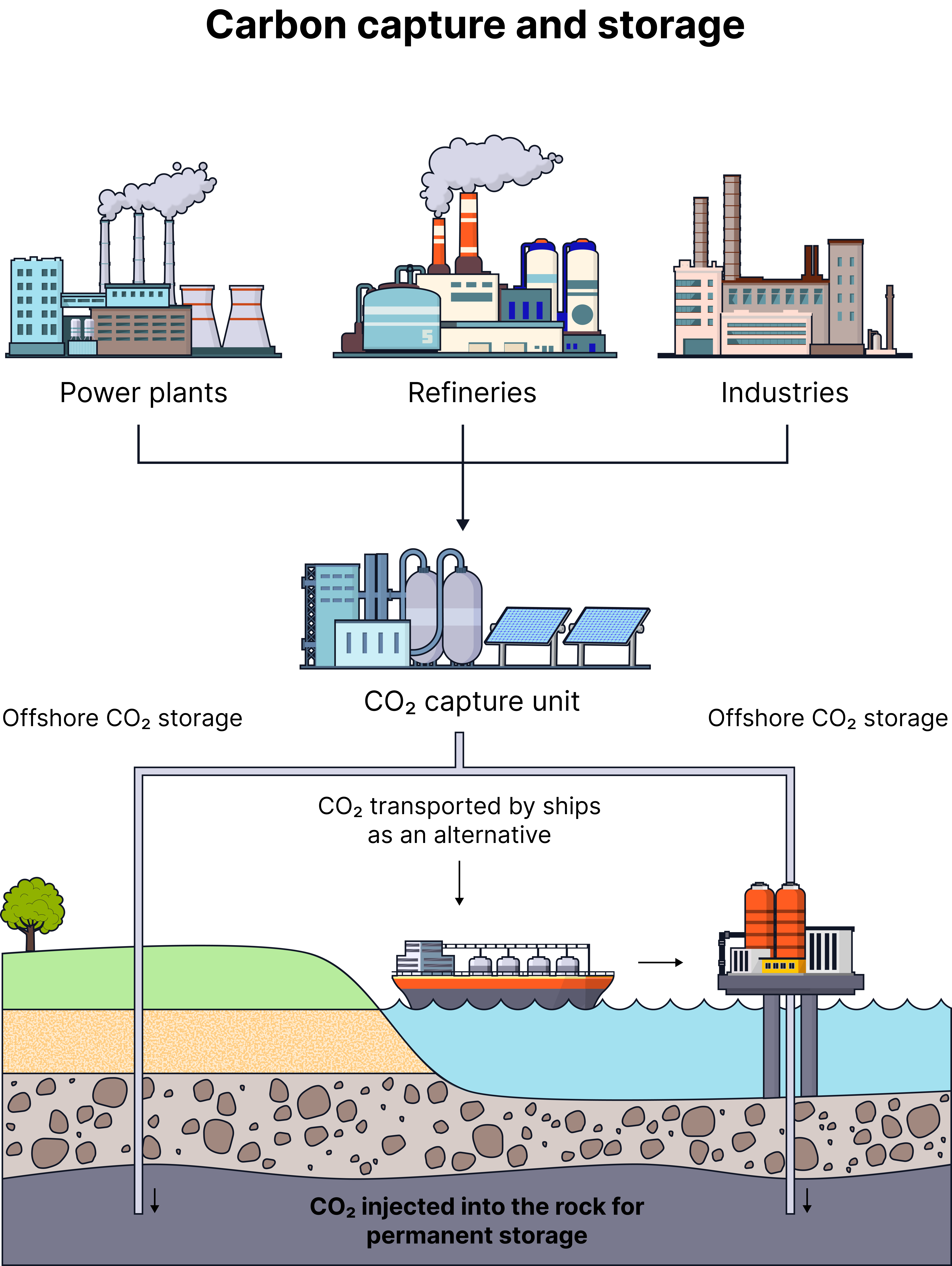
Carbon capture systems collect carbon dioxide from power-station emissions and store it deep underground to prevent it entering the atmosphere.
Problems With Reducing Carbon Footprints
Reducing emissions is important but also challenging for several reasons:
Economic impact
Many countries rely on manufacturing or fossil fuels for jobs and economic growth.
Policies that limit emissions can:
- Increase costs for companies
- Reduce profits
- Affect employment
Developing countries may feel these changes slow down their progress.
Cost of new technology
Cleaner technology (renewables, CCS, efficient systems) can be expensive to install.
Poorer countries or smaller businesses may struggle to afford these changes.
International disagreements
Some nations may reduce emissions, but others may not.
This creates issues such as:
- Unfair economic competition
- Difficulty setting global agreements
- Lack of shared responsibility
Public attitude and lifestyle
Individuals can lower their footprint by taking actions such as:
- Walking or cycling
- Using less heating
- Choosing energy-efficient appliances
However:
- Many people are unwilling to change habits.
- Convenience, cost, and lack of awareness are common barriers.
- There may be limited alternatives available (e.g., poor public transport).
More than just science
Decision-making also involves:
- Social considerations (jobs, lifestyles)
- Economic issues (costs and growth)
- Ethical issues (fairness between countries and generations)
Science alone cannot decide policies - governments must balance many factors.
Check Your Understanding
Recall
a) Name three greenhouse gases.
Answer:
Carbon dioxide; methane; water vapour
b) What type of radiation does Earth emit after being heated by the Sun?
Answer:
Long-wavelength infrared radiation
c) What is meant by the enhanced greenhouse effect?
Answer:
The extra warming caused by increased greenhouse gases due to human activity
Application
d) Explain how greenhouse gases warm the lower atmosphere.
Answer:
Sunlight (short-wavelength radiation) passes through atmosphere; Earth absorbs and warms; Earth emits infrared radiation; greenhouse gases absorb infrared; re-emit in all directions; some returned to surface; atmosphere warms
e) Explain why increasing carbon dioxide levels lead to an increase in water vapour in the atmosphere.
Answer:
Higher CO₂ increases temperature; warmer temperatures increase evaporation; more water vapour enters atmosphere; water vapour is a greenhouse gas; positive feedback
f) Describe two human activities that increase methane levels and explain how they do so.
Answer:
Agriculture (cattle/sheep digestion produces methane; rice paddies produce methane from bacteria in waterlogged conditions); landfill (decomposition of waste produces methane)
Challenge (HT Only)
g) Explain why climate models contain uncertainty but scientists are still confident that human carbon dioxide emissions are causing global warming.
Answer:
Climate system is complex; many interacting variables; some processes not fully understood; models simplify reality; small uncertainties grow over time; however CO₂ directly measured increasing; matches industrialisation; laboratory evidence shows CO₂ absorbs infrared; models only match observed warming when human emissions included
More Practice
Try to answer these practice questions from the TikTok videos on your own, then watch the videos to see how well you did!