BIDMAS and Algebra
Neil Trivedi
Teacher

Contents
BIDMAS and Algebra
BIDMAS tells us the correct order in which we carry out calculations. Here’s what this acronym stands for.
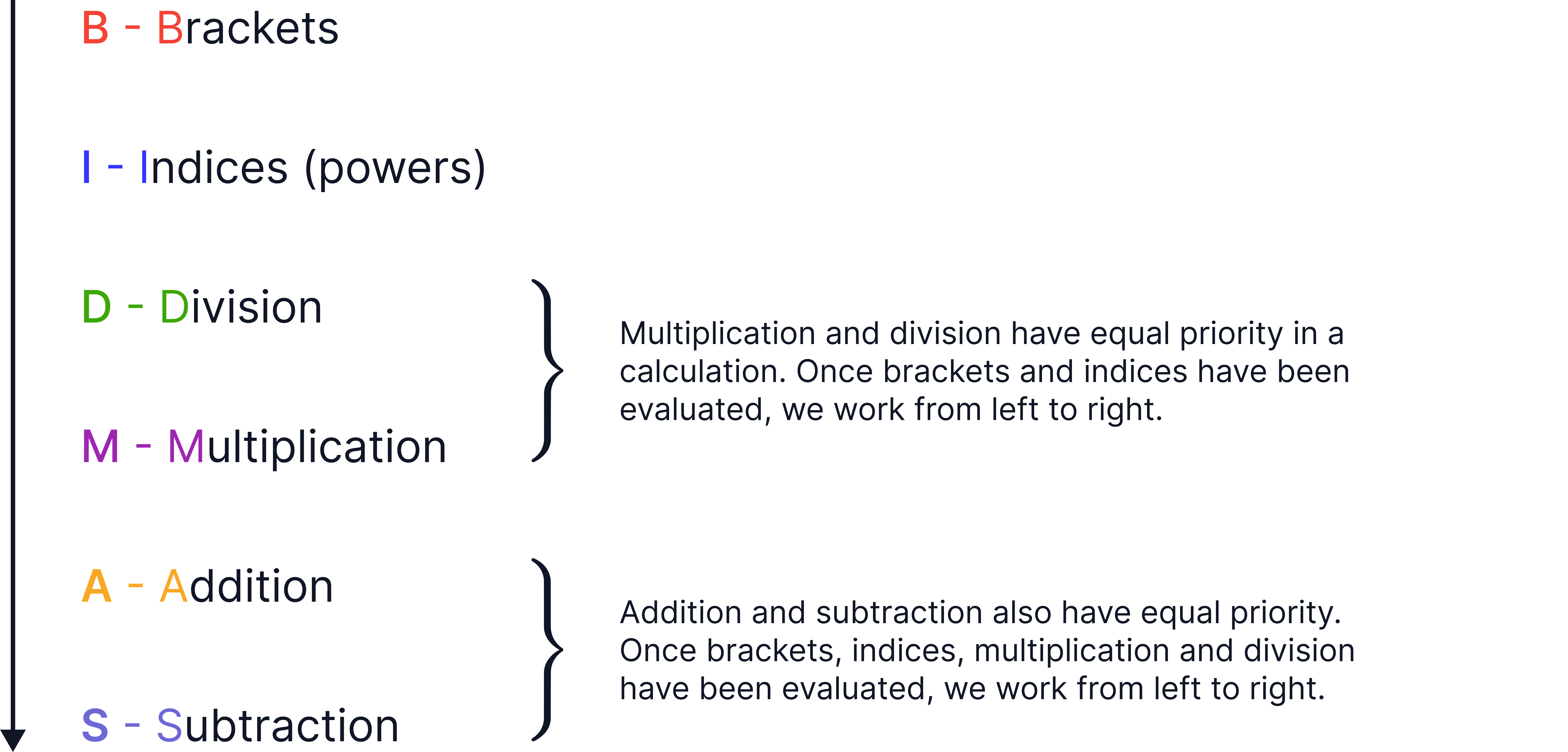
Overall, if two operations have equal priority, always work from left to right.
We have previously used BIDMAS to perform numerical calculations. For instance, suppose we are asked to calculate.
A common mistake students make is when they work from left to right by default. If we did this, we would add first and then multiply.
However, this is not correct because BIDMAS tells us that multiplication comes before addition. So, we must complete the multiplication first.
Therefore, the correct answer is
BIDMAS does not only apply to numerical calculations. It also applies when simplifying algebraic expressions.
General Steps for Using BIDMAS to Simplify Algebraic Expressions
1) Evaluate anything inside brackets first.
2) Evaluate any indices.
3) Work through any multiplication and division from left to right.
4) Finally, work through any addition and subtraction from left to right.
Simple Examples
Example 1:
Simplify the following expressions:
a)
Single Step: Use BIDMAS to simplify the expression.
Here, we have addition and multiplication. According to BIDMAS, multiplication is performed before addition. So, we first evaluate
Then, we perform the addition.
b)
Single Step: Use BIDMAS to simplify the expression.
We begin with the brackets. In algebra, this means expanding by multiplying through.
Now, we have addition and subtraction. These have equal priority, so we work from left to right and collect the like terms.
c)
Single Step: Use BIDMAS to simplify the expression.
We begin with the expression inside the brackets. We use the index rules for multiplication, which states that
Then, we evaluate the power (indices). We use the index rule which states that
Finally, we use the index rules for division, which states that
d)
Single Step: Use BIDMAS to simplify the expression.
We begin with the two brackets and evaluate the powers by expanding both expressions.
Expanding each bracket and simplifying,
Now, we have addition and subtraction. Once again, these have equal priority, so we work from left to right and collect the like terms to simplify.
The four operations (addition, subtraction, multiplication and division) and BIDMAS can be extended to algebraic fractions.
The order of operations remains the same, but we must also follow the rules for working with fractions.
Operations with algebraic fractions work the same way as numerical fractions but we have to be more careful because we would be working with algebraic expressions rather than numbers.
Multiplying and Dividing Algebraic Fractions
Example 2:
Simplify fully:
a)
Single Step: Multiply the fractions.
When multiplying fractions, we multiply the numerators together and multiply the denominators together. We also simplify by cancelling common factors using cross-cancelling. Here, the common factor is so that will cancel.
b)
Single Step: Divide the fractions.
When dividing fractions, we keep the first fraction the same, flip the second fraction and then change the sign from division to multiplication (also known as Keep, Flip, Change, or KFC).
Now, we multiply the fractions and cancel any common factors using cross-cancelling. Here, the common factor is so that will cancel.
c)
Step 1: Factorise the numerator of the first fraction.
We factorise the numerator using the difference of two squares principle.
So,
Step 2: Multiply the fractions.
Now, we multiply the fractions and cancel any common factors using cross-cancelling. Here, the common factor is so that will cancel.
We could expand the brackets in the numerator, but this is not necessary unless the question specifically asks for expansion.
Adding and Subtracting Algebraic Fractions
Example 3:
Express the following as a single fraction in its simplest form:
a)
Step 1: Rewrite both fractions so that they have a common denominator.
The common denominator will be the lowest common multiple of the denominators. The lowest common multiple of and is
To get a denominator of we multiply the numerator and denominator of by and multiply the numerator and denominator of by
Step 2: Combine the fractions by adding the numerators.
Note: The order of the terms in the numerator does not matter. So, we could have written it as
b)
Step 1: Rewrite both fractions so that they have a common denominator.
The lowest common multiple of and is To get a denominator of we keep unchanged and multiply the numerator and denominator of by
Step 2: Combine the fractions by subtracting the numerators.
Mixed Questions
Example 4:
Simplify fully:
Here, we follow BIDMAS. We first evaluate the expression inside the brackets and then perform the multiplication.
Step 1: Simplify the expression inside the brackets.
Inside the brackets, we have
We are performing a subtraction, so we rewrite the fractions so that they have a common denominator, which will be the lowest common multiple of both denominators.
The lowest common multiple of and is
So, we multiply the numerator and denominator of by and multiply the numerator and denominator of by
Combining the fractions, we subtract the numerators.
Then, we simplify the numerator by expanding the brackets.
We have simplified the expression inside the brackets, so therefore,
Step 2: Multiply the fractions.
We now move on to the multiplication. We multiply the numerators and multiply the denominators. We also simplify by cancelling common factors using cross-cancelling. Here, the common factor is so that will cancel.
Example 5:
Show that:
where and are integers.
We simplify this expression using BIDMAS. First, we simplify the expression inside the brackets and then perform the addition.
Step 1: Simplify the expression inside the square brackets.
Inside the brackets, we have
Since we are dividing by a fraction, we keep the first expression the same, flip the second fraction and then change the sign from division to multiplication. To note, can be written as So,
Before multiplying the two fractions together, we factorise the quadratic expression in the denominator of the second fraction.
For more on factorising quadratics, please read our “Factorising Quadratics” note.
So, we have
Now, we multiply the fractions by multiplying the numerators and multiplying the denominators. We also simplify by cancelling common factors using cross-cancelling. Here, the common factor is so that will cancel.
Therefore, the expression inside the brackets simplifies to
So,
Step 2: Perform the addition.
Firstly, for clarity, we can write as
We are performing an addition, so we rewrite the fractions so that they have a common denominator, which will be the lowest common multiple of both denominators. The lowest common multiple of and is
So, we multiply the numerator and denominator of by and keep unchanged.
Combining the fractions, we add the numerators.
Simplifying the numerator by expanding the brackets,
Now, we have addition and subtraction in the numerator, and since they have equal priority according to BIDMAS, we work from left to right and collect the like terms.
So, and
Practice Question