Solving Quadratics by Factorising
Neil Trivedi
Teacher

Solving Quadratics by Factorising
A quadratic equation is an equation that can be written in the form
where is not equal to
One method that can be used when solving quadratic equations is by factorising first. To factorise a quadratic is to rewrite it as a product of two linear factors which, when equated to means at least one of the factors equals So, we set each factor equal to and solve each one for
General Steps for Solving Quadratics by Factorising
1) If needed, rearrange the equation so that it is in the form
2) Factorise the quadratic expression (for more information on this, see our Factorising Quadratics note).
3) Set each factor equal to and solve for The solutions obtained are called the roots of the equation.
Example 1:
Solve the following quadratics by factorising:
a)
Step 1: Factorise the quadratic expression on the left side of the equation.
First, we look at what multiplies to give Since we write in both brackets.
Next, we look for two numbers that multiply to give and add to give We list the factor pairs of
The pairs are:
and
and
and
and
and
Out of these pairs, only and can make To get we do Therefore, the quadratic factorises to
Now, we have a product of two factors that equal so one or both factors must be We have:
or
Step 2: Solve each linear equation for to find the roots.
For the first equation:
Subtracting from both sides to isolate
For the second equation:
Adding to both sides to isolate
Therefore, the roots of the quadratic equation are or
b)
Step 1: Factorise the quadratic expression on the left side of the equation.
The quadratic expression is an example of the difference of two squares principle. Recall that
Using this principle, we factorise the quadratic.
So, setting each factor equal to we have
or
Step 2: Solve each linear equation for to find the roots.
For the first equation:
Subtracting from both sides,
Dividing both sides by
For the second equation:
Adding to both sides,
Dividing both sides by
Therefore, the roots of the quadratic equation are or
Note: Alternatively, we could solve for here by simply rearranging the equation for
First, we add to both sides.
Then, we divide both sides by
Finally, we square root both sides to isolate Remember that when we square root, it will produce a positive and a negative solution.
Therefore, the solutions are or
c)
Step 1: Factorise the quadratic expression on the left side of the equation.
First, we look at what multiplies to give The only option is and so we write these in the brackets.
We now look for two numbers that multiply to give We list the factor pairs of
The pairs are:
and
and
Usually, we should first choose the pair whose values are closest together, which will be and We write in both brackets.
We now apply the OI-OI method to check whether we can obtain the correct middle term, which is using this arrangement.

Here, the outer product is and the inner product is We can make by doing Therefore, the quadratic factorises to
So, setting each factor equal to we have,
or
Step 2: Solve each linear equation for to find the roots.
For the first equation:
Adding to both sides,
Dividing both sides by
For the second equation:
Subtracting from both sides,
Therefore, the roots of the quadratic equation are and
Example 2:
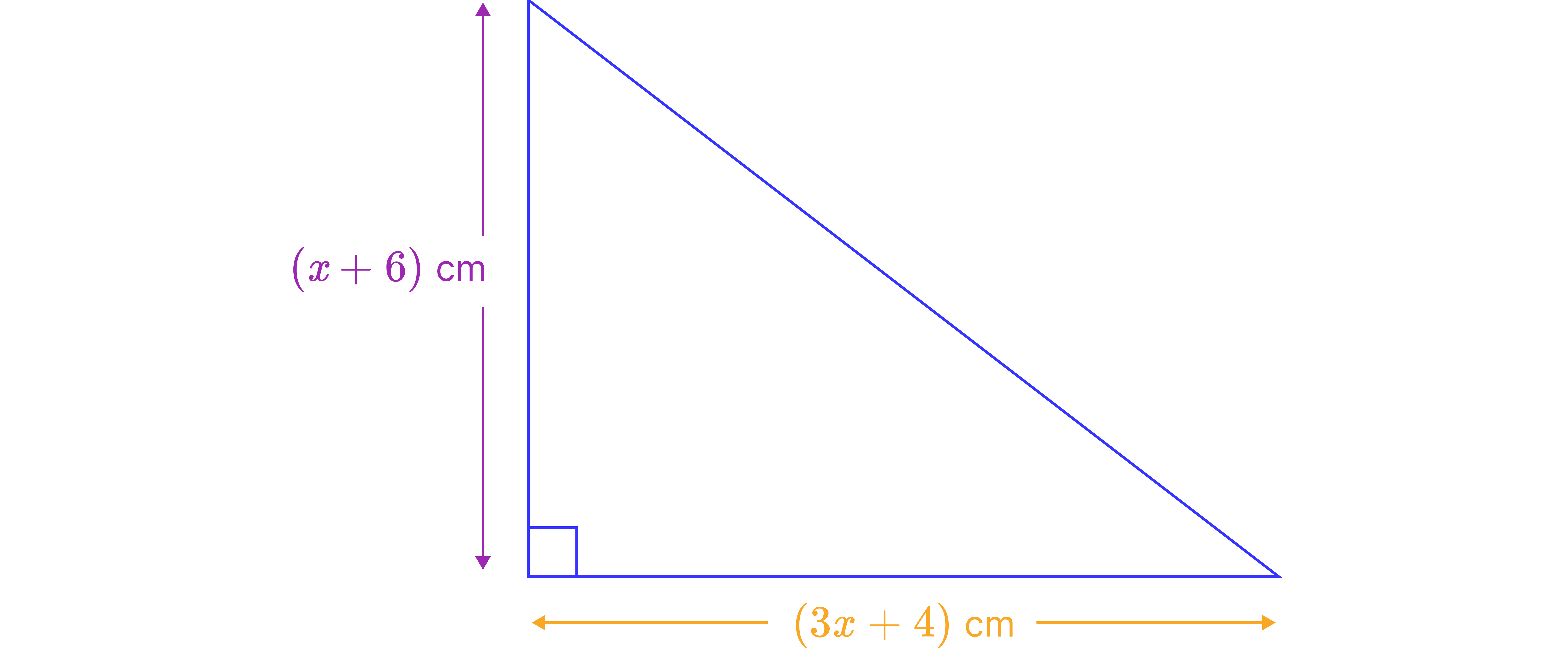
The area of this triangle is
a) Show that
Step 1: Use the formula for the area of a triangle and our lengths to form an equation.
Recall that the area of a triangle is given by
Base Height
Here, we have a base of cm and a height of cm. So,
We can multiply both sides by to cancel out the on the left side.
Step 2: Expand the brackets using FOIL and rearrange the equation to get it in the form required by the question.

Subtracting from both sides so that one equals
b) Work out the value of
We need to solve the following quadratic equation found in part (a).
Step 1: Factorise the quadratic expression on the left side of the equation.
First, we look at what multiplies to give The only option is and so we write these in the brackets.
We now look for two numbers that multiply to give We list the factor pairs of
The pairs are:
and
and
and
First, we should choose the pair whose values are closest together, which will be and We write in both brackets.
We now apply the OI-OI method to check whether this arrangement gives the middle term, which is

Here, the outer product is and the inner product is However, we cannot make using these products, so and are not a suitable pair.
We therefore try the next closest factor pair, which is and We now decide which bracket the and should go in. The options are
or
Once again, we apply the OI-OI method to check whether any of these arrangements give the middle term, which is

Here, the outer product is and the inner product is We can make by doing Therefore, the quadratic factorises to
So, setting each factor equal to we have,
or
Step 2: Solve each linear equation for to find the roots.
For the first equation:
Adding to both sides,
Dividing both sides by
For the second equation:
Subtracting from both sides,
Therefore, the roots of the quadratic equation are and .
However, since this question involves lengths, we must ensure that the value of gives a positive base and height. The solution is not valid. For example, let’s substitute into the expression for the height
Height cm
We get
Height cm
Since a length cannot be negative, we discard Hence, the only solution is
It can be easily verified that this value of is correct as both the base and height of the triangle will be positive.
Practice Question