Circle Theorems
Neil Trivedi
Teacher

Circle Theorems
A circle theorem is a rule that links the angles or lengths created when points, chords, tangents and radii are drawn on a circle. In this note, we cover the nine circle theorems you need, along with the vocabulary and the basic angle facts used alongside them. Once the theorems are known, most circle problems become a matter of "angle chasing" — finding one unknown angle at a time and giving a reason at every step.
Parts of a Circle
Before stating the theorems, it helps to be confident with the names of the different parts of a circle. The diagram below shows each one.
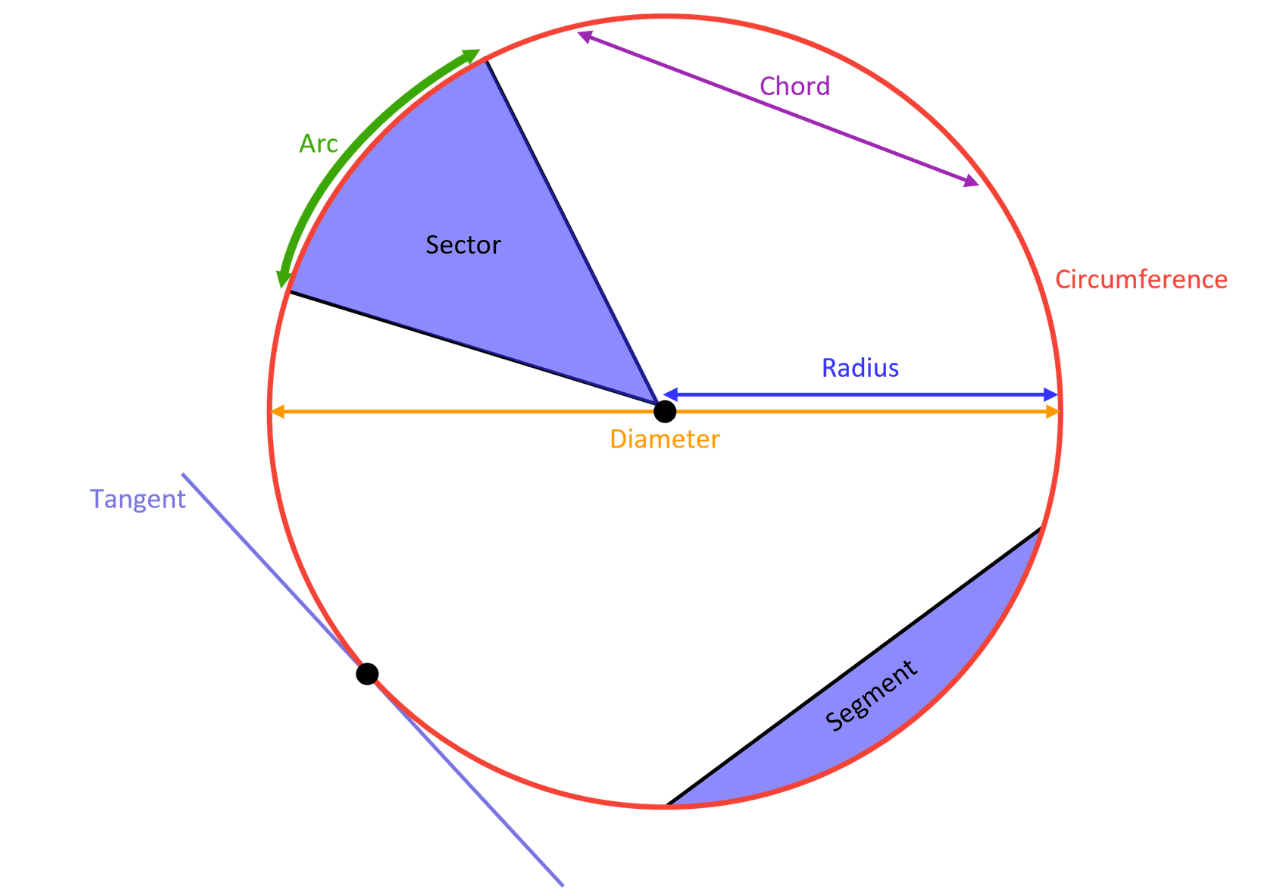
Parts of a Circle
Radius — a straight line from the centre to any point on the circumference.
Diameter — a chord that passes through the centre; it is twice the radius.
Circumference — the perimeter (outer boundary) of the circle.
Chord — a straight line joining two points on the circumference.
Tangent — a straight line that touches the circle at exactly one point.
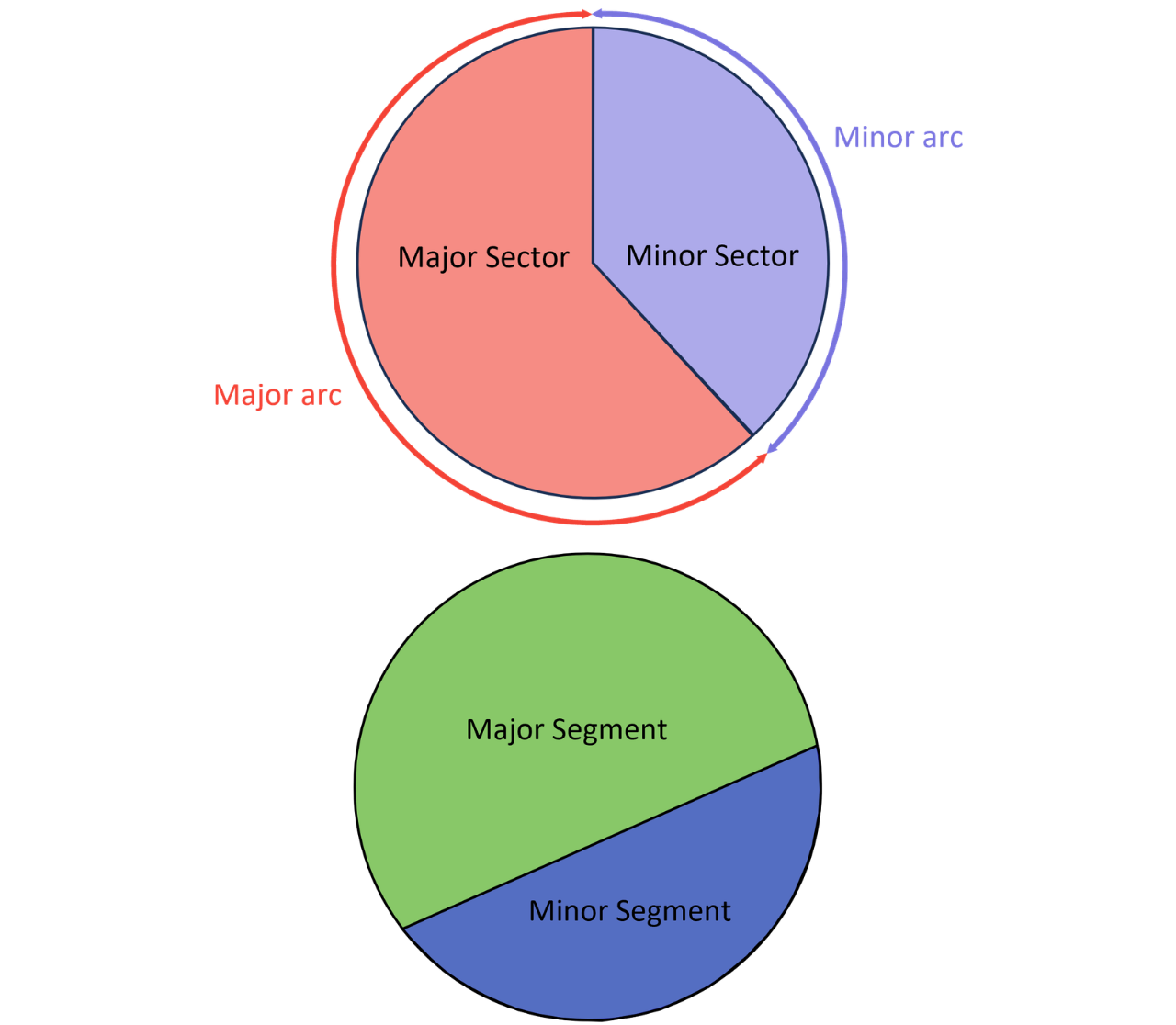
Arc — a part of the circumference. The shorter arc is known as the minor arc; the longer is known as the major arc.
Sector — a region enclosed by two radii and an arc. The smaller sector is known as the minor sector; the larger is known as the major sector.
Segment — a region enclosed by a chord and an arc. The smaller segment is known as the minor segment; the larger is known as the major segment.
The circle theorems are usually combined with a few basic angle facts that we already know. Keep these to hand, because they are often the reason that justifies a step in our working.
Useful Angle Facts
Angles in a triangle add up to
Angles on a straight line add up to
Angles around a point add up to
Angles in a quadrilateral add up to
The base angles of an isosceles triangle are equal.
The Nine Circle Theorems
We group the theorems by the kind of result they give. Each is stated in a yellow box, with a diagram to follow alongside it.
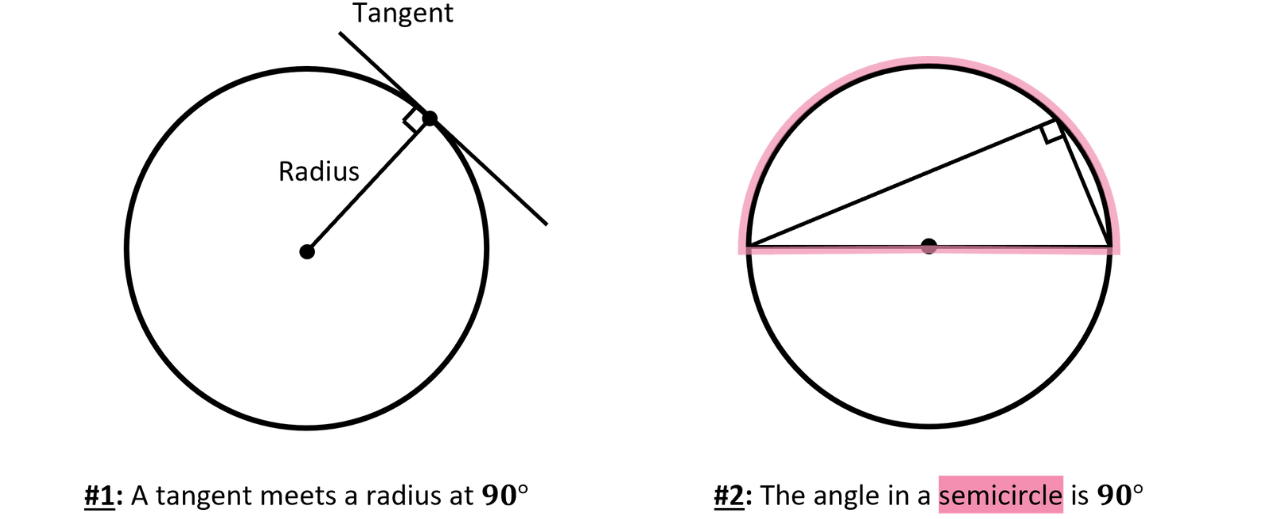
Theorems Involving Right Angles
#A tangent meets a radius at
#The angle in a semicircle is
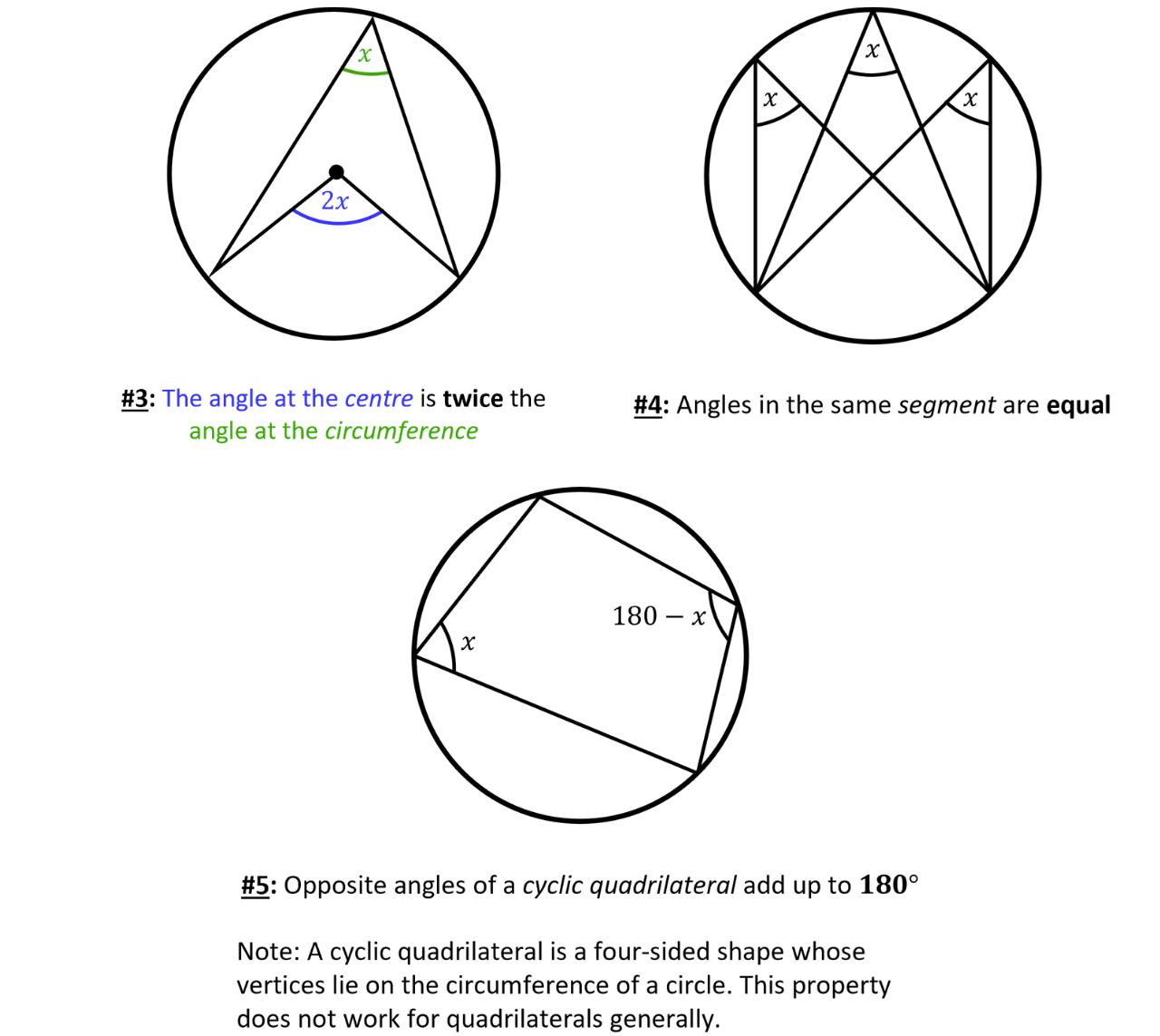
Theorems Involving General Angles
#The angle at the centre is twice the angle at the circumference.
#Angles in the same segment are equal.
#Opposite angles of a cyclic quadrilateral add up to
Note: Theorem #(The angle in a semicircle is is a special case of Theorem #- a diameter makes an angle of at the centre, and half of is
Theorems Involving Lengths and Tangents
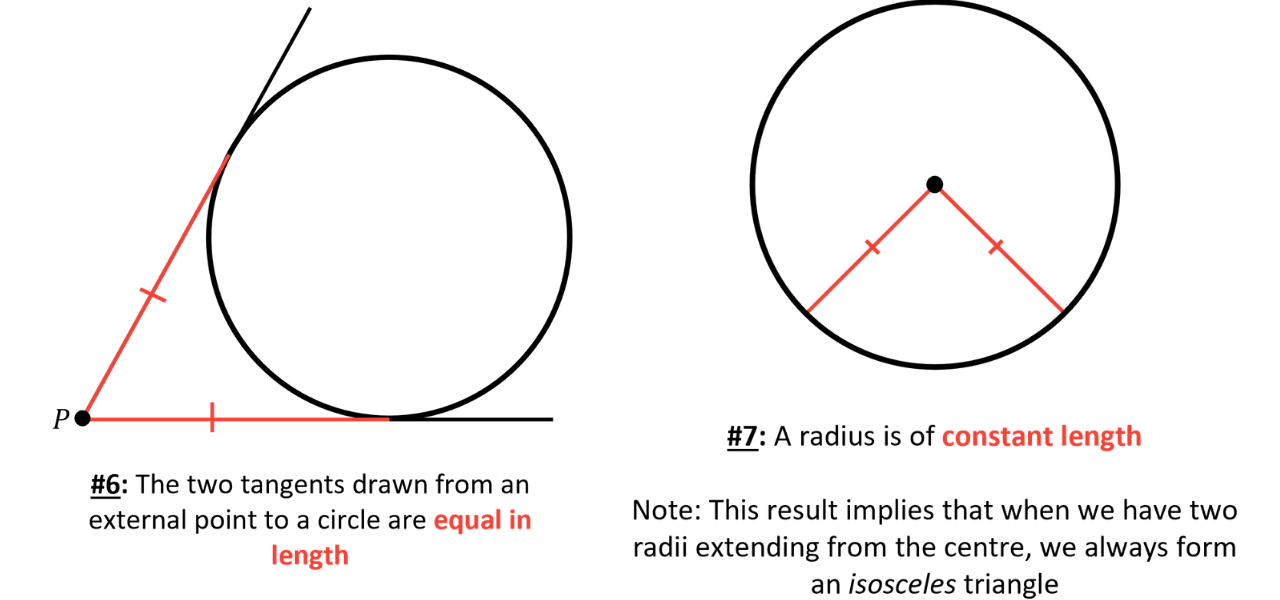
#The two tangents drawn from an external point to a circle are equal in length.
#A radius is of constant length.
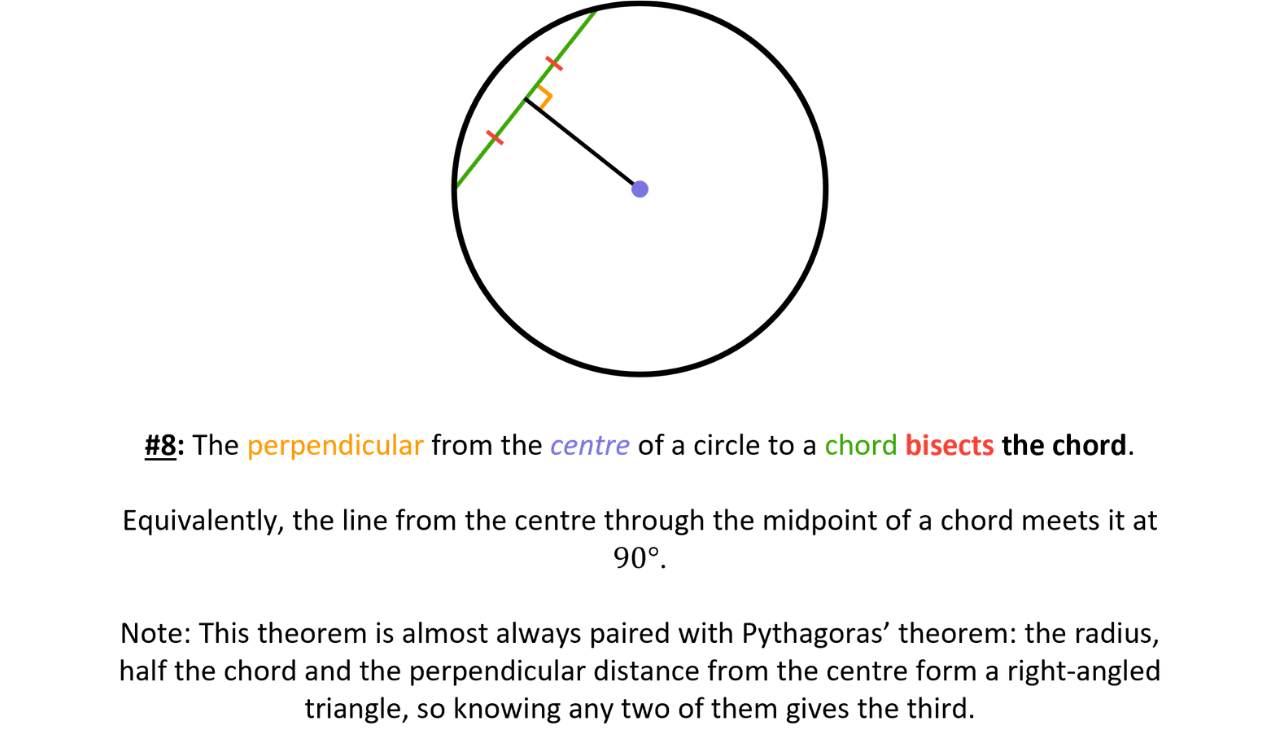
#The perpendicular from the centre of a circle to a chord bisects the chord.
The Alternate Segment Theorem
#The angle between a tangent and a chord is equal to the angle in the alternate segment (the angle subtended by that chord at a point on the circumference in the segment on the other side of the chord).
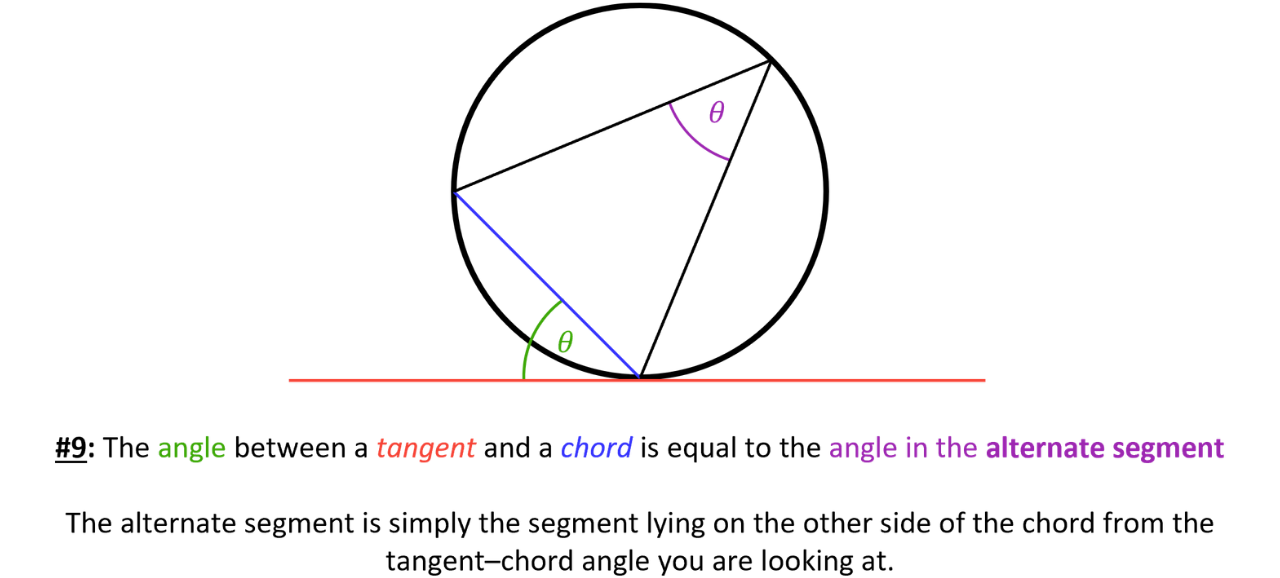
We can combine this with theorem #to produce multiple angles in the alternate segment that are equal.

In the exam you must usually give a reason for each step. The clearest way is to quote the wording of the theorem you used, for example "the angle at the centre is twice the angle at the circumference" or "angles in the same segment are equal". In the following worked examples, the reason is written in brackets after each result.
Example 1:
and lie on a circle with centre and positioned on the circumference such that
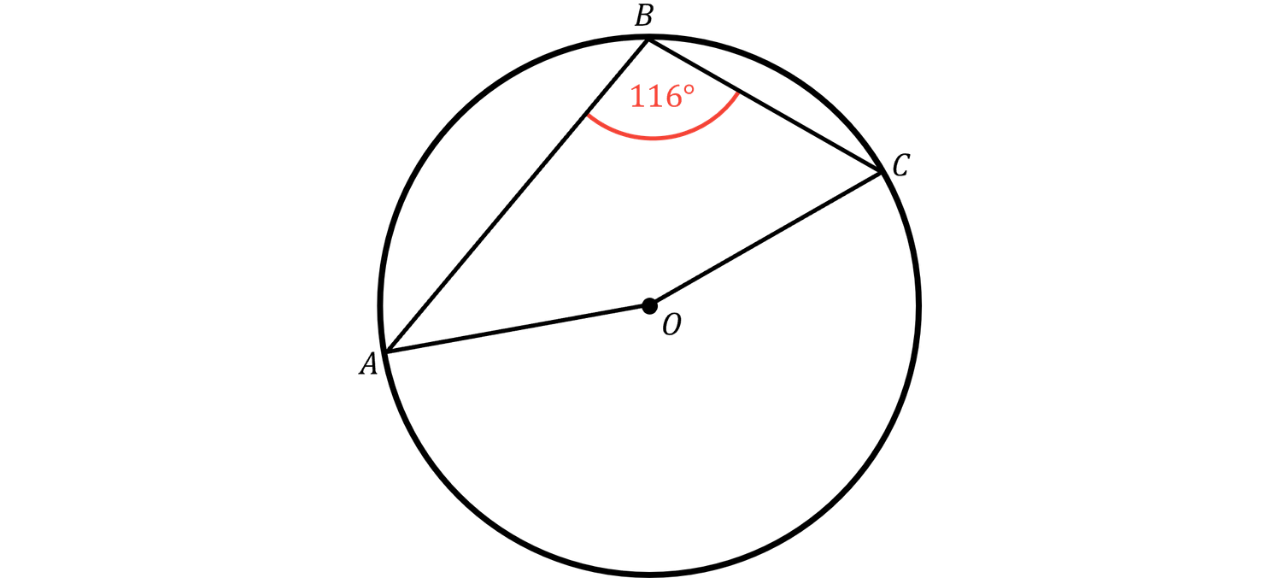
a) Find the reflex angle
Step 1: Identify which angle at the centre to use.
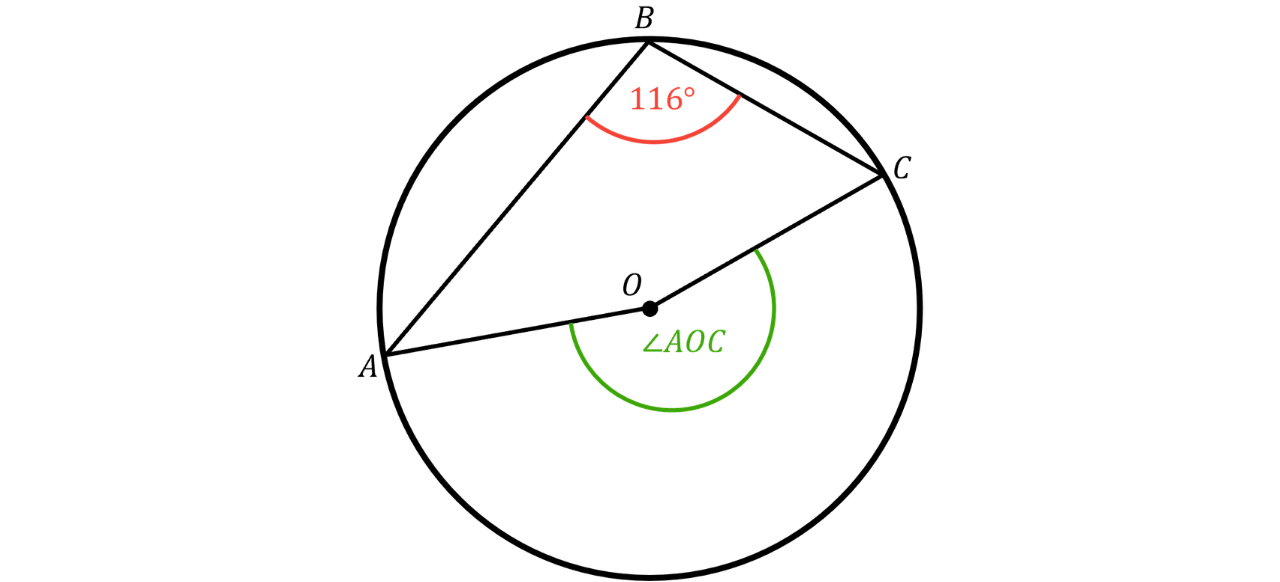
is an angle at the centre of the circle and is an angle at the circumference. So, the theorem we are considering is the angle at the centre is twice the angle at the circumference.
Step 2: Apply the angle at the centre theorem.
Reflex
(the angle at the centre is twice the angle at the circumference)
b) Hence, find the obtuse angle
Single Step: Use the fact that angles around the point add up to
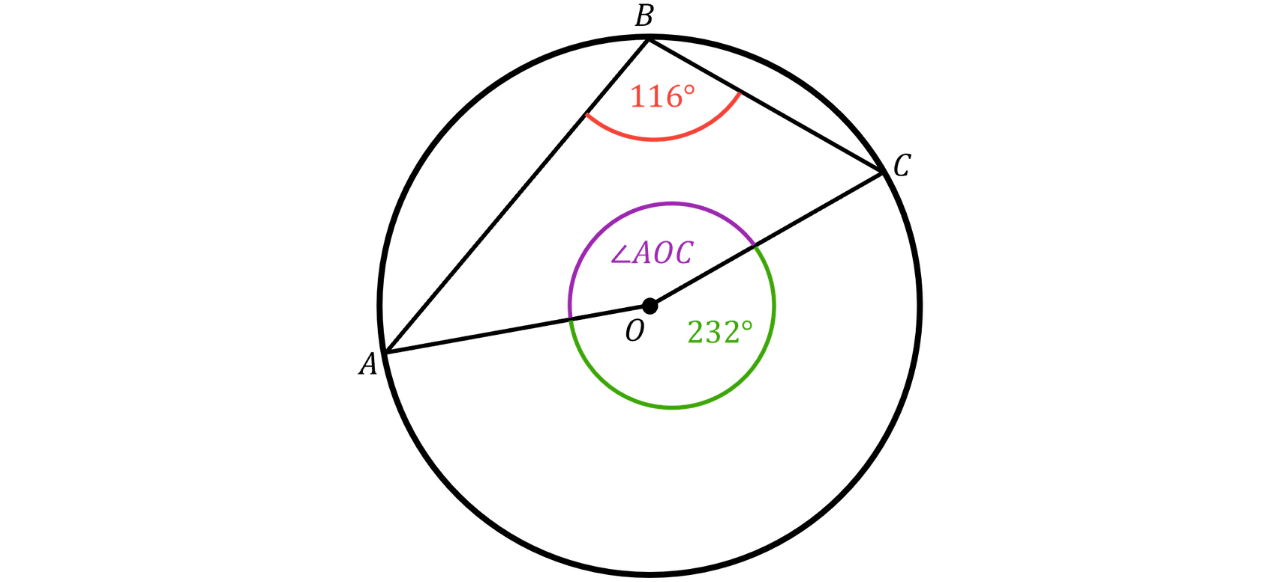
Obtuse Reflex
(angles around a point add up to
Example 2:
is a diameter of a circle and is a point on the circumference. Given that find giving reasons for your answer.
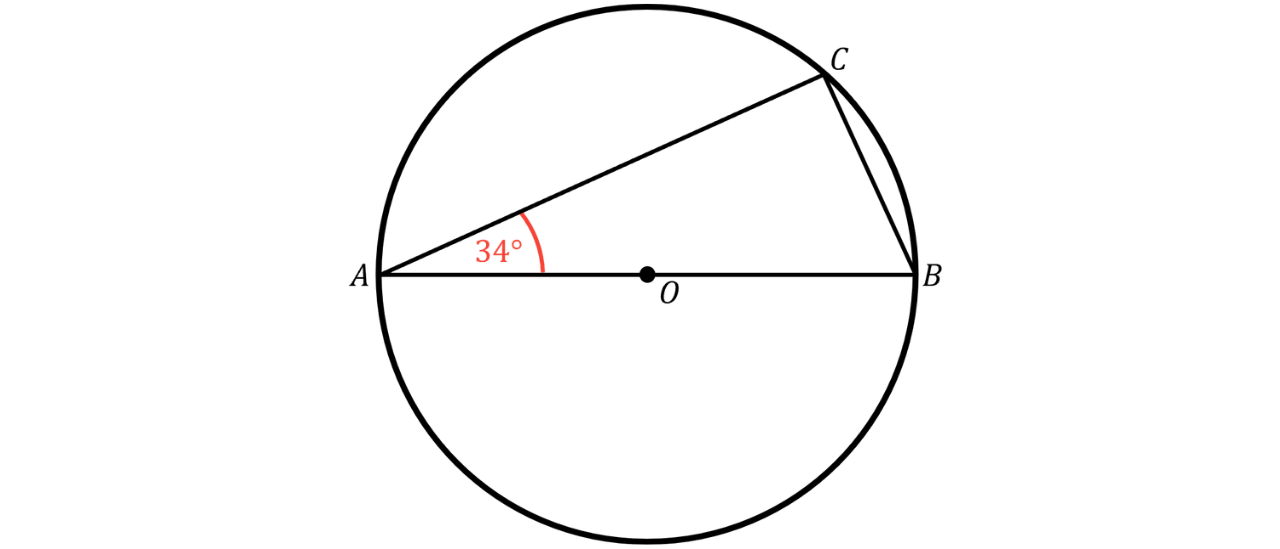
Step 1: Identify the right angle.
Because is a diameter, lies on a semicircle, so the angle at is a right angle.
(the angle in a semicircle is
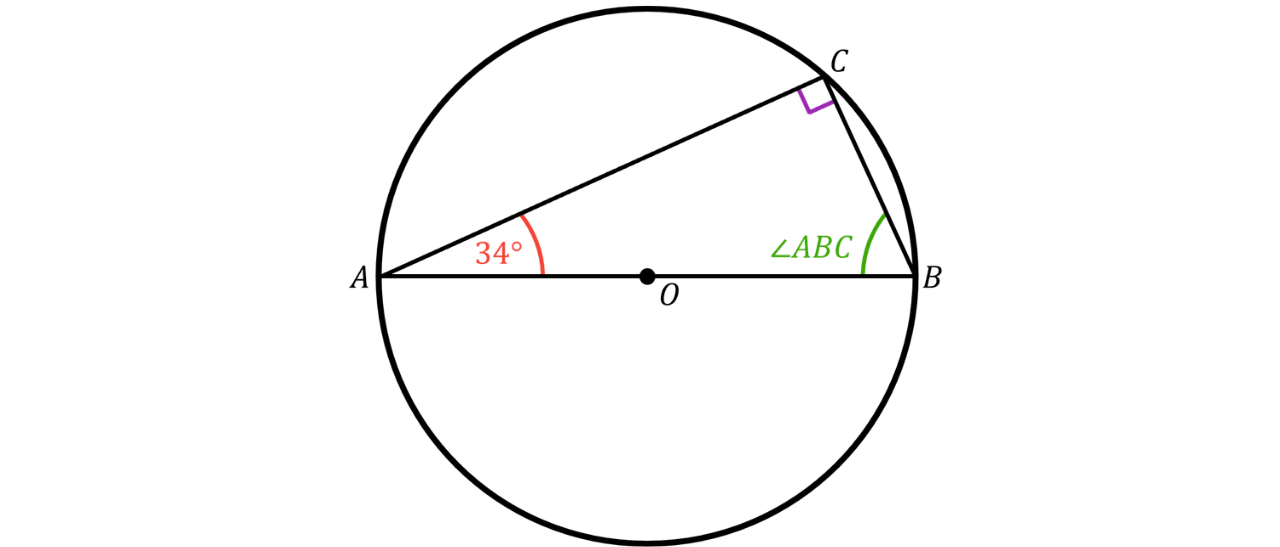
Step 2: Use the fact that angles in a triangle add up to
Therefore,
Example 3:
is the centre of a circle, and and lie on the circumference. The chord subtends at the circumference.
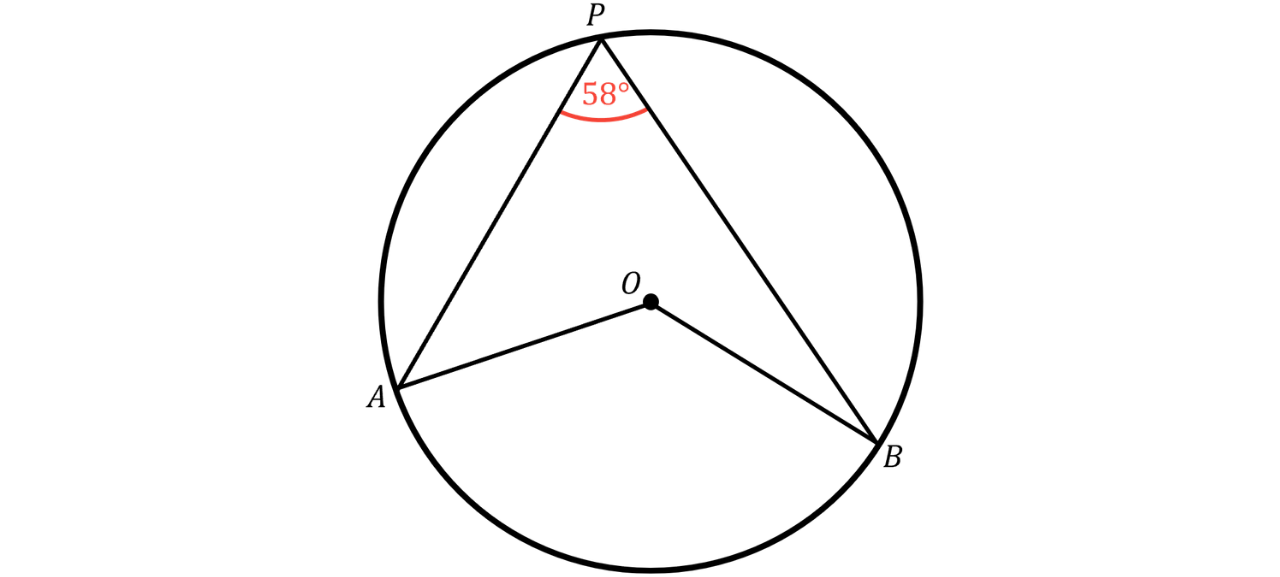
a) Find the obtuse angle
Single Step: Apply the angle at the centre theorem.
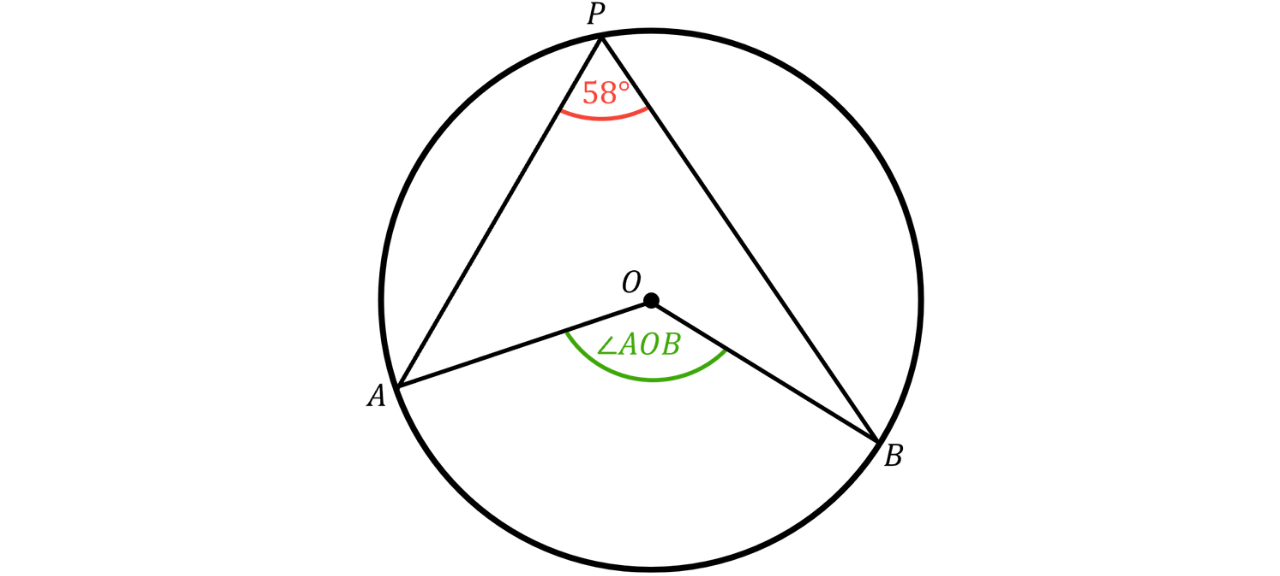
(the angle at the centre is twice the angle at the circumference)
b) Hence find
Step 1: Recognise the isosceles triangle.
(both are radii), so triangle is isosceles and the base angles and are equal.
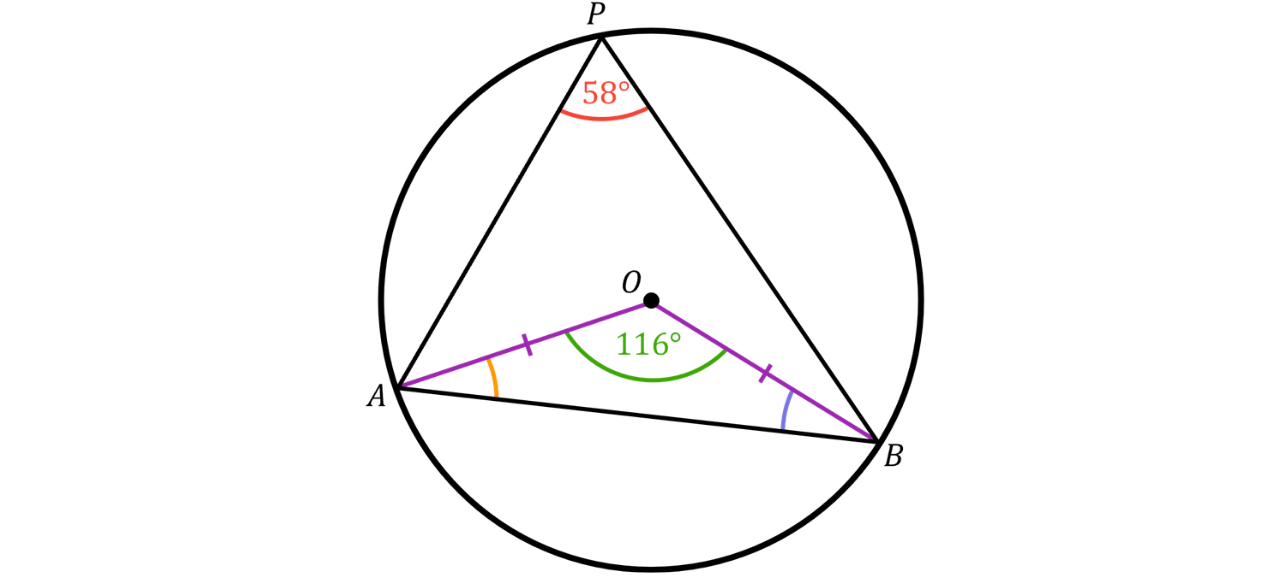
Step 2: Use that angles in a triangle add up to
Therefore,
Note: gave us the sum of the two base angles of the isosceles triangle, then we divided that by because the two base angles are of equal value. This gives us the three angles of the isosceles triangle to be and which all sum to
Example 4:
and lie on a circle.
a) Given find
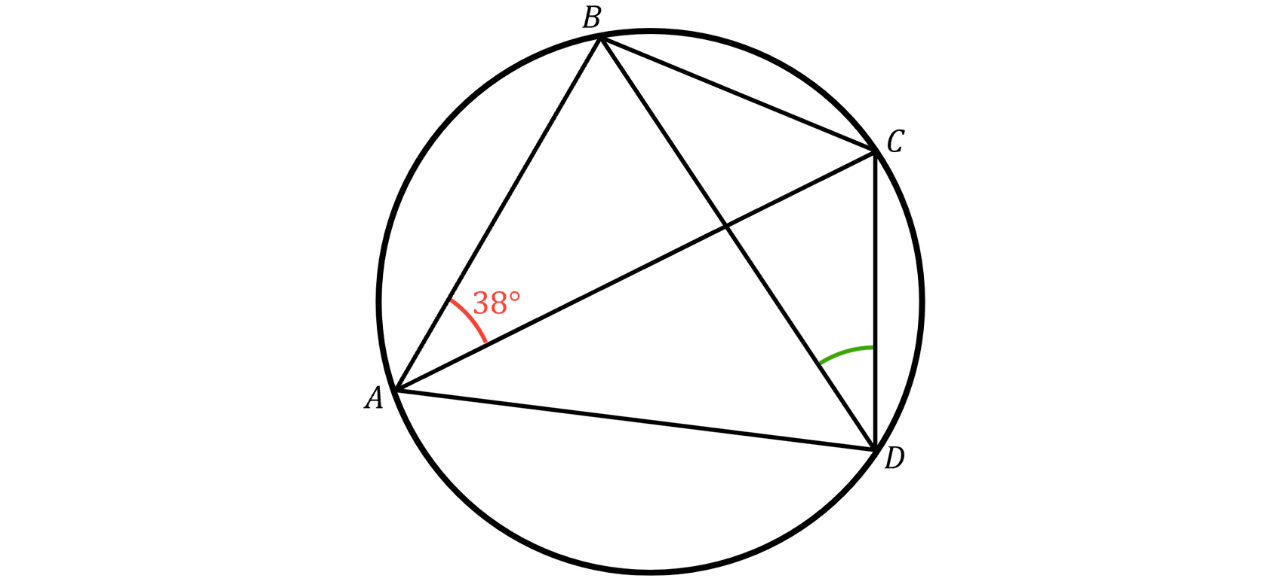
Single Step: Apply the angles in the same segment theorem.
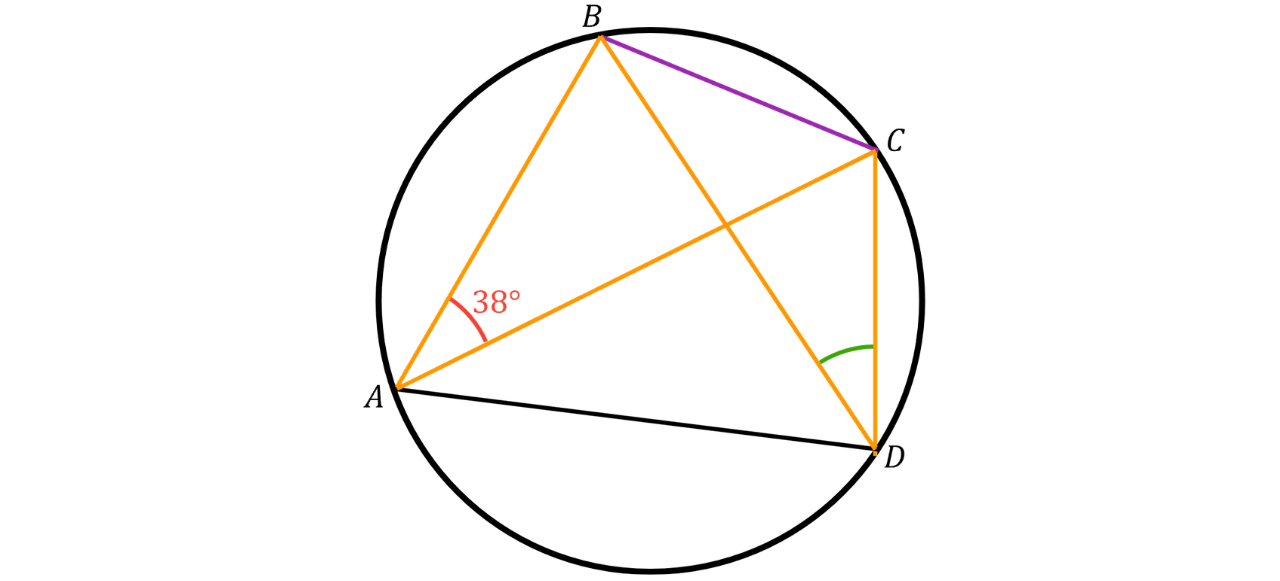
Both angles stand on the same chord so they are in the same segment.
(angles in the same segment are equal)
b) On the same circle, given find
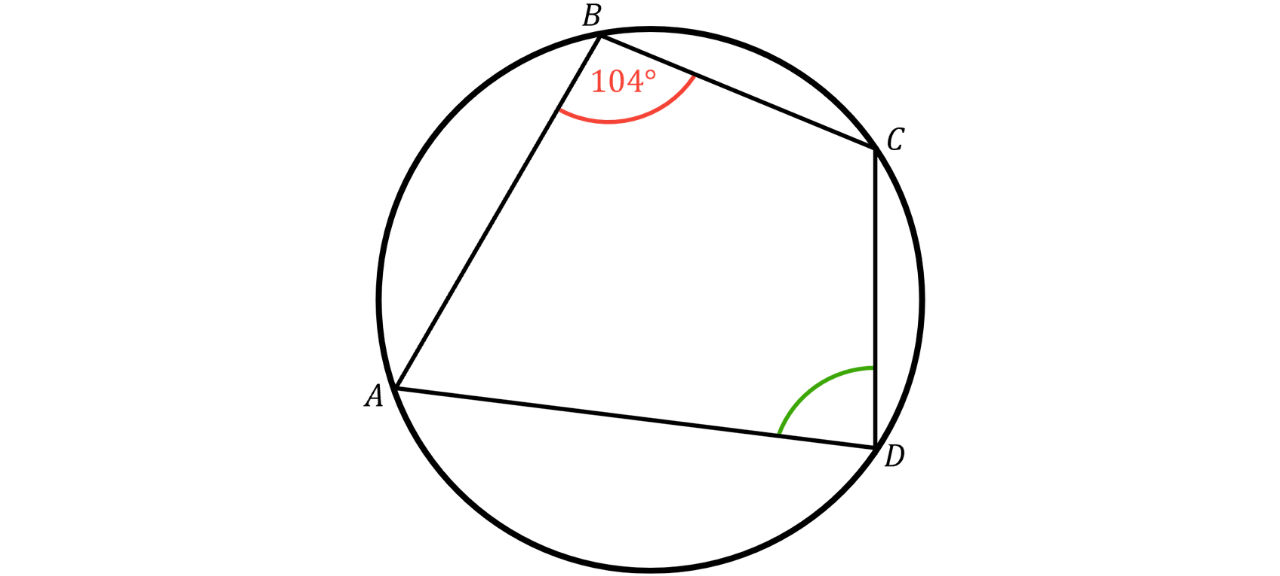
Single Step: Apply the opposite angles in a cyclic quadrilateral theorem.
and are opposite angles of the cyclic quadrilateral.
(opposite angles of a cyclic quadrilateral add up to
Example 5:
and are tangents to a circle with centre touching it at and Given
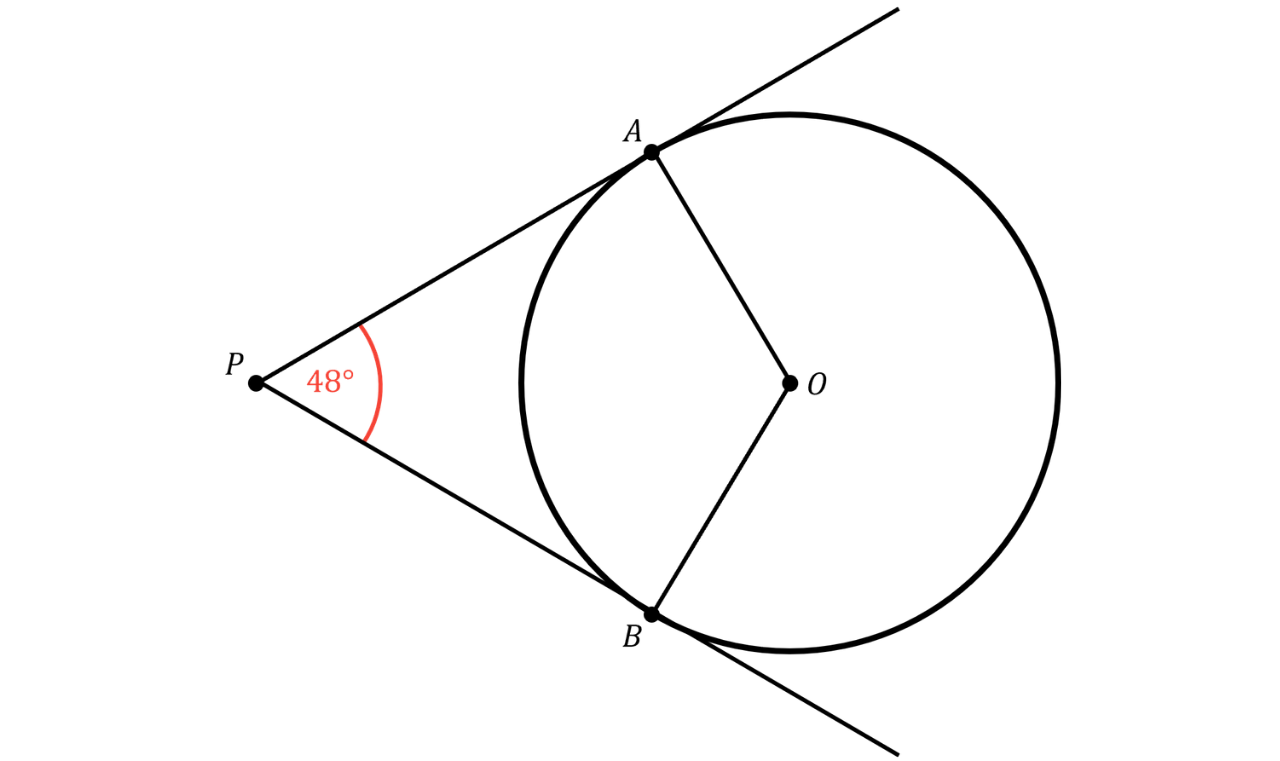
a) Find giving reasons.
Step 1: Mark the right angles.
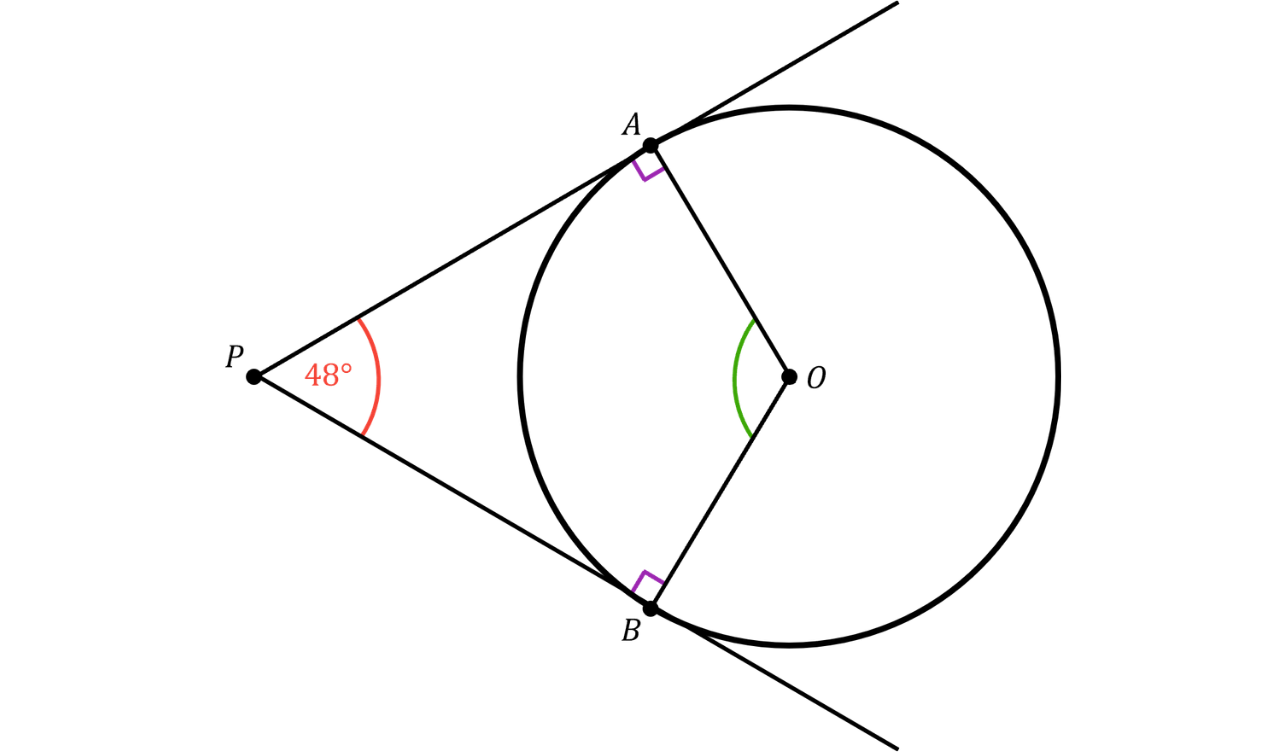
(a tangent meets a radius at
Step 2: Use the fact that angles in a quadrilateral add up to (quadrilateral
b) Hence, find
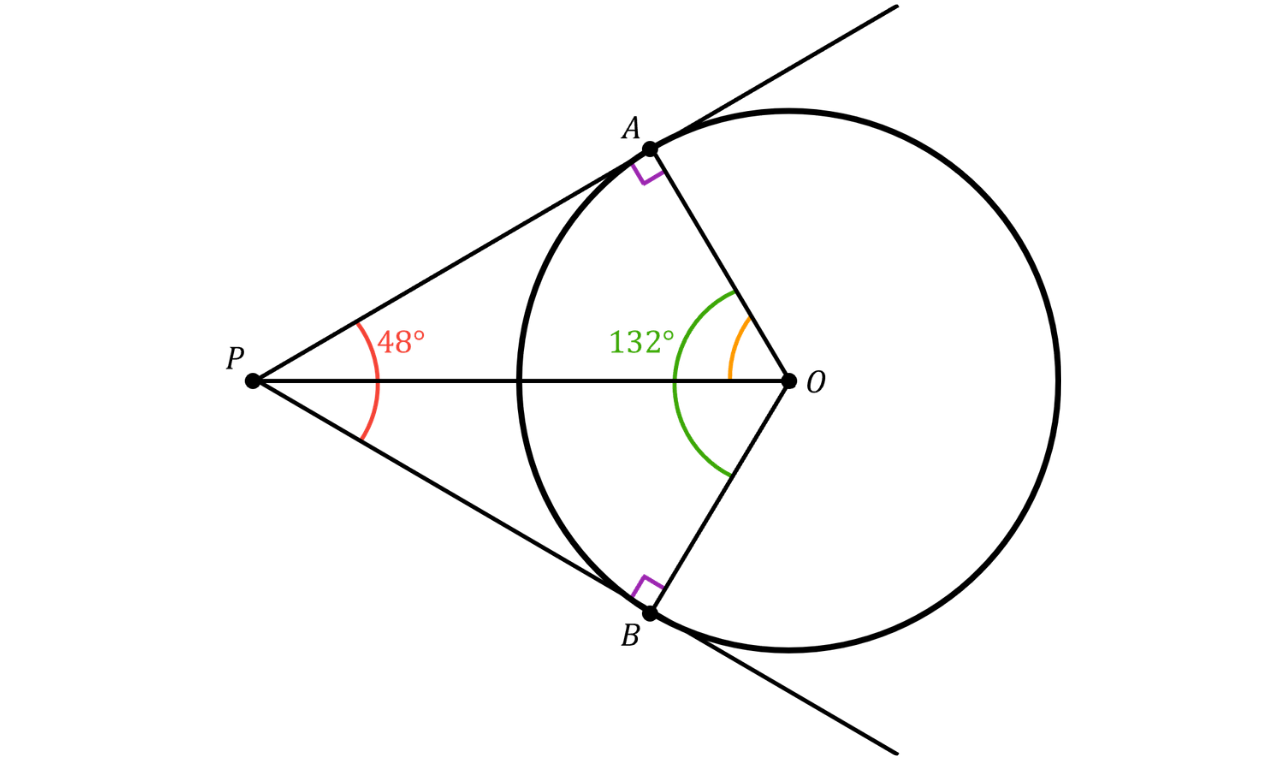
Single Step: Use symmetry.
Triangles and are congruent (same shape and size), so bisects
Therefore
Example 6:
is a tangent to a circle with centre touching it at The radius is cm and cm. The line crosses the circle at
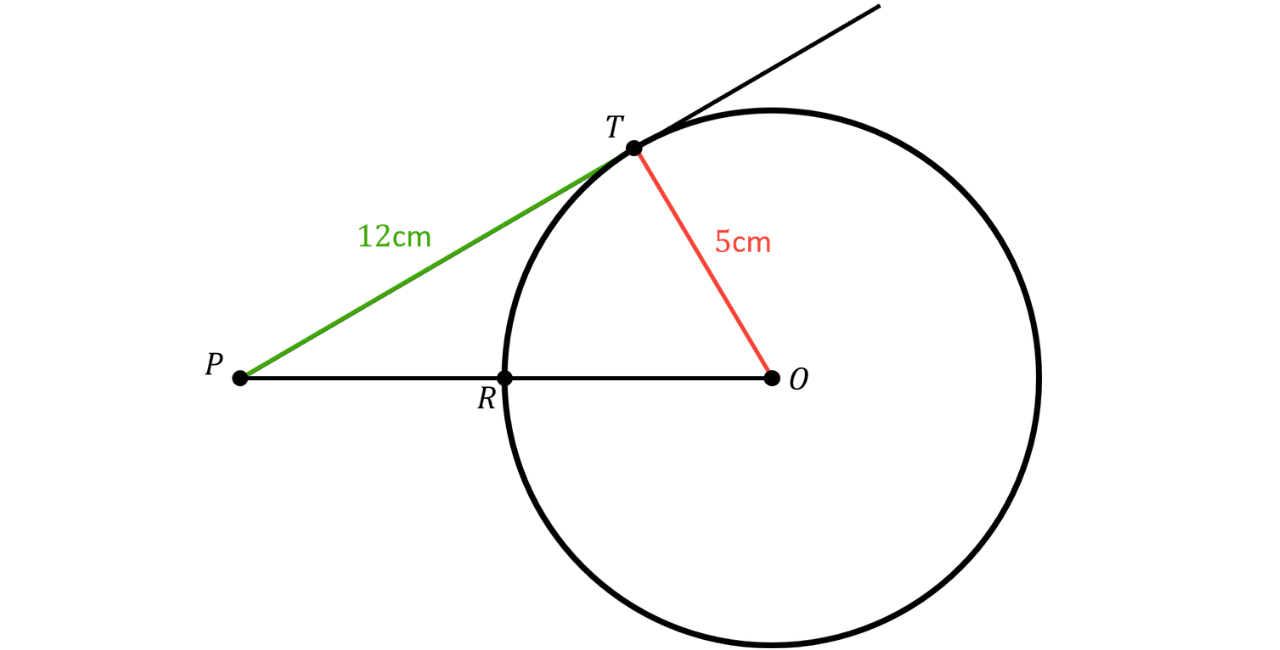
a) Find the length
Step 1: Identify the right-angled triangle.
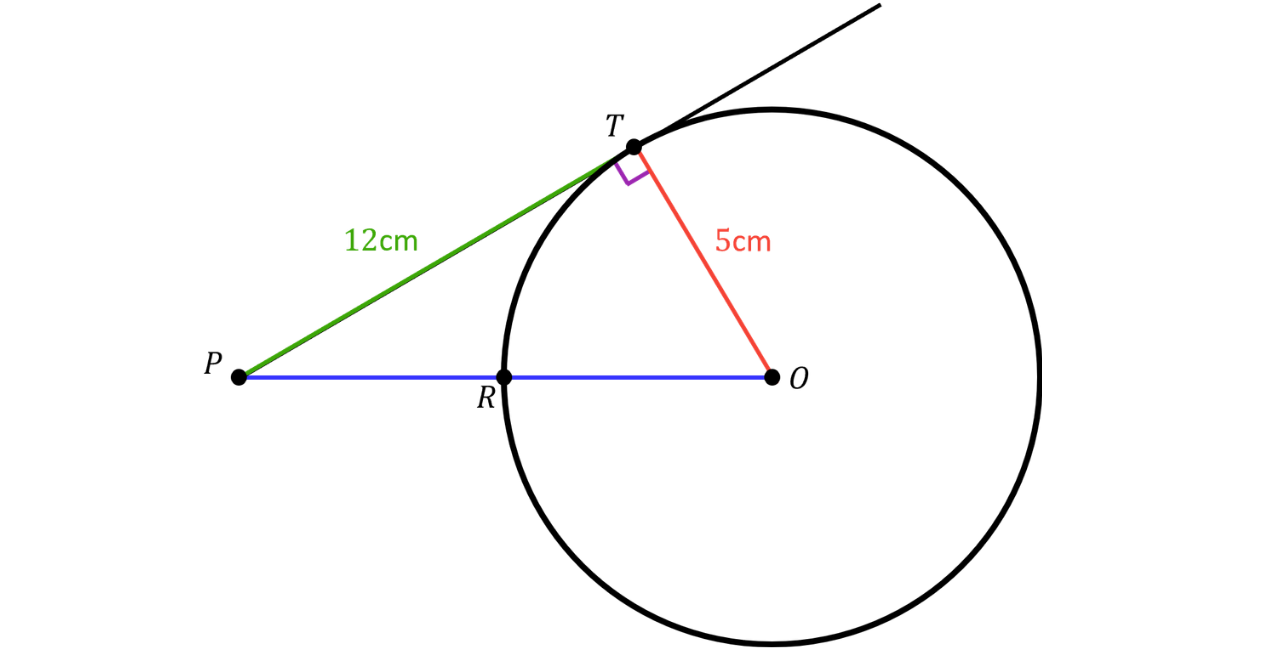
The tangent meets the radius at so and triangle is right-angled at with as the hypotenuse.
Step 2: Apply Pythagoras’ theorem.
cm
b) Find the length
Single Step: Subtract the radius from
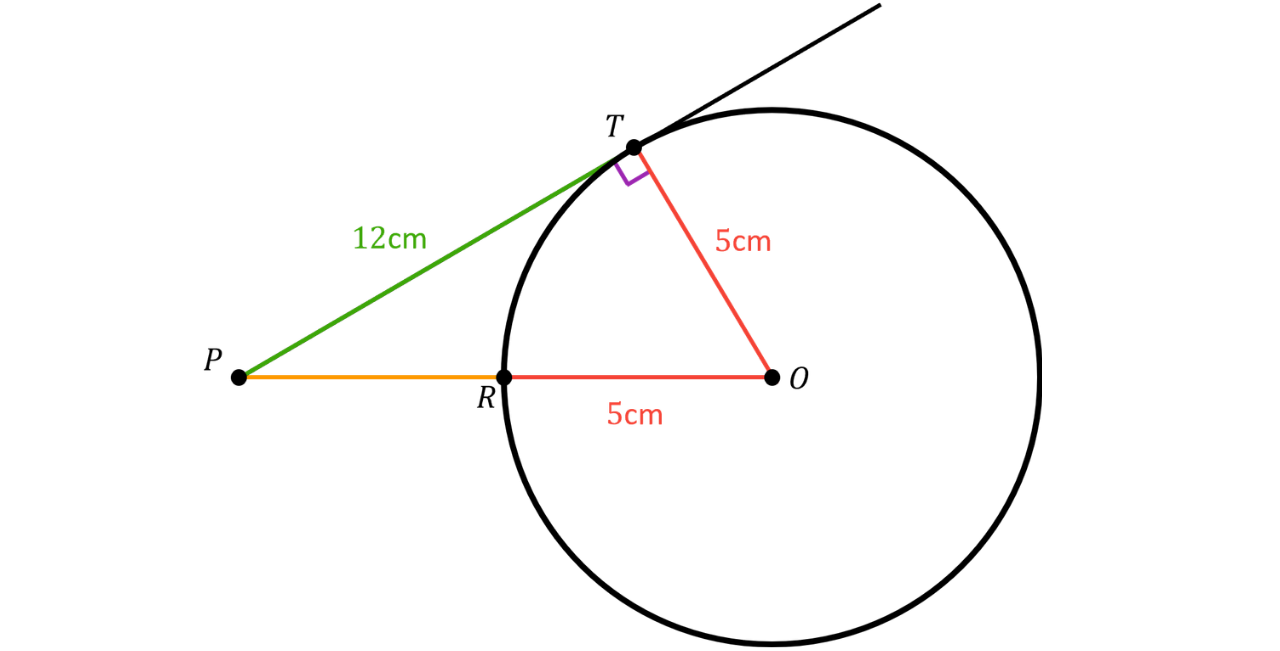
lies on the circle, so is a radius, cm.
cm
Therefore cm.
Example 7:
A chord of a circle with centre has length cm. The perpendicular distance from to the chord is cm.
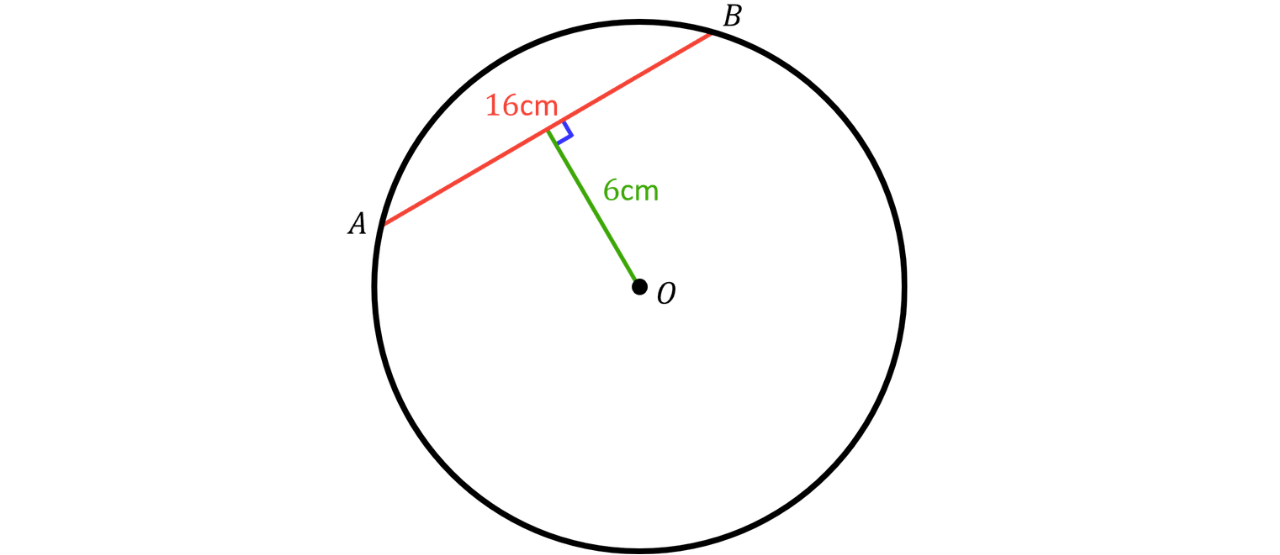
a) Find the length of the radius of the circle.
Step 1: Use the perpendicular-from-the-centre theorem.
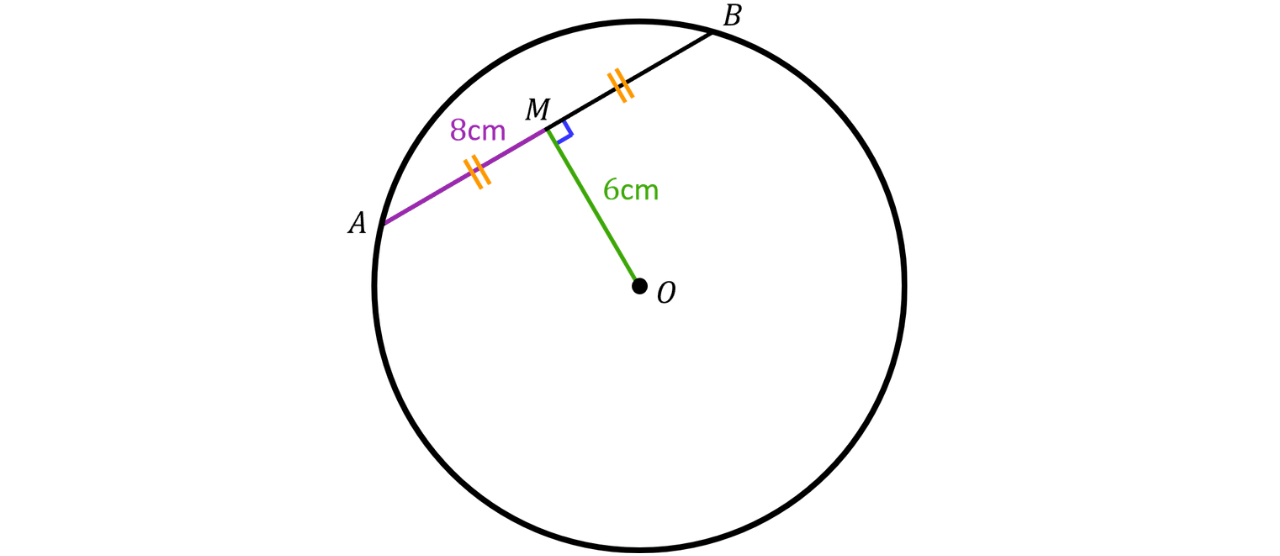
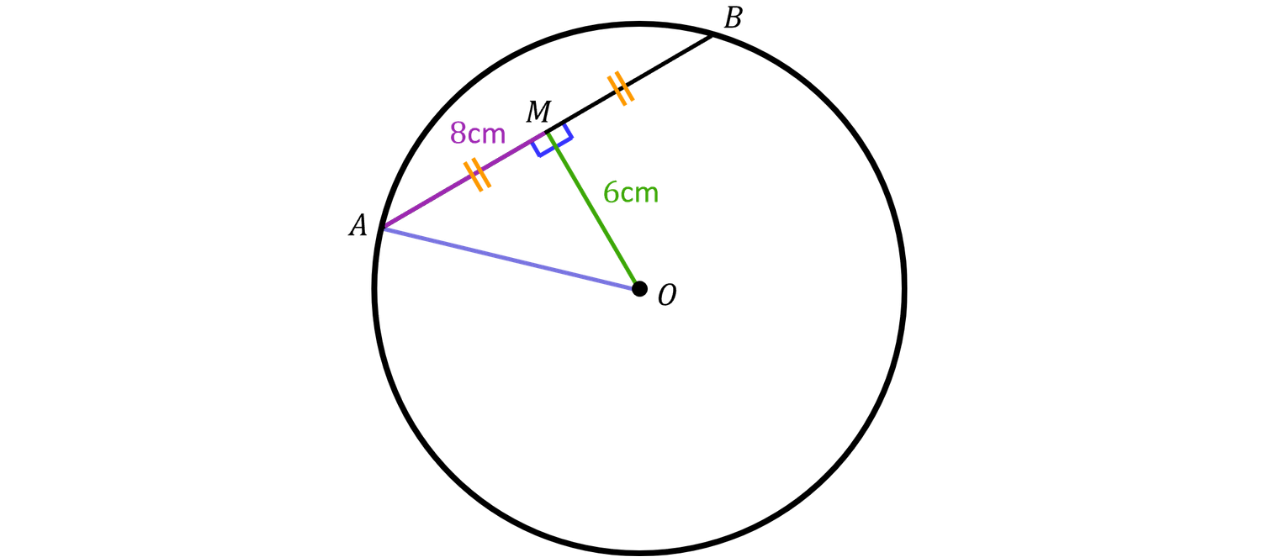
Let be the base of the perpendicular from to The perpendicular from the centre bisects the chord, so is the midpoint and triangle is right-angled at
cm
Step 2: Apply Pythagoras’ theorem (is a radius and the hypotenuse).
A second chord in the same circle has length cm.
b) Find its distance from

Step 1: Bisect the second chord.
When we are asked for the distance between a line (the chord) and a point (the centre), really, we are being asked for the closest distance between them, which in turn, means the perpendicular distance.
Let be the midpoint of so is perpendicular to and triangle is right-angled at
cm

Step 2: Apply Pythagoras’ theorem (is a radius).
In part a), we worked out that the radius was cm.
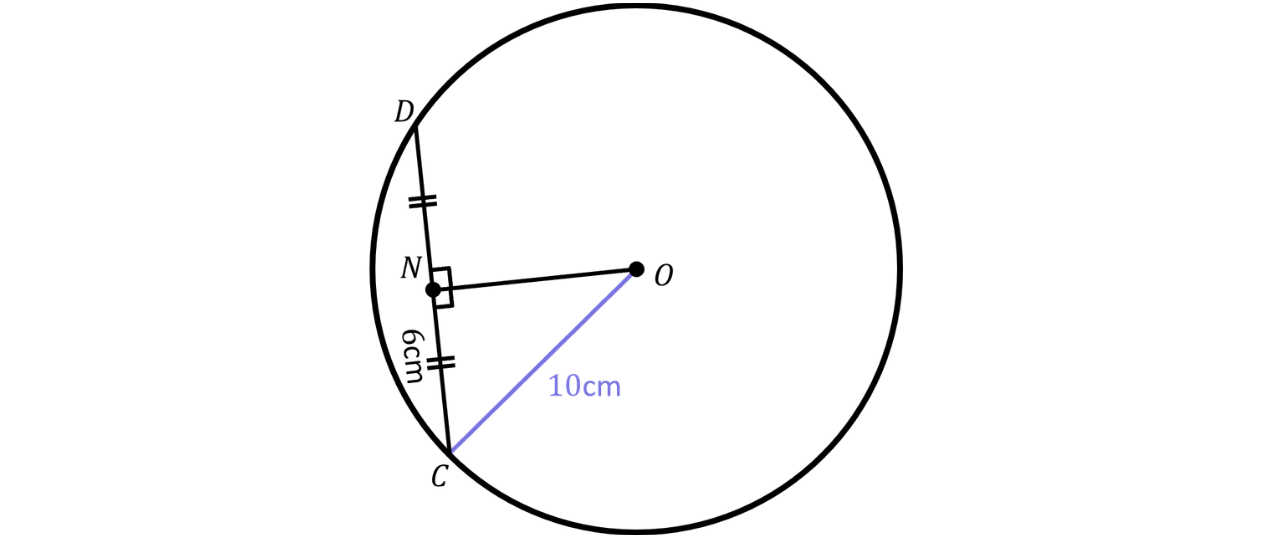
cm
Therefore, is cm from the centre.
Example 8:
is a tangent to a circle at and and lie on the circle. The angle between the tangent and the chord is and Find giving reasons.
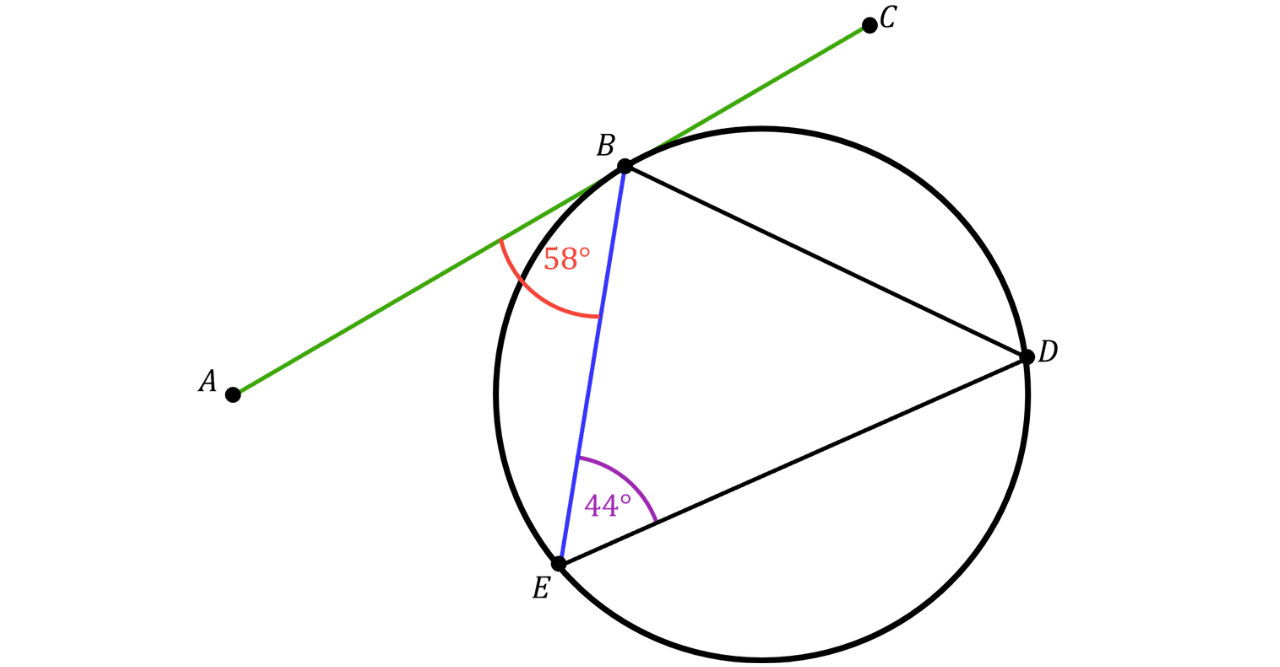
Step 1: Apply the Alternate Segment Theorem.
The angle between the tangent and chord equals the angle in the alternate segment subtended by which is
(alternate segment theorem)
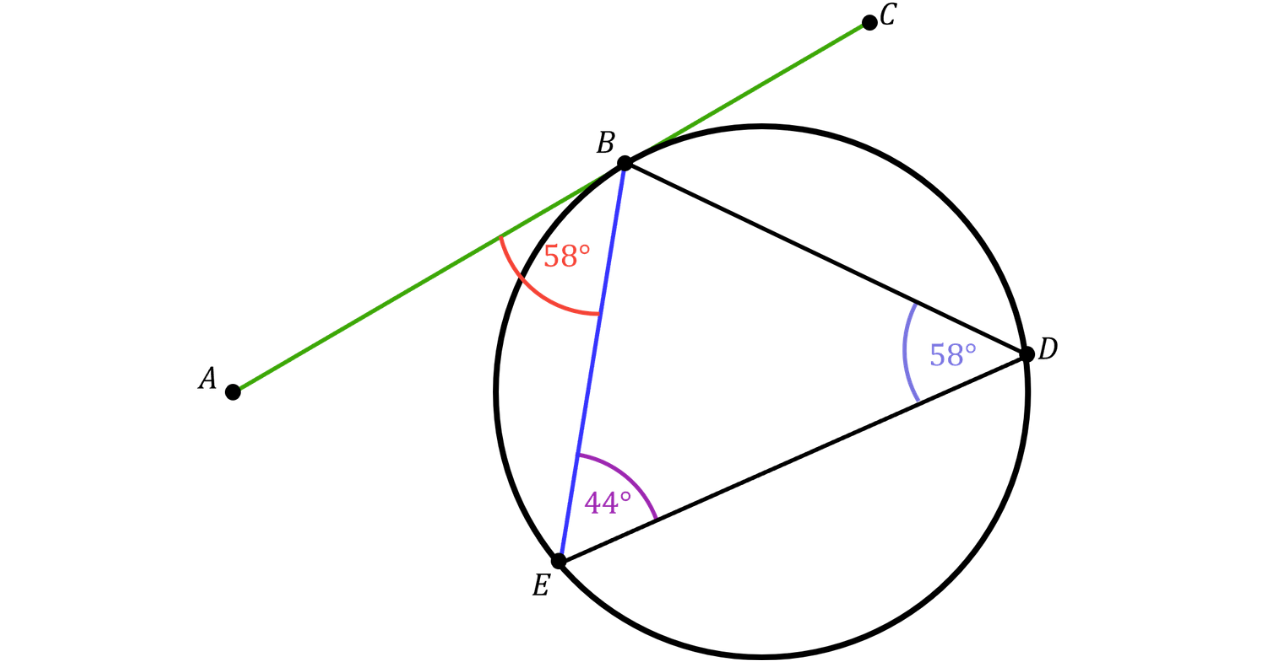
Step 2: Use the fact that angles in a triangle add up to in triangle
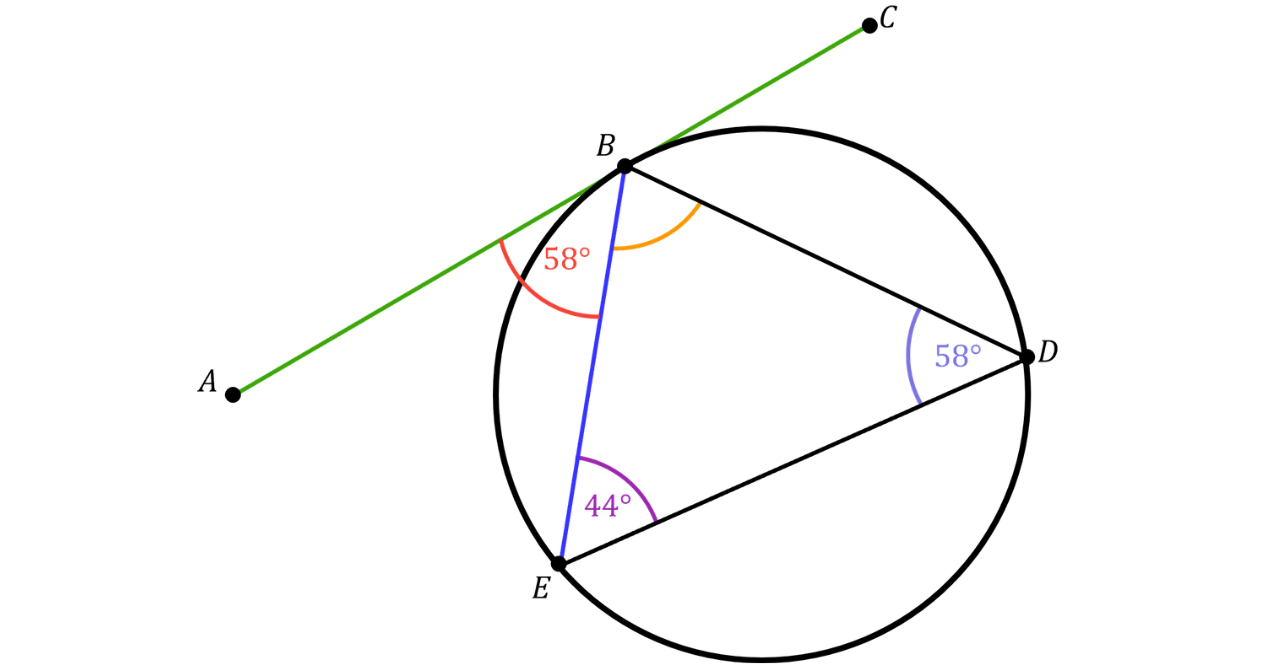
Therefore,
Practice Questions