Circle Theorem Proofs
Neil Trivedi
Teacher

Circle Theorems Proofs
In our Circle Theorems note, we learnt how to use these results to find missing angles. In this note, we go one step further and learn how to prove them, which means to show why each result must be true, starting only from a small set of basic angle facts.
There is a natural order to these proofs. One theorem, which is the angle at the centre is twice the angle at the circumference, is the cornerstone. Once we have proved it, we can essentially prove most of the other theorems.
Regarding the angle in a semicircle, you may have seen a separate proof that the angle in a semicircle is We do not prove it here, separately, because it is simply the special case of the cornerstone theorem when the two points lie at the ends of a diameter. We point this out at the right moment below.
The Angle Facts We Build Every Proof From
Every proof in this note is assembled from the same small toolkit. Make sure you know each one because, in a proof, you are allowed to quote these without re-deriving them:
Two radii are equal. Any triangle made from two radii is isosceles, so its base angles are equal.
Angles in a triangle add up to
Angles on a straight line add up to
Angles around a point add up to
Exterior angle of a triangle the sum of the two opposite interior angles.
A tangent meets a radius at at the point where it touches the circle.
Note: the exterior angle of a triangle the sum of the two opposite interior angles is not commonly used by students at any level, but it is very useful. The idea can be seen below.
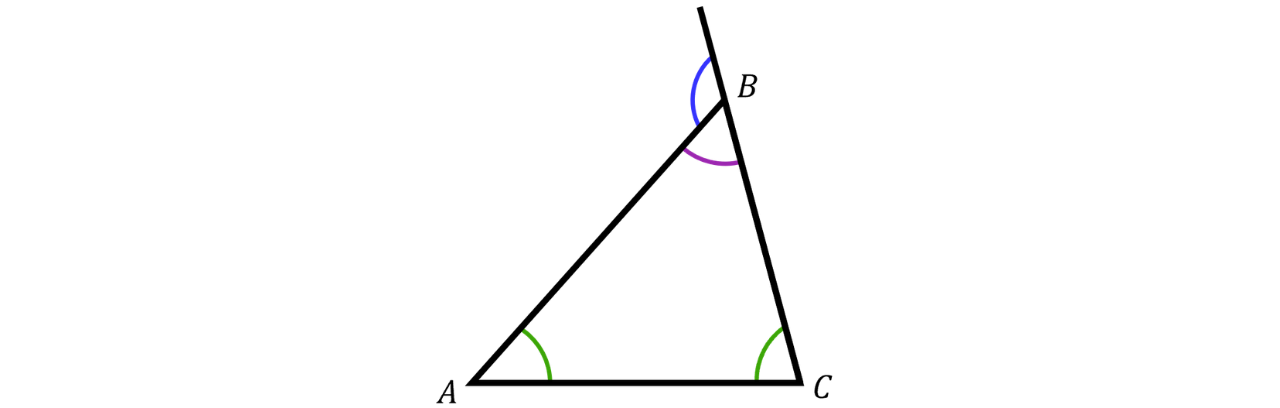
This can easily be shown by letting the interior angles and Then, the interior angle at the top of the triangle will be Then, using angles on a straight line, we find that the exterior angle at is
So, the exterior angle at equals the sum of the opposite two interior angles at and
Proof #1 — The Angle at the Centre is Twice the Angle at the Circumference
What we want to prove:
If points and lie on a circle with centre and the angle at the centre and the angle at the circumference both stand on the same arc then
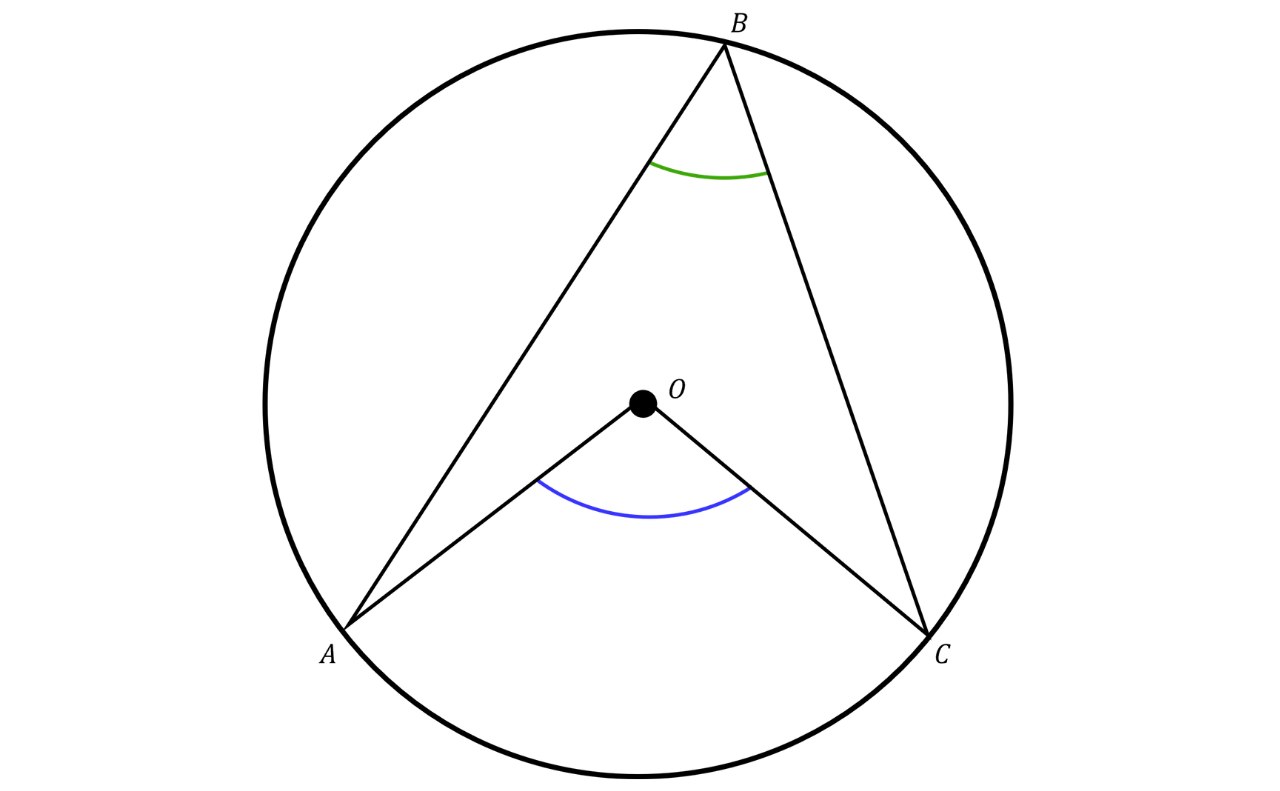
The proof:
Draw a line from to and let and
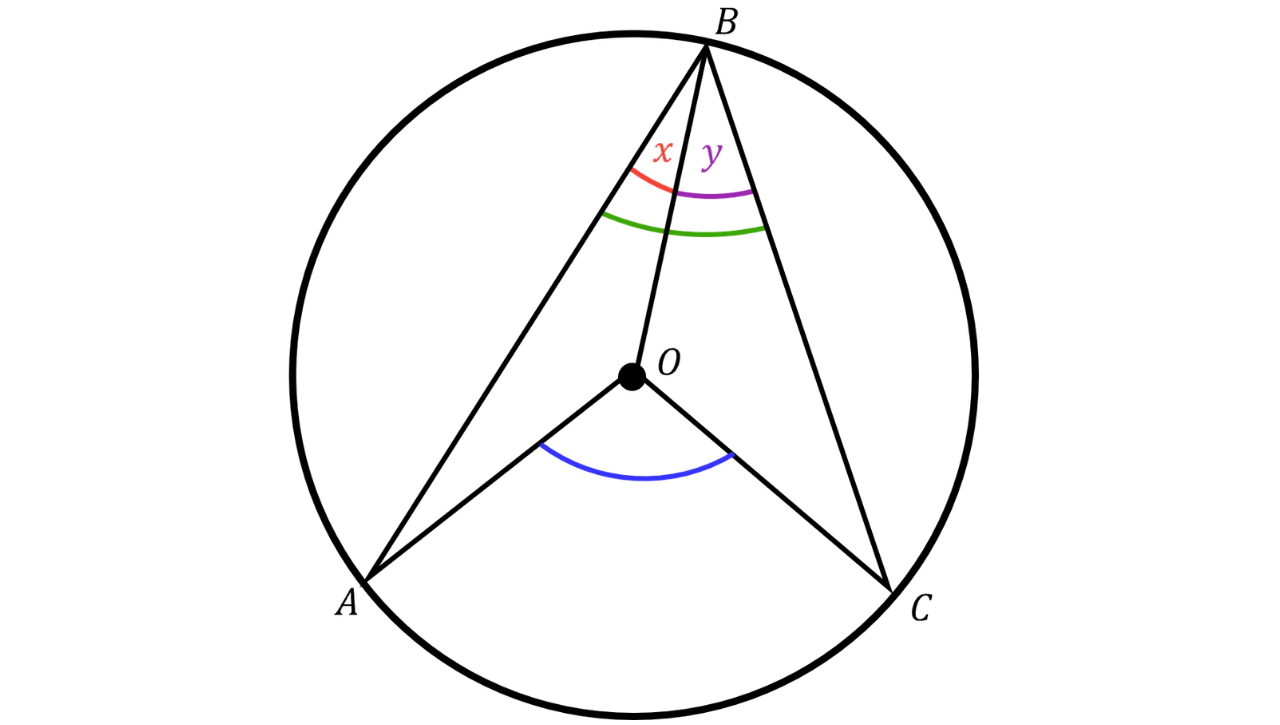
The angle at the circumference is now
Because (radii), triangle is isosceles, so its base angles are equal:
Likewise, (radii), so triangle is isosceles and
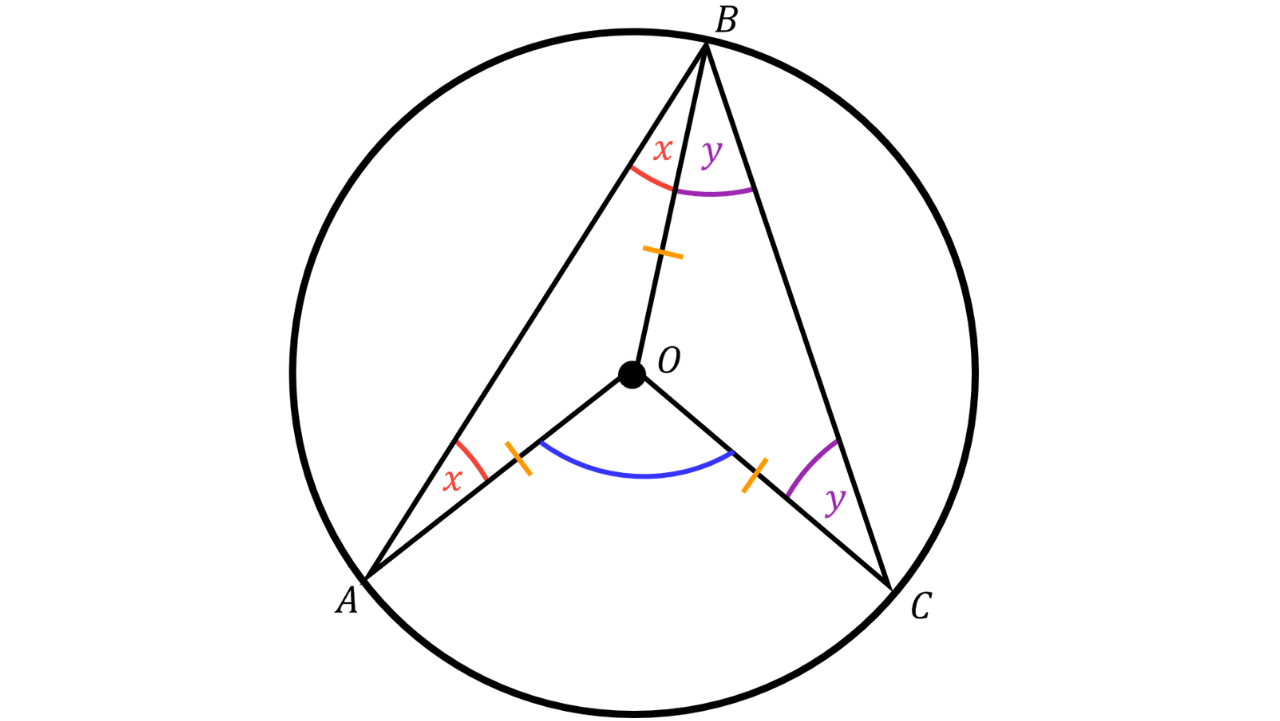
From here, there are a couple of ways to find with the quickest being the use of the exterior angle of a triangle fact.
First, we extend the line until it meets the circumference at a new point
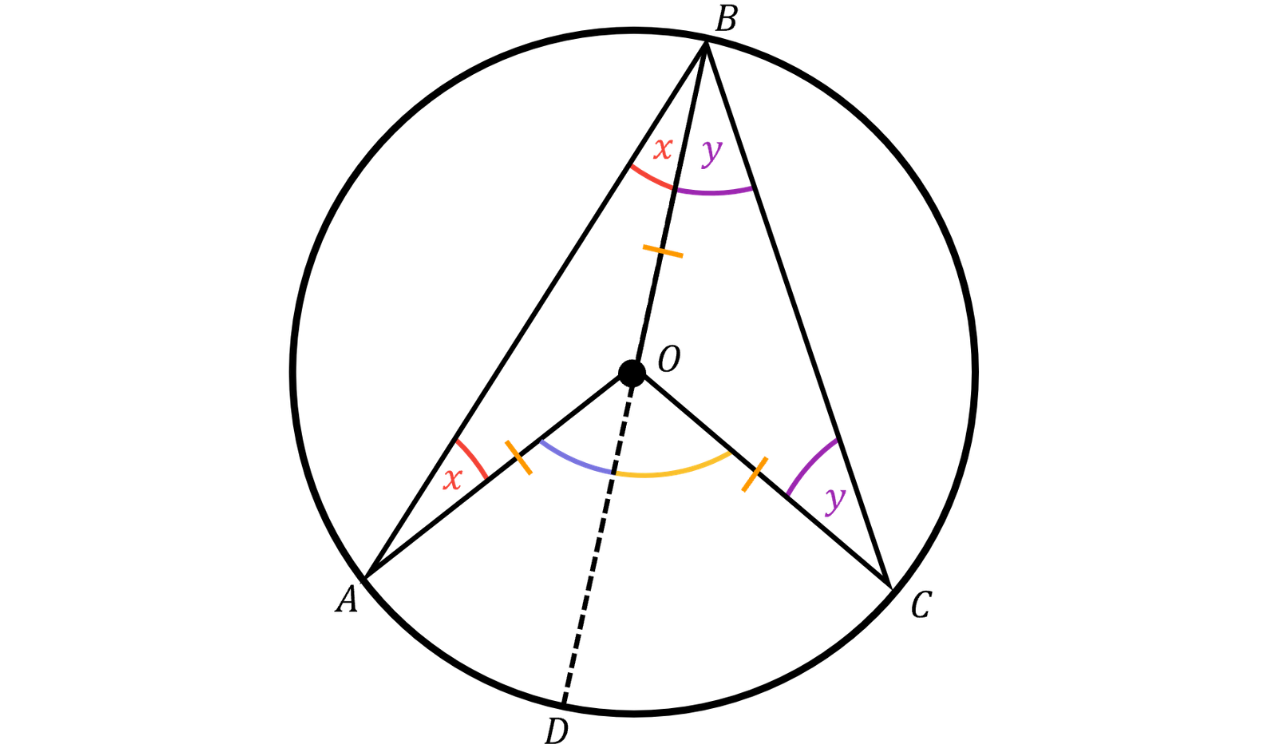
Now, we use the exterior angle of a triangle fact. The angle is the exterior angle of triangle at so it equals the sum of the two opposite interior angles:
Similarly, is the exterior angle of triangle so
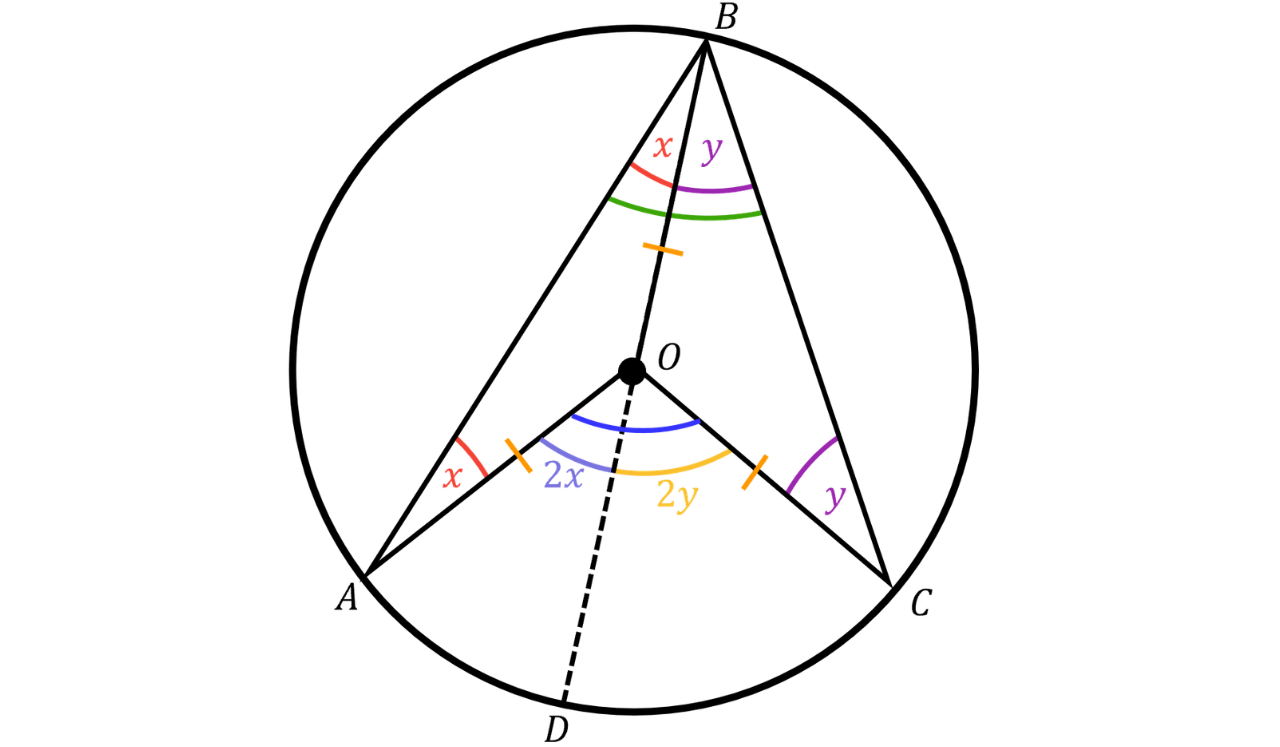
Finally, the full central angle is made up of these two pieces:
We have established before that was exactly Therefore,
Proof #2 — Angles in the Same Segment are Equal
What we want to prove:
If and both stand on the same arc of a circle (the same segment), and both stand on the same chord then
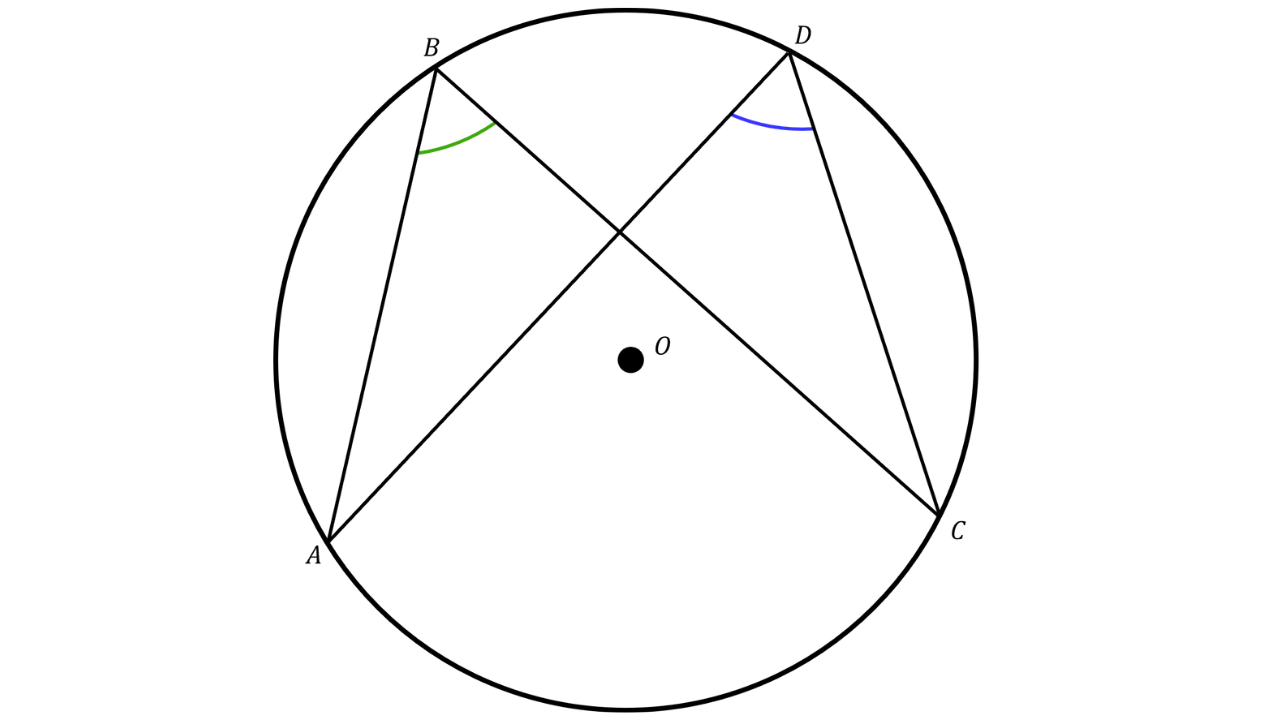
The proof:
Join and to the centre and let the angle at the centre be
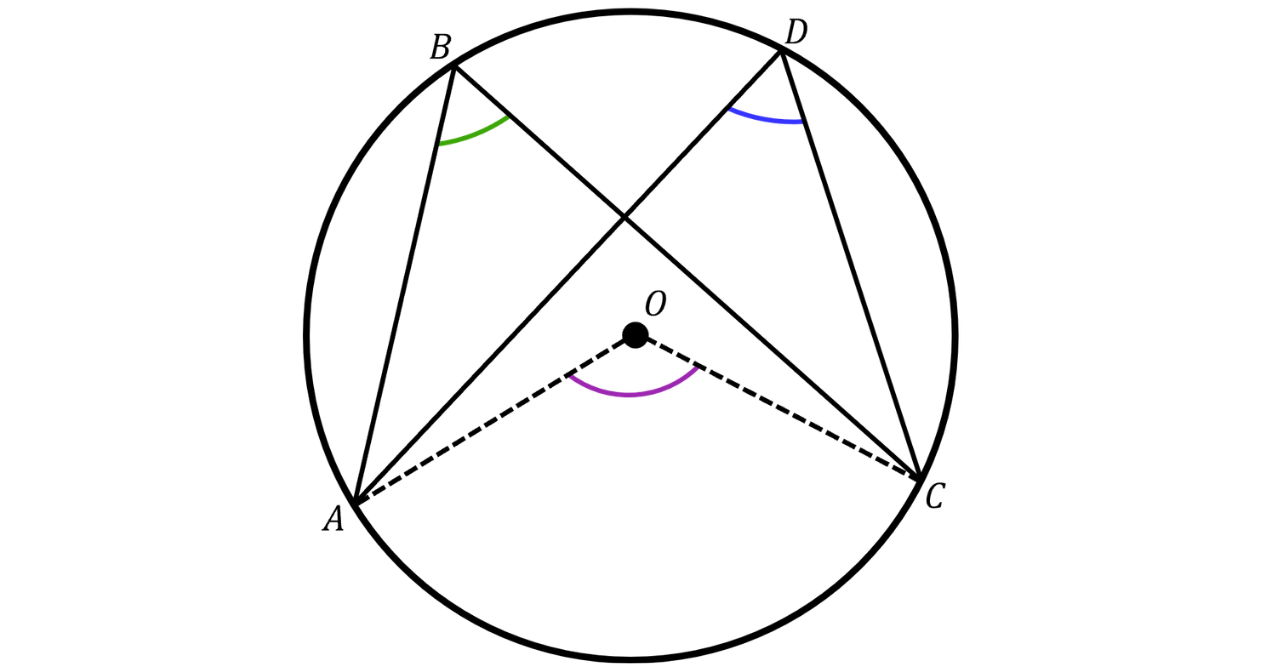
Using Proof #1, with on the circumference:
Using the same theorem, but this time with on the circumference (the central angle is the same, because and have not moved):
The left-hand sides are identical (both equal so the right-hand sides must be equal:
Dividing both sides by gives the result:
Proof #3 — Opposite Angles in a Cyclic Quadrilateral Sum to
What we want to prove:
If is a cyclic quadrilateral (all four vertices on the circle), then opposite angles add up to that is
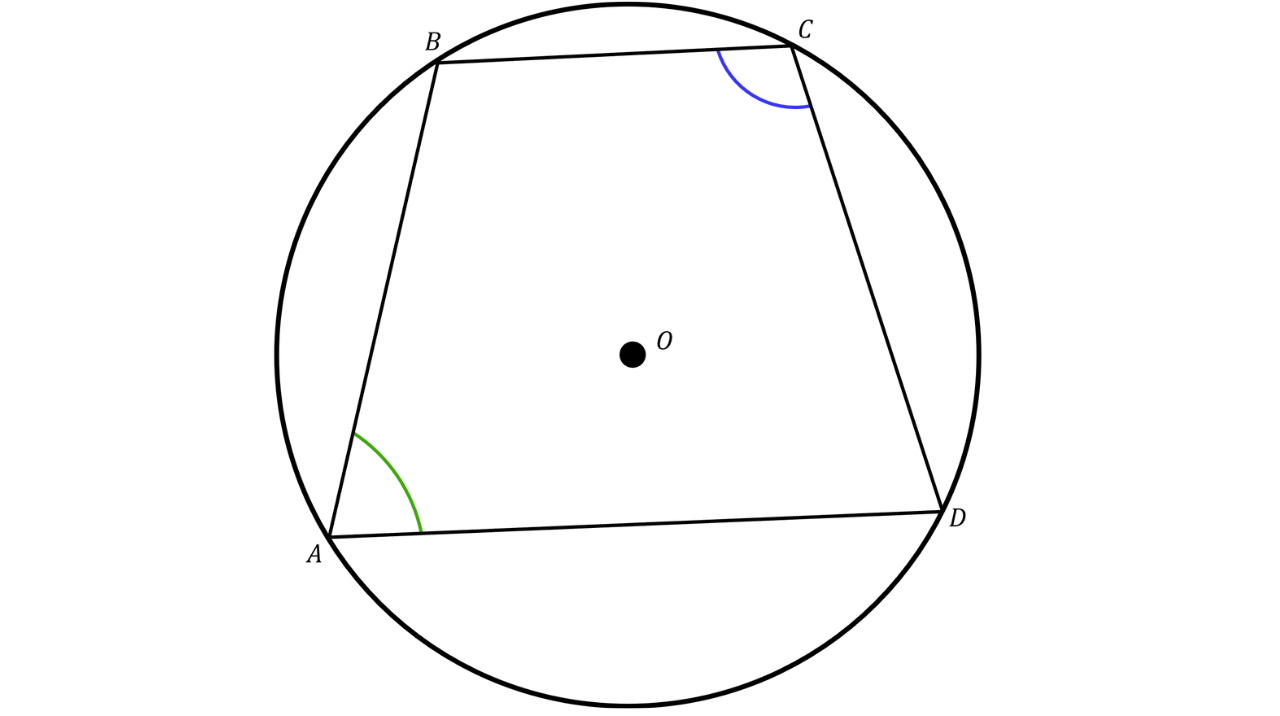
The proof:
Let the two opposite angles be and Join and to the centre
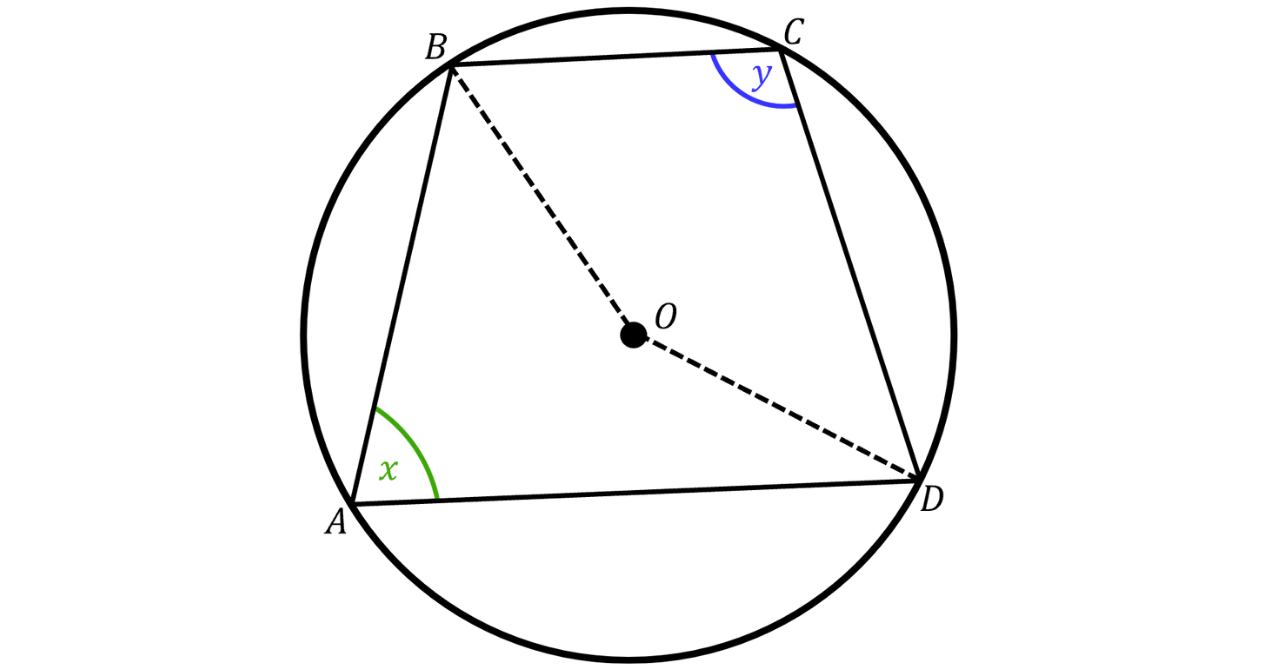
The angle at vertex subtends the arc (the arc from to that passes through By Proof #1, the angle at the centre subtending that same arc is twice as big:
Angle at subtending the arc
The angle at vertex subtends the other arc (the arc passing through By the same theorem, the angle at the centre subtending that arc is:
Angle at subtending the arc
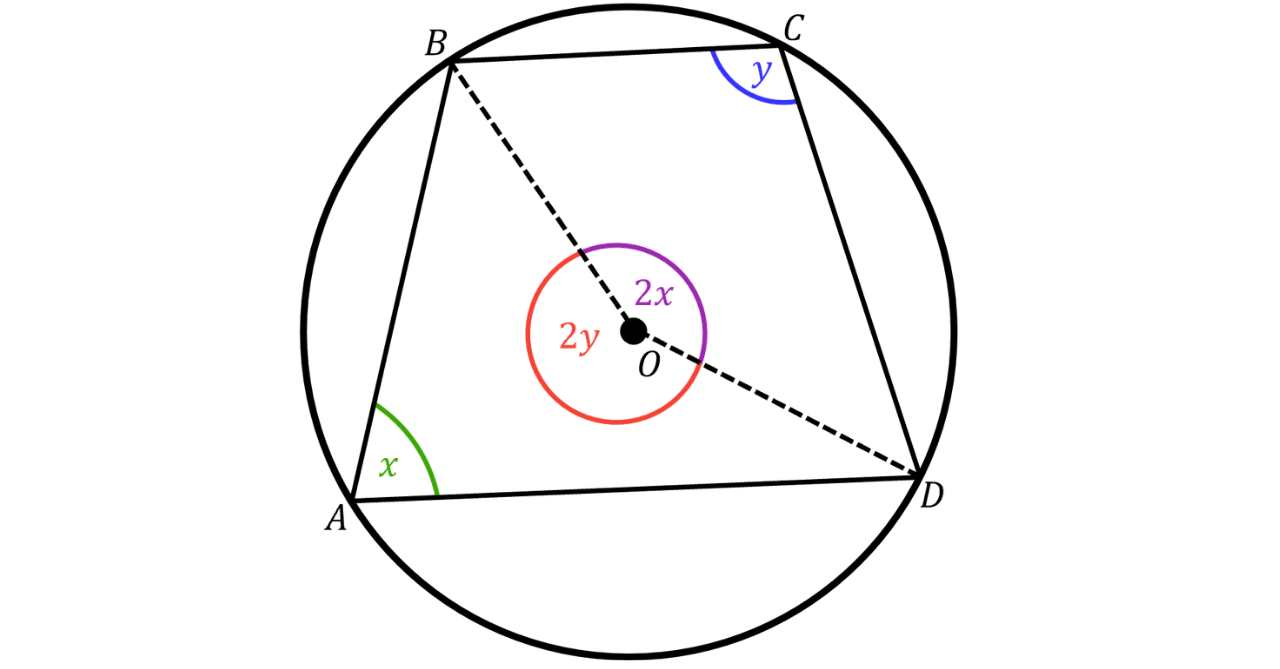
These two angles at the centre sit on either side of and, between them, sweep all the way around the point, so they add up to
Dividing every term by gives
Proof #4 — The Alternate Segment Theorem
What we want to prove:
The angle between a tangent and a chord, measured at the point where they meet, is equal to the angle in the alternate segment (the angle made by that same chord on the far side of the circle).

The proof:
Let the angle between the tangent and the chord be and draw the radius
Because a tangent meets a radius at the angle between the tangent and the radius is
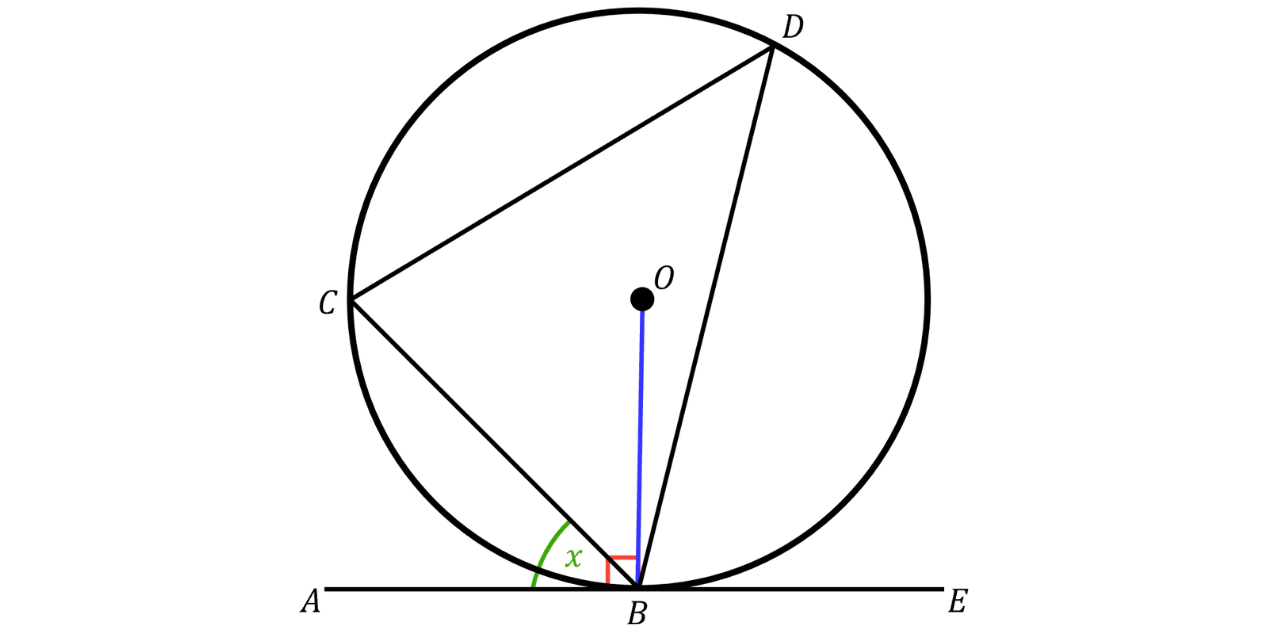
The chord lies inside this right angle, so
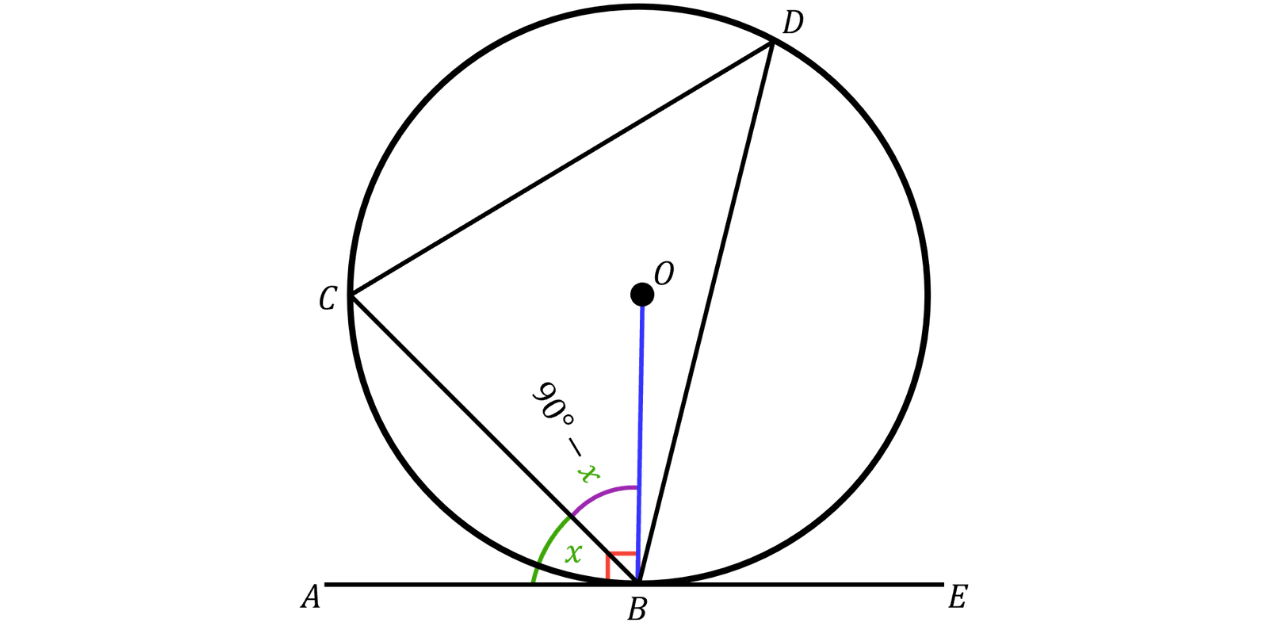
Next, we draw which is also a radius. This forms an isosceles triangle with (radii), whose base angles are equal. This means that
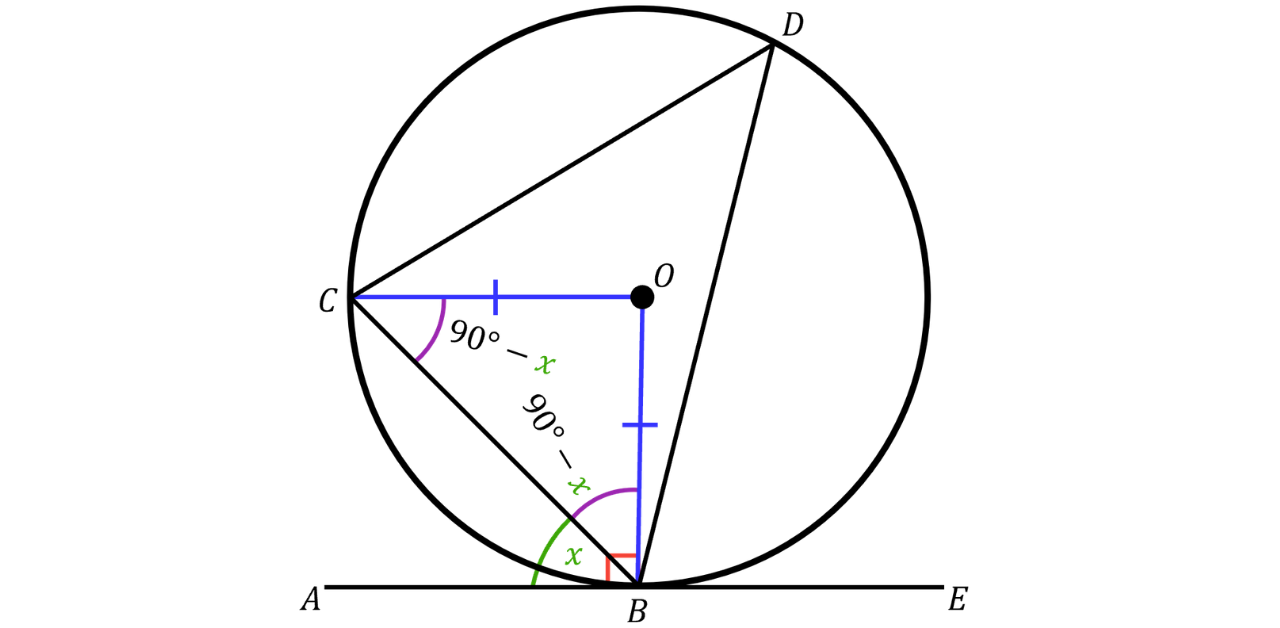
Now, we can find the missing angle in our isosceles triangle.
Simplifying what’s inside the bracket,
Expanding the bracket and simplifying, we are left with
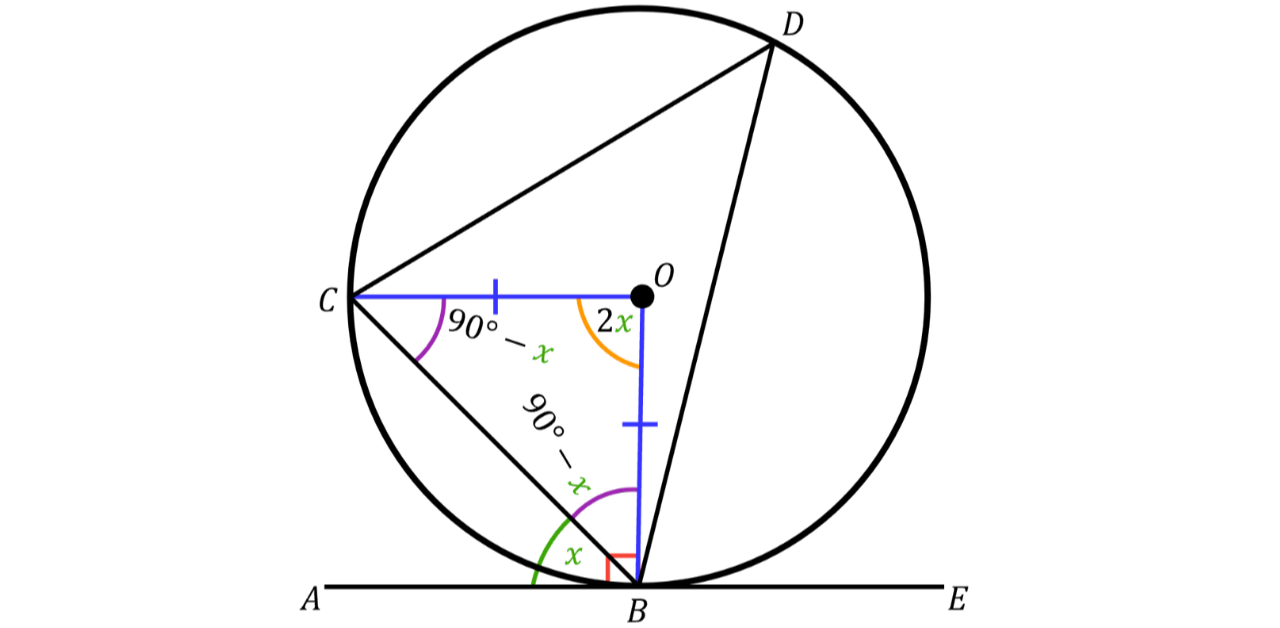
Finally, by Proof #1, the angle at the centre, is double the angle at the circumference,
Practice Question