Arcs, Sectors and Segments
Neil Trivedi
Teacher

Contents
Arcs, Sectors and Segments
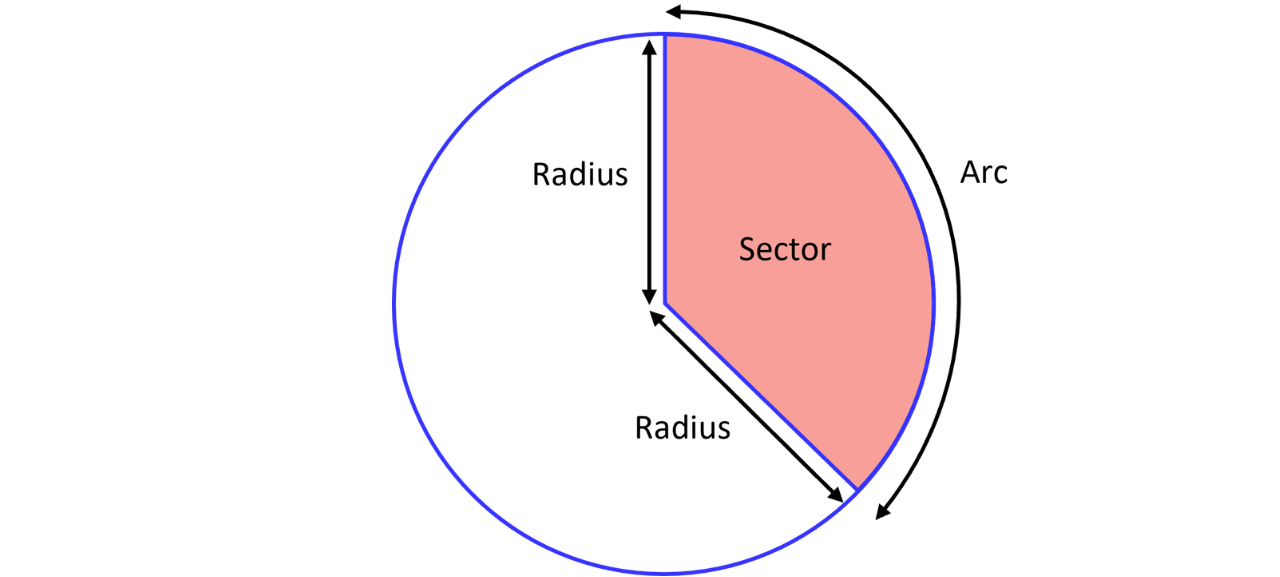
A sector is a part of a circle. It is formed when we draw two radii from the centre, and it is the region bounded by those two radii and the curved edge between them. That curved edge is called an arc.
Here is a diagram showing a sector of a circle.
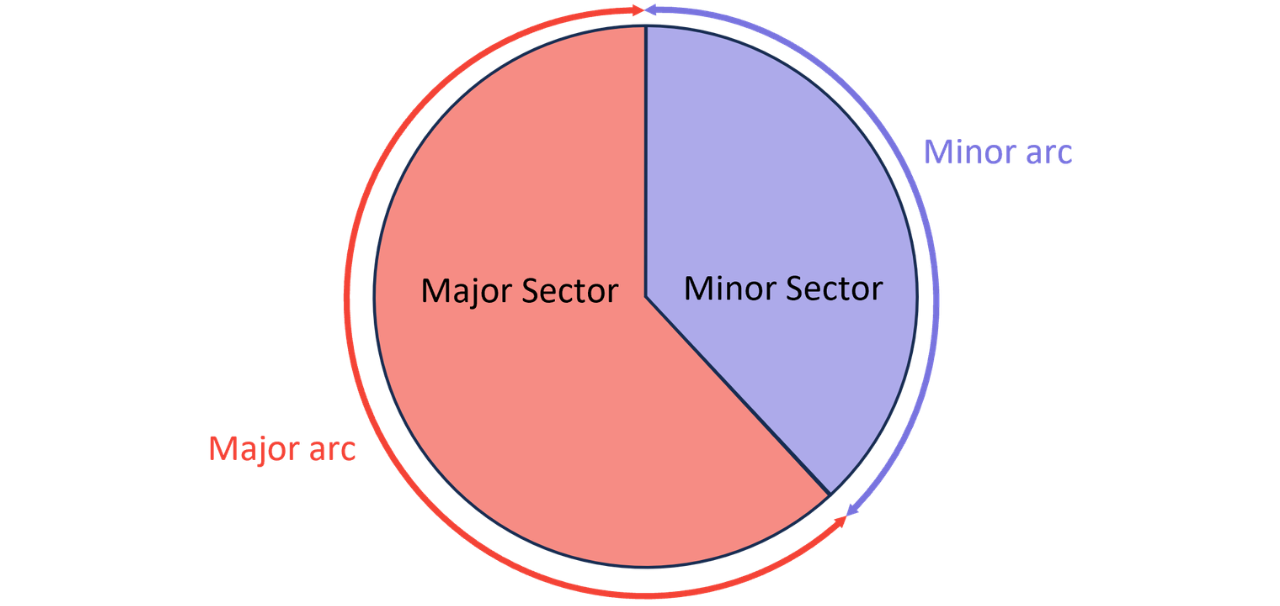
As a side note, if the circle is split into two sectors, the larger sector is known as the major sector while the smaller one is known as the minor sector. Similarly, the longer arc is known as the major arc while the shorter one is known as the minor arc.
We can think of a sector as a fraction of the area of a full circle, depending on the angle subtended at the centre (the angle made at the centre between the two radii).
Similarly, the arc is a fraction of the circumference of a full circle.
The angle of rotation that forms a full circle is Therefore, to find what fraction of the full circle a sector makes up, we divide its angle by
For example, a semi-circle is of a full circle, and its angle at the centre is because

Let’s consider another example, where the angle is
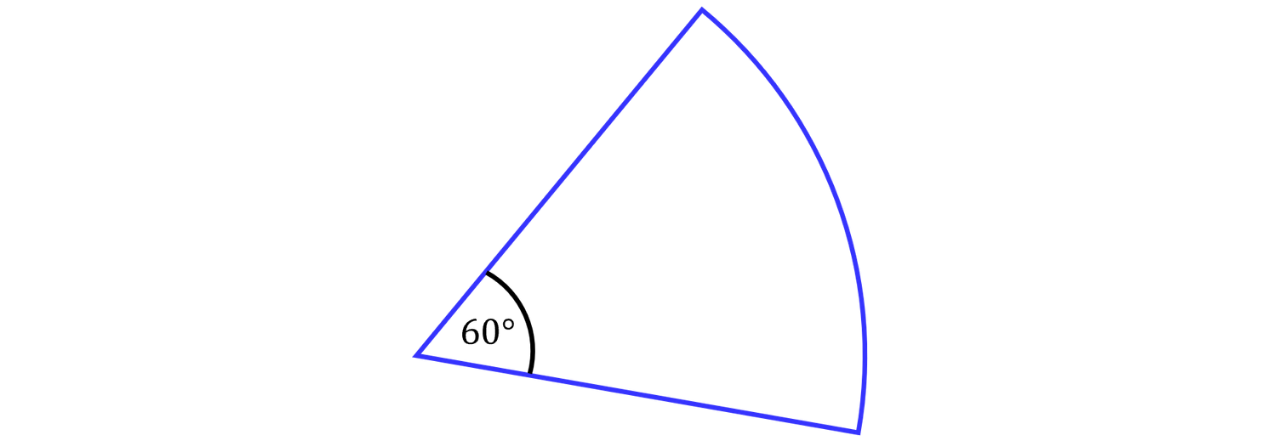
The area of this sector would be of the area of a full circle.
General Formulae – Area of a Sector and Arc Length
We can derive general formulae for the arc length and the area of a sector.
Consider a general sector with a radius and angle
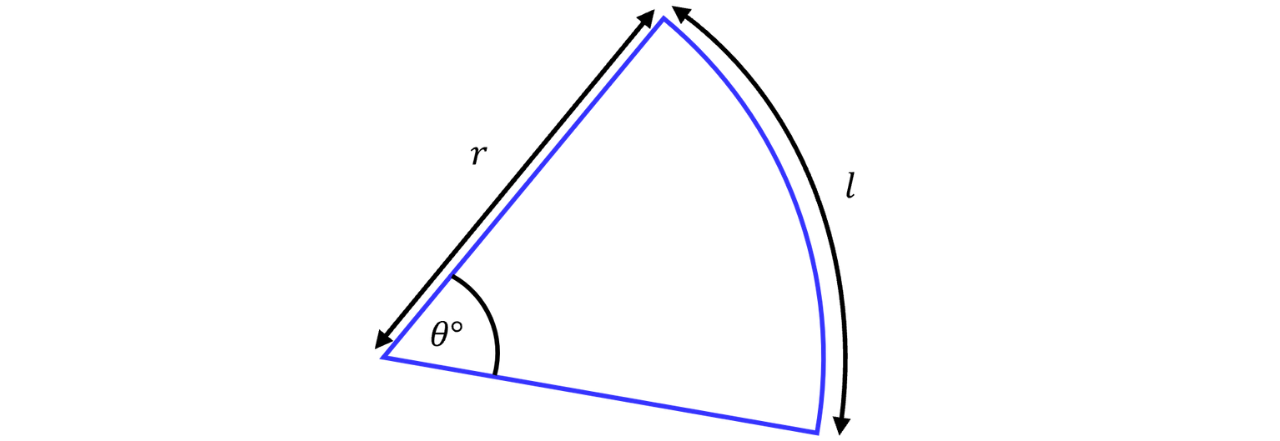
The area, , of a sector is found by working out of the area of a full circle. Since the area of a full circle is the area of a sector is given by
Similarly, the arc length, , is found by working out of the circumference of a full circle. Since the circumference of a full circle is the arc length is given by
The Arc Length and the Area of a Sector
The area of a sector is given by
The arc length of a sector is given by
Finding the Arc Length
Example 1:
The diagram shows a sector of a circle. The radius is cm.
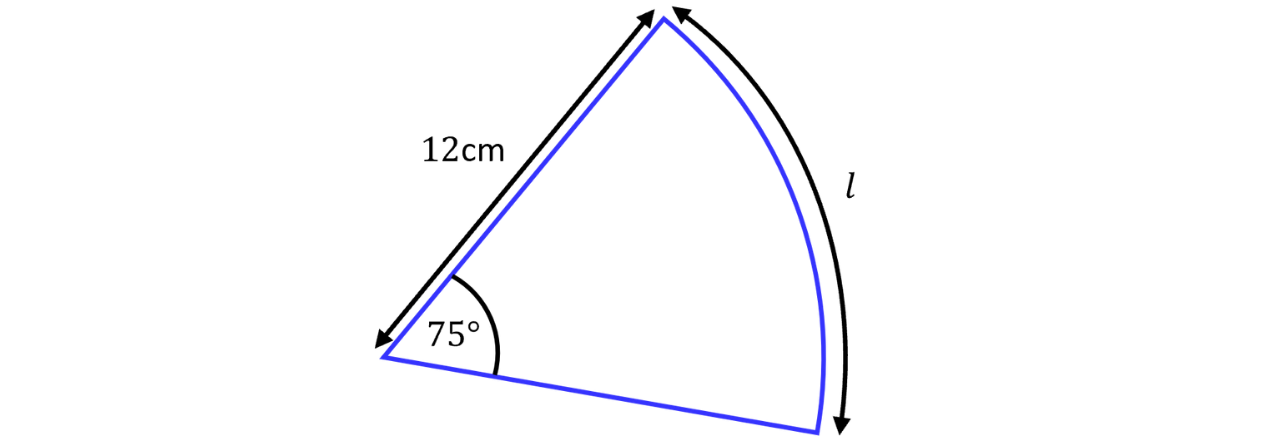
Work out the arc length of the sector, giving your answer in terms of
Single Step: Work out the arc length by using the formula.
The arc length of a sector, is given by
From the question, we have and cm, which we substitute into the formula. So,
We can simplify
Therefore, the arc length is
cm
b) Hence, work out the perimeter of the sector, giving your answer in terms of
In the diagram below, the lengths along the perimeter are shown.
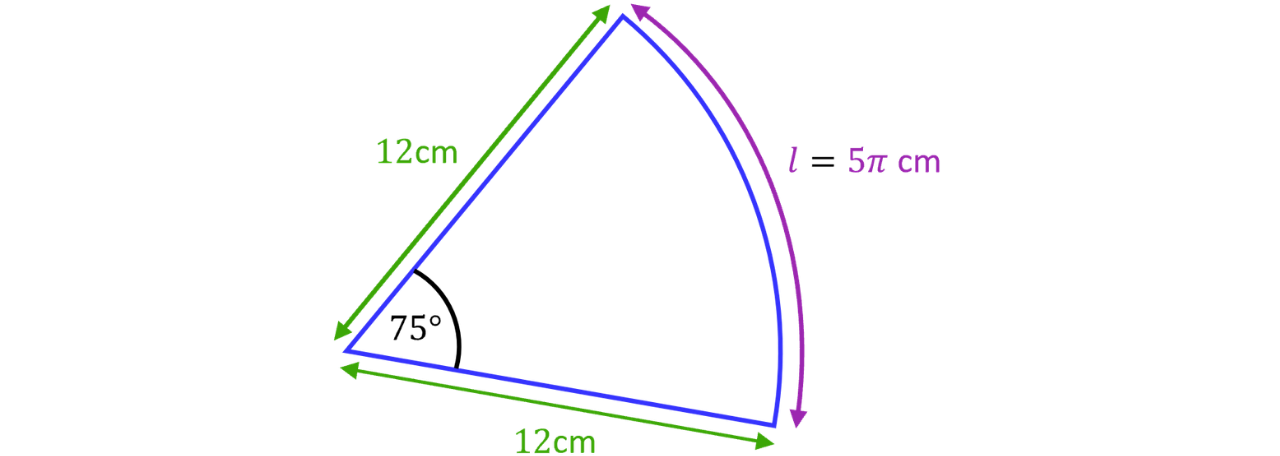
To find the perimeter, we add the arc length and the two radii together.
Therefore, the perimeter of the sector is cm.
Finding the Area of a Sector
Example 2:
The diagram shows a sector with a radius of cm. Find the area of the sector, giving your answer in terms of
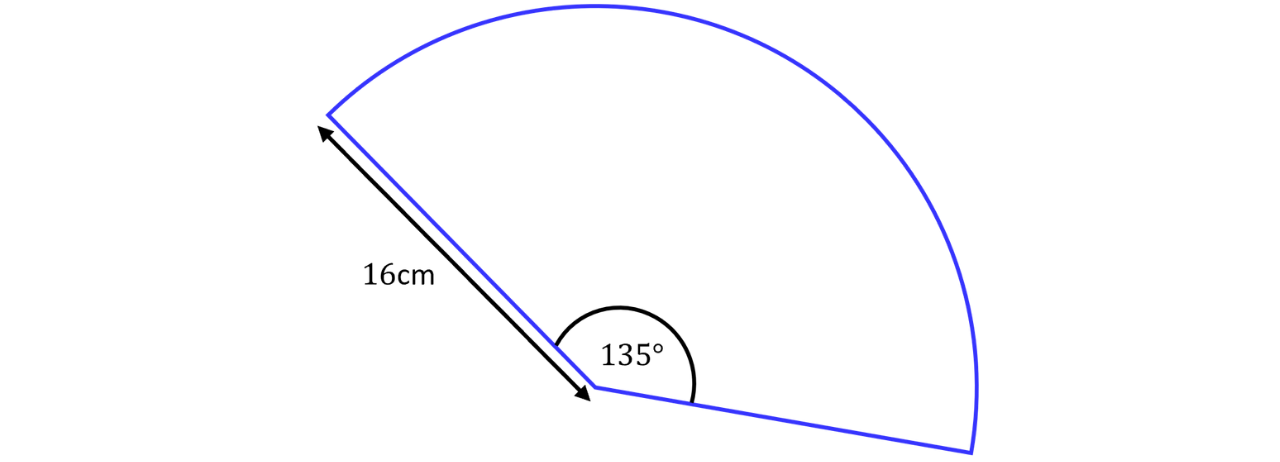
Single Step: Work out the area of the sector by using the formula.
The area of a sector, is given by
From the question, we have and cm, which we substitute into the formula. So,
We can simplify
Also, Therefore, the area of the sector is
cm²
Finding the Area of a Segment
A segment is a region bounded by an arc and a straight line joining its two ends. This straight line is called the chord.
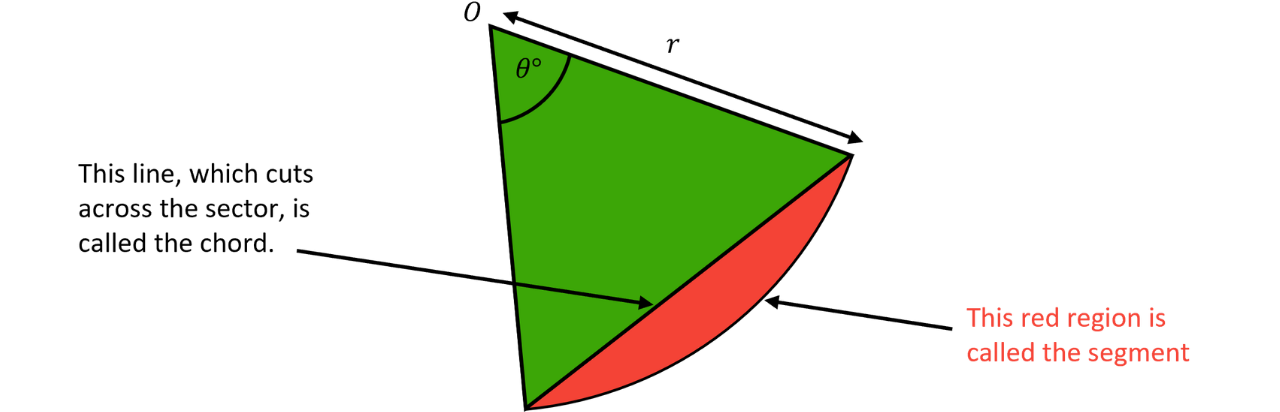
To find the area of a segment, we work out the area of the triangle and subtract it from the area of the sector.
To find the area of the triangle, we use the following formula
Area
where and are side lengths of the triangle (in this context, and are the radii) and is the angle between and To illustrate, here’s what the triangle would look like.

For more information on this, please read our Areas of Non-Right-Angled Triangles note.
Note that we cannot use the base height formula here. This is because we know neither the base nor the height of the triangle.
Area of Segment
Area of Segment = Area of Sector − Area of Triangle
Example 3:
The diagram shows a sector of a circle, centred at Determine the area of the shaded segment. Give your answer to significant figures.
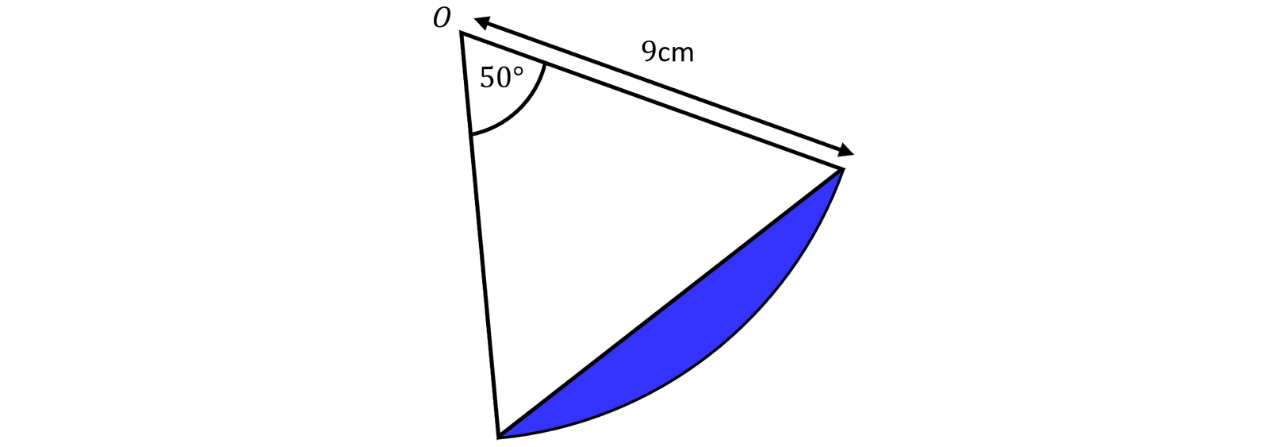
Step 1: Find the area of the sector.
The area of a sector is given by
From the question, we have and cm, which we substitute into the formula. So,
simplifies to by dividing both the numerator and denominator by
cm²
Step 2: Find the area of the triangle.
The area of a triangle is given by
Here, and are the radii, so cm and

So,
Area of triangle
Note that does not give an exact value, so we keep it as throughout the working to avoid rounding errors, rounding only the final answer to significant figures.
So, the area of the triangle is cm².
Step 3: Subtract the area of the triangle from the area of the sector to get the area of the segment.
Area of Segment Area of Sector Area of Triangle
We compute the following into our calculator:
Therefore, the area of the segment is cm² to significant figures.
Exam-style Questions
Sometimes, a question gives the arc length or area of a sector and asks us to work backwards to find the unknown radius or angle. To tackle these, we use the formulae to form an equation from the information given, then solve it for the unknown.
Example 4:
The arc length of the following sector is cm. Find the size of angle
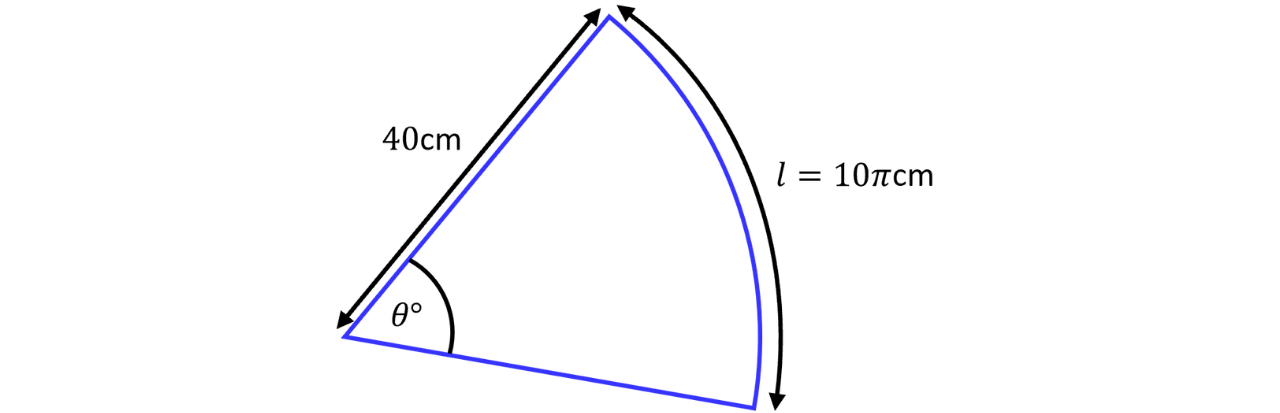
Step 1: Set up an equation using the arc length formula and the information given in the question.
From the question, the arc length is cm and the radius is cm.
The arc length is given by
So,
The on both sides cancel out (by dividing both sides by
can be simplified.
Therefore,
Multiplying both sides by
Finally, dividing both sides by
Example 5:
The diagram shows a sector with centre and radius cm.
The area of the sector is cm² and the arc length is cm.
Determine the value of and the value of
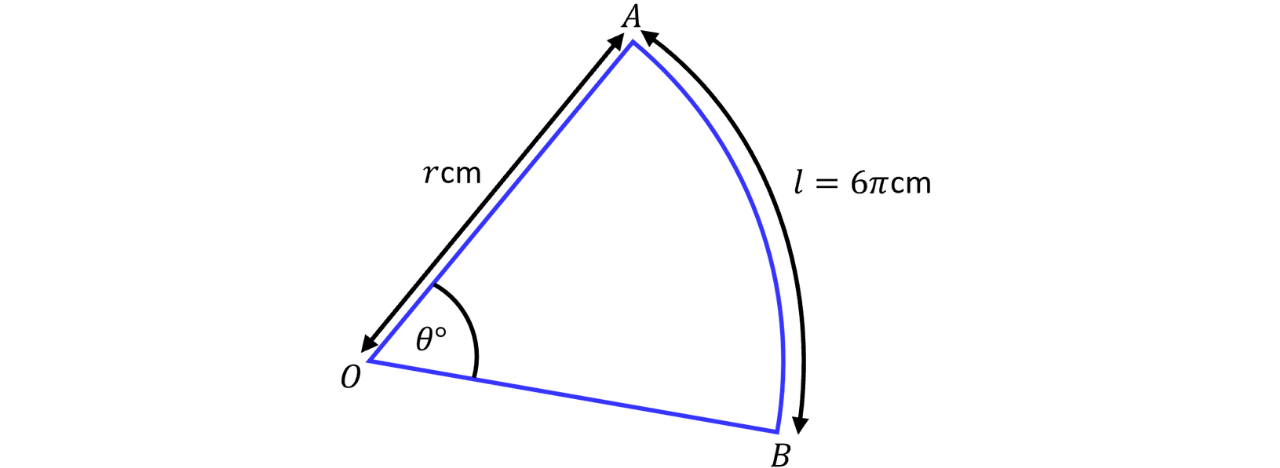
In this question, we need to form two equations using the formulae for the arc length and area of a sector and solve them simultaneously.
Step 1: Form two equations, in terms of and using the formulae for the arc length and area of a sector.
The area of the sector is cm². So,
The on both sides cancel.
Multiplying both sides by
(equation 1)
The arc length is cm. So,
The on both sides cancel.
Multiplying both sides by
(equation 2)
Step 2: Solve the two equations simultaneously.
We have formed the following two equations.
(equation 1)
(equation 2)
We start solving by dividing equation by equation The as well as an in the numerator and denominator.
Next, we substitute the value of we found into equation and then rearrange to solve for
Dividing both sides by
Therefore, the radius of this sector is cm and the angle is
Challenging Questions