Areas of Non-Right-Angled Triangles
Neil Trivedi
Teacher

Contents
Areas of Non-Right-Angled Triangles
So far, to find the area of a triangle, we have always used the formula
Area Base Height
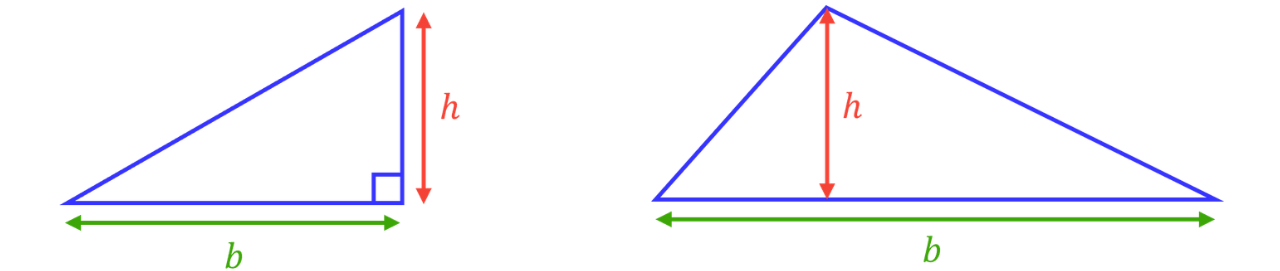
This formula works well if we know the lengths of the base and the perpendicular height of the triangle (the triangle can be right-angled or non-right-angled). However, in lots of exam questions, the height is not given directly.
Fortunately, trigonometry gives us a formula that can find the area of any triangle, as long as we know two sides and the angle between them.
The Area of a Non-Right-Angled Triangle
The area, , of any triangle is given by
where and are two side lengths, and is the angle between them.
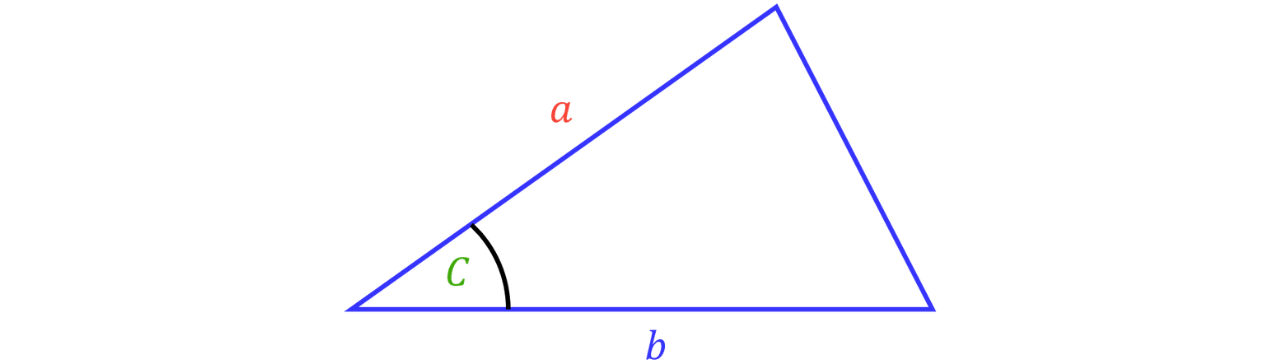
Note: This is the same arrangement as the cosine rule where we need two sides and the angle in between them.
Note: It does not matter which of the two sides we label and which we label It does not affect the calculation as both lengths are on either side of the angle.
Derivation of the Formula
Let’s see where this formula comes from. Consider the following triangle, with known side lengths and and a known angle in between the two sides. We would like to find the area of this triangle.
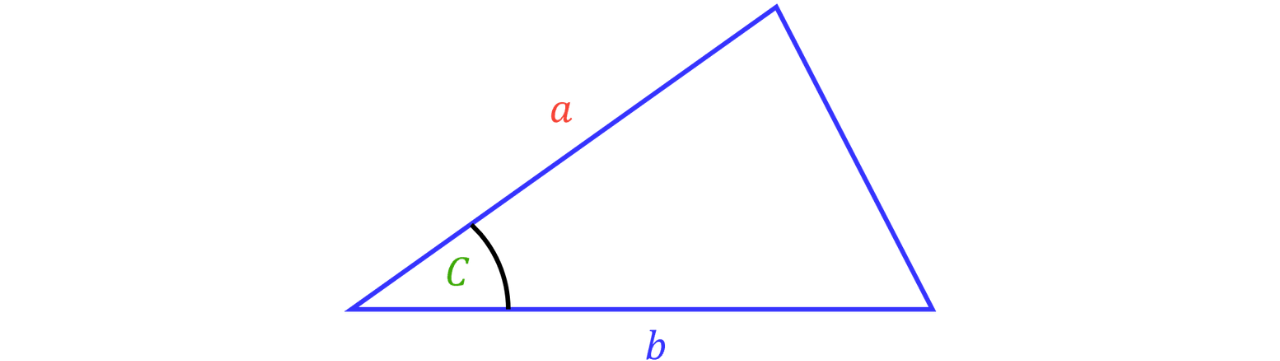
Firstly, we draw a vertical line from the base, , to the top of the triangle, and this will be the perpendicular height,
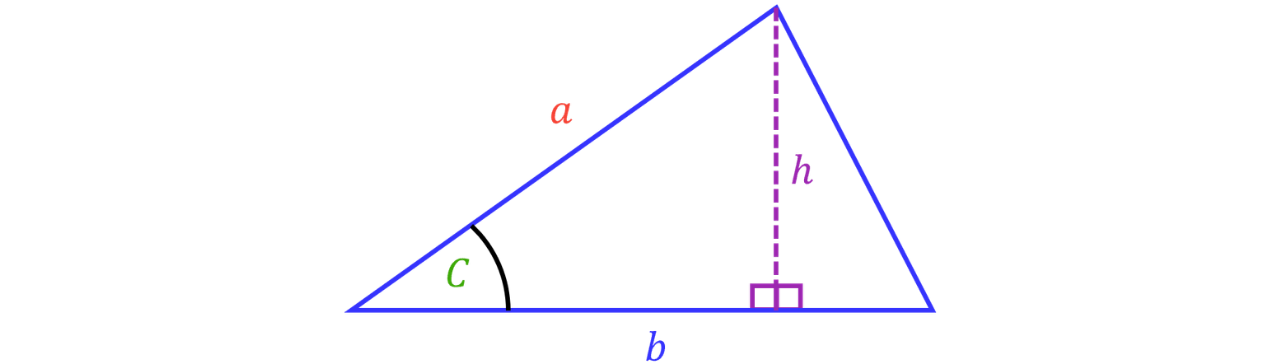
Drawing this line, we have split the triangle into two smaller right-angled triangles. We will focus on the right-angled triangle on the left-hand side. We need to find which we do via SOHCAHTOA.

In this triangle, is the opposite and is the hypotenuse. So, we use the SOH part of SOHCAHTOA.
Multiplying both sides by
Now, we know both the base and the perpendicular height, so we find the area of the triangle using
Area Base Height
So,
Area
Practice Questions
Example 1:
Find the area of the following triangles, giving your answers to decimal place.
a)
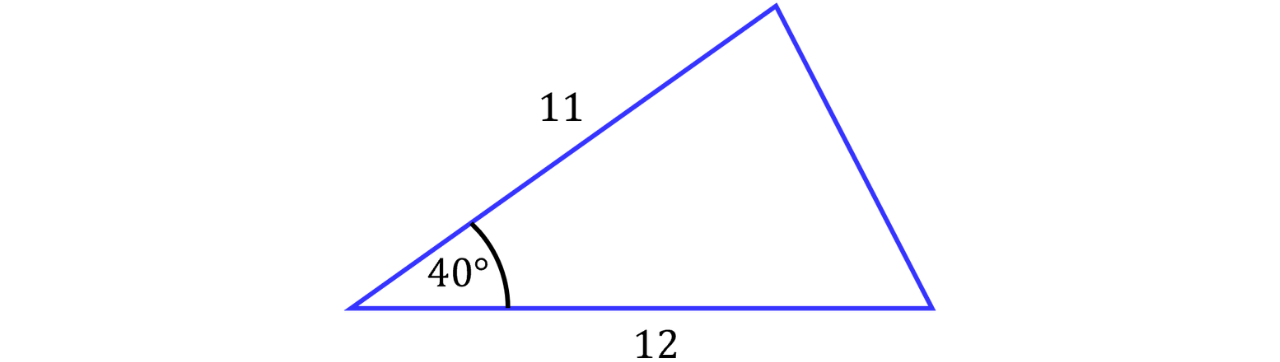
Step 1: Identify the lengths and angles which we will use to substitute into the formula for the area of a triangle.
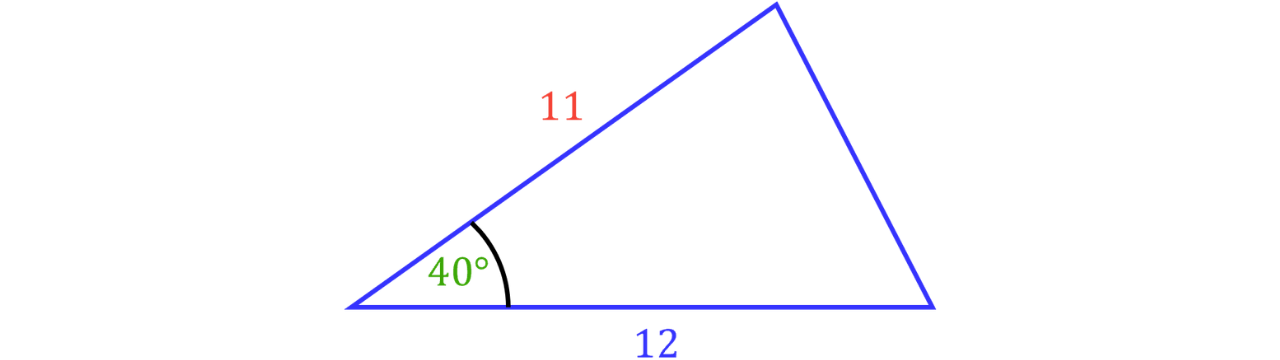
The area, , of any triangle is given by
In this case, we have and
Step 2: Substitute these values into the formula to find the area of the triangle.
Therefore, to decimal place, the area is units².
b)

Step 1: Identify the lengths and angles which we will use to substitute into the formula for the area of a triangle.

In this case, we have and
Step 2: Substitute these values into the formula to find the area of the triangle.
Therefore, to decimal place, the area is units².
So far, we have practised applying the formula directly to find the areas of triangles. We were able to use the formula straight away because we were given two lengths and an angle between them, which were the three components we needed to substitute into the formula.
However, it is rare that we are given all three components at the start. For example, it is common for the angle in between the two sides to not be given, and we would need to find the size of that angle before we can proceed with using the formula to find the area of the triangle.
To find any missing components, we use the other trigonometry rules we learnt: the sine rule and the cosine rule.
For more on these rules, please read our Sine Rule and Cosine Rule study notes.
The Area of a Triangle and The Sine Rule
Example 2:
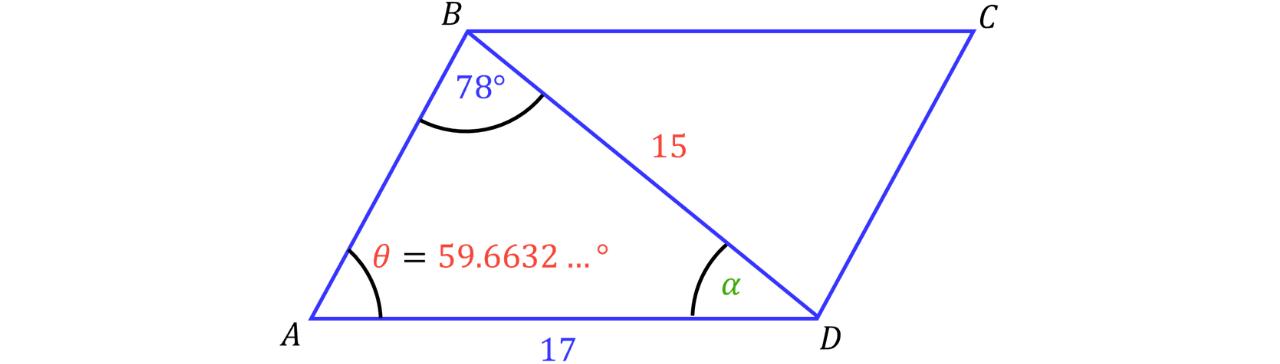
The diagram shows a parallelogram Calculate the area, giving your answer to decimal place.
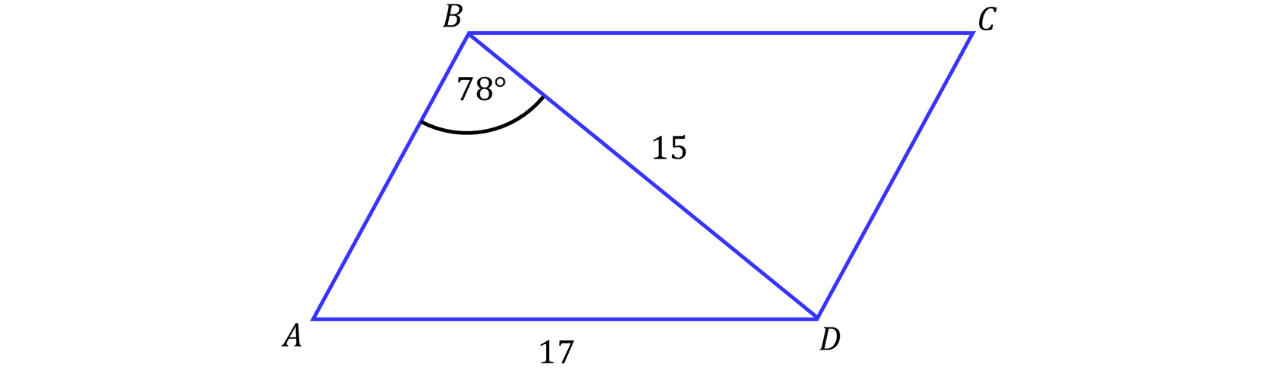
To find the area of the parallelogram, we will find the area of one of the triangles (we will work out the area of triangle ) and then multiply by We can do this because the two triangles, and are congruent. For more details on this, please see our Congruence study note.
Step 1: Identify the components that we need to find the area of triangle
We have two lengths, and , but the angle is not the angle that is wedged in between the two sides. It is angle which we need to find. Unfortunately, we do not have the length that is opposite the angle so we must find angle first. Then, we can use the fact that angles in a triangle add up to to find angle
Step 2: Use the sine rule to find angle
As a reminder, the sine rule (rearranged with the angle on top) is given by
We will use the sine rule because we are given an angle its opposite side and another side We can find the size of angle labelled in the following diagram, which lies opposite the
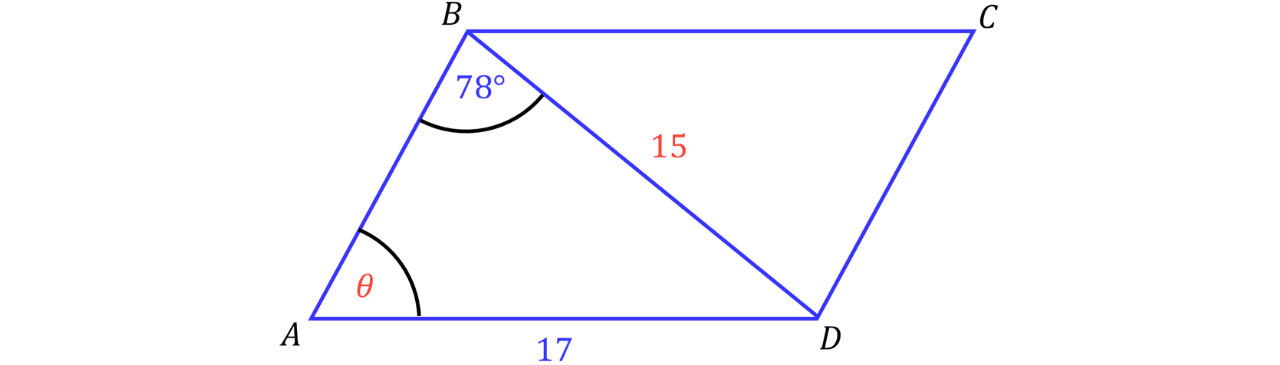
So, we have and
Substituting these values into the sine rule,
Next, we multiply both sides by to bring it to the right-hand side and remove it from the denominator on the left-hand side.
Then, we use the calculator to apply to both sides to isolate
Note: We will be using this value in future calculations, so we keep this answer exact to avoid rounding errors towards the end. You can store this value in your calculator or use the ANS button.
Step 3: Use the fact that angles in a triangle add up to to find angle
Since angles in a triangle add up to
Subtracting and from both sides,
Note: Once again, we keep this value exact as we will be using it later.
Step 6: Find the area of triangle
Area
We substitute and into the formula.
Area
Step 7: Find the area of the parallelogram.
To find the area of the parallelogram, we multiply the area of triangle by
Therefore, to decimal place, the area of the parallelogram is units².
The Area of a Triangle and The Cosine Rule
Example 3:
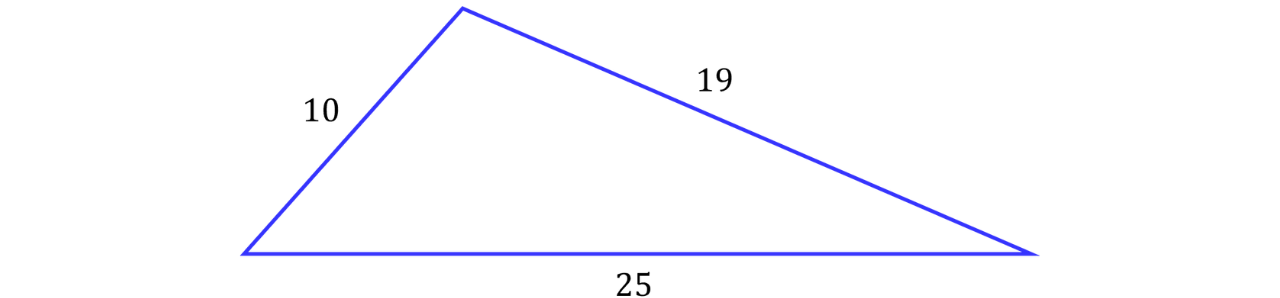
Find the area of this scalene triangle.
Step 1: Identify the lengths and angles which we will use to substitute into the cosine rule.
Here, we are given three lengths but no angles, so we can’t work out the area directly. Therefore, we will need to find an angle, which we will use the cosine rule for.
In this case, we can choose to find any of the three angles. This is because for any angle we find, there will be known lengths on both sides of it and, hence, we can calculate the area after.
As a reminder, the cosine rule is
If we rearrange the rule for an angle, we get
We will work out the angle that’s labelled in the following diagram.
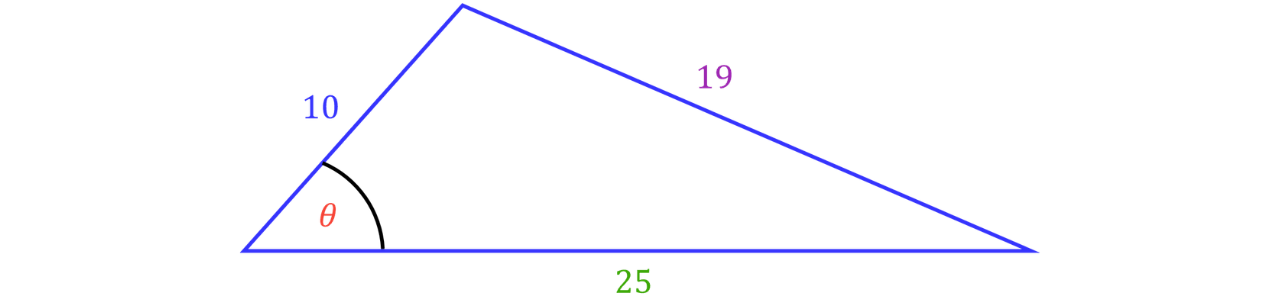
Here, we have and
Step 2: Substitute these values into the rearranged cosine rule to find the missing angle
Typing the right-hand side into the calculator,
Step 3: Use the calculator to apply to both sides.
Step 4: Find the area of the triangle.
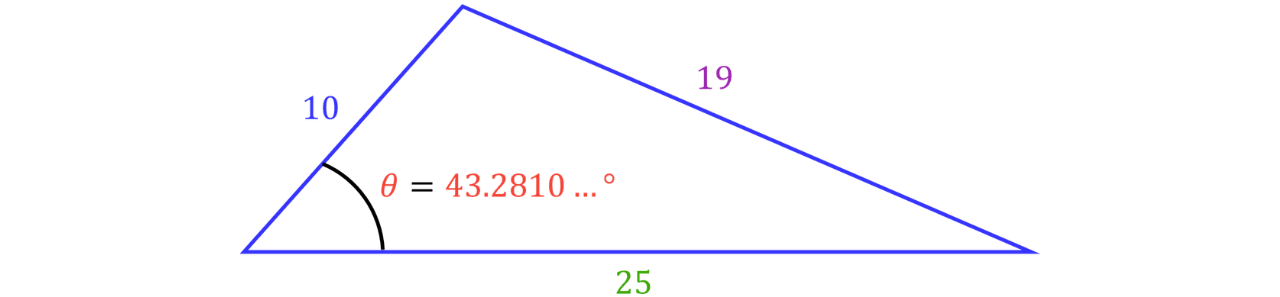
Now, we have an angle that’s between two lengths, so we can find the area of the triangle now.
We substitute and into the formula.
Area
Therefore, to decimal place, the area of the triangle is units².
Working Backwards
We may get questions where we are giving the area and then asked to find a missing side or angle.
Example 4:
The diagram shows a triangle where cm and
Given that the area of the triangle is cm², find the length of giving your answer to decimal place.
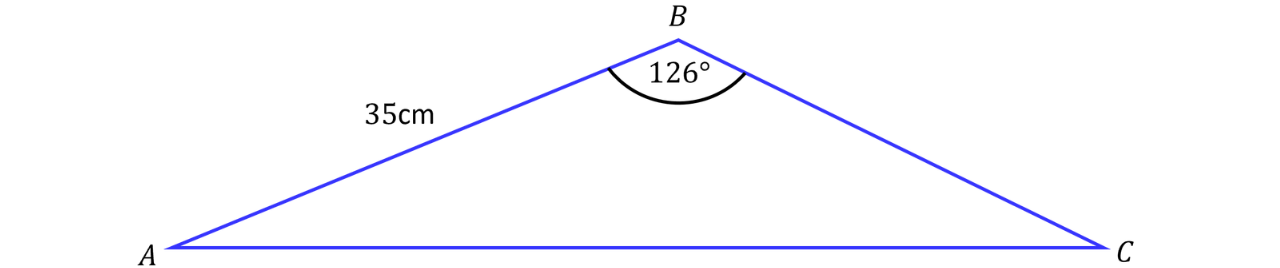
Step 1: Use the formula of the area of the triangle to form an equation, using the information that we have.
The area of a triangle is given by
Area
We have one of the side lengths cmand the angle However, we don’t have the side length, on the other side of the angle. Let’s call it for the time being.
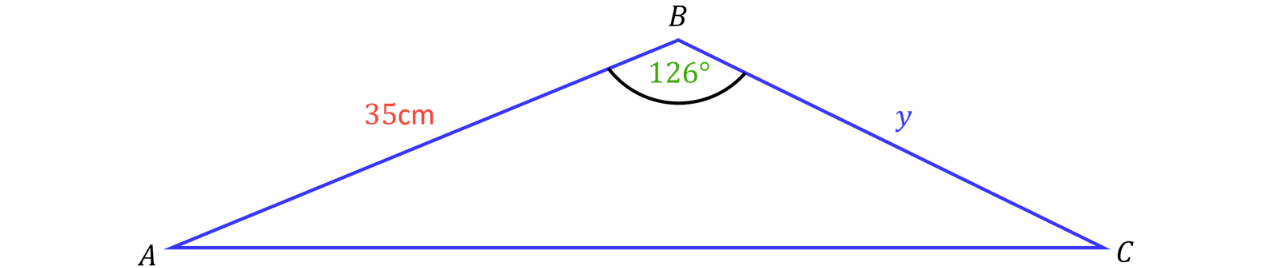
Substituting and Area into the formula,
Step 2: Solve for
Firstly, we multiply both sides by to get rid of the
Then, we divide both sides by and
cm
Step 3: Use the cosine rule to find the length of
Let the length of be
The cosine rule is
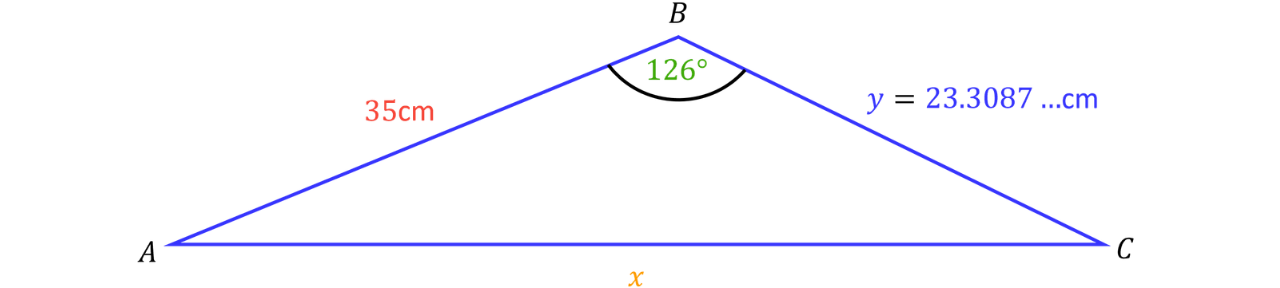
Here, we have and Substituting these values into the cosine rule,
Computing the right-hand side on our calculator,
Square rooting both sides,
Therefore, to decimal place, the length of is cm.
Challenging Questions