The Sine Rule
Neil Trivedi
Teacher

Contents
The Sine Rule
The sine rule is a formula that connects the sides of a triangle to the angles opposite them. Unlike SOHCAHTOA, which only works in right-angled triangles, the sine rule works in any triangle.
Here is a general, non-right-angled triangle with all three sides and all three angles labelled. Each side is assigned a lower-case letter which matches the capital letter of the angle directly opposite it (i.e. side is opposite angle side is opposite angle and side is opposite angle
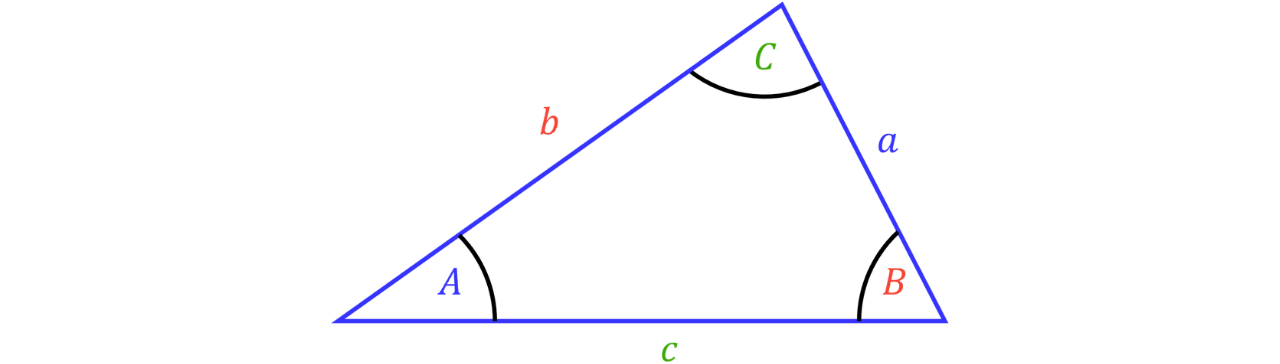
The Sine
The sine rule is given by
To note, we only ever use two of the three fractions at a time.
Generally, we use the sine rule when we are working with two angles and their opposite sides, where one of these four values is unknown.
Finding a Missing Side using the Sine Rule
When the unknown value is a side, it is easiest to keep the version of the formula with the sides on top. We always rearrange the formula so that the unknown is in the numerator.
Example 1:
Find the length in each triangle, giving your answers to significant figures.
a)
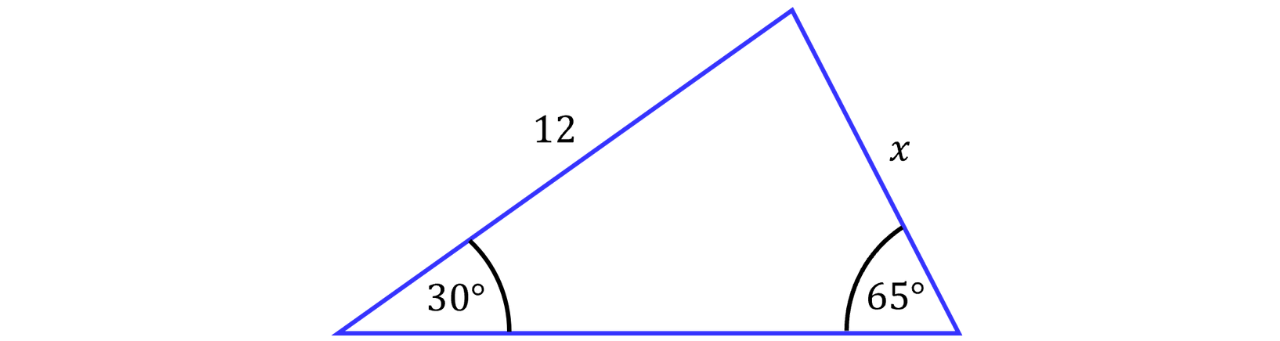
Step 1: Identify the lengths and angles which we will use to substitute into the sine rule.
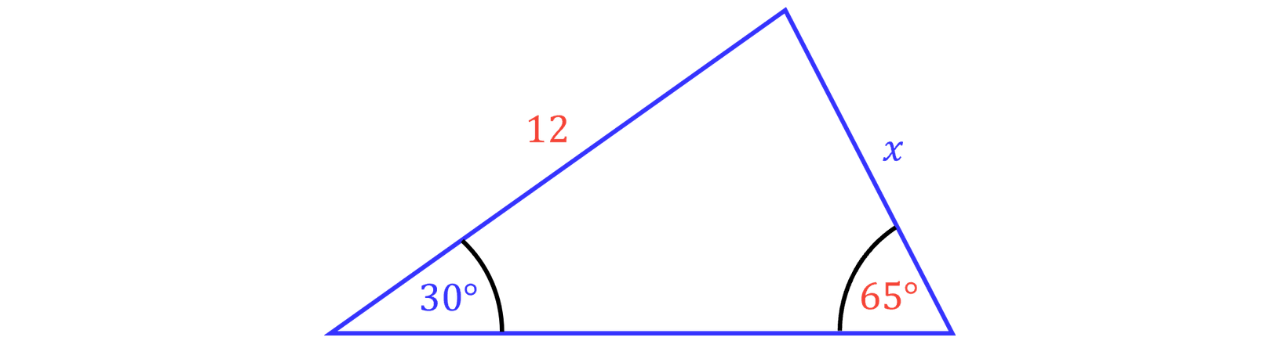
The sine rule is
We did not include the third fraction, because it is not needed for this calculation.
In this case, we have and
Step 2: Substitute these values into the sine rule and rearrange to find the missing length
To isolate we multiply both sides of the equation by sin to bring it to the right-hand side and remove it from the denominator on the left-hand side.
Computing the right-hand side on our calculator, we get
Therefore, to significant figures,
b)
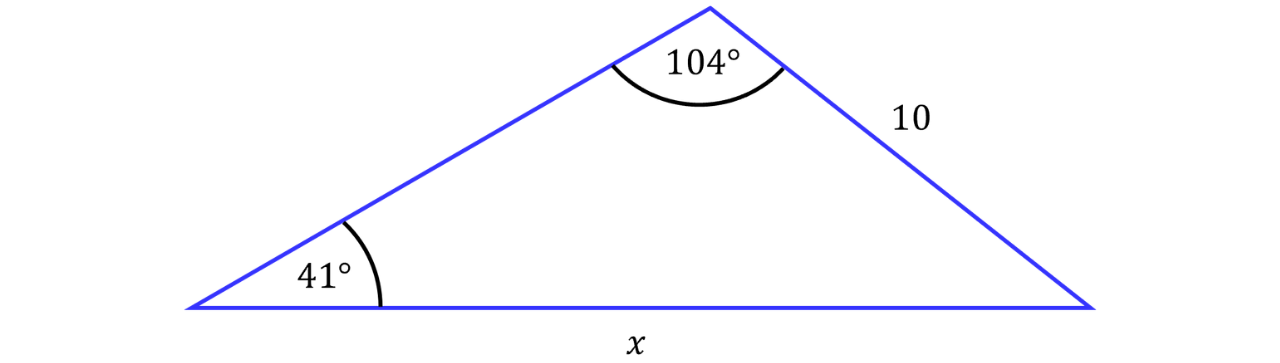
Step 1: Identify the lengths and angles which we will use to substitute into the sine rule.
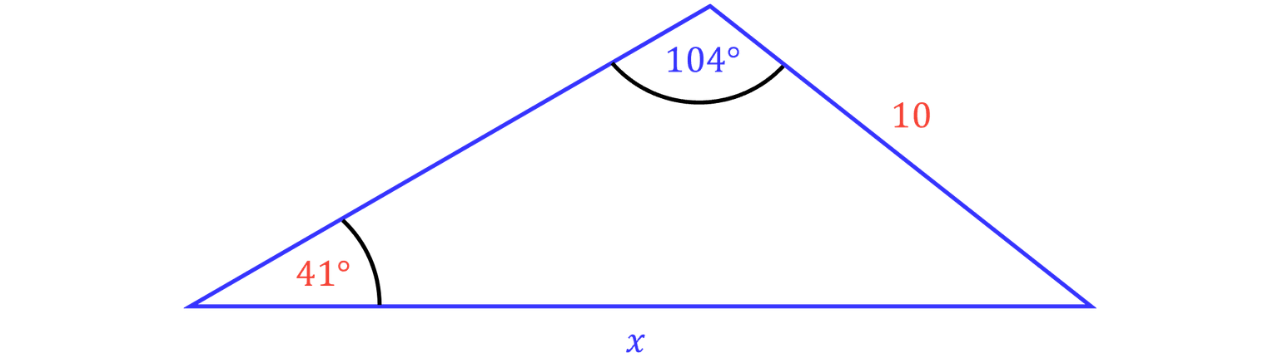
In this case, we have
Step 2: Substitute these values into the sine rule and rearrange to find the missing length
To isolate we multiply both sides of the equation by sin to bring it to the right-hand side and remove it from the denominator on the left-hand side.
Computing the right-hand side on our calculator, we get
Therefore, to significant figures,
Finding a Missing Angle using the Sine Rule
When the unknown is an angle, it is easier to ‘flip’ the formula, so the sines are on top. This keeps what we’re looking for in the numerator.
The Sine Rule (missing angle)
Example 2:
Find the missing acute angles of the following triangles, giving your answers to decimal place.
a)
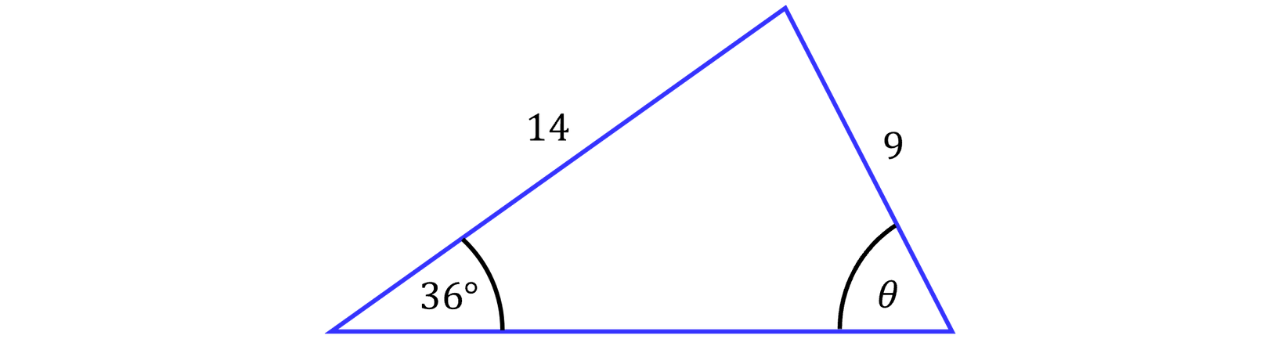
Step 1: Identify the lengths and angles which we will use to substitute into the flipped sine rule.
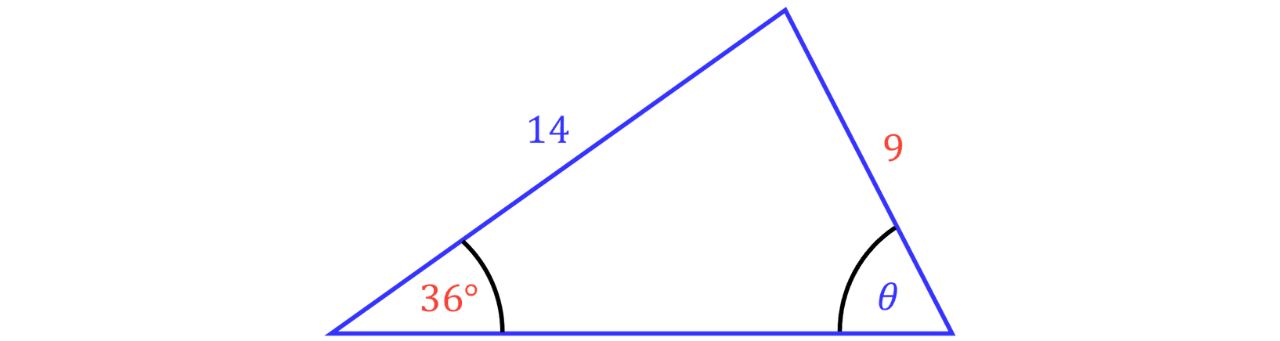
The flipped sine rule is
In this case, we have and
Step 2: Substitute these values into the sine rule and rearrange to find the missing angle
Next, we multiply both sides by to bring it to the right-hand side and remove it from the denominator on the left-hand side.
Step 3: Use the calculator to apply to both sides to isolate
Therefore, to decimal place,
b)
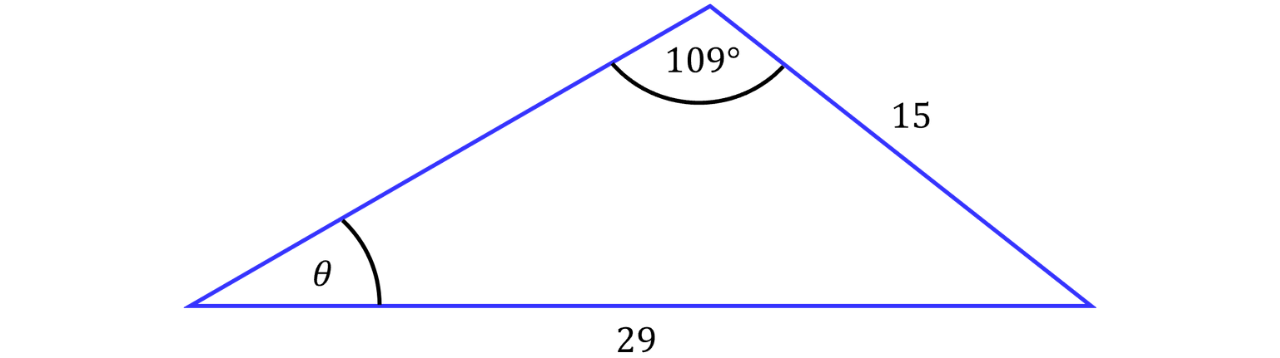
Step 1: Identify the lengths and angles which we will use to substitute into the flipped sine rule.
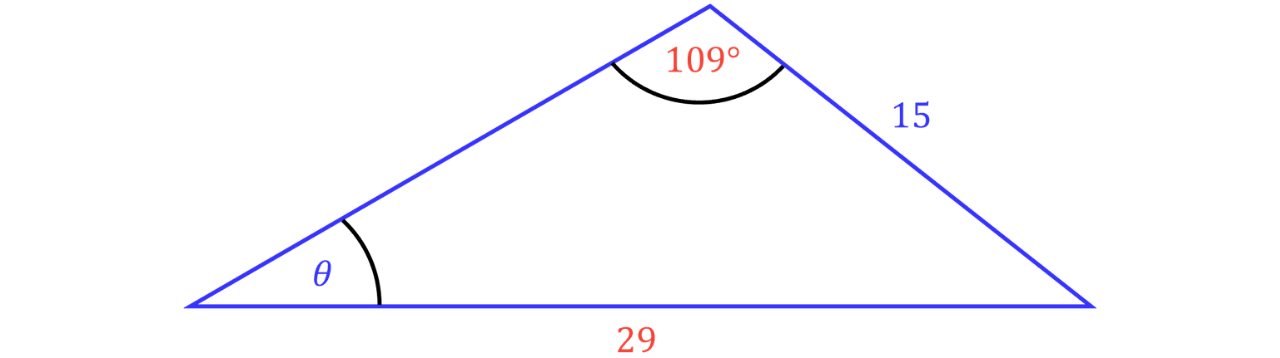
In this case, we have
Step 2: Substitute these values into the sine rule and rearrange to find the missing angle
Next, we multiply both sides by to bring it to the right-hand side and remove it from the denominator on the left-hand side.
Step 3: Use the calculator to apply to both sides to isolate
Therefore, to decimal place,
Finding the Missing Side when the Opposite Angle is Unknown
Sometimes, we are asked to find the missing side, but the opposite angle is missing. For these questions, we need to follow these steps:
Use the sine rule to find the other missing angle.
Use the fact that angles in a triangle add up to to find the angle that lies opposite to the side we’re looking for.
Use the sine rule a second time to find the side.
Example 3:
In triangle and angle
Given that angle is acute, find the length giving your answer to significant figures.
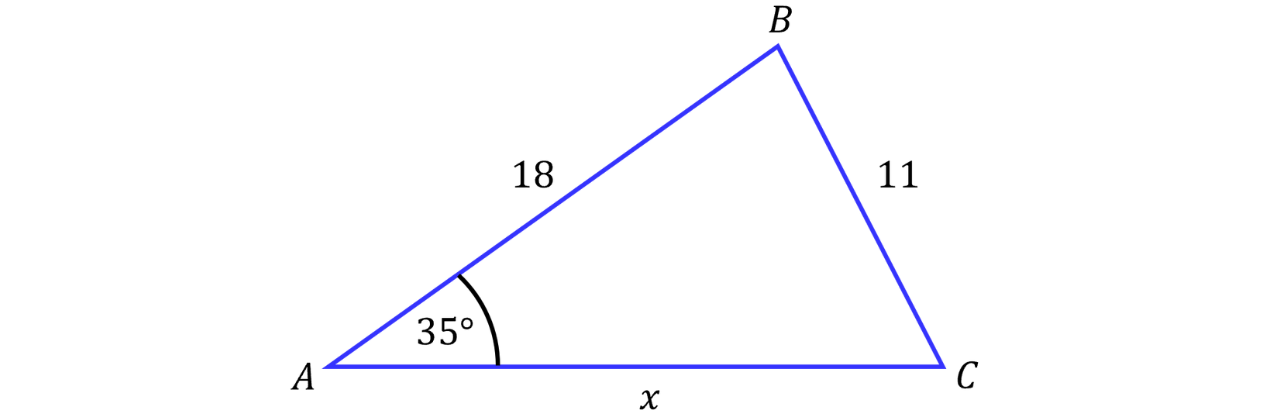
Step 1: Label the lengths and angles on the triangle which we will use to substitute into the sine rule.
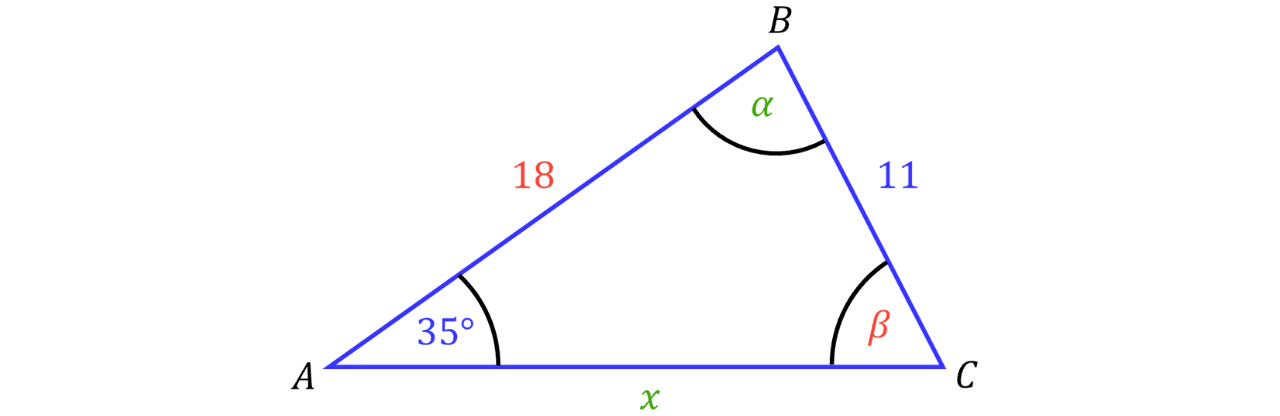
We will use the flipped sine rule:
In this case, we have and
Step 2: Use the sine rule to find the missing angle
Substituting these values into the sine rule,
Next, we multiply both sides by to bring it to the right-hand side and remove it from the denominator on the left-hand side.
Then, we use the calculator to apply to both sides to isolate
To note, we keep this angle unrounded to avoid rounding errors as we will be using it in further calculations. So, we store this value in our calculator.
Step 3: Use the fact that angles in a triangle add up to to find angle
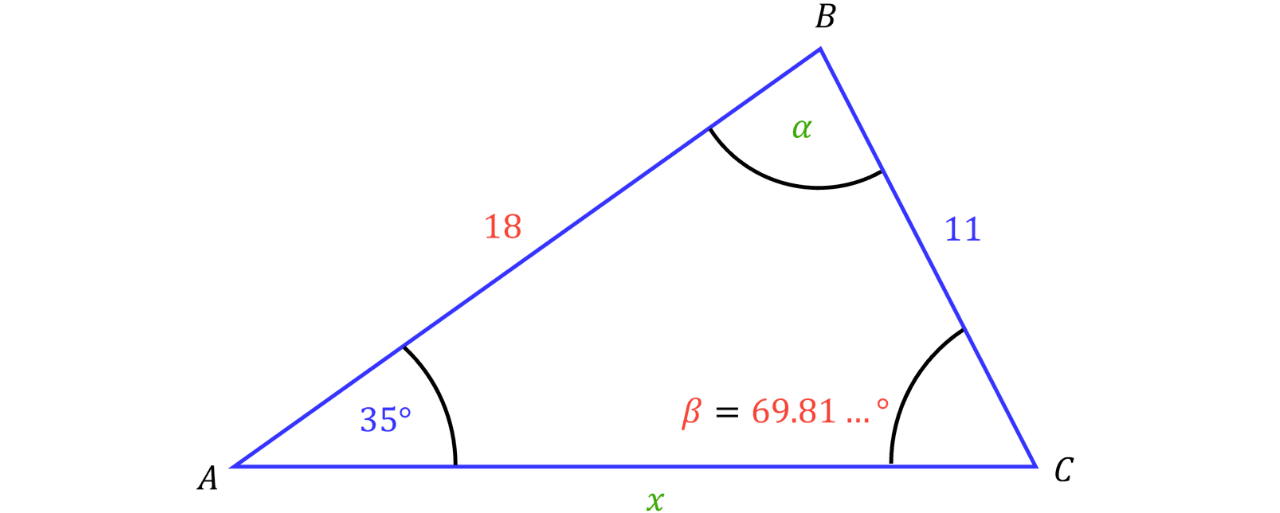
Subtracting and from both sides,
To note, we keep unrounded and store it in our calculator.
Step 4: Use the sine rule to find the missing side
We will use the regular sine rule with the sides on top. We could use either of the two other pairs of opposite sides and angles, but it would be easier to use the pair since these are clean values.
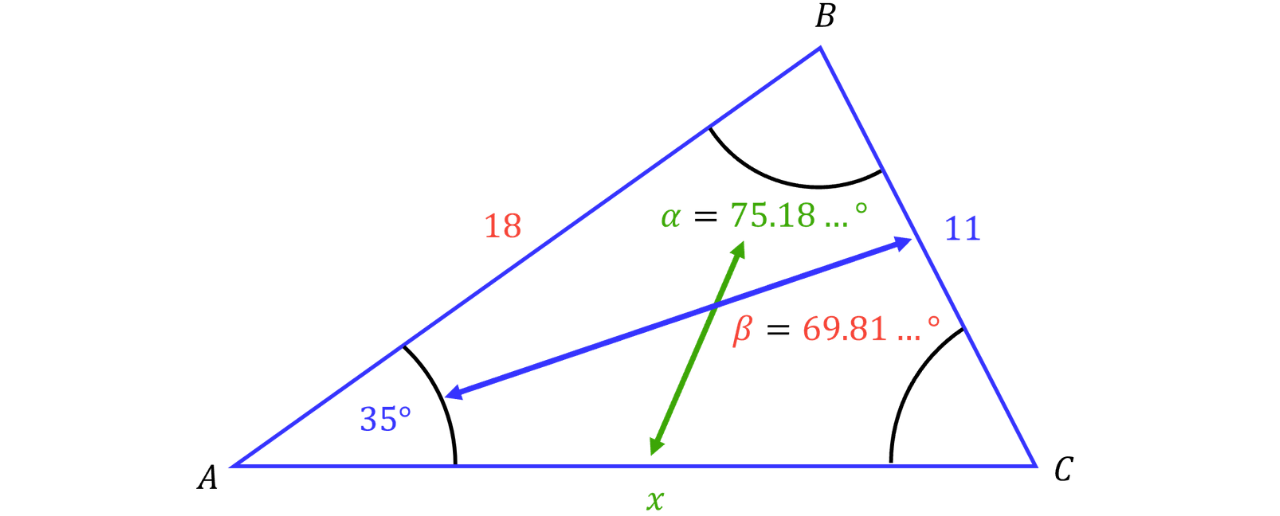
Here, we have and
Substituting these values into the sine rule,
To isolate we multiply both sides of the equation by sin to bring it to the left-hand side and remove it from the denominator on the right-hand side.
Computing the left-hand side on our calculator, we get
Therefore, to significant figures,
The Ambiguous Case for Sine
Sometimes, when we are given three pieces of information (one angle and two sides), we can construct two different triangles from them, one containing an unknown acute angle and the other an unknown obtuse angle.
This is known as the ambiguous case for sine, and the question will state clearly whether it wants the acute or the obtuse angle.
Suppose we have a triangle where and angle There are two possible triangles we could draw from this information.
Triangle Acute Angle
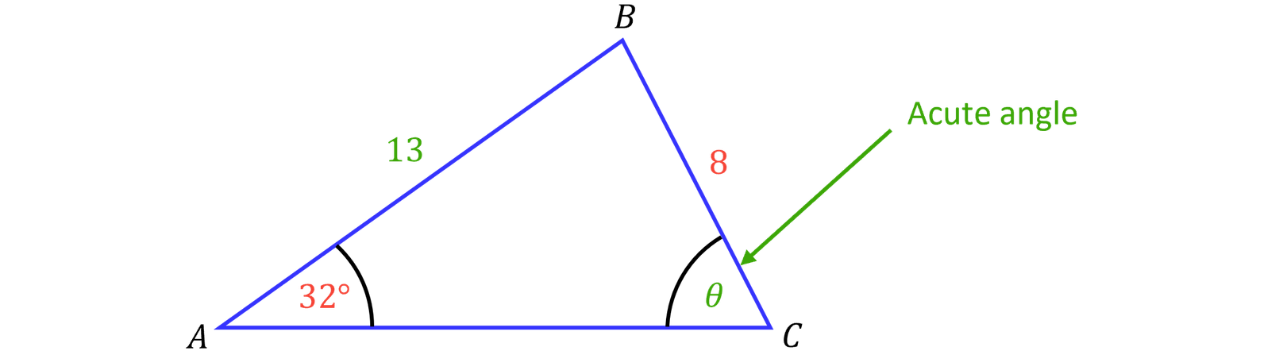
Here, the angle at is acute. To find it, we use the flipped sine rule, keeping the unknown angle on top.
Multiplying both sides by
Applying to both sides,
Triangle Obtuse Angle
The same three measurements also fit a second triangle. This time, the angle at is obtuse.
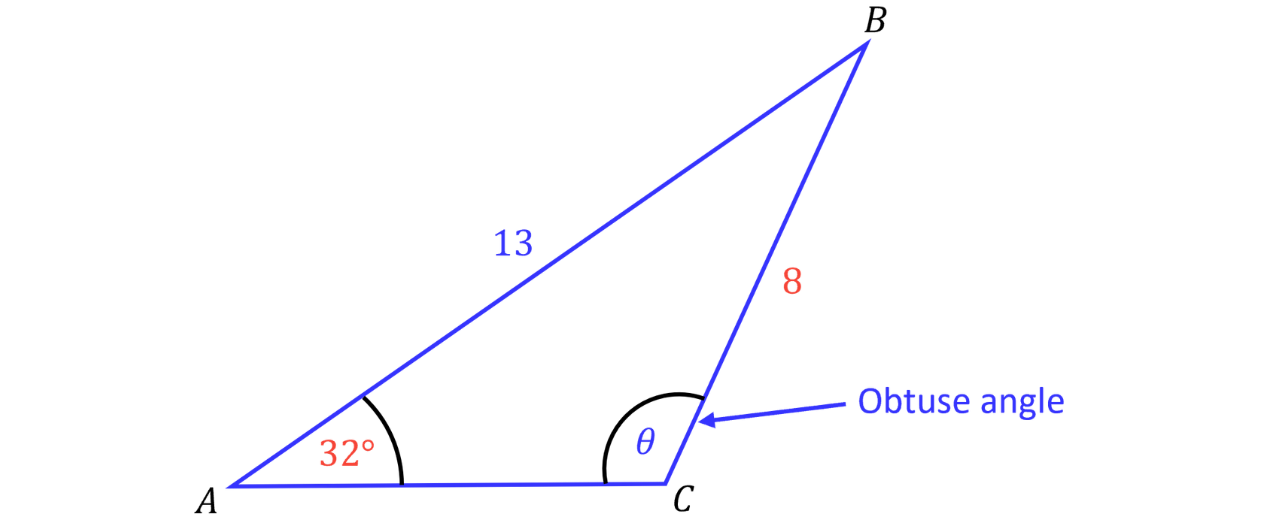
Here, is obtuse. We begin with the flipped sine rule exactly as before.
The working out is identical to the one from triangle so the calculator again gives the acute value
To find the obtuse angle, we subtract this from
To confirm that both triangles exist, we check that the third angle is positive. It works out to be about in triangle and in triangle so both are valid.
Why the Obtuse Angle Works
We ask ourselves why subtracting from gives the second (obtuse) angle. The reason lies in the sine graph.
The button on a calculator only ever gives the first (acute) angle. This is known as the primary value. However, there is a second angle with exactly the same sine, and the graph shows us where it is. This second angle is known as the secondary value.
Between and the sine graph increases from to its maximum of at and then decreases back to in a mirror image, so it’s symmetrical about
A horizontal line, drawn at the height of our sine value, meets the curve at two places, one before and one after, sitting the same distance either side of
In our example, the first is the acute primary value of and the second is the obtuse secondary value of
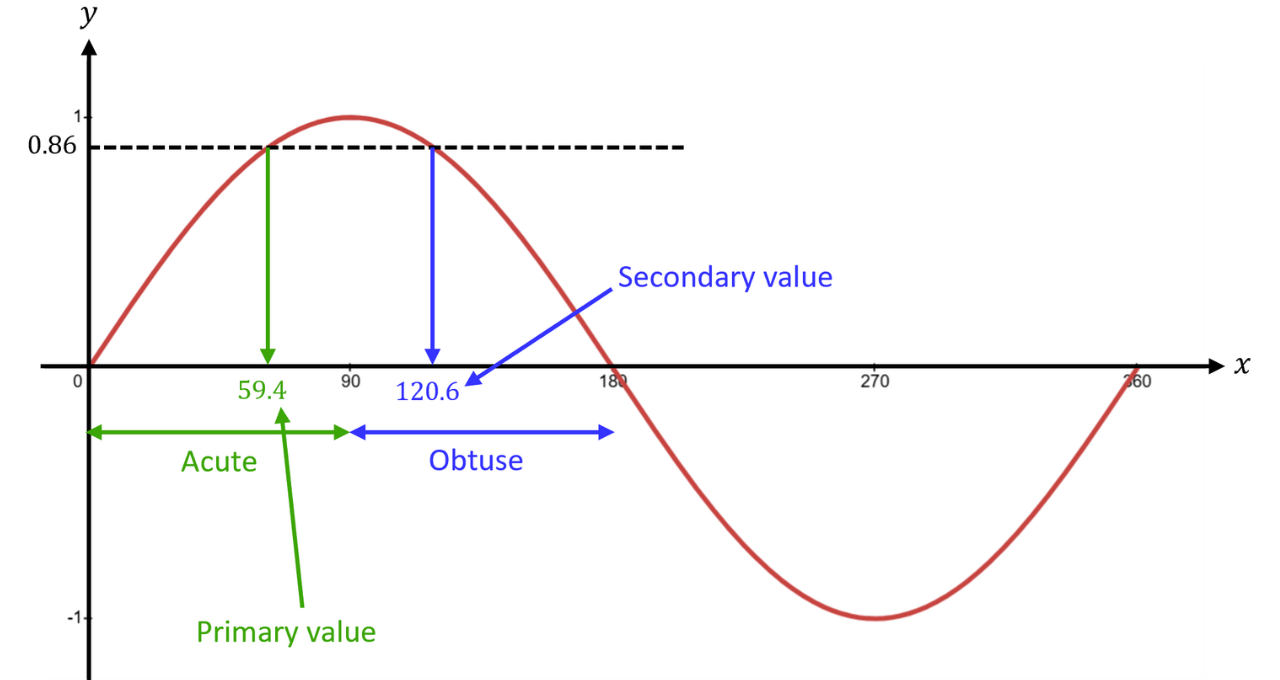
Since the two angles sit at equal distances from they always add up to So, that’s why we subtract the primary value from to get the secondary value.
To find a missing obtuse angle when applying the sine rule, we use this rule:
Obtuse angle Acute angle
Example 4:
Find the missing obtuse angle in the following triangle, giving your answer to decimal place.
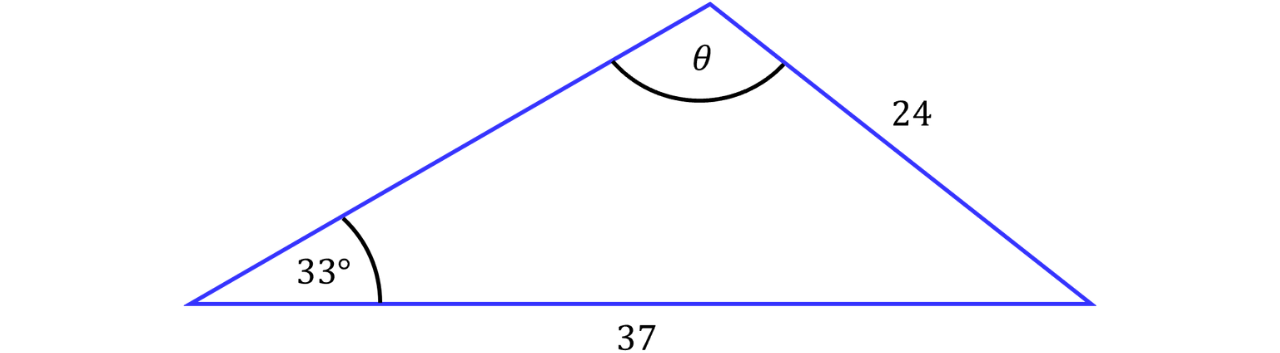
Step 1: Identify the lengths and angles which we will use to substitute into the flipped sine rule.
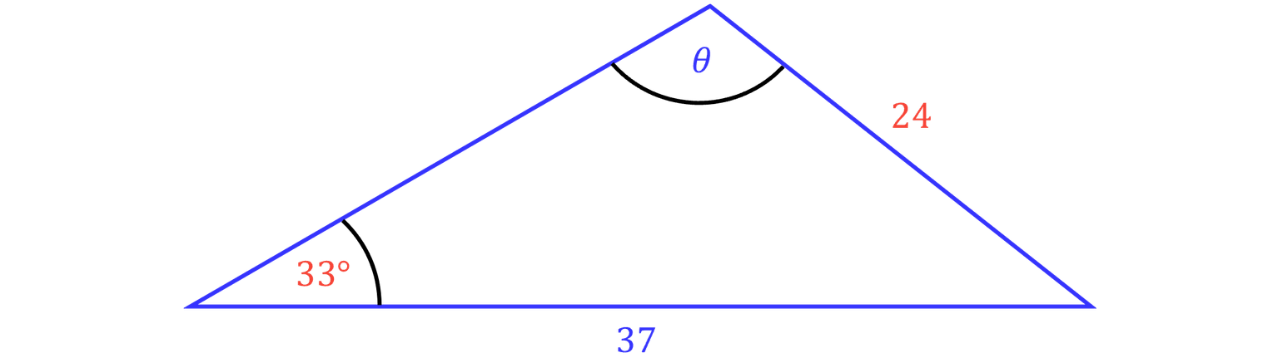
We will use the flipped sine rule
In this case, we have and
Step 2: Substitute these values into the sine rule and rearrange to find the missing angle
Next, we multiply both sides by to bring it to the right-hand side and remove it from the denominator on the left-hand side.
Step 3: Use the calculator to apply to both sides to isolate
Step 4: Find the obtuse angle.
We have found the acute angle to be
However, the question asks for the obtuse angle. So, we subtract the acute angle from
Therefore, to decimal place, the missing obtuse angle is
Challenging Question