The Cosine Rule
Neil Trivedi
Teacher

Contents
The Cosine Rule
For right-angled triangles, we can use SOHCAHTOA to find a missing side or angle. However, this cannot be used for non-right-angled triangles, which is why we use rules such as the cosine rule.
The cosine rule is used when we are working with one angle and three sides, where only one of those four quantities can be unknown. Traditionally, we use the cosine rule to find the length of the side that’s opposite the angle.
The Cosine Rule
The cosine rule is given by
where is the angle that’s between sides and and is the side opposite that angle.
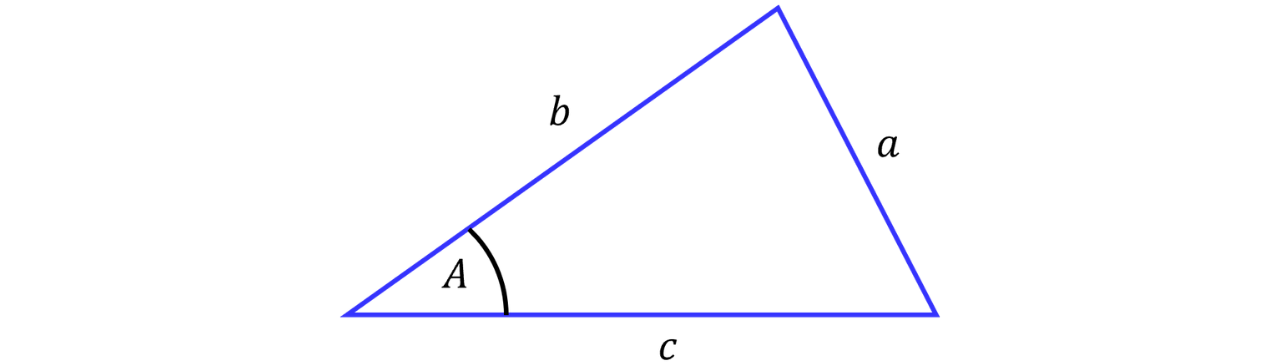
Notice that if then the cosine rule reduces to Pythagoras’ Theorem. Here’s why.
When we substitute into the cosine rule, we get
Recall that cos Therefore, the entire term becomes and hence disappears. Then, we’re left with
which is exactly Pythagoras’ Theorem with the letters in a different order. Here, the hypotenuse would be (opposite the angle).
Finding a Missing Side using the Cosine Rule
Example 1:
Find the missing sides of the following triangles, giving your answers to significant figures:
a)
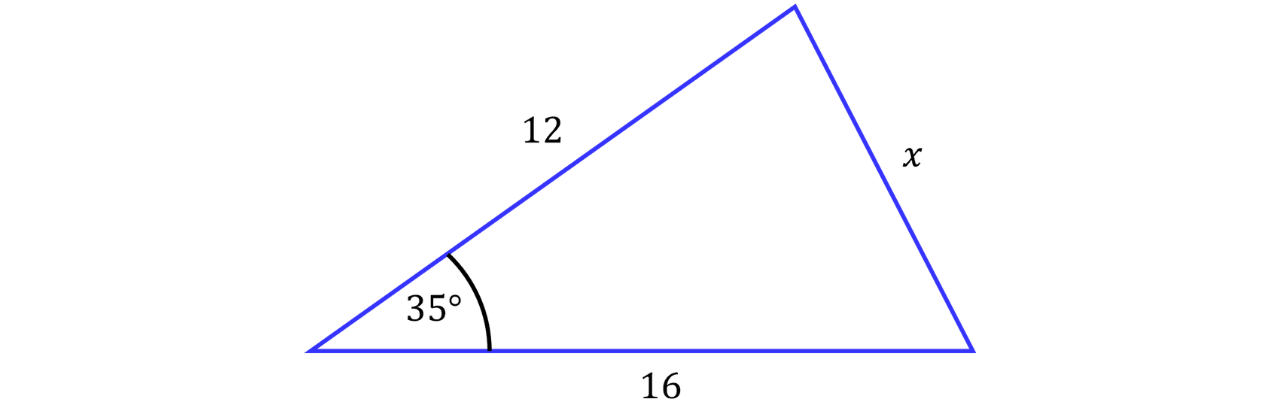
Step 1: Identify the lengths and angles which we will use to substitute into the cosine rule.
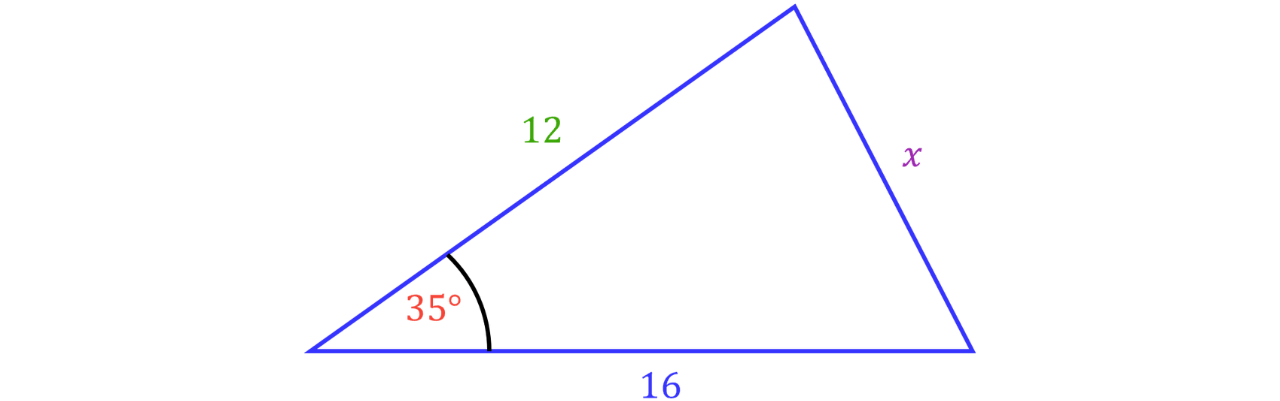
The cosine rule is
In this case, we have and
Note that it does not matter which of or we label as and which we label as because those lengths are on either side of the angle. It is only what we label as length that must be opposite the angle
Step 2: Substitute these values into the cosine rule to find the missing length
Computing the right-hand side on our calculator,
Square rooting both sides,
Therefore, to significant figures,
b)
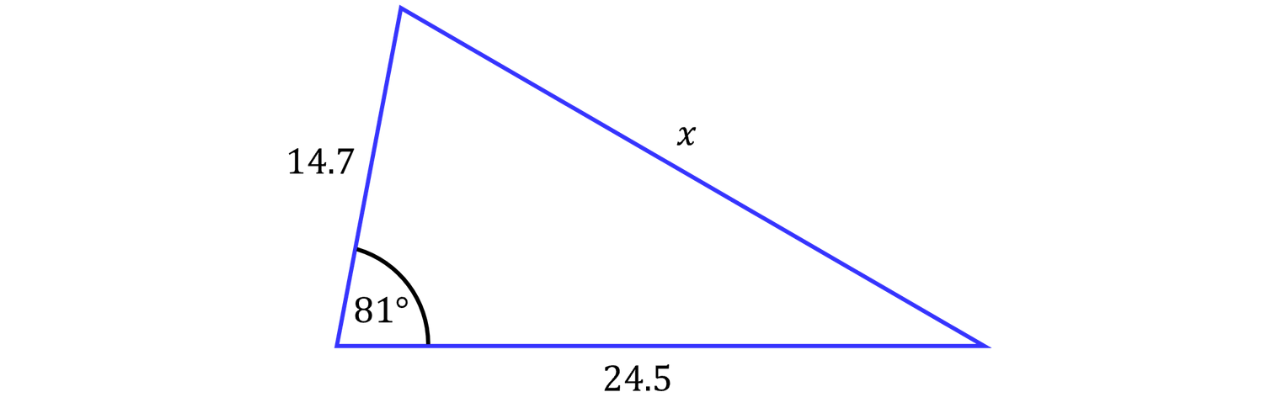
Step 1: Identify the lengths and angles which we will use to substitute into the cosine rule.
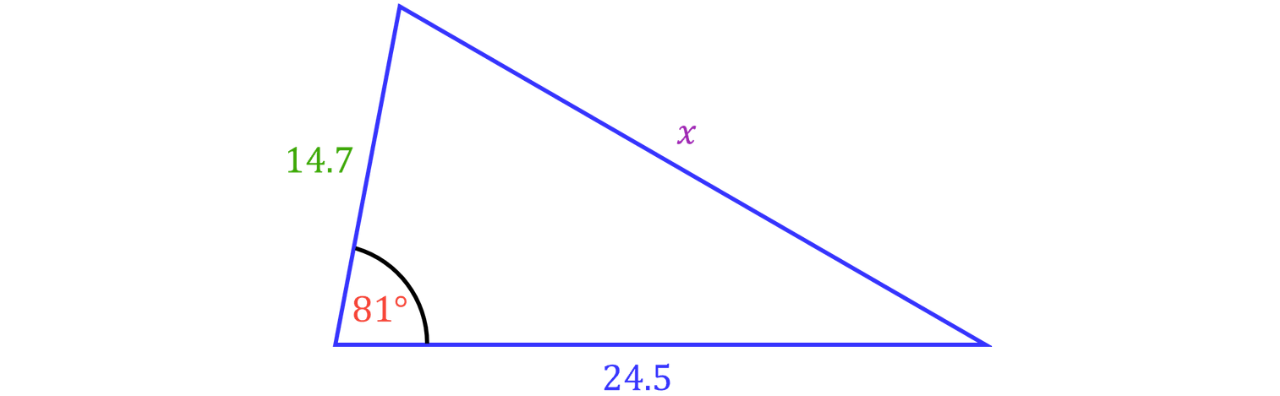
In this case, we have and
Step 2: Substitute these values into the cosine rule to find the missing length
Computing the right-hand side on our calculator,
Square rooting both sides,
Therefore, to significant figures,
Finding a Missing Angle using the Cosine Rule
We can use the cosine rule to find a missing angle. However, we can only use the rule if we are given all three sides.
In order to work out the angle, we need to rearrange the cosine rule to isolate the angle
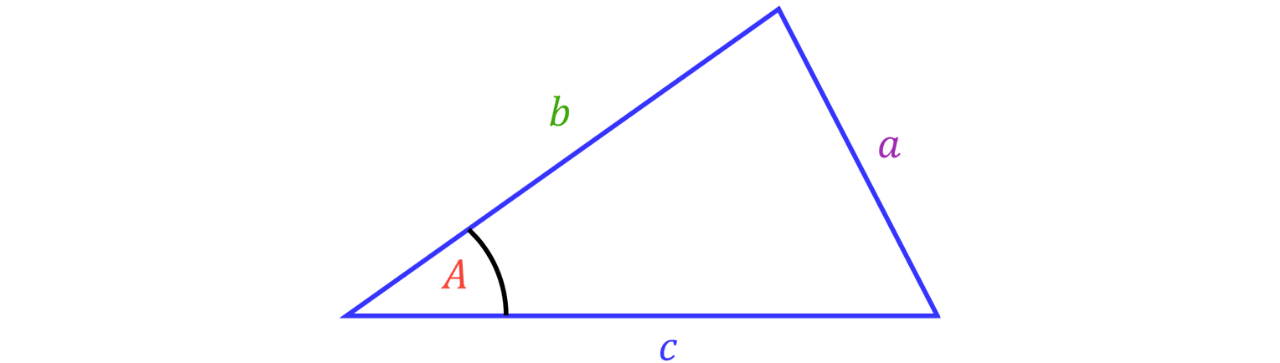
Let’s start with the cosine rule
We start by moving the term to the right-hand side and the term to the left-hand side.
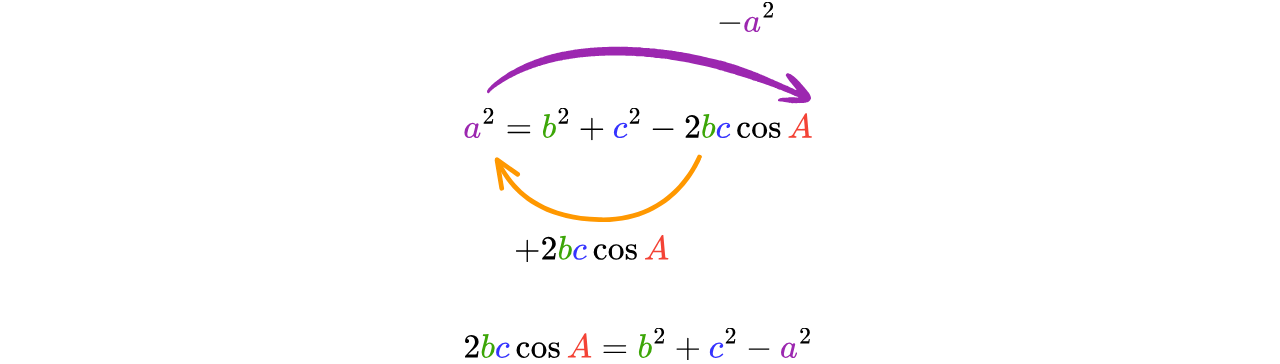
Then, we divide both sides by
This is the rearranged cosine rule which we begin with when working out the angle.
Finally, to work out the angle we use our calculators and apply to both sides.
The Cosine Rule (rearranged for an angle)
Example 2:
Find the missing angles in the following triangles, giving your answers to decimal place.
a)
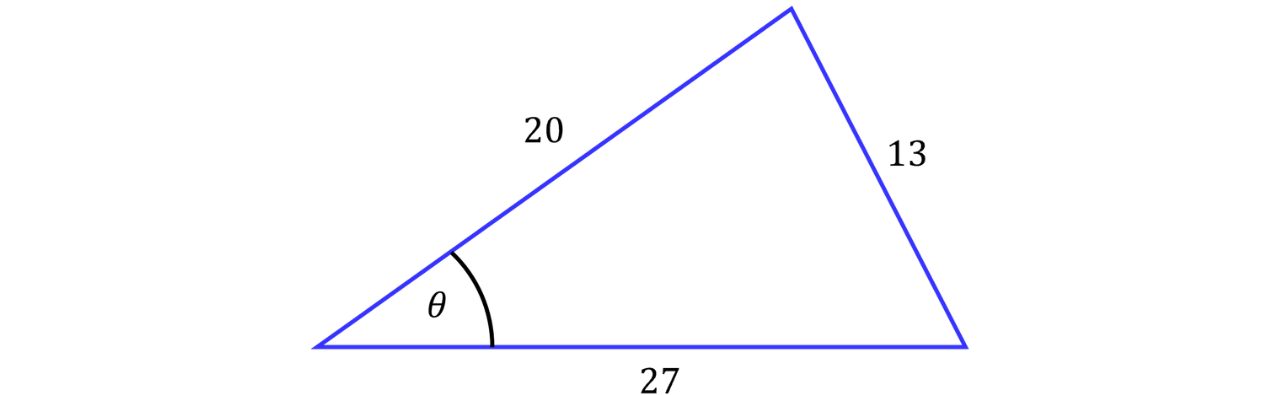
Step 1: Identify the lengths and angles which we will use to substitute into the cosine rule.
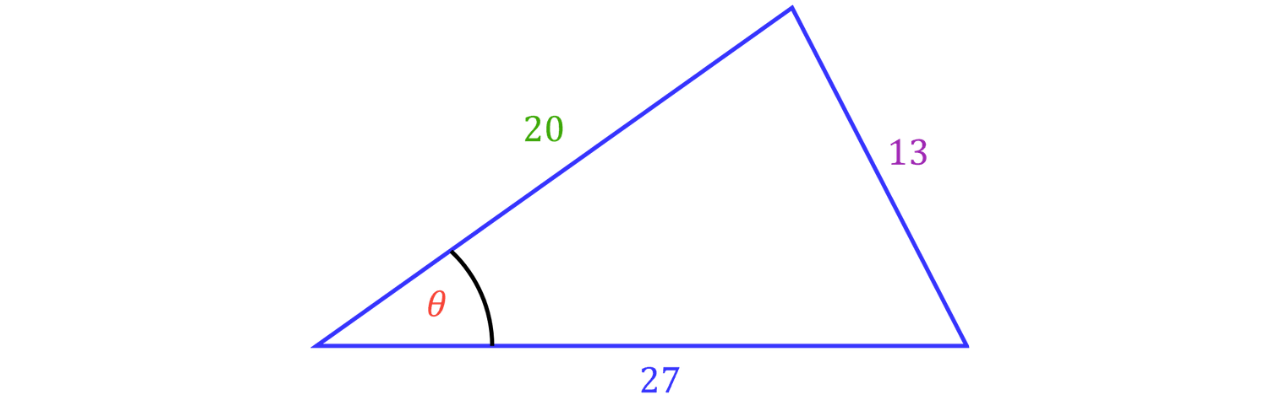
In this case, we have and
Step 2: Substitute these values into the rearranged cosine rule.
Our rearranged cosine rule is
Substituting our values into the formula,
Typing the right-hand side into the calculator,
Step 3: Use the calculator to apply to both sides.
Therefore, to decimal place,
b)
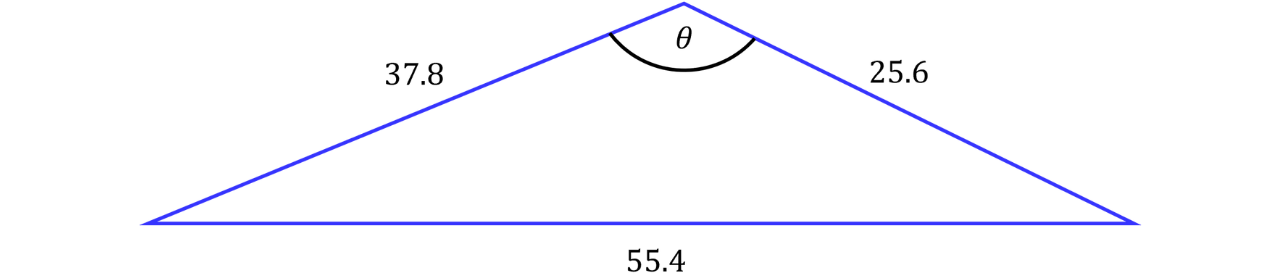
Step 1: Identify the lengths and angles which we will use to substitute into the cosine rule.
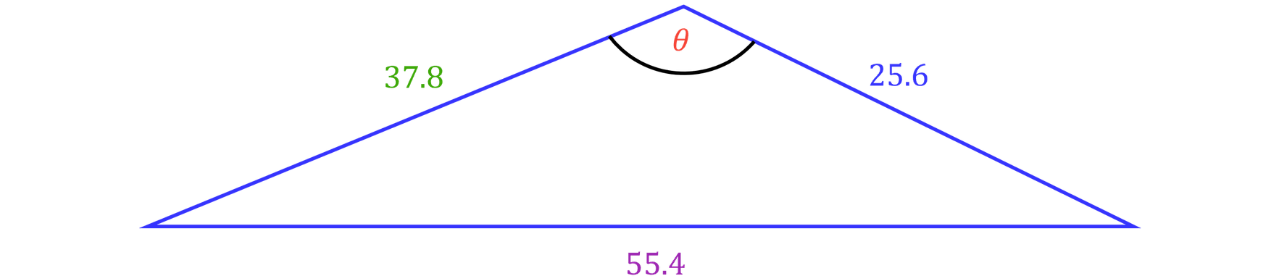
In this case, we have and
Step 2: Substitute these values into the rearranged cosine rule.
Substituting our values into the rearranged cosine rule,
Typing the right-hand side into the calculator,
Step 3: Use the calculator to apply to both sides.
Therefore, to decimal place,
Example 3:
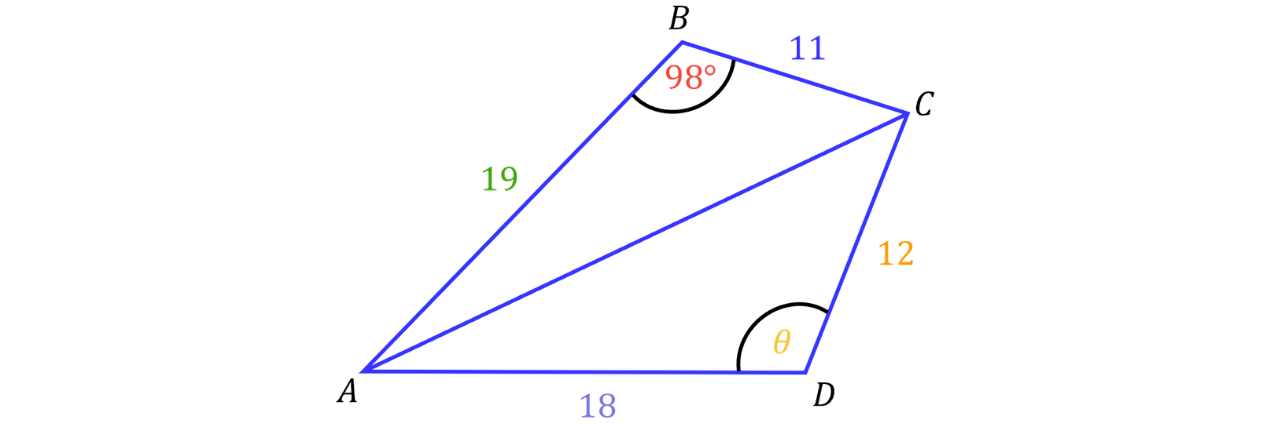
The diagram shows a quadrilateral where and angle
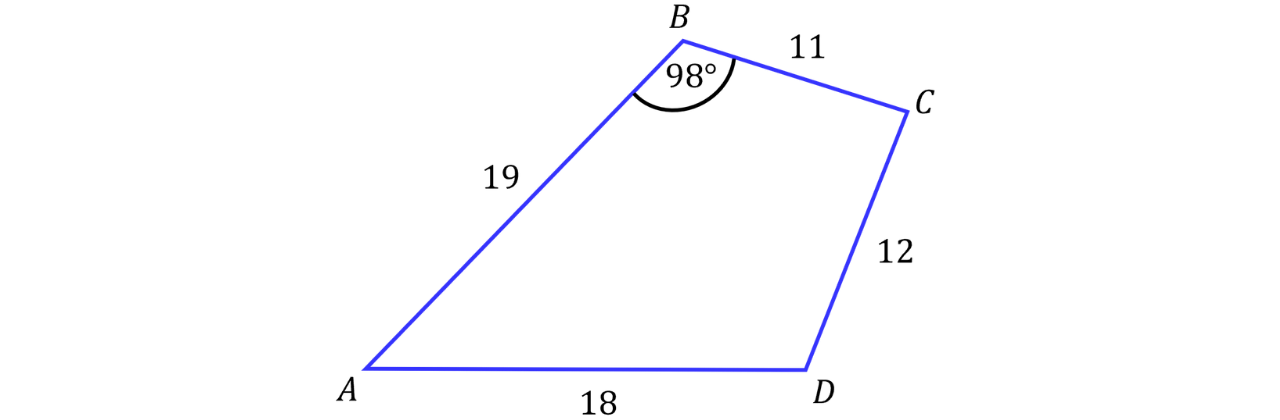
Work out the size of angle Give your answer to decimal place.
Step 1: Draw a line to divide the quadrilateral into two triangles so that we can use the cosine rule.
We draw a line between and This splits the quadrilateral into two triangles, and we avoid splitting the known angle of which we need when using the cosine rule.
The following diagram shows the quadrilateral divided into triangles and
Step 2: Use the cosine rule to find the length from triangle
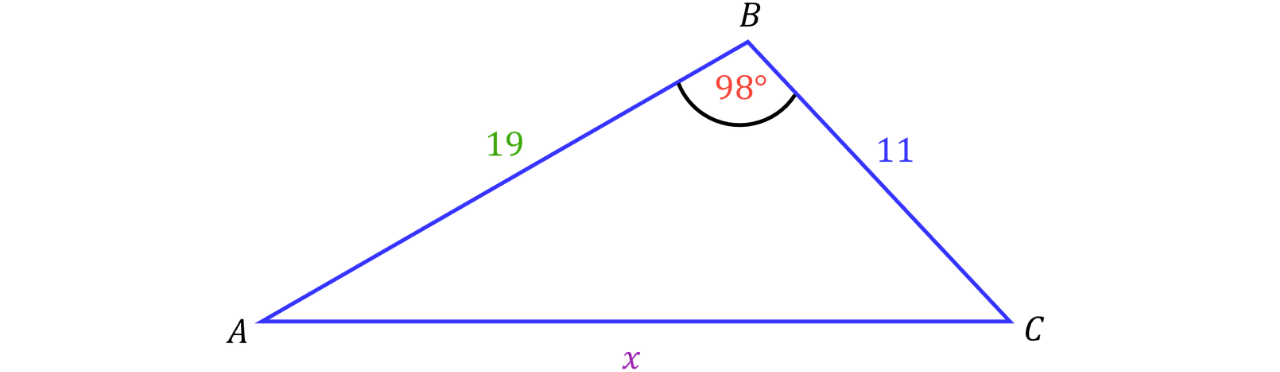
The cosine rule is
In this triangle, we have and
Computing the right-hand side on our calculator,
Square rooting both sides,
To avoid rounding errors in our final answer, we do not round the value of Instead, we store the unrounded value in our calculator to use later (or keep the answer on our calculator and use the ANS button).
Step 3: Use the cosine rule to find the anglefrom triangle
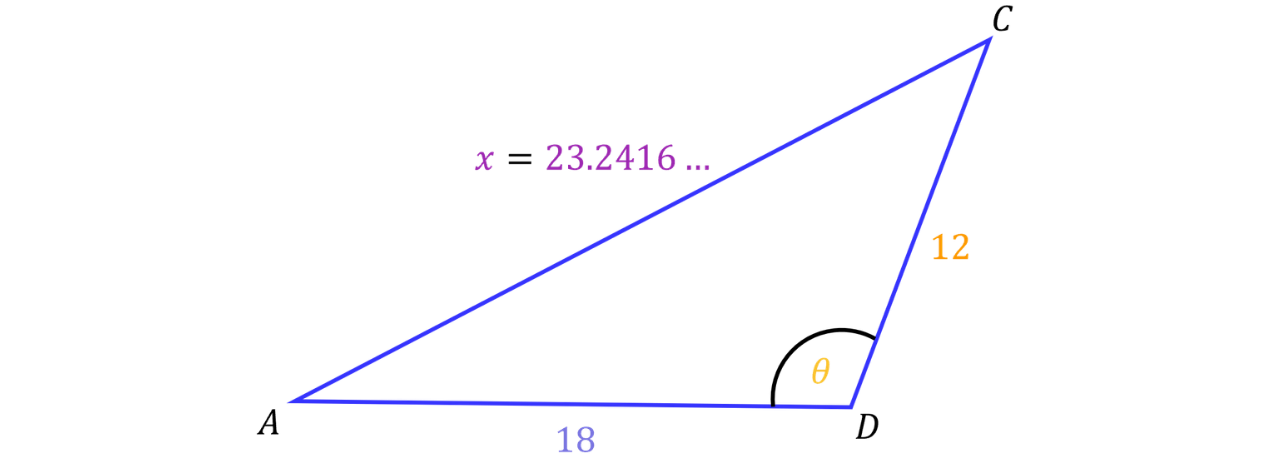
In this triangle, we have and
Since we need to find the missing angle, we use the rearranged cosine rule, which is
Substituting our values into the formula,
Typing the right-hand side into the calculator,
Then, we use the calculator to apply to both sides.
Therefore, to decimal place, the size of angle is
Challenging Questions