Exact Trigonometric Ratios
Neil Trivedi
Teacher

Contents
Exact Trigonometric Ratios
There are some sine, cosine and tangent ratios that we are expected to know by heart for the non-calculator paper.
In this note, we will see where these exact ratios come from and use them in questions involving right-angled triangles, the sine and cosine rules, and the area of a triangle.
Where the Exact Trigonometric Ratios Come From
We will derive the exact trigonometric ratios using just two triangles.
Triangle The triangle
We begin with a right-angled triangle with a base of and an angle of
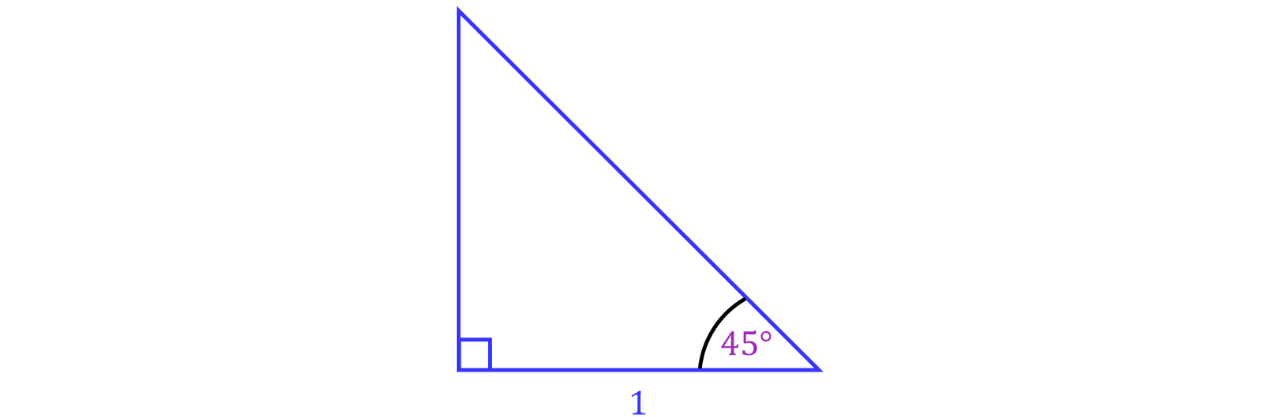
Firstly, the third angle can be found using the fact that angles in a triangle add up to
Notice that two of the angles are equal (both ), so the triangle is isosceles. This means that the height of the triangle is also
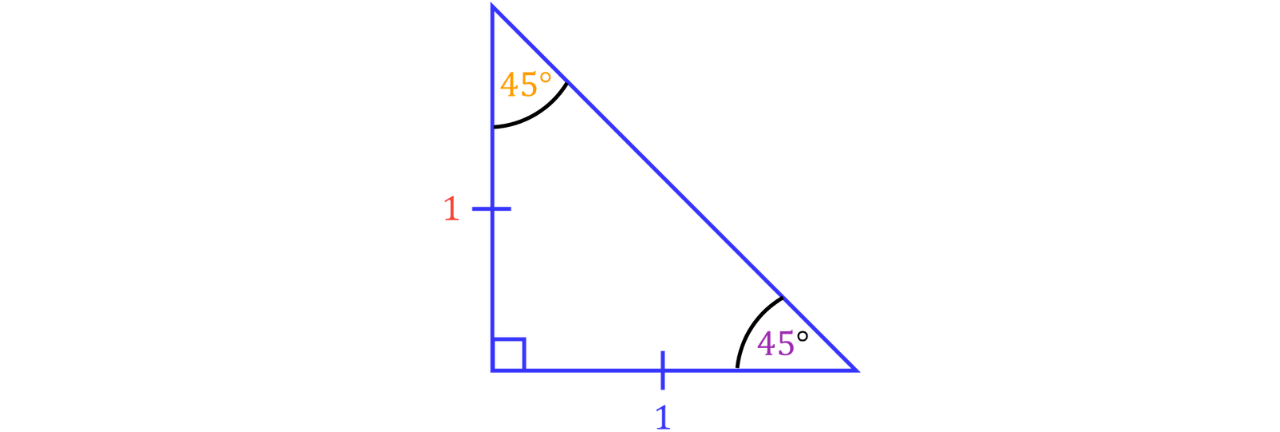
Next, we find the hypotenuse of the triangle using Pythagoras’ theorem.
The hypotenuse is represented by in the triangle below.
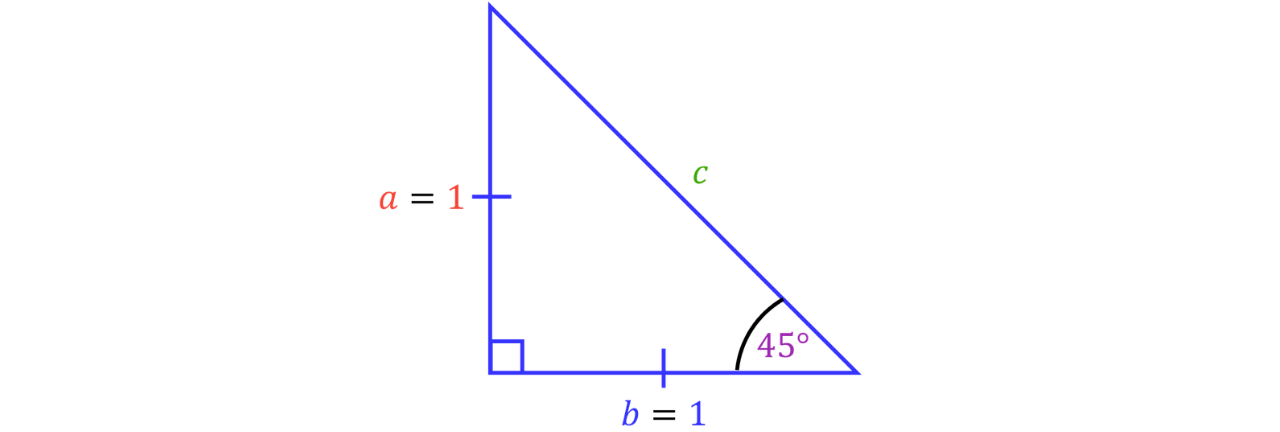
So,
Square rooting both sides,
Therefore, we get the following triangle.
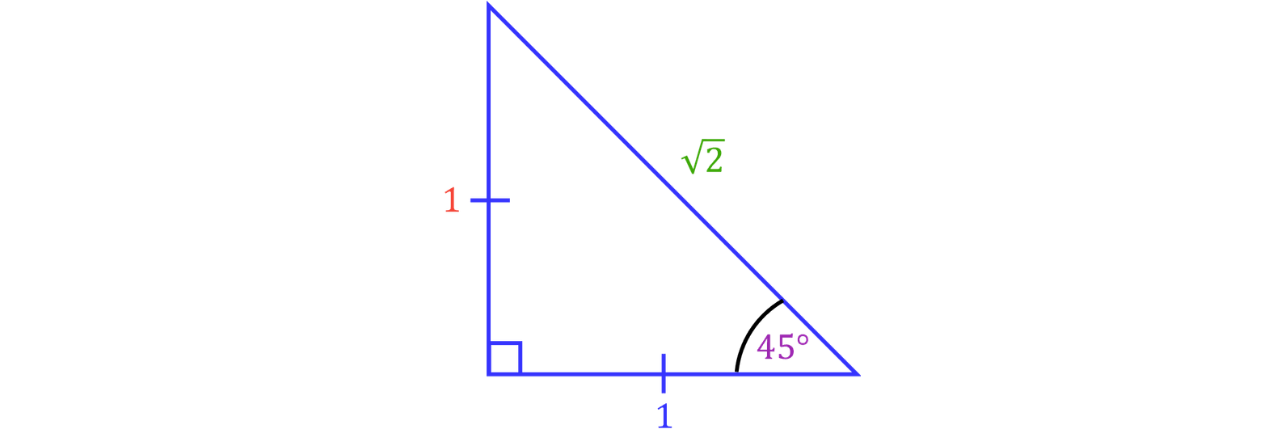
In this triangle, the hypotenuse is the side that’s adjacent to the angle is and the side that’s opposite the angle is
With these values, we use SOHCAHTOA to find the exact values of and
To find this value, we use the SOH part of SOHCAHTOA.
Since the opposite is and the hypotenuse is
Note: can be written as if we rationalise the denominator. For more practice on this, please see our Rationalising Denominators with Surds study note.
To find this value, we use the CAH part of SOHCAHTOA.
Since the adjacent is and the hypotenuse is
Notice that this is equal to sin
To find this value, we use the TOA part of SOHCAHTOA.
Since the opposite is and the adjacent is
Therefore,
or or
Triangle The and triangle
We begin with an equilateral triangle with sides of length (you could start with any side length, however, using keeps the numbers nicer).
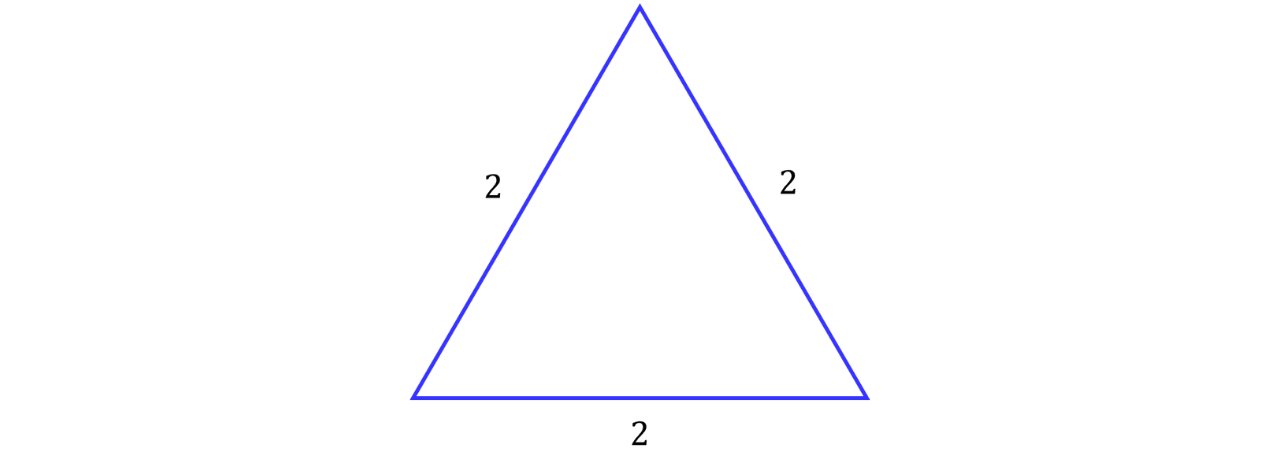
Firstly, we cut the triangle in half down its line of symmetry (we will call this vertical line ) to produce two congruent right-angled triangles. Every angle in an equilateral triangle is and the cut splits the top angle into two angles.
For this derivation, we only need one of the two new right-angled triangles, so we will use the triangle on the left-hand side.
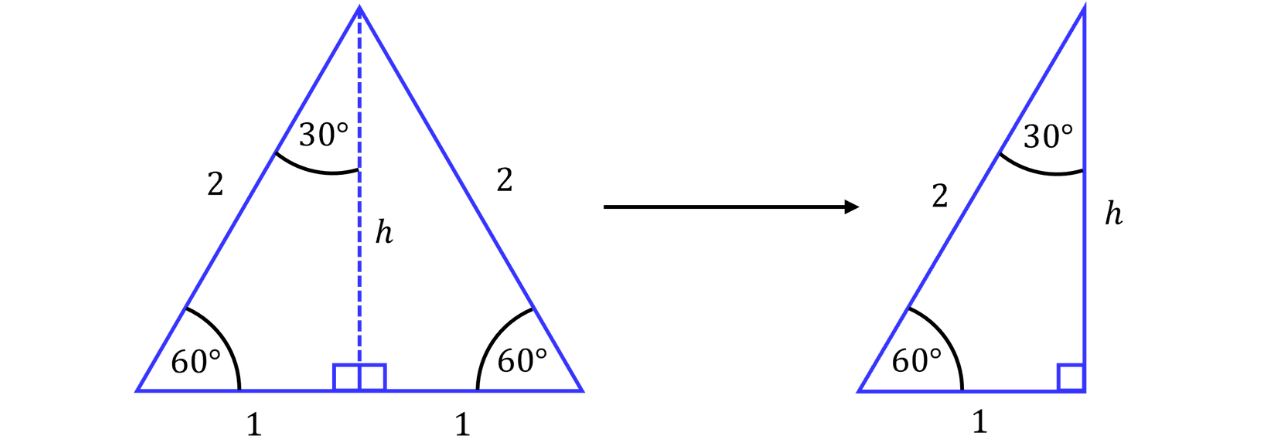
Next, we find the height, using Pythagoras’ theorem.
Subtracting from both sides,
Square rooting both sides,
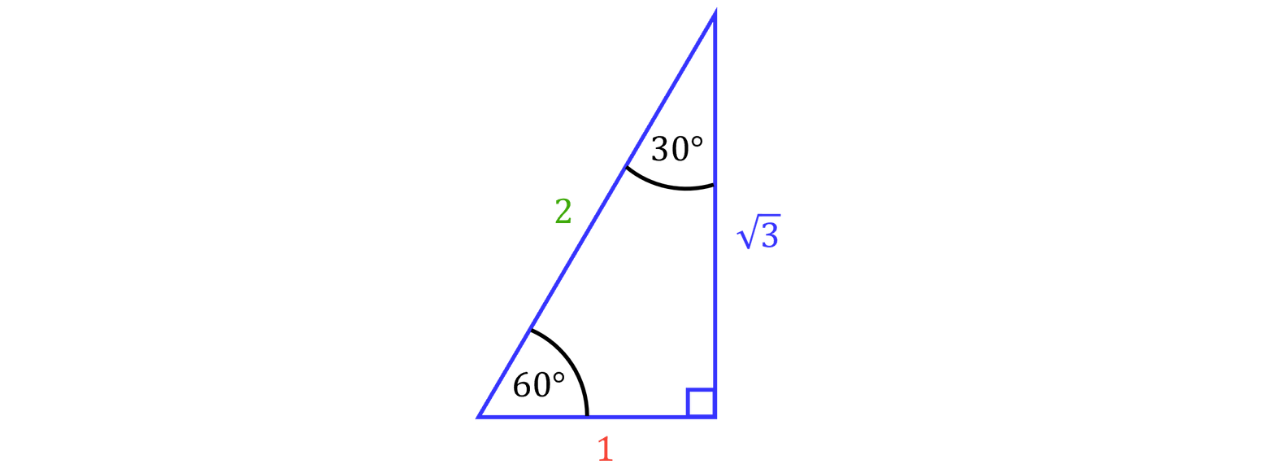
This triangle will give us all the and values. Let’s start with the angle.
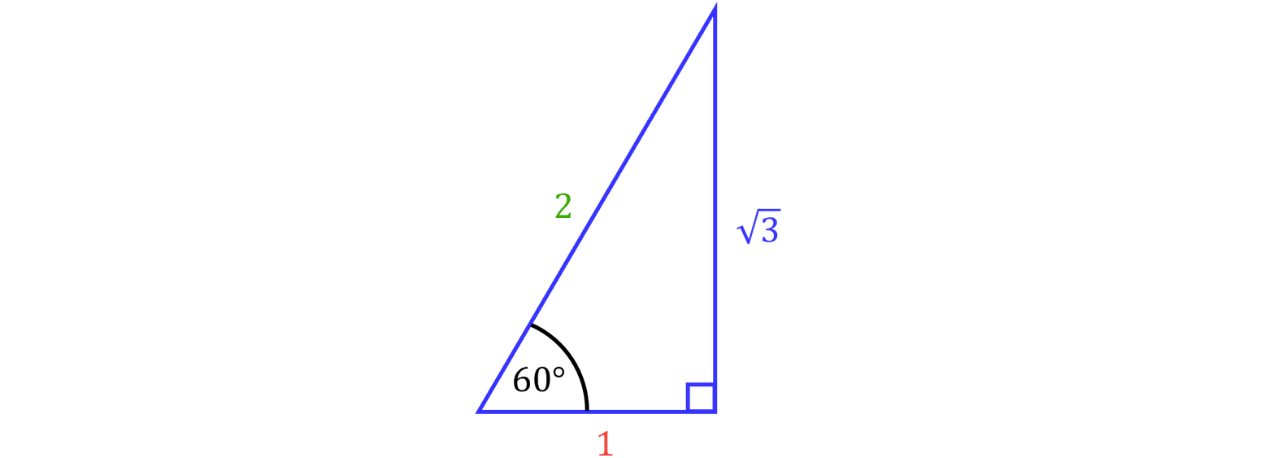
In this triangle, the hypotenuse is the side that’s adjacent to the angle is and the side that’s opposite the angle is
With these values, we use SOHCAHTOA to find the exact values of and
To find this value, we use the SOH part of SOHCAHTOA.
Since the opposite is and the hypotenuse is
To find this value, we use the CAH part of SOHCAHTOA.
Since the adjacent is and the hypotenuse is
To find this value, we use the TOA part of SOHCAHTOA.
Since the opposite is and the adjacent is
Therefore,
Now, we move on to the angle.
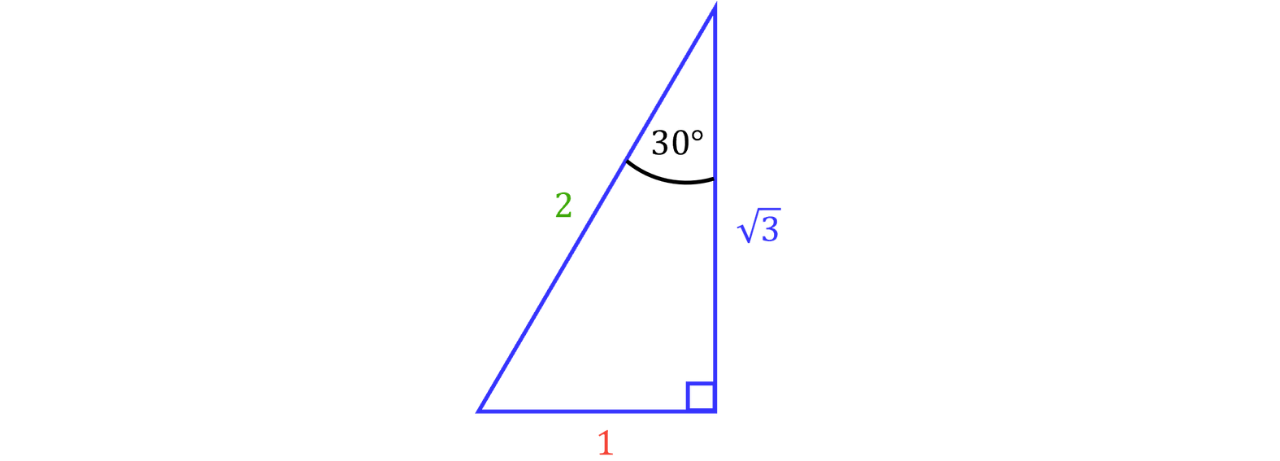
This time, the hypotenuse is the side that’s adjacent to the angle is and the side that’s opposite the angle is
With these values, we use SOHCAHTOA to find the exact values of and
To find this value, we use the SOH part of SOHCAHTOA.
Since the opposite is and the hypotenuse is
To find this value, we use the CAH part of SOHCAHTOA.
Since the adjacent is and the hypotenuse is
To find this value, we use the TOA part of SOHCAHTOA.
Since the opposite is and the adjacent is
Note: Like and we can rewrite as by rationalising the denominator.
Therefore,
or
The and values
We cannot draw a right-angled triangle for these two angles. This is because a right-angled triangle already uses up so each of its other two angles must be bigger than and smaller than
Instead, we imagine a right-angled triangle with a hypotenuse of and watch what happens as the angle changes. Let’s start by decreasing the angle towards
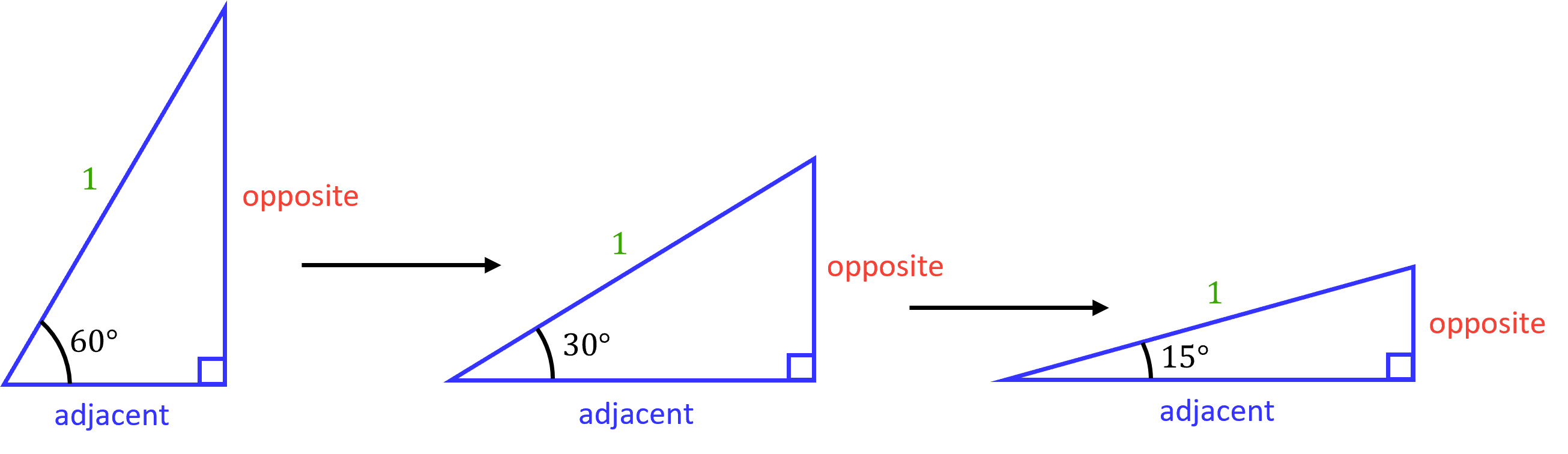
As the angle gets closer and closer to the triangle gets flatter and flatter. Here, the opposite side shrinks towards while the adjacent side grows towards the hypotenuse, which is
So, using SOHCAHTOA, with as the opposite, as the adjacent, and as the hypotenuse:
Therefore,
Now, we move onto the values. Consider the right-angled triangle with a hypotenuse of and, this time, watch what happens as the angle increases towards
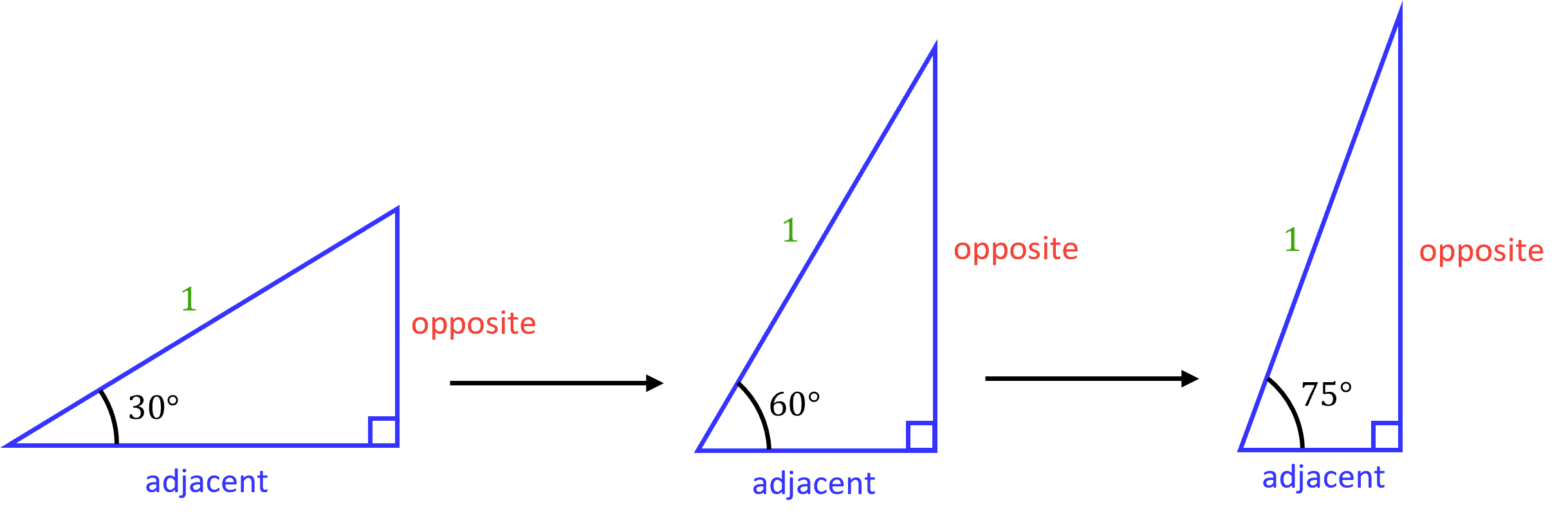
As the angle gets closer and closer to the triangle gets taller and thinner. This time, the opposite side grows towards the hypotenuse, and the adjacent side shrinks towards
So, using SOHCAHTOA, with as the opposite, as the adjacent, and as the hypotenuse:
For tan we would need
However, dividing by is not possible, so tan is undefined.
Note: We can see this on a calculator. For instance, and As the angle gets closer to just keeps growing, so there is no value we can give to If we type in the calculator, we’d get an error message.
Therefore,
undefined
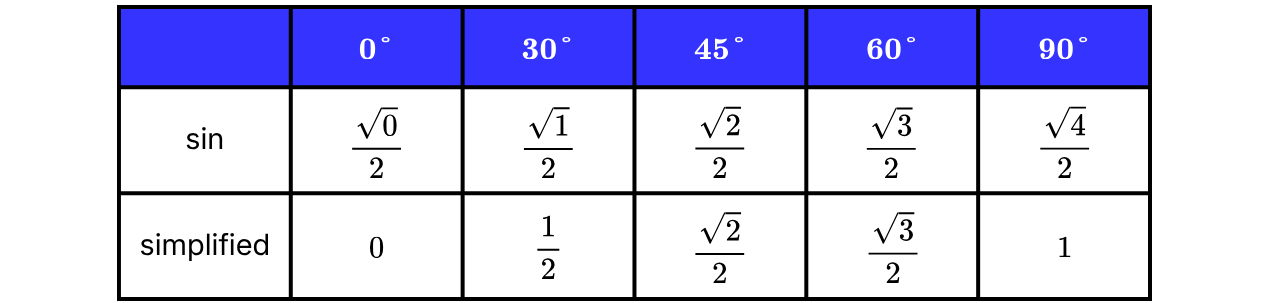
Below is a table which summarises all the exact trigonometric values that we need to know by heart.
The Exact Trigonometric Ratios
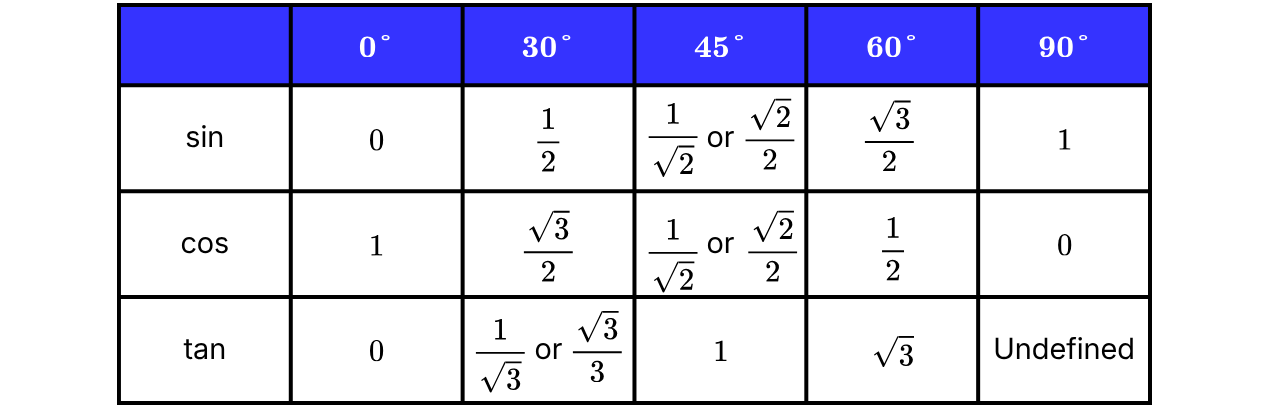
Here is how we could remember the values in this table:
For the row, we can use the pattern shown below: the number inside the square root increases from to and each value is divided by
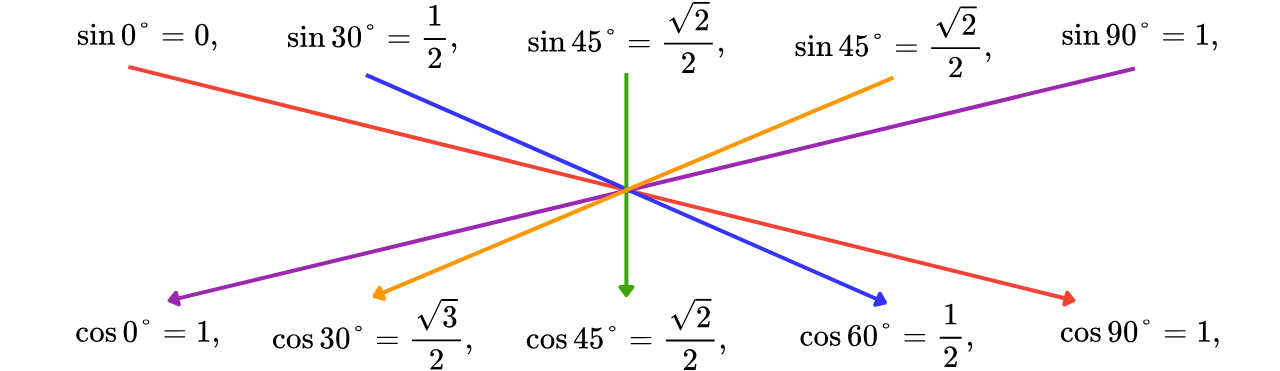
The row is just the sin row written backwards.
Each value can be found by doing for that angle.
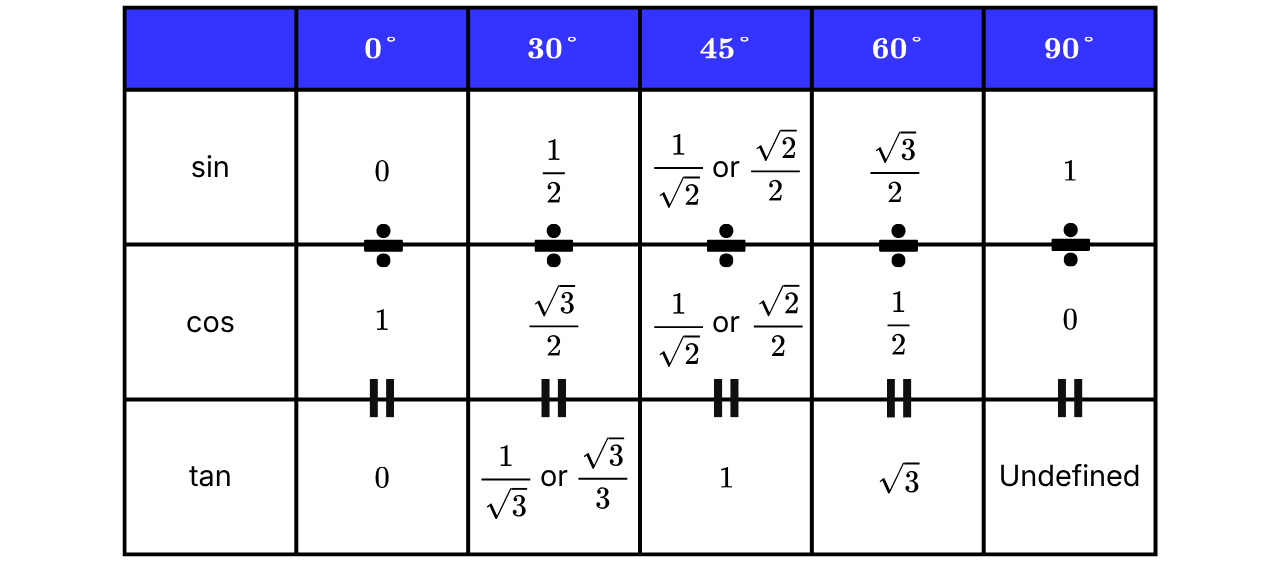
This reinforces why is undefined, because we would be doing
which, as mentioned before, is not possible.
The Exact Trigonometric Ratios and Right-Angled Triangles
In this section, we will practise using our exact ratios when working with right-angled triangles. These types of questions appear often in non-calculator papers.
Example 1:
Without using a calculator, find the exact values of in the following right-angled triangles.
a)
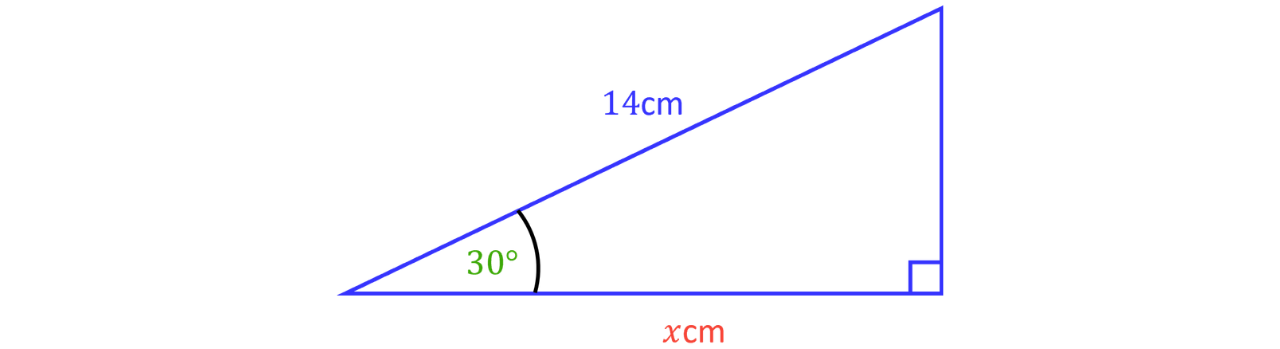
Single Step: Use SOHCAHTOA to work out the value of
In this triangle, we have cm as the hypotenuse, and cm as the side adjacent to the angle. Therefore, we use the CAH part of SOHCAHTOA.
Multiplying both sides by
Since
Therefore, cm.
b)
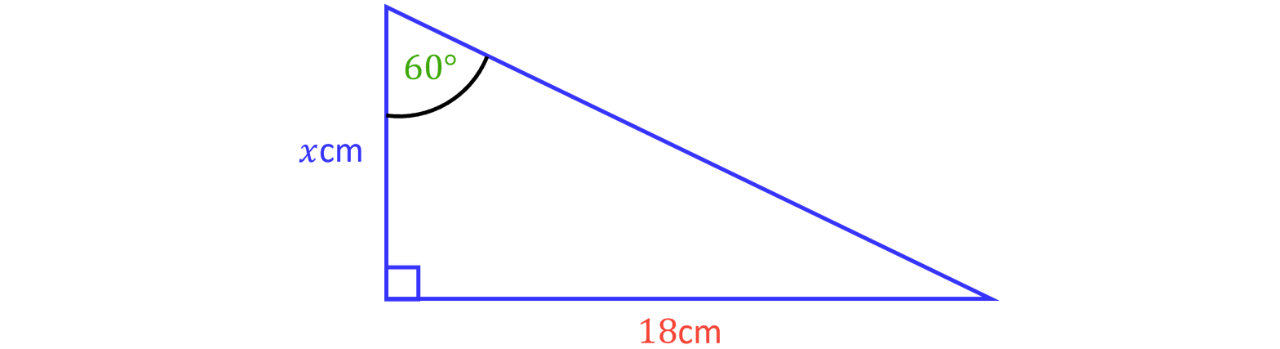
Single Step: Use SOHCAHTOA to work out the value of
In this triangle, we have cm as the side adjacent to the angle, and cm as the opposite side. Therefore, we use the TOA part of SOHCAHTOA.
Now, we need to multiply both sides by and then divide both sides by tan In other words, we are just swapping the positions of the and the tan

Since
Rationalising the denominator,
Therefore, cm.
The Exact Trigonometric Ratios and Non-Right-Angled Triangles
The exact trigonometric ratios also appear in non-calculator questions about triangles that are not right- angled. The rules and methods stay the same, but we simply substitute the exact values instead of using a calculator.
Here is a reminder of the rules that we’ve learnt. For more information on them, please read our Cosine Rule, Sine Rule, and Areas of Non-Right-Angled Triangles study notes.
The cosine rule is given by
The sine rule is given by
The area, , of a triangle is given by
Example 2:
Without using a calculator, find the exact value of giving your answer in the form
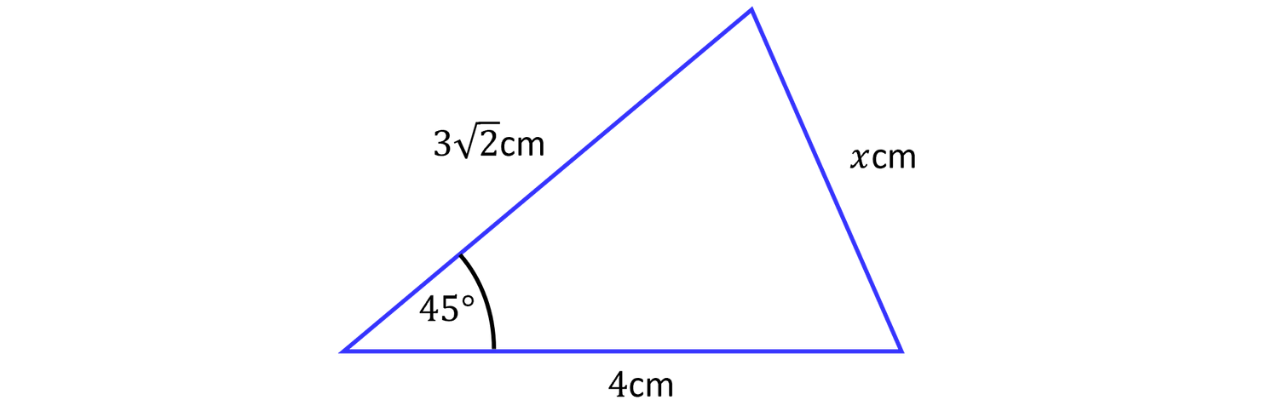
In this question, we will use the cosine rule.
Step 1: Identify the lengths and angles which we will use to substitute into the cosine rule.
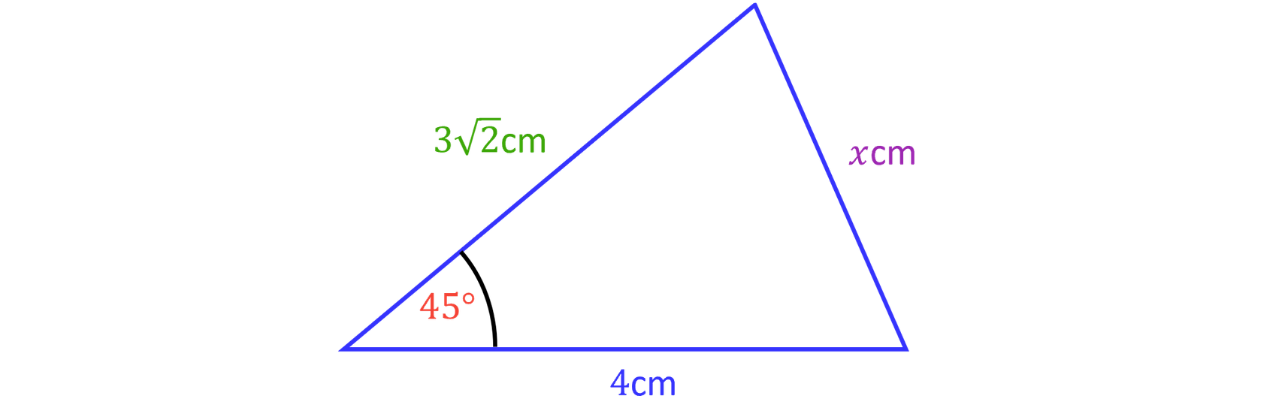
The cosine rule is
In this case, we have cm, cm, cm, and
Step 2: Substitute these values into the cosine rule to find the missing length
Without a calculator, we need to simplify the right-hand side term by term.
For we’re just working out which gives (we multiply the coefficients and the surds separately), giving us For more practice on how to perform operations with surds, see our Simplifying Surds study note.
gives
For since there will be some cancellations straight away:
So, we have
Therefore, our cosine rule equation simplifies to
Square rooting both sides,
cm
Note: We are only taking the positive square root because is a length, and lengths can’t be negative.
Example 3:
Without using a calculator, find the exact value of
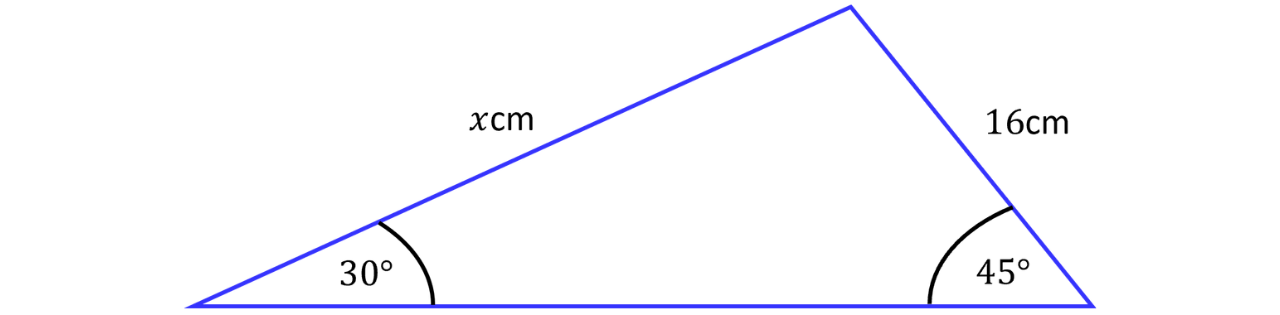
In this question, we will use the sine rule.
Step 1: Identify the lengths and angles which we will use to substitute into the sine rule.
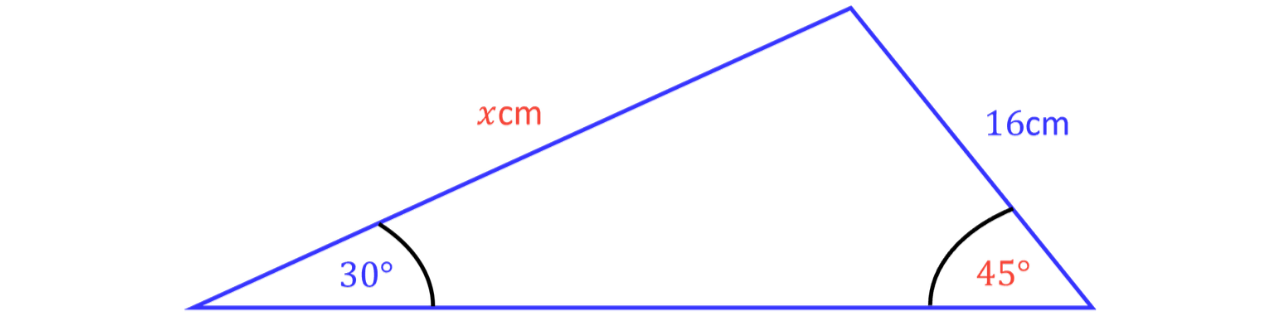
We will be using the sine rule, rearranged to have the lengths in the numerator:
In this case, we have cm, cm, , and
Step 2: Substitute these values into the sine rule and rearrange to find the missing length
To isolate we multiply both sides of the equation by sin to bring it to the right-hand side and remove it from the denominator on the left-hand side.
We know that and So,
Dividing by is the same as multiplying by so we get
cm
The Exact Trigonometric Ratios and Algebra
In this section, we will practise harder exam-style questions which combine exact ratios and algebra. For these questions, we’d form equations, using the rules and exact ratios, and then solve them.
Example 4:
Without using a calculator, find the value of
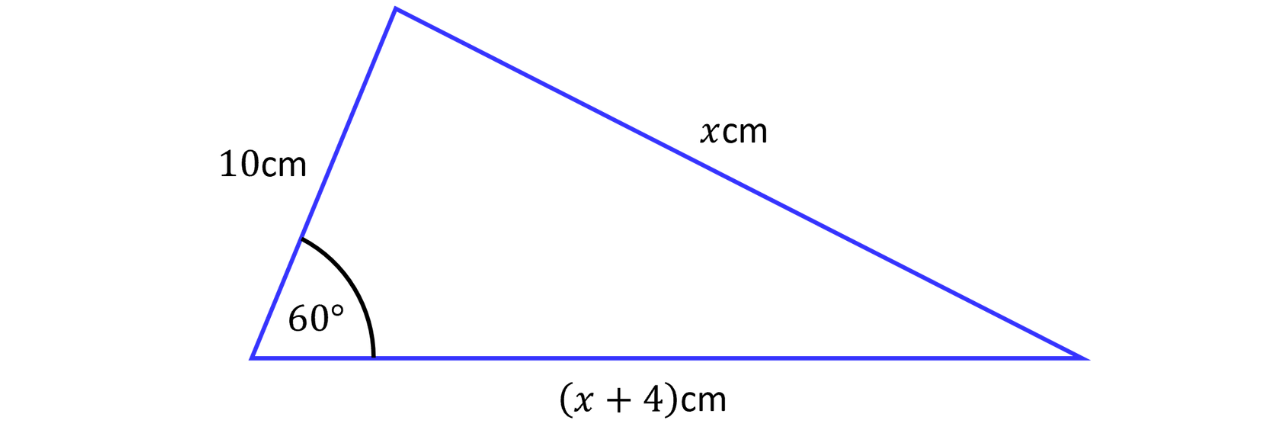
In this question, we will use the cosine rule.
Step 1: Identify the lengths and angles which we will use to substitute into the cosine rule.
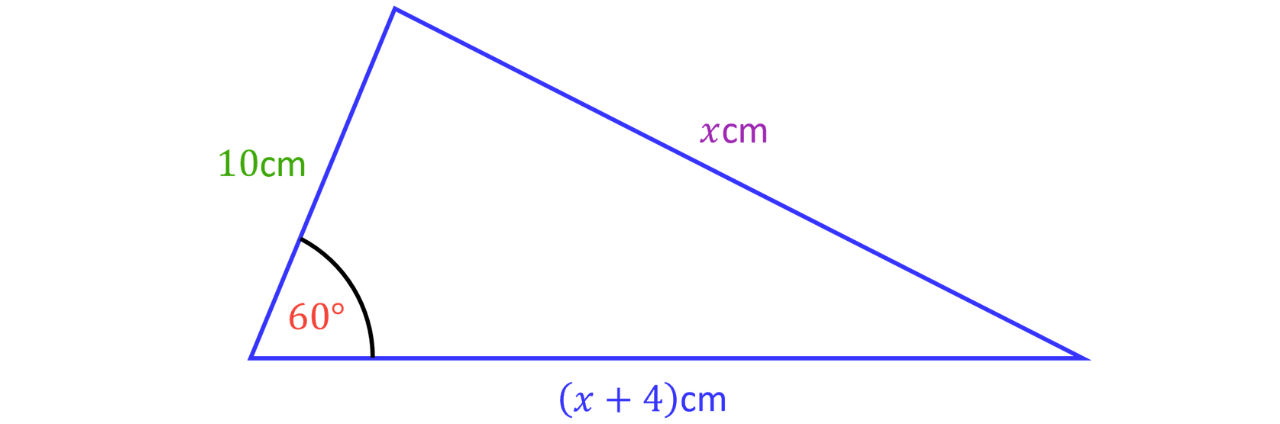
In this case, we have cm, cm, cm, and
Step 2: Substitute these values into the cosine rule to form an equation in terms of
Without a calculator, we need to simplify the right-hand side term by term.
gives
For we expand the brackets.
For since there will be some cancellations straight away.
So, we have
When we expand the brackets, we get
Therefore, our cosine rule equation simplifies to
Expanding the negative into the bracket,
Collecting like terms on the right-hand side,
Step 3: Solve for
We move the terms to the left-hand side. We subtract from both sides and add to both sides.

Dividing both sides by
Example 5:
Given that the area of the triangle is cm², find, without a calculator, the value of
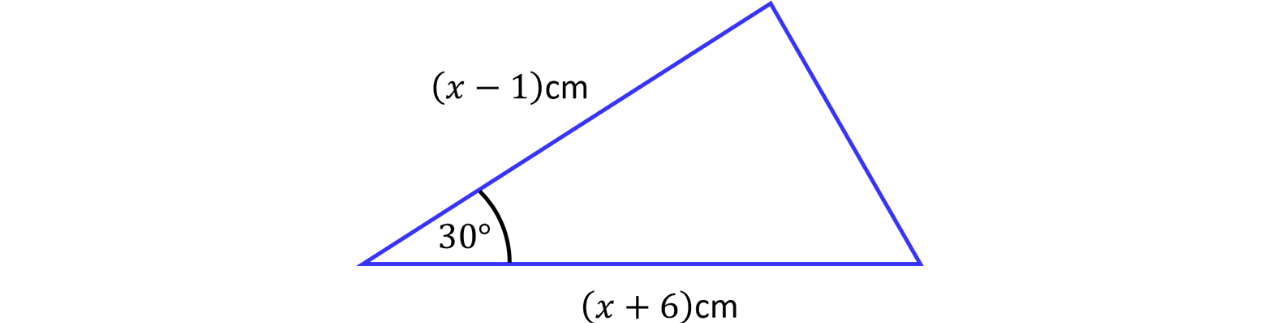
Step 1: Identify the information (area, lengths and angle) which we will use to substitute into the formula for the area of a triangle.
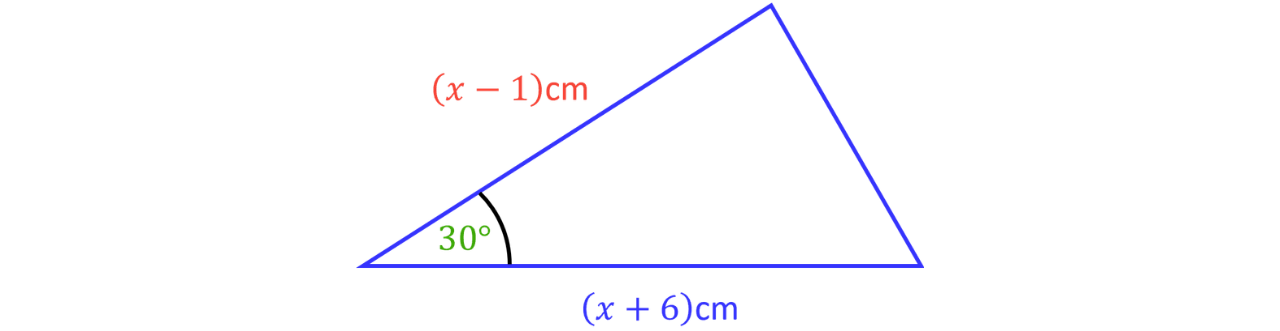
The area, , of a triangle is given by
In this case, we have cm², cm, cm, and
Step 2: Substitute these values into the formula to form an equation in terms of
Since
Multiplying the two together, we get
Next, we clear the fraction on the right-hand side by multiplying both sides by
Expanding the brackets on the right-hand side,
Then, we subtract 60 from both sides to bring all terms to one side, forming a quadratic equation to solve.

Step 3: Solve the quadratic equation for
This quadratic can be factorised. When we factorise it, we get
Then, setting each bracket equal to
or
Rearranging each linear equation to isolate
or
For more practice on factorising and solving quadratics, please read our Factorising Quadratics and Solving Quadratics by Factorising study notes.
Since a length must be positive, we reject We can easily check by substituting into any of the lengths on the triangle, and if we did, we’d get lengths of cm and cm which are not possible.
Therefore, only.
Note: It is worth verifying that works with the lengths on this triangle. If we substitute we’d get lengths of cm and cm, so it is correct.
Challenging Question