Pythagoras in 3D
Neil Trivedi
Teacher

Contents
Pythagoras
Previously, we used Pythagoras’ theorem and SOHCAHTOA to find missing lengths and angles in right-angled triangles drawn on a flat page. In this note, we extend these tools into three dimensions, to find lengths and angles inside shapes such as cuboids, pyramids and prisms.
The key idea of the whole topic is that every 3D question is really a 2D question in disguise: we find a right-angled triangle that’s hidden inside the shape, sketch it flat, and then apply Pythagoras’ theorem or SOHCAHTOA as we normally do.
Pythagoras’ Theorem and SOHCAHTOA Recap
Pythagoras’ Theorem

where is the hypotenuse and and are the two shorter side lengths.
SOHCAHTOA
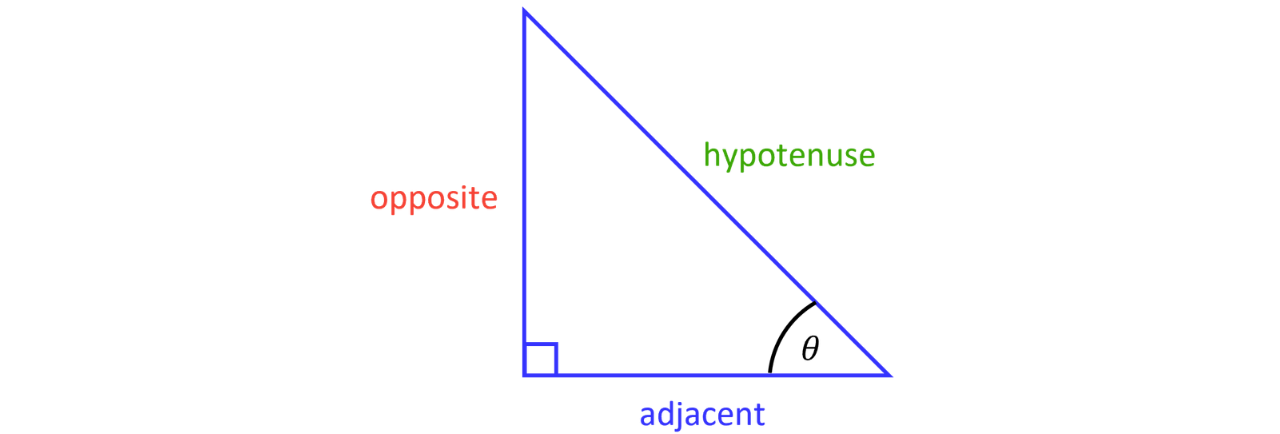
Example 1:
Find the value of in the following right-angled triangle.
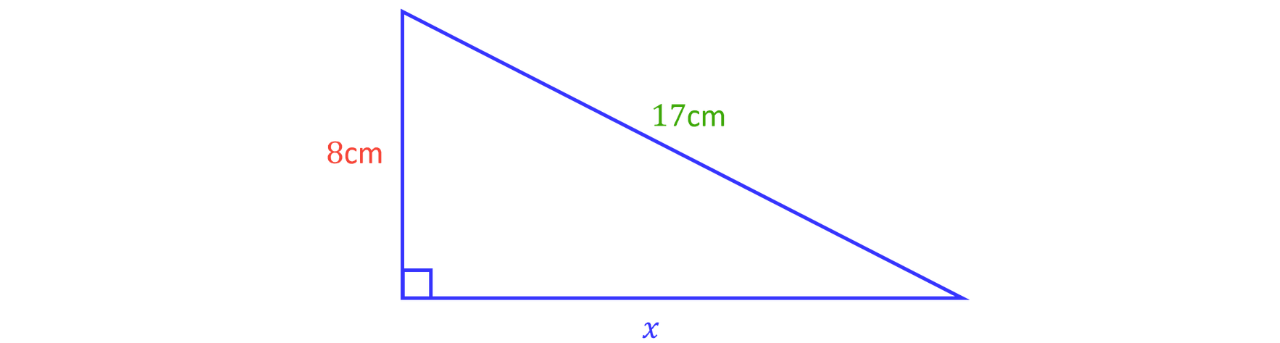
Single Step: Apply Pythagoras’ theorem to find the length
Here, cm, , and cm, which we substitute into the equation.
Subtracting from both sides,
Square rooting both sides,
cm
Example 2:
Find the size of the angle in the following right-angled triangle, giving your answer to decimal place.
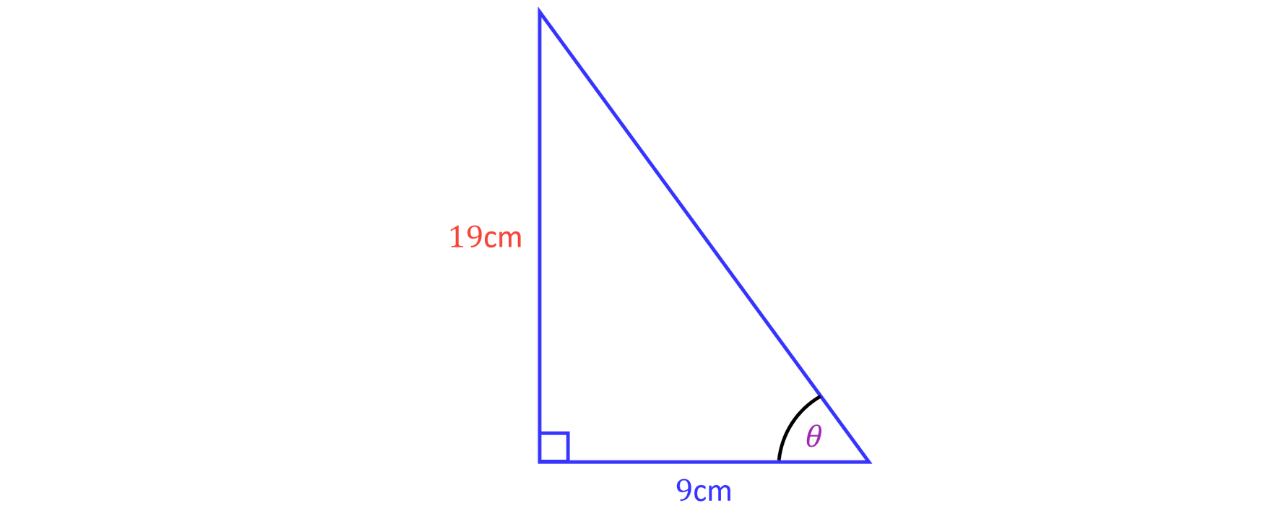
Single Step: Apply SOHCAHTOA to find the angle
Here, we have cm as the length that’s adjacent to and cm as the length that’s opposite So, we use the TOA part of SOHCAHTOA.
Next, we use our calculator to apply to both sides to isolate
Therefore, to decimal place,
Finding the Longest Diagonal of a Cuboid
The longest diagonal of a cuboid is the line connecting two opposite corners, passing through the inside of the shape. To find its length, we use Pythagoras’ theorem twice.
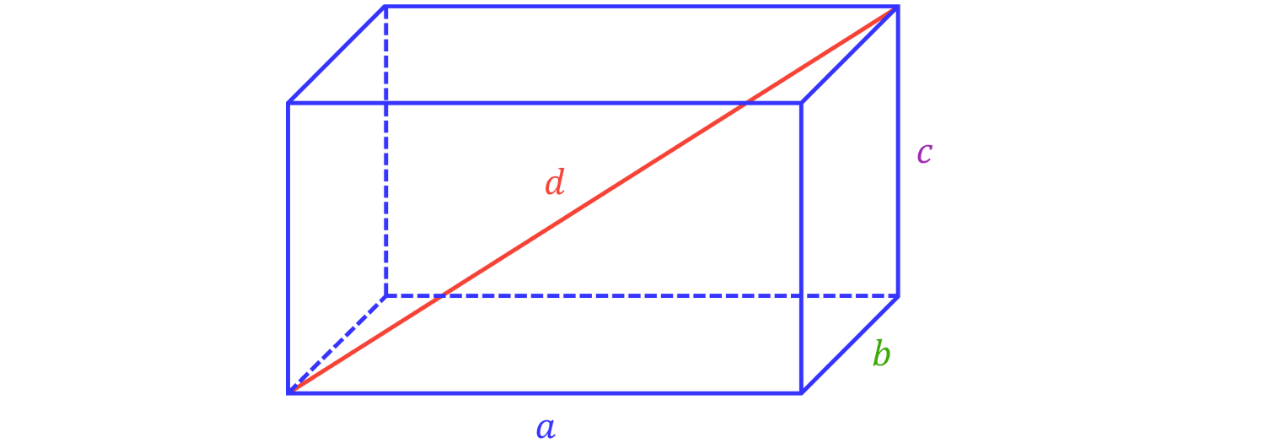
For example, consider the following cuboid We are asked the length of the diagonal (represented by the red line, with length , in the diagram).
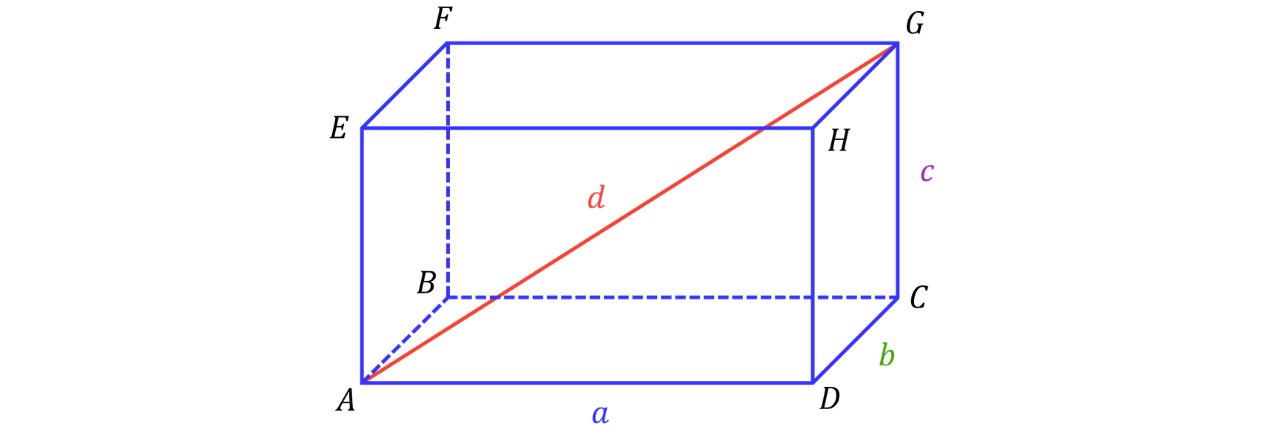
At first, we will manually apply Pythagoras’ theorem with two different right-angled triangles that are hidden in the cuboid. This will help us see the process and derive a formula which will make answering these types of questions much faster.
Triangle 1 -
The first right-angled triangle we will apply Pythagoras’ theorem to is triangle which lies on the base, We need to work out the length of the diagonal (represented by the orange line, with length in the diagram below), which is the hypotenuse of triangle
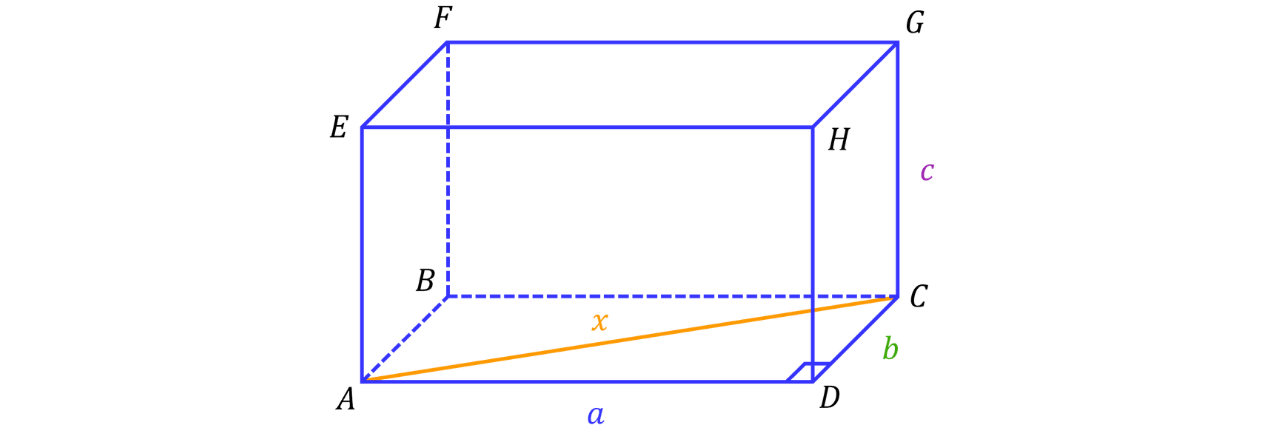
Redrawing triangle on a flat surface,

Applying Pythagoras’ theorem to find
Square rooting both sides,
Therefore, the length of the diagonal will be
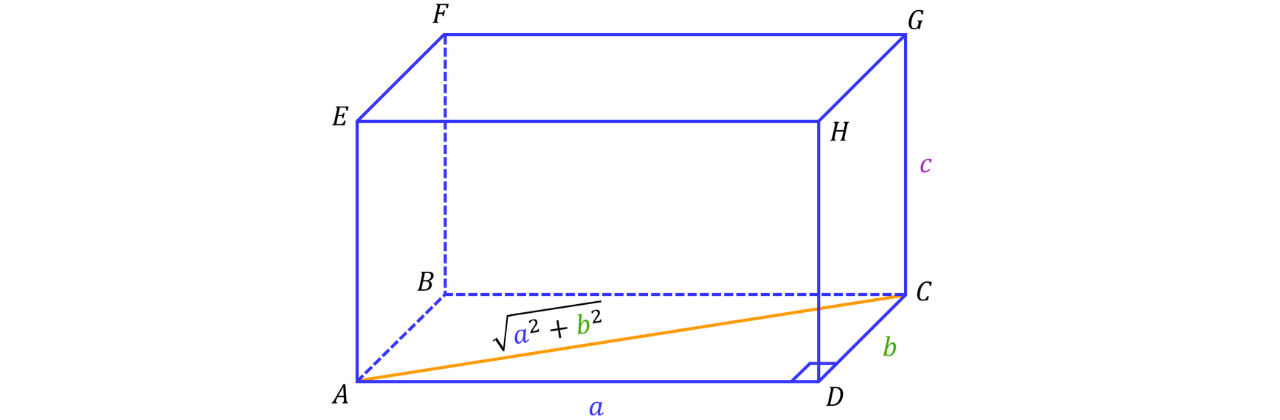
Triangle 2 -
The second right-angled triangle we will apply Pythagoras’ theorem to is triangle which cuts diagonally across the cuboid. In this triangle, the diagonal is the hypotenuse.
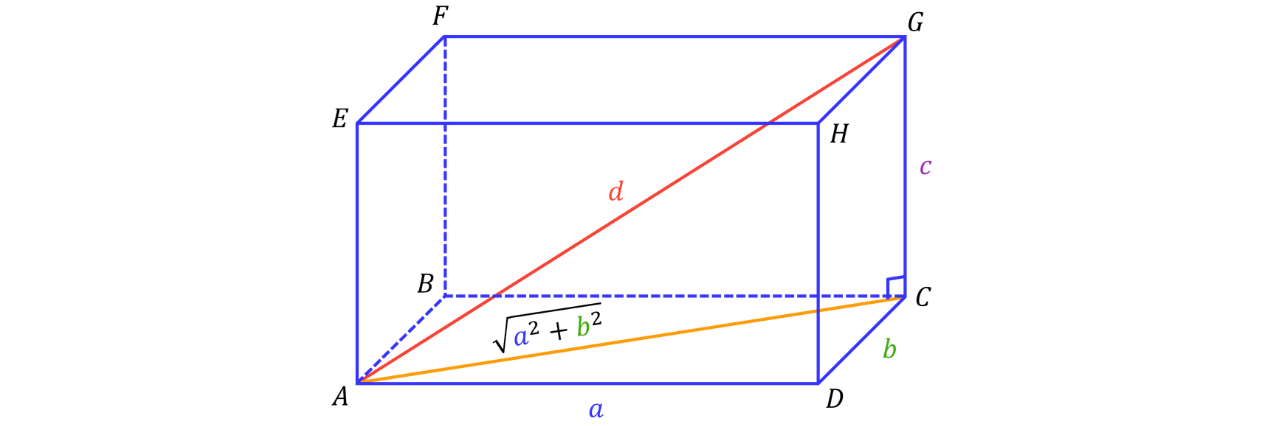
Redrawing triangle on a flat surface,

Applying Pythagoras’ theorem to find
Note: for the term, the power of outside and the square root will cancel each other out. This is due to our index rules: the square root can be written as a power of and then we use the rule which states that to simplify.
For more practice on the index rules, please read our Introduction to Index Rules and Negative and Fractional Indices study notes.
So, we are left with
Square rooting both sides,
Therefore, the length of the diagonal will be
Notice that is equal to the square root of the sum of the squares of and This comes from the fact that we used Pythagoras’ theorem twice.
Therefore, if asked to find the longest diagonal in the cuboid, we could just apply Pythagoras’ theorem once, using all three dimensions, and this would be a faster process than manually applying the theorem twice with two different right-angled triangles.
Finding the Length of the Longest Diagonal of a Cuboid
Example 3:
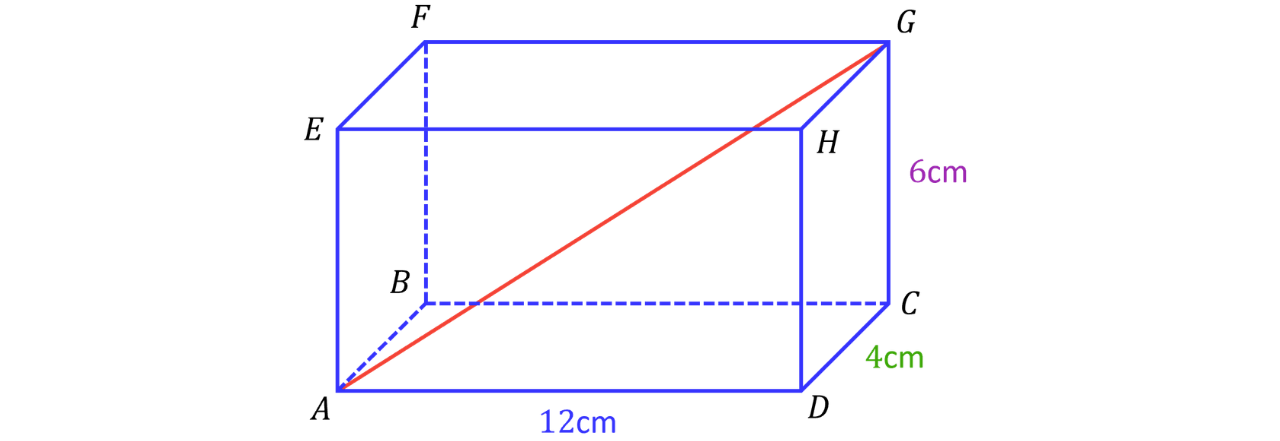
The diagram shows a cuboid measuring cm by cm by cm. Find the length of the diagonal
Single Step: Substitute the three dimensions into the 3D Pythagoras formula.
Here, we have cm, cm, cm, and
cm
Note: An integer answer for a question like this is unusual. We’d often get surd answers, which we keep exact unless the question asks us to round it.
Example 4:
A gift box is a cuboid measuring cm by cm by cm. Mary wants to post a rolled-up poster of length cm inside the box. Show that the poster will fit.
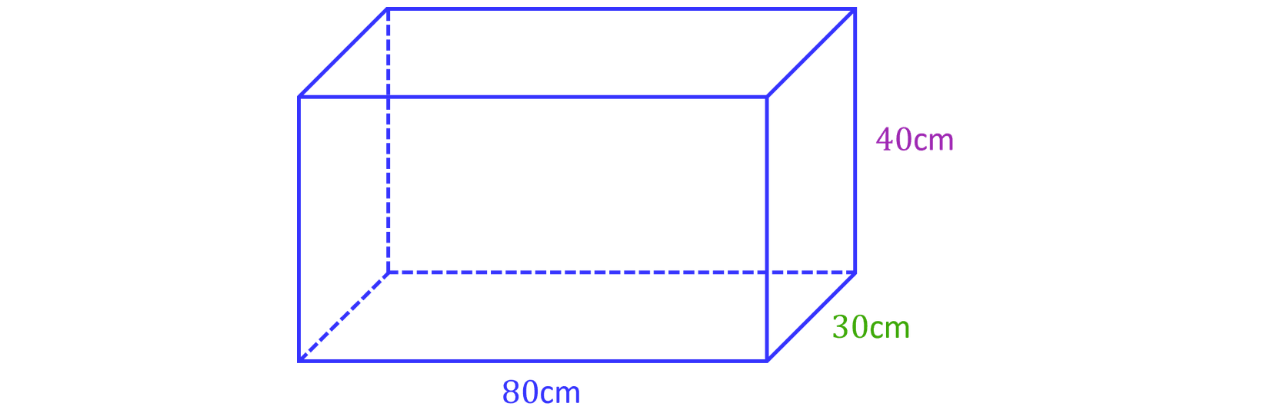
Step 1: Find the longest length available inside the box.
The longest length available is the diagonal that connects opposite corners of the box. It is represented by the red line, which is labelled in the following diagram.
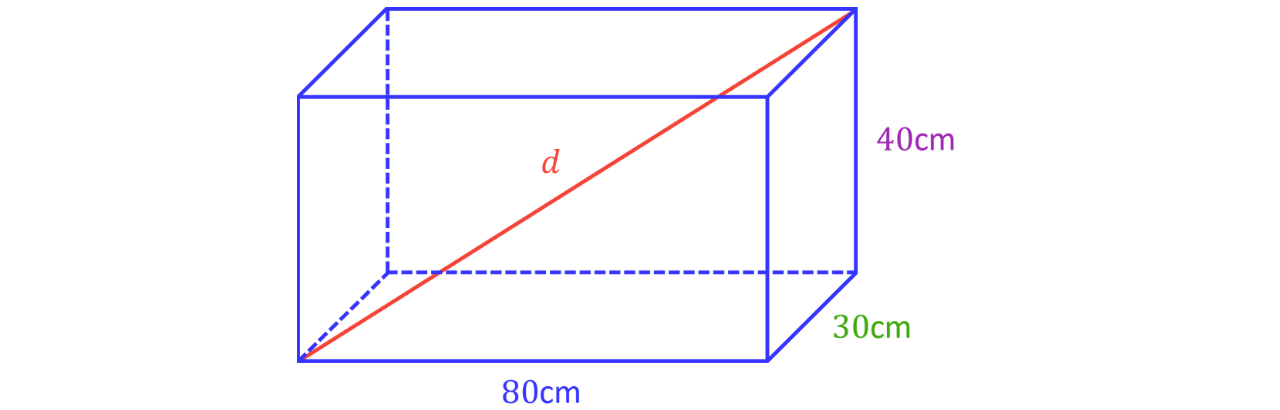
We apply the 3D Pythagoras formula to find where cm, cm, and cm.
cm
Therefore, the longest available length in the box is cm.
Step 2: Compare the length of the diagonal with the length of the poster.
cm
Therefore, the poster fits inside the box.
Finding the Height of a Pyramid
In this section, we will practise finding the height of a pyramid using Pythagoras’ theorem. In the pyramids in this topic, the apex (the top of the pyramid) sits directly above the centre of the base, which we normally label as
Finding the Height of a Pyramid
For a pyramid we follow these steps to work out the height.
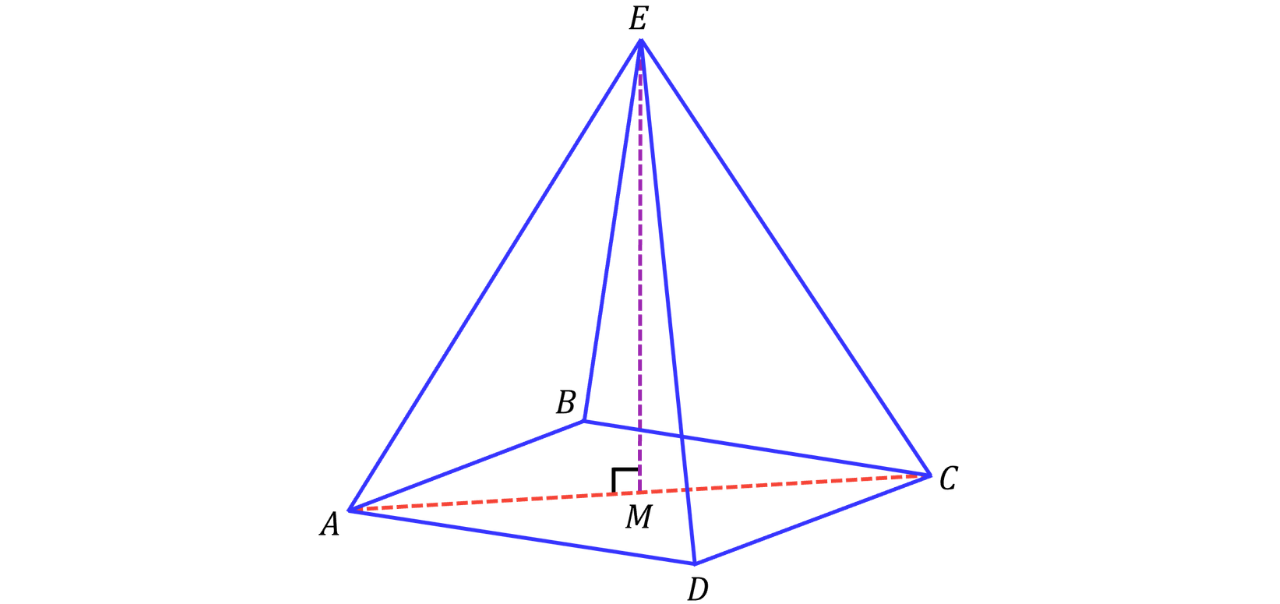
Use Pythagoras’ theorem on the base to find the length of the diagonal
Halve the length of to get the length of since is the centre of the base and, hence, the midpoint of
Use Pythagoras’ theorem in the triangle where is a sloping edge, to find the height
Example 5
The diagram shows a pyramid with a horizontal rectangular base measuring cm by cm. The apex is directly above the centre of the base, and each sloping edge has length cm.
Find the exact height of the pyramid, giving your answer in the form
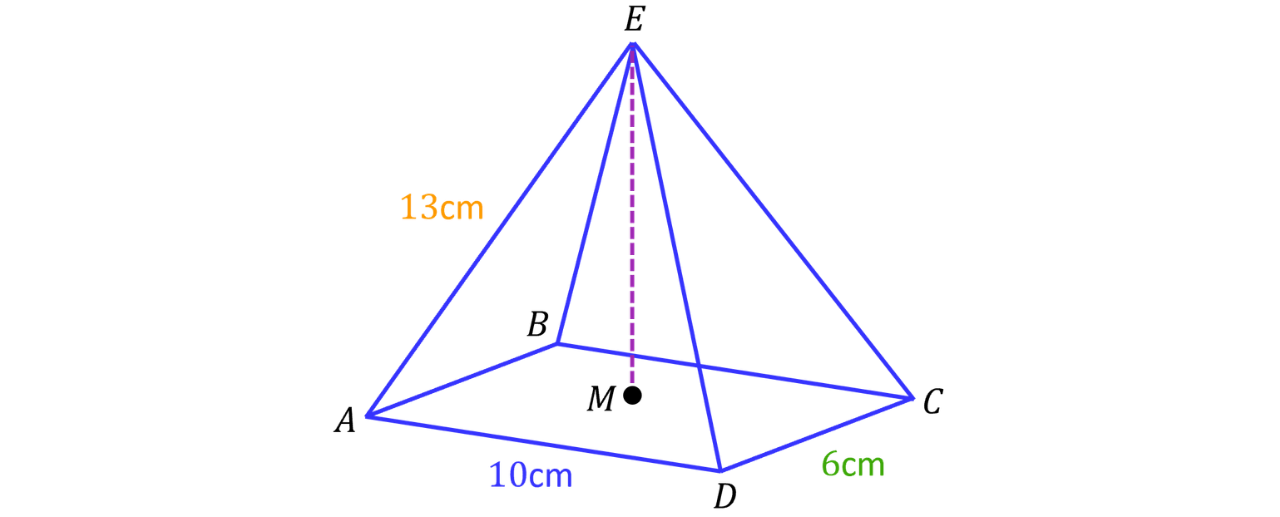
Step 1: Use Pythagoras’ theorem to find the length of the diagonal
Firstly, here’s the base, drawn on a flat surface with the diagonal whose length is represented by which is the midpoint of is also indicated.

We use Pythagoras’ theorem on the right-angled triangle to find (since the two triangles are congruent to each other, we could have used Pythagoras’ theorem on triangle to find The answer would have been the same either way. See our Congruence study note for more information).
Square rooting both sides,
cm
Note: can be simplified. We can rewrite it as For more practice on this, please read our Simplifying Surds study note. It is useful to simplify, if we can, because some cancellations may end up happening when we move on to the next step.
Step 2: Halve the length of to get the length of
cm
cm
Step 3: Use Pythagoras’ theorem in the triangle where is a sloping edge, to find the height
Here’s the right-angled triangle, drawn on a flat surface. The height is represented by here.

Using Pythagoras’ theorem,
Subtracting from both sides,
Square rooting both sides,
cm
can be simplified. We can rewrite it as
Therefore, the height of the pyramid is cm.
The Angle Between a Line and a Plane
A plane is a flat 2D surface, like a sheet of paper or the floor of a room.

For instance, each face of a cuboid is a plane.
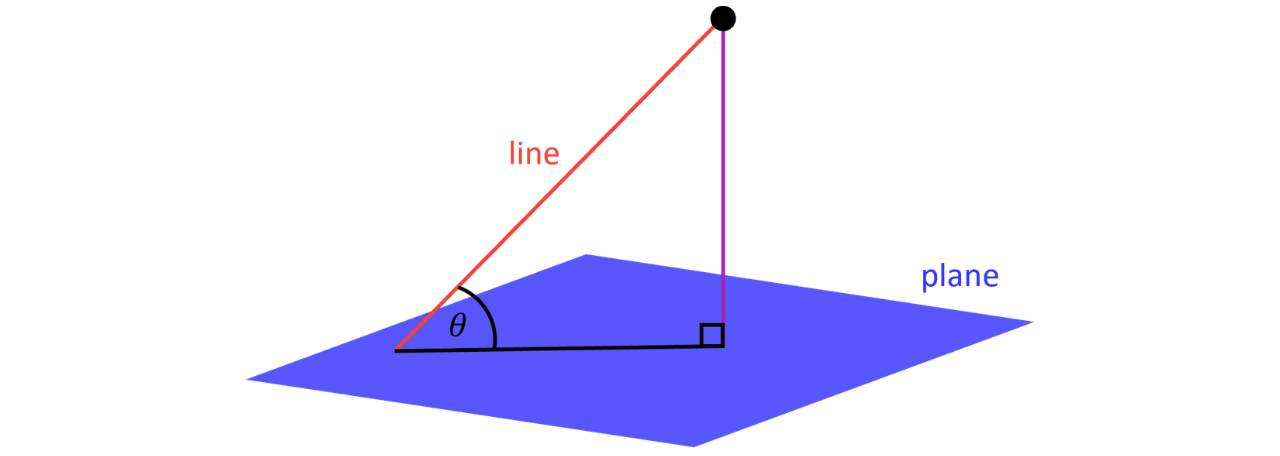
To find the angle between a line and a plane, imagine dropping a ball from the highest point of the line straight down onto the plane.
The vertical drop, the line itself, and the “shadow” of the line on the plane (or, in other words, the line segment which joins the lowest point of the line and the point on the plane where the ball lands) together form a right-angled triangle.
The angle between the line and the plane is the angle between the line and its shadow, as shown below.
Finding the Angle Between a Line and a Plane
Identify the shadow of the line on the plane and, hence, the right-angled triangle we will use to find the angle.
Use Pythagoras’ theorem to find missing lengths if needed (we need to know at least two of the three lengths of the triangle).
Use SOHCAHTOA to find the angle.
Example 6:
The diagram shows a cuboid with cm, cm and cm.
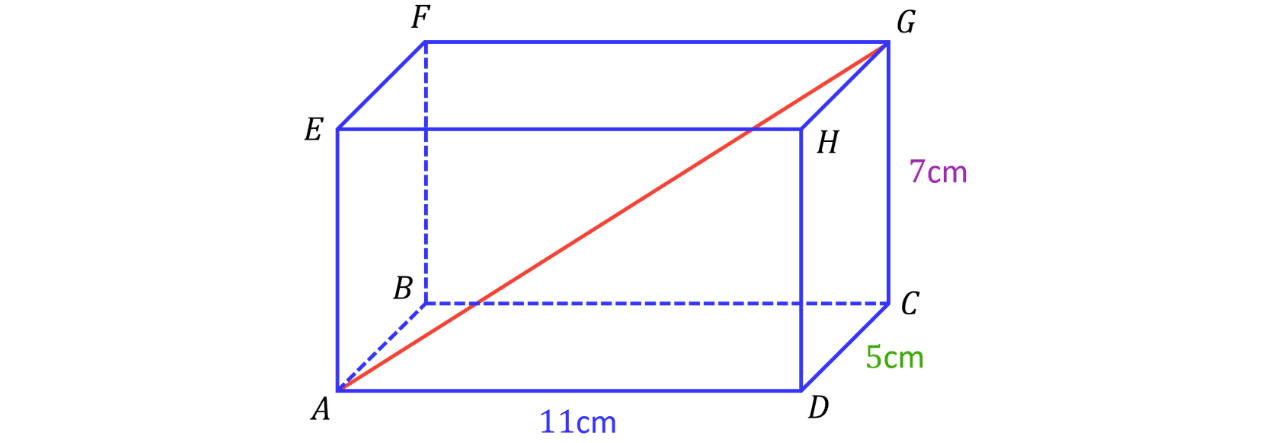
a) Find the exact length of
Single Step: Substitute the three dimensions into the 3D Pythagoras formula
Here, we have cm, cm, cm, and
cm
Therefore, the length of is cm.
b) Calculate the angle that makes with the plane giving your answer to decimal place.
Step 1: Identify the shadow of on the base, hence, the right-angled triangle we will use to find the angle.
This question asks us to find the angle that the line makes with the plane which is the base of the cuboid.
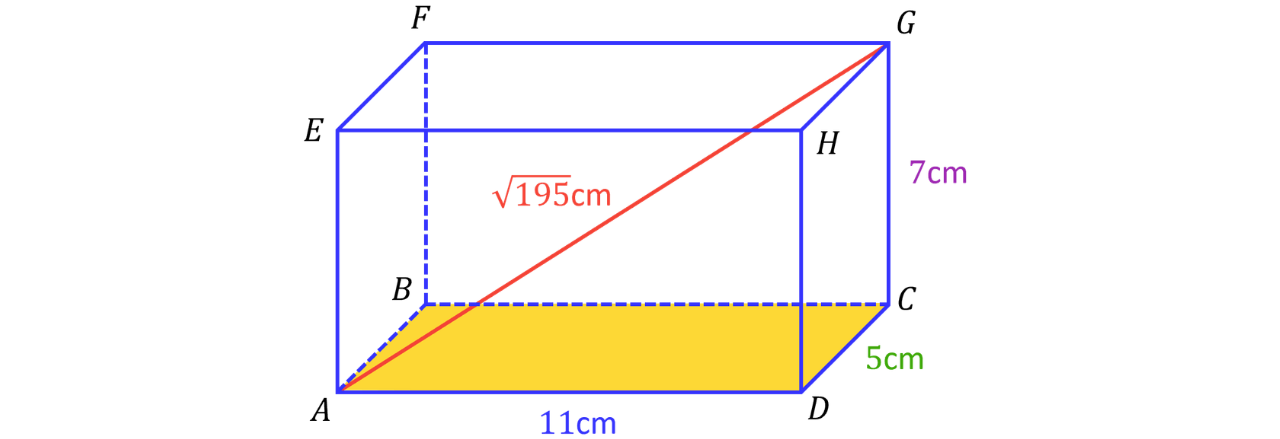
The shadow of on the base is the diagonal The height is (cm). So, a right-angled triangle, would be formed inside the cuboid, as shown in the following diagram. The angle we are looking for is wedged between and labelled
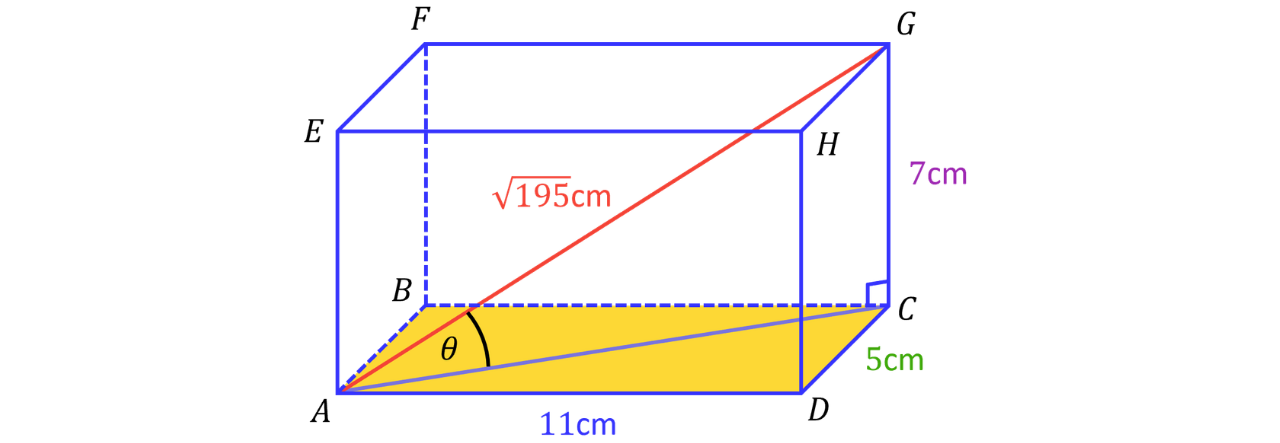
Redrawing triangle ACG on a flat surface,

Step 2: Use SOHCAHTOA to find the angle
In this case, we don’t need to find the length of because we already know two lengths: the hypotenuse, which is and the length opposite which is Therefore, we can go straight to applying SOHCAHTOA.
Since we have the hypotenuse and the opposite, we use the SOH part of SOHCAHTOA.
Next, we use our calculator to apply to both sides to isolate
Therefore, to decimal place, the angle that makes with the plane is approximately
Example 7:
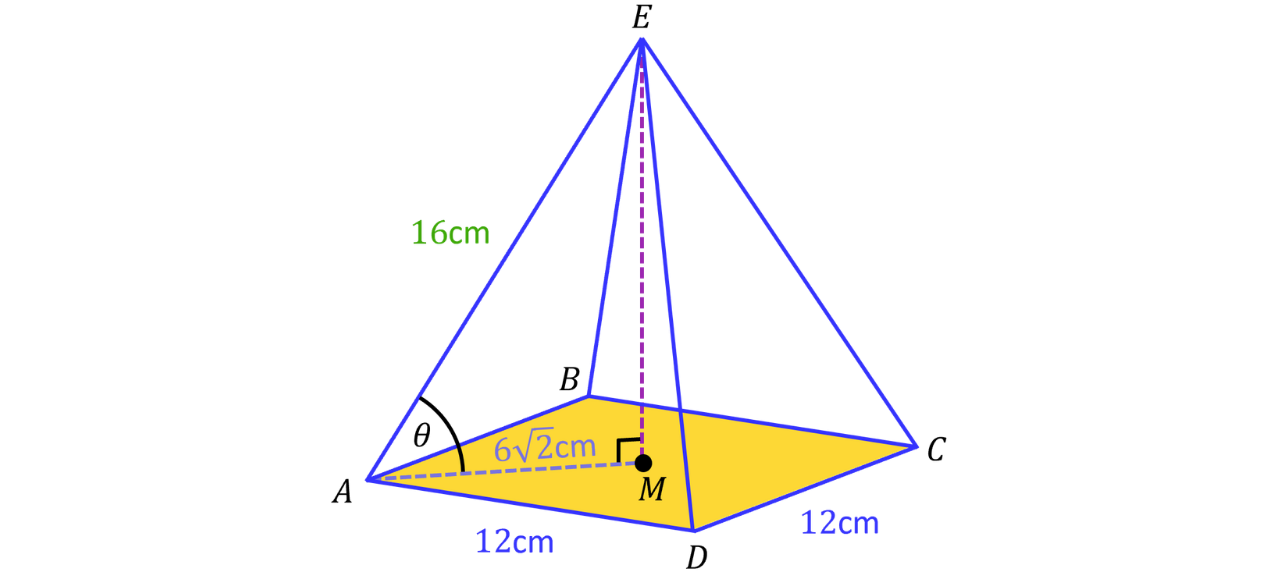
The diagram shows a pyramid with a square base of side cm. The apex is directly above the centre of the base, and cm.
Calculate the size of the angle between the edge and the base Give your answer to decimal place.
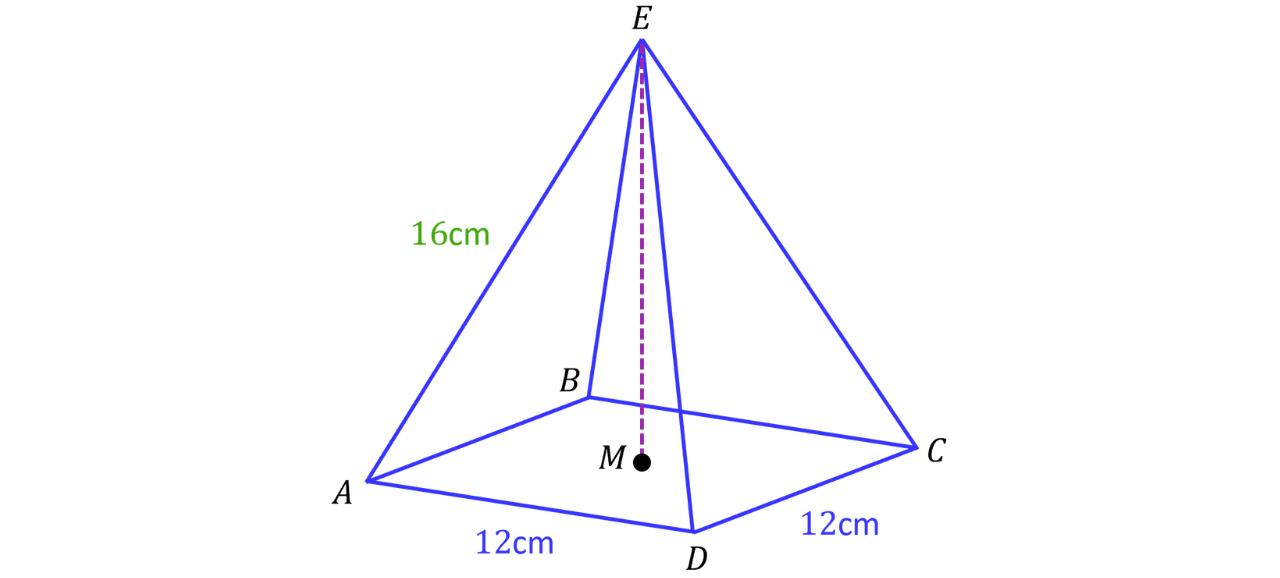
Step 1: Identify the shadow of on the base and, hence, the right-angled triangle we will use to find the angle.
The shadow of on the base is which is halfway along the diagonal The shadow is not since spans from to only directly above and not all the way to a point that’s directly above unlike in Example 6.
Here, the height is So, a right-angled triangle, is formed inside the pyramid, as shown in the following diagram.
The angle we are looking for is wedged between and labelled
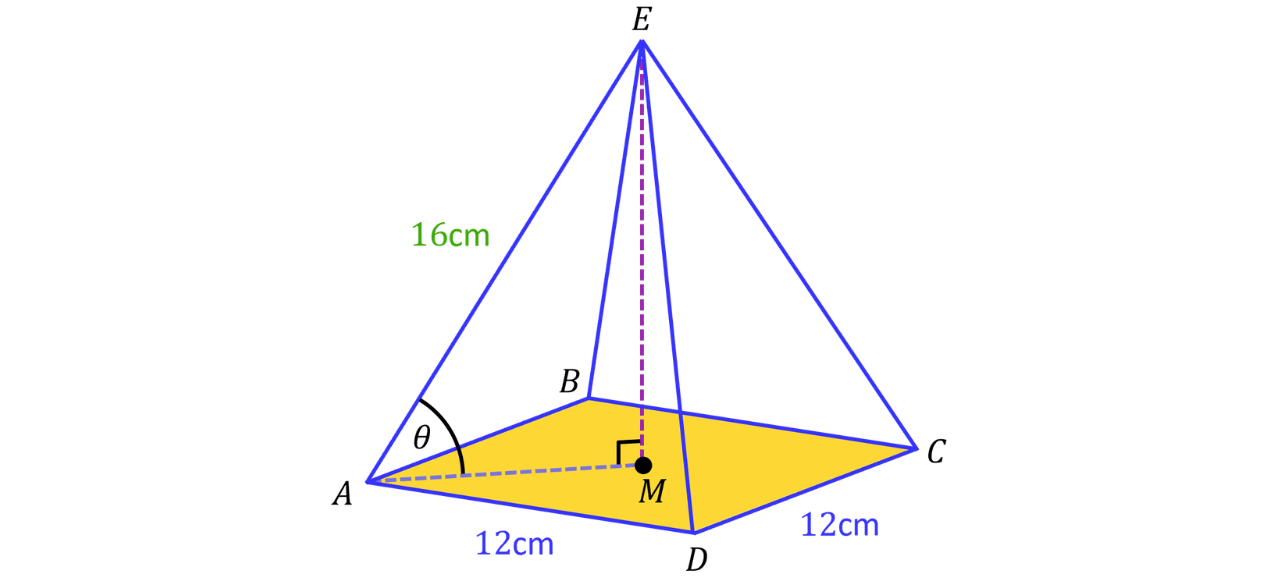
Step 2: Use Pythagoras’ theorem to find the length of and then divide by to find the length of
In order to find the length of we need to first find the length of which lies on the base of the pyramid.
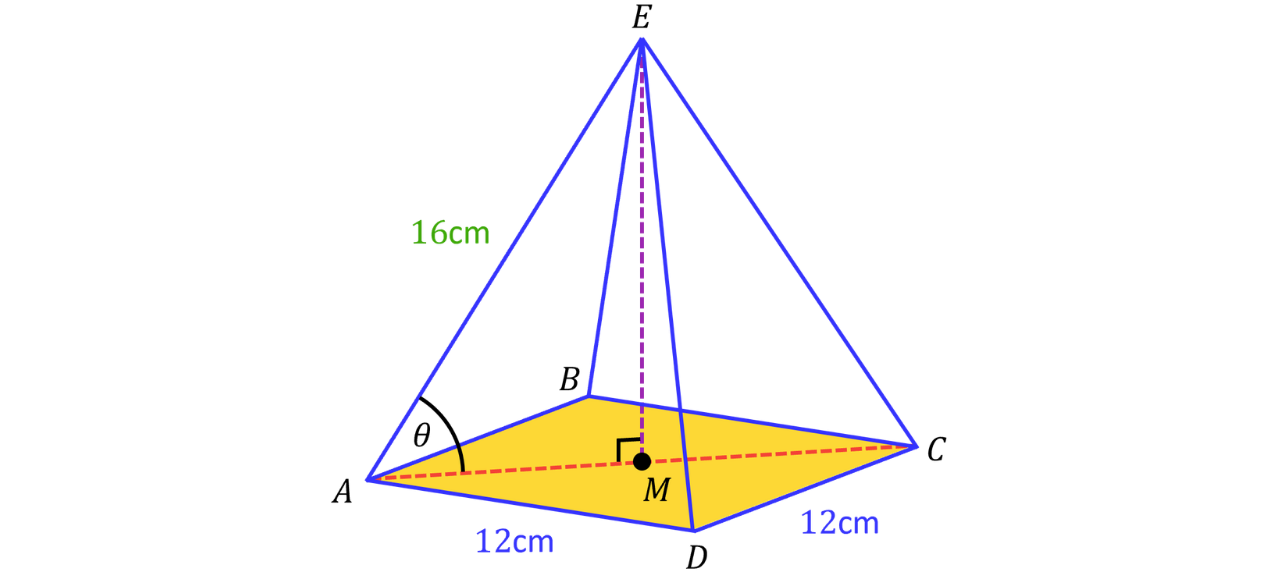
Firstly, here’s the base, drawn on a flat surface with the diagonal and indicated. The length of is represented by

We use Pythagoras’ theorem on the right-angled triangle to find
Square rooting both sides,
cm
can simplify. We can rewrite it as
Therefore, the length of is cm.
Finally, we divide the length of by to get the length of
cm
Step 3: Use SOHCAHTOA to find the angle
Now, we extract triangle from the 3D image, redrawing it on a flat surface.
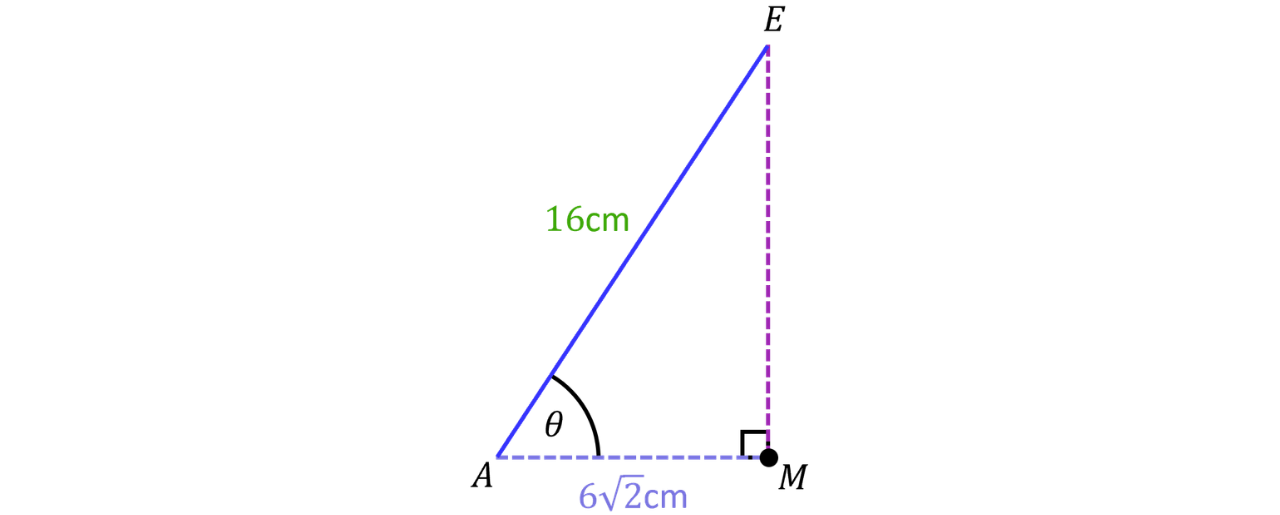
Here, we have (cm), which is adjacent to the angle and cm, which is the hypotenuse. We will use the CAH part of SOHCAHTOA.
Next, we use our calculator to apply to both sides to isolate
Therefore, to 1 decimal place, the angle between the edge and the base is approximately
The Angle Between Two Planes
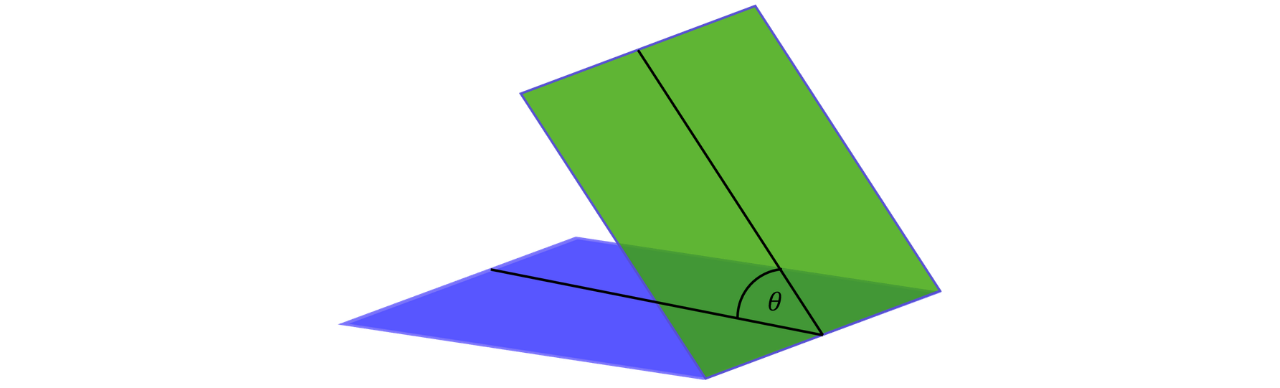
When two planes meet, they meet along a straight line, which we can think of as a hinge. Imagine the sloping plane is a door on that hinge: the angle between the planes is the angle the door would sweep through if you let it fall flat.
To measure this angle, draw one line on each plane, usually through the middle of each surface, so that the two lines meet at the same point on the hinge. The angle, , between these lines is the angle between the planes.
Finding the Angle Between Two Planes
Identify the hinge, which is the line where the two planes meet.
From one point on the hinge, usually the midpoint, draw a line along the middle of each plane. Use these lines to form a right-angled triangle.
Use SOHCAHTOA to find the required angle. If we don’t know at least two of the lengths of the triangle, then we first use Pythagoras’ theorem to find some missing lengths.
Example 8:
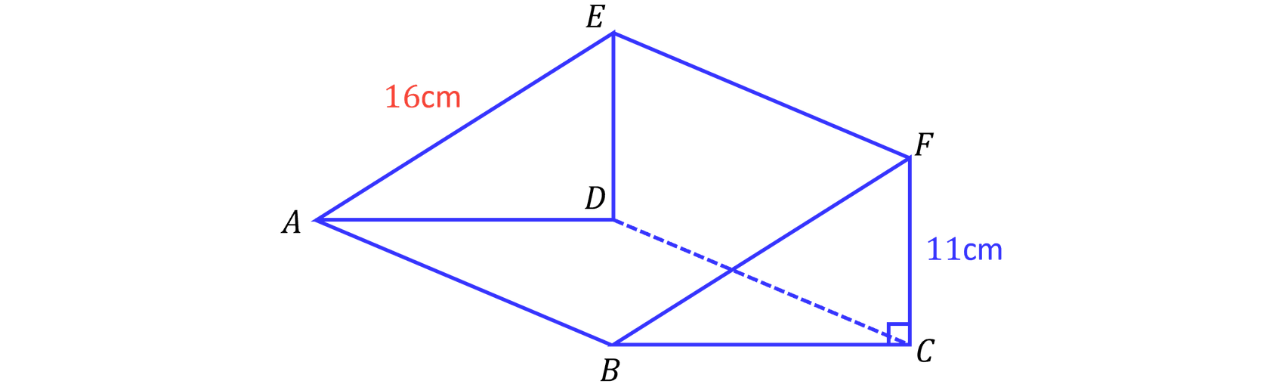
The diagram shows a triangular prism where cm, and cm. Find the size of the angle between the planes and Give your answer to decimal place.
Step 1: Identify the hinge, which is the line where the two planes meet.
The planes and meet along the line which is our hinge.
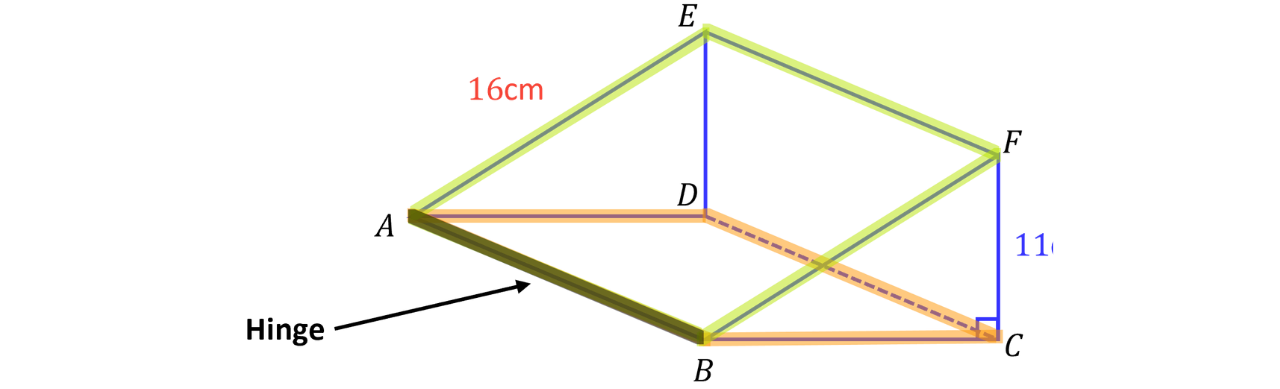
Step 2: From one point on the hinge, draw a line through the middle of each plane. Then, use these lines to form a right-angled triangle.
Suppose we draw lines, from the midpoint of through the middle of both planes and towards the plane as shown in the diagram below. We can form a right-angled triangle (shown as a purple triangle) by including the height that sits on the plane The required angle, would be wedged between the two lines we draw.
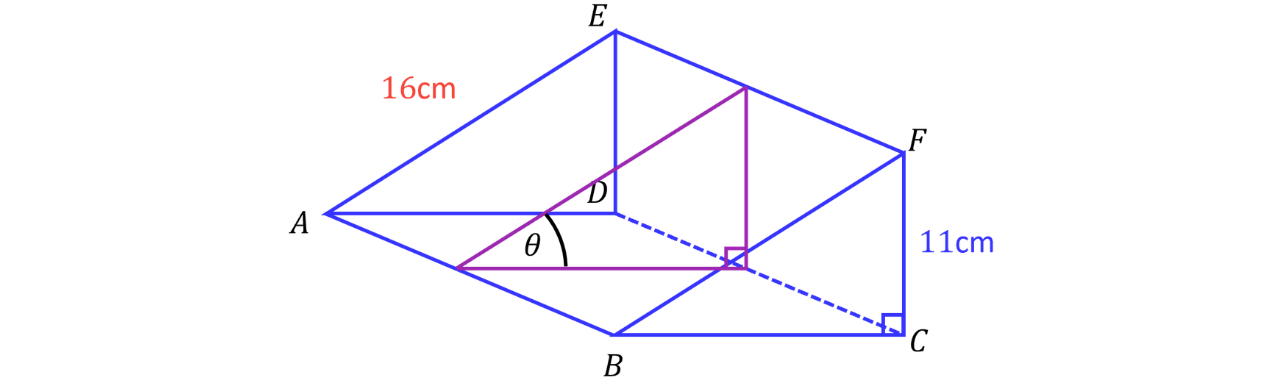
The right-angled triangle we produce is the cross-section of the prism, and since this is a prism, the cross-section is uniform throughout the shape.
This means that from whichever point along we draw our lines from, including from the vertices or we would produce the same right-angled triangle. The dimensions of the purple triangle and triangles and would be the same so, therefore, it doesn’t matter which triangle we use to find the angle as the answer would not change.
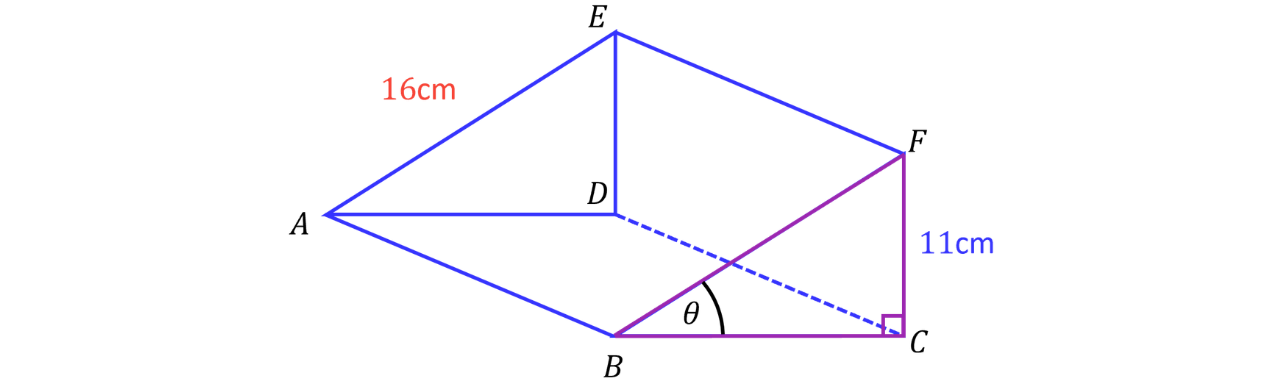
For our calculations, we will use triangle Redrawing that on a flat surface,

Step 3: Use SOHCAHTOA to find the angle
In this triangle, we have cm as the hypotenuse and cm as the length opposite Therefore, we use the SOH part of SOHCAHTOA.
Next, we use our calculator to apply to both sides to isolate
Therefore, to decimal place, the angle between the planes and is approximately
Example 9:
The diagram shows a pyramid with a horizontal rectangular base measuring cm by cm. The apex is directly above the centre of the base, and each sloping edge has length cm.
Find the size of the angle between the planes and Give your answer to decimal place.
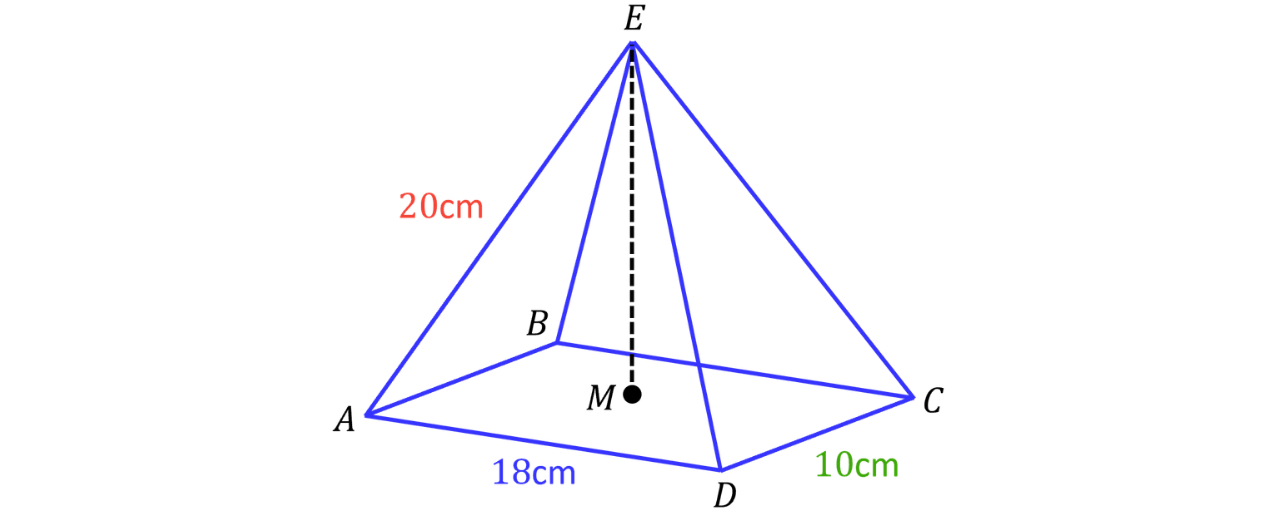
Step 1: Identify the hinge, which is the line where the two planes meet.
The planes and meet along the line which is our hinge.
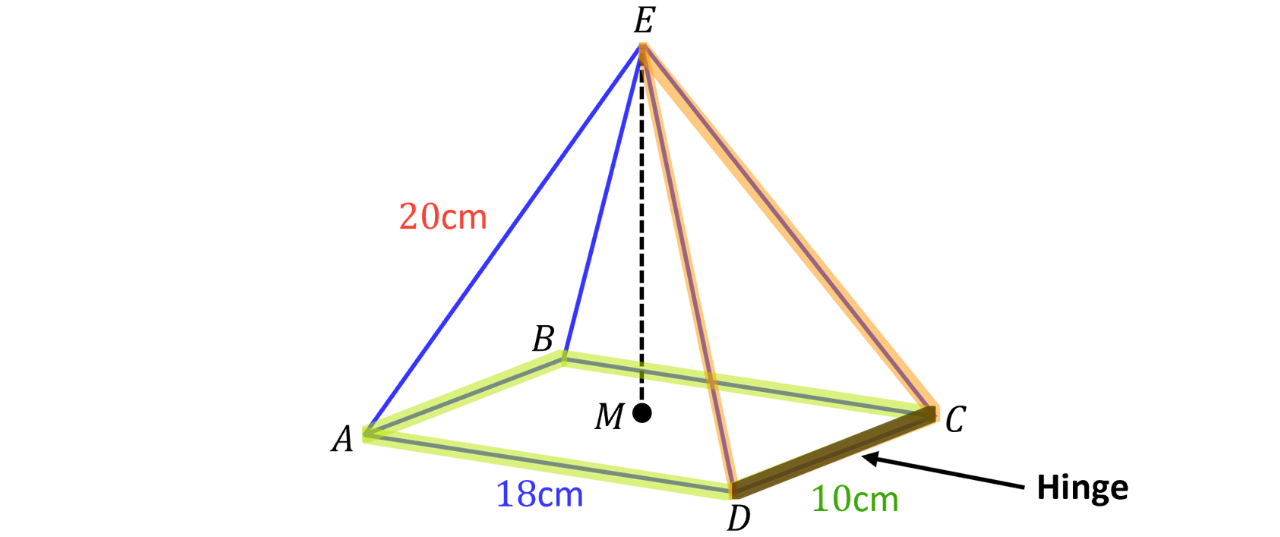
Step 2: From one point on the hinge, draw a line through the middle of each plane. Then, use these lines to form a right-angled triangle.
On the hinge, we will draw lines from a point which is the midpoint between and
We draw a line, from to through the middle of the plane We draw a line, from to through the middle of the plane
The two lines, and are connected by the height so we form a right-angled triangle, (shown in purple in the diagram below). The required angle is wedged between the two planes, so we are looking for angle
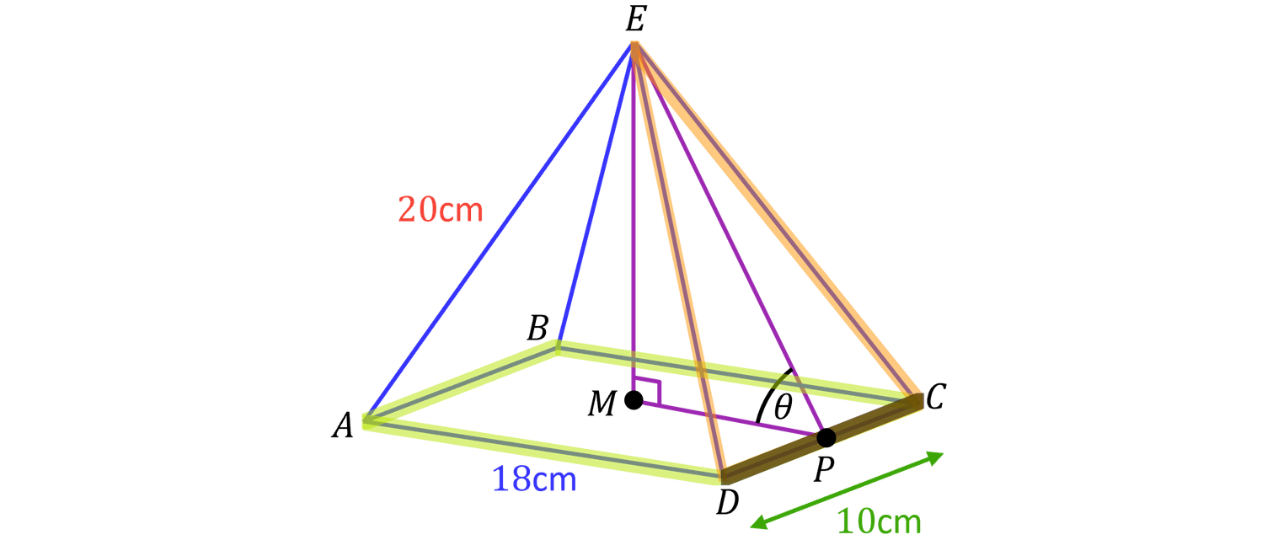
Drawing triangle on a flat surface,

Step 3: Find two of the missing lengths of triangle
At the moment, we do not have any of the lengths of the triangle, so we need to find two of them to find via SOHCAHTOA.
We can quickly find that the length of is cm because it goes halfway along the plane parallel to whose length is cm.
Next, we need to find the length of either or We will find Students often confuse the length down the middle of the plane, with the sloping edge of length cm, but they are different lengths.
Here’s the plane drawn on a flat surface, with indicated and labelled as
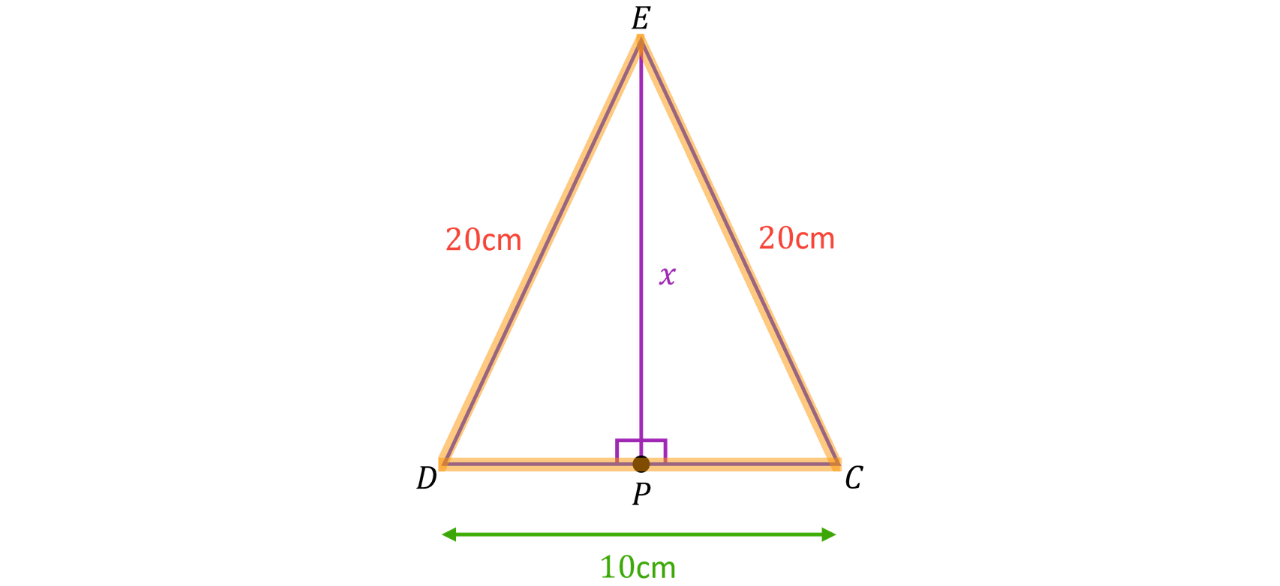
When we drew the line we split down the middle, into two congruent right-angled triangles, and Since we split the plane down the middle, the lengths of both and equal cm.
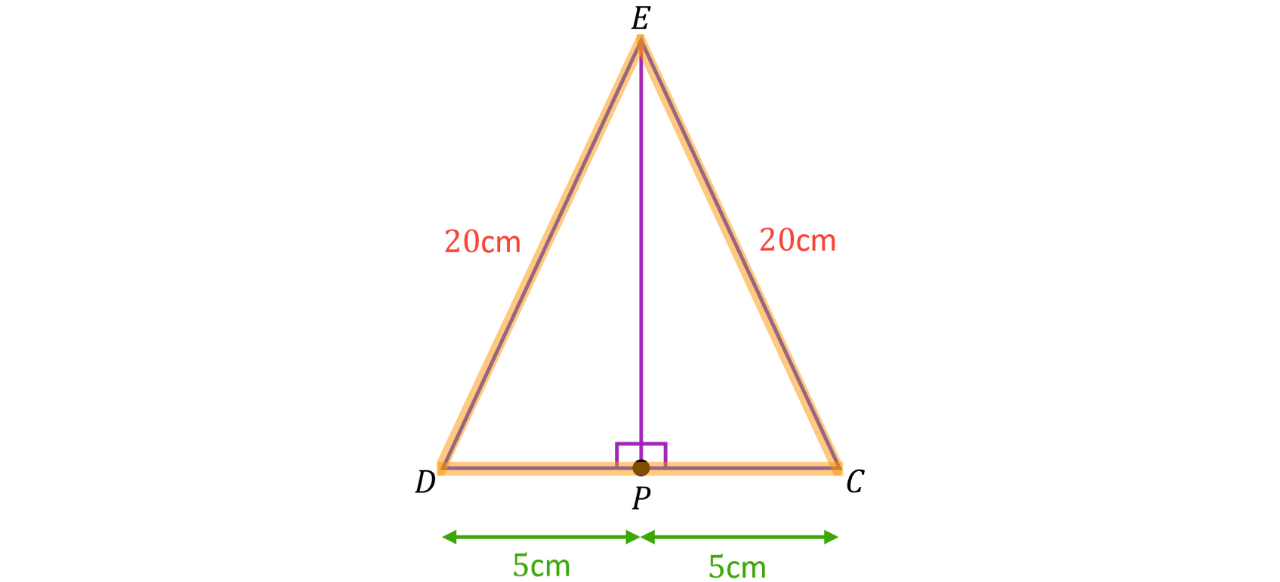
Next, we apply Pythagoras’ theorem to one of the triangles to find
Subtracting from both sides,
Square rooting both sides,
cm
Note: can simplify. We can rewrite it as However, we can keep it as as we are using it later and would not need to simplify.
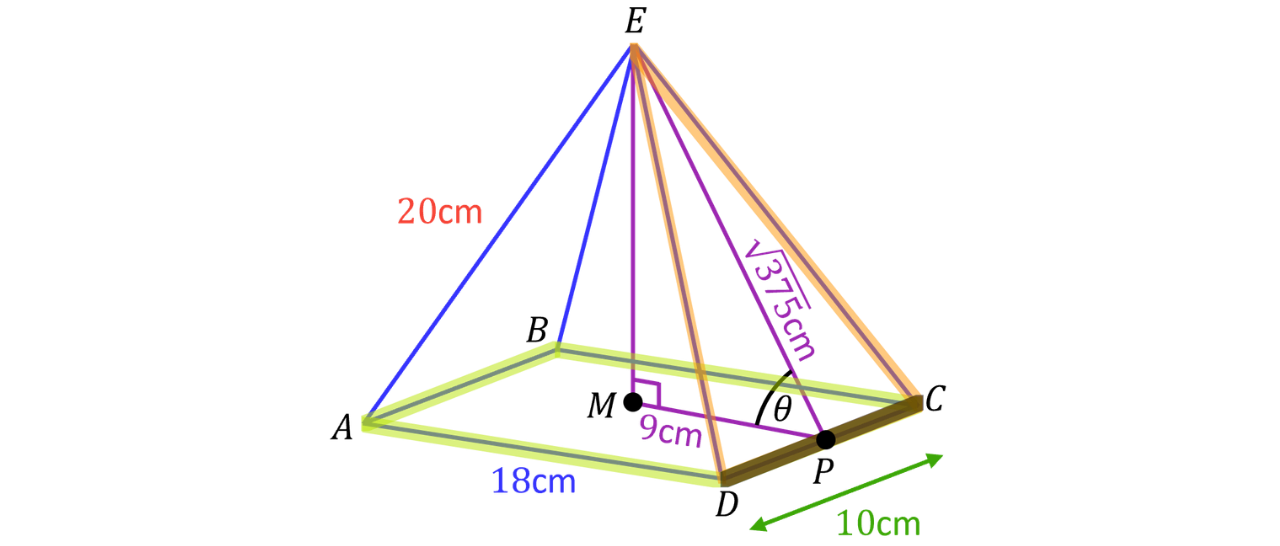
Now, we can extract the right-angled triangle with the two known lengths and draw it on a flat surface.

Note: Alternatively, we could have found the length of but it would take longer because we’d first have to work out the length of the diagonal using Pythagoras’ theorem, halve it to get the length of then use Pythagoras’ theorem again with and to find (the same method as in Example 5 and Example 7).
Step 4: Use SOHCAHTOA to find
Here, we have cm as the hypotenuse and cm as the length that’s adjacent to
Next, we use our calculator to apply to both sides to isolate
Therefore, to decimal place, the angle between the planes and is approximately
Challenging Question