Bearings and Trigonometry
Neil Trivedi
Teacher

Contents
Bearings
In real life, we often need to describe the direction of one place from another. Sailors, pilots and rescue teams all need a way of doing this that is completely precise, and compass directions like "north-east" are not precise enough on their own. Instead, we use bearings.
A bearing is an angle that describes a direction. Bearings always follow the same three rules.
The Three Rules of Bearings
A bearing is measured from North.
A bearing is measured clockwise.
A bearing must always be written using three figures.
The three figures rule means that we pad smaller angles with zeros at the front. For example, an angle of clockwise from North is written as the bearing and an angle of is written as An angle of already has three figures, so it is simply written as
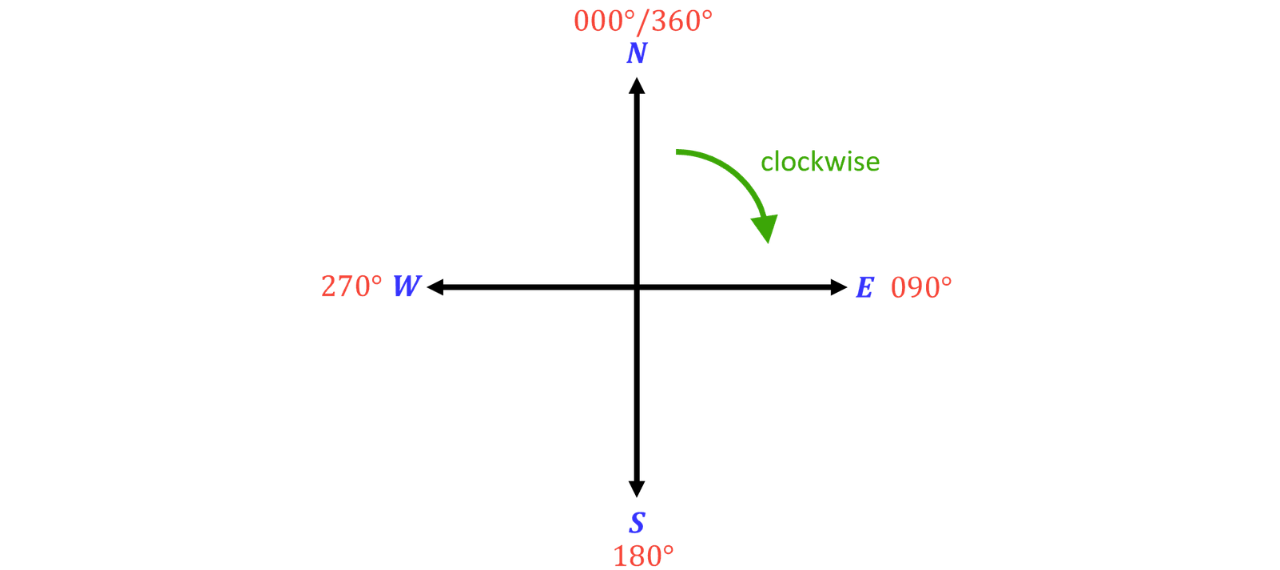
The compass diagram above shows the bearings of the four main compass directions: due east is due south is and due west is North itself is (or if you have done a full rotation). Exam questions often use phrases like "due east" or "due south", so these four values are worth remembering.
Measuring and Drawing Bearings
The wording "the bearing of from " tells us exactly where to stand and where to look. The word “from” is the important one: we stand at so the North line and the angle are both drawn at We then measure clockwise from that North line until we reach the line
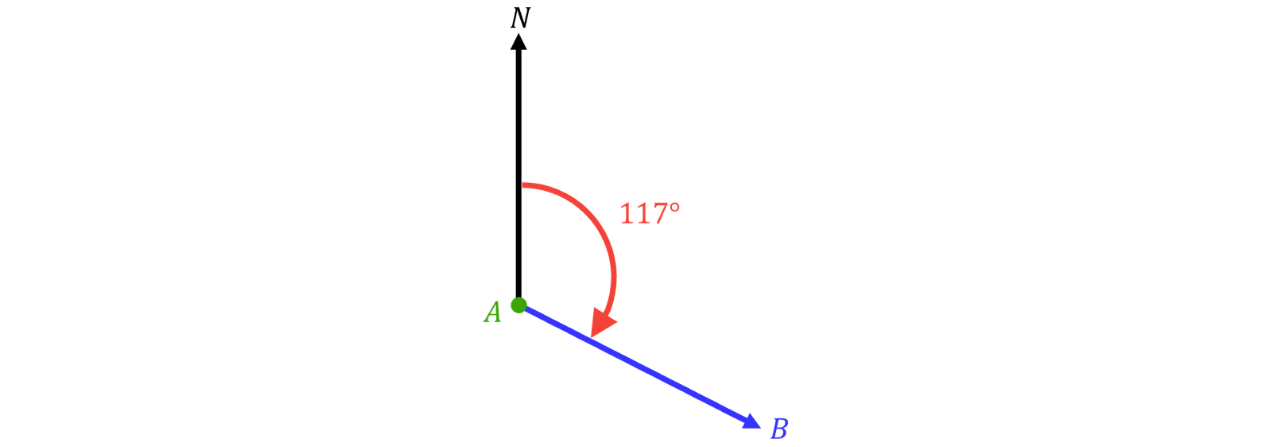
In the diagram above, starting at the North line at and turning clockwise through takes us to the line from to So, the bearing of from is
Many bearings questions come with no diagram at all, or with a diagram that is missing the North line we need. Our advice: when in doubt, draw it out! A quick sketch showing the points, the North lines, and the angles turns a confusing worded question into a straightforward angles question.
Example 1:
Each diagram below shows the positions of two points.
a) Find the bearing of from
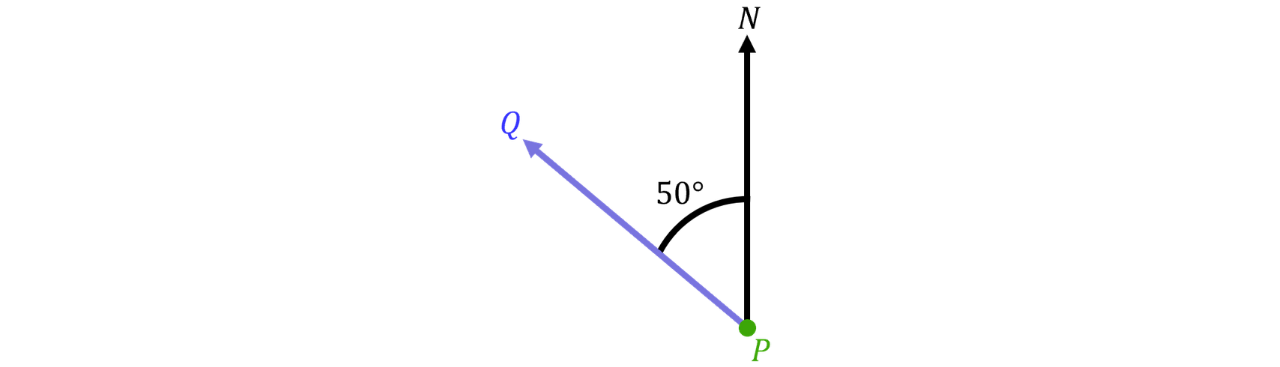
Step 1: Identify the angle between North and the line
We are finding the bearing of from so we work at The diagram shows that the angle between the North line at and the line is but it is measured anticlockwise, which is the wrong way round for a bearing.
Step 2: Measure clockwise from North instead.
A bearing must be measured clockwise from North, so we go the long way round. A full turn is and our angle falls short of it:
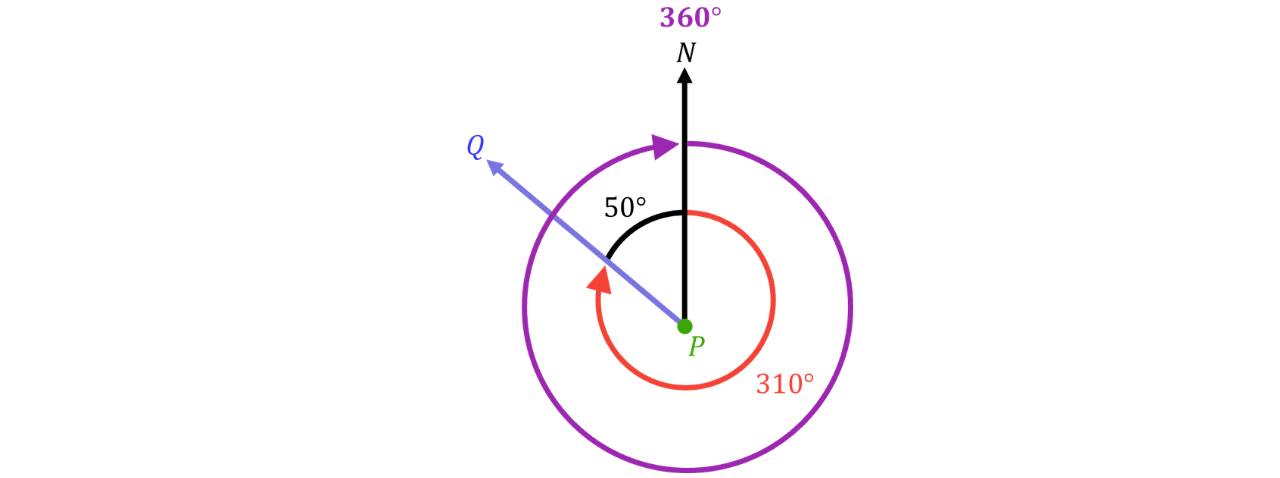
Bearing of from
b) Find the bearing of from
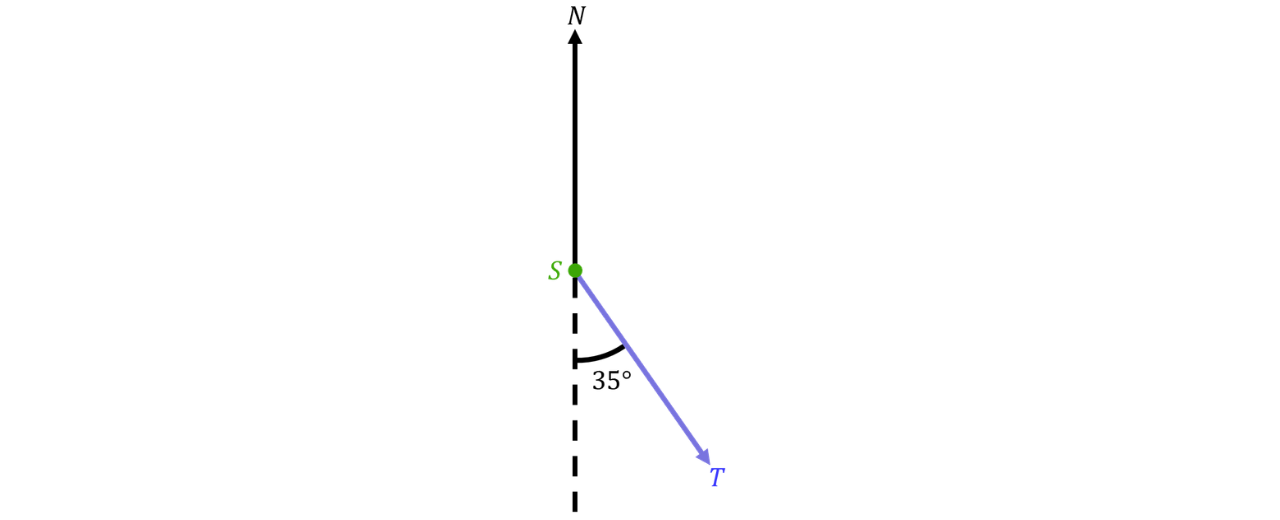
Step 1: Identify the known angles at
This time, the angle is measured from the South direction (the dashed line). From the compass diagram earlier, we know that turning clockwise from North all the way round to South is
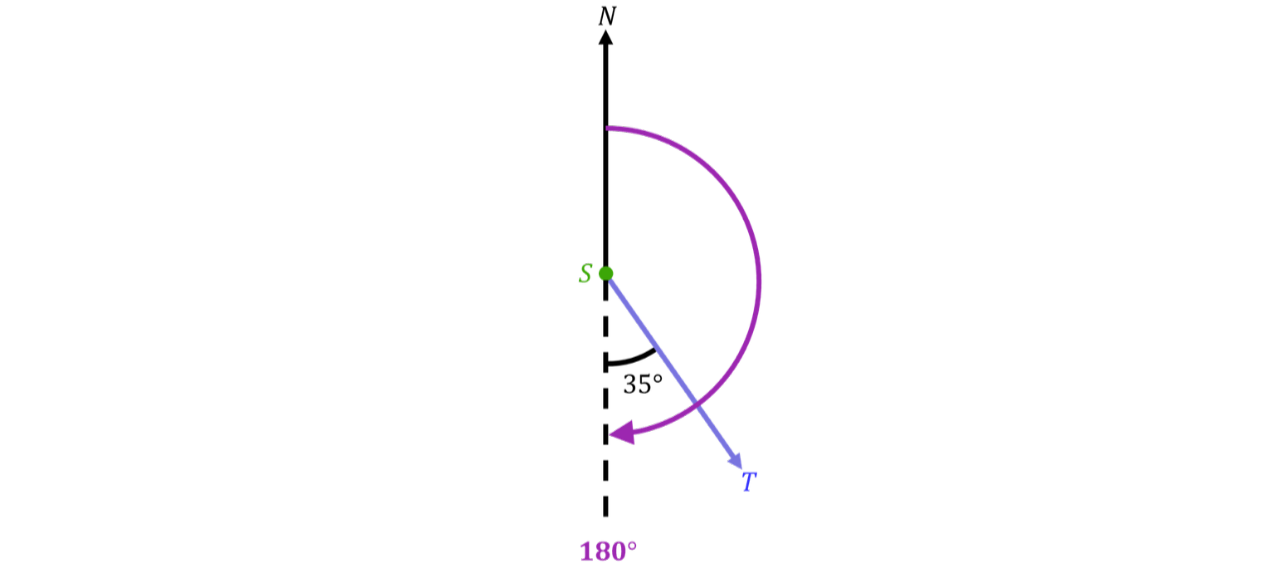
Step 2: Subtract to find the bearing.
Turning clockwise from North, we reach the line just before we reach South. In fact, we stop short of it:
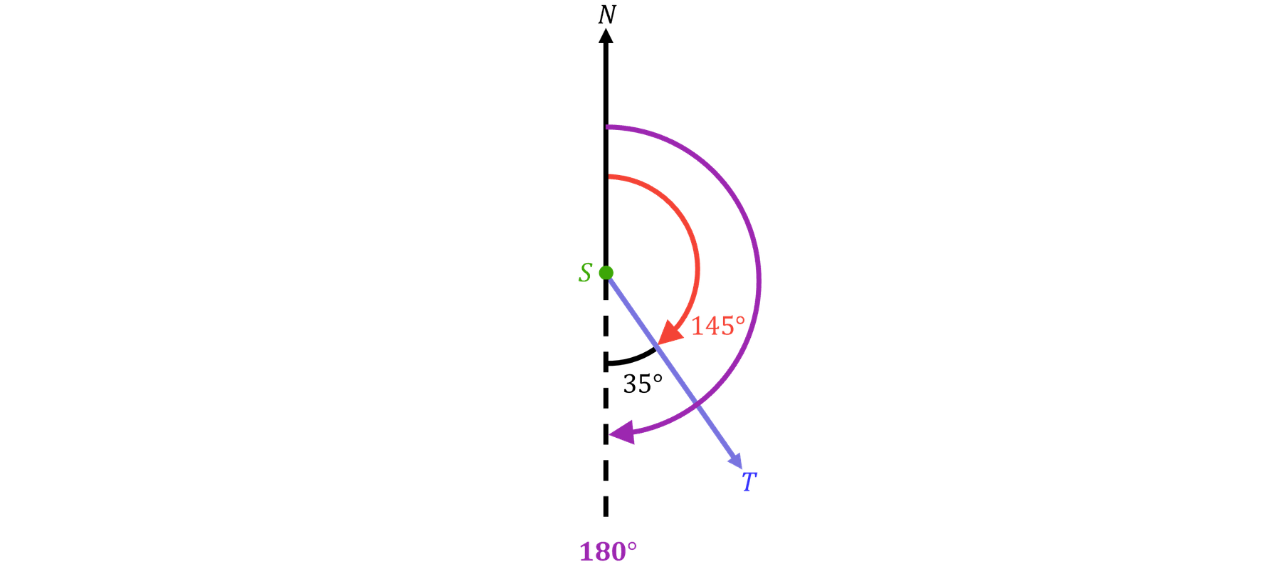
Bearing of from
Back Bearings
Suppose we know the bearing of from What is the bearing of from measured from the other end? This reversed bearing is often called a back bearing.
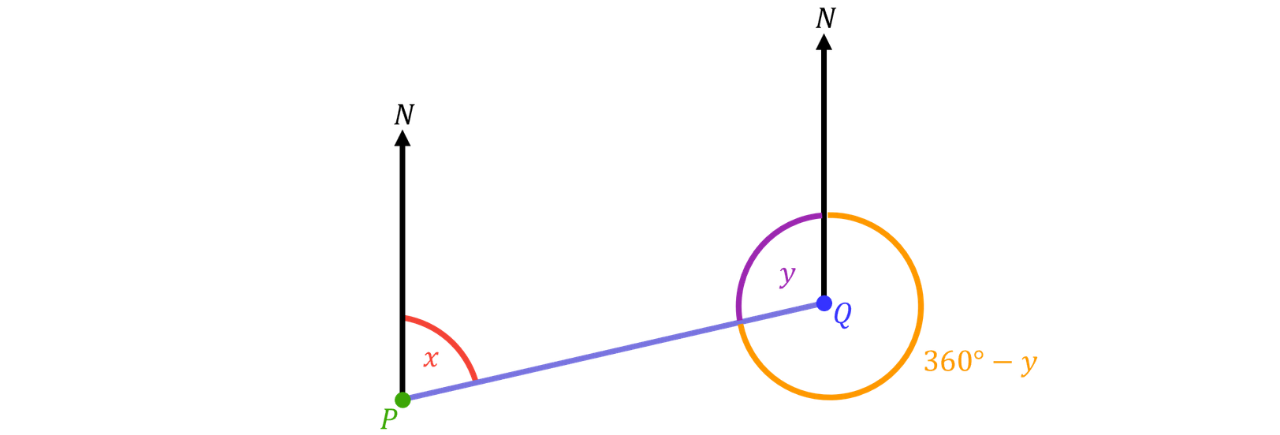
The key idea is that all North lines point the same way, so the North lines at and at are parallel. The line is then a straight line crossing a pair of parallel lines, which means we can use our angle rules for parallel lines.
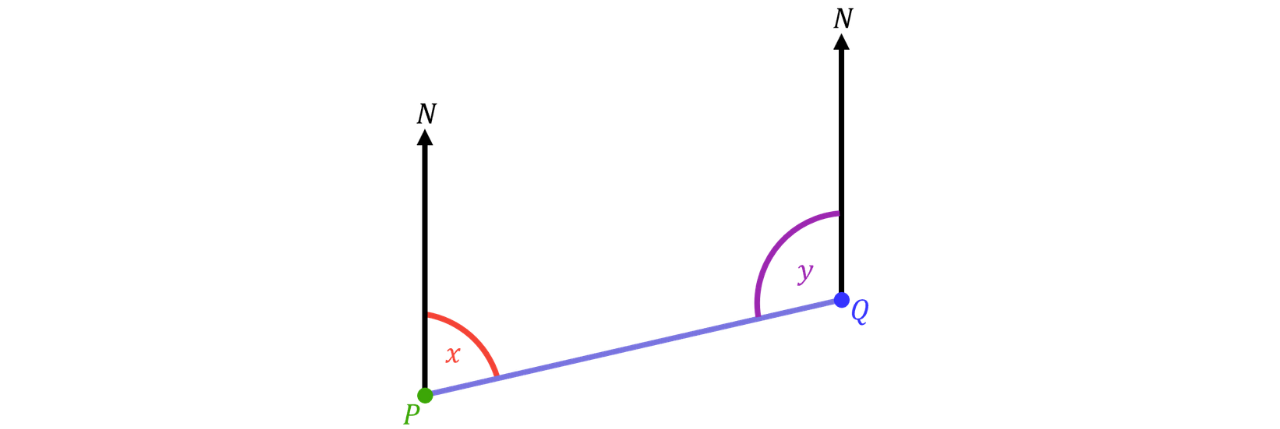
In the diagram, is the bearing of from and is the angle between the North line at and the line These two angles sit between the parallel North lines on the same side of the line so they are co-interior angles and, hence, add up to
Once we know the size of angle the bearing of from is a full clockwise turn minus
Example 2:
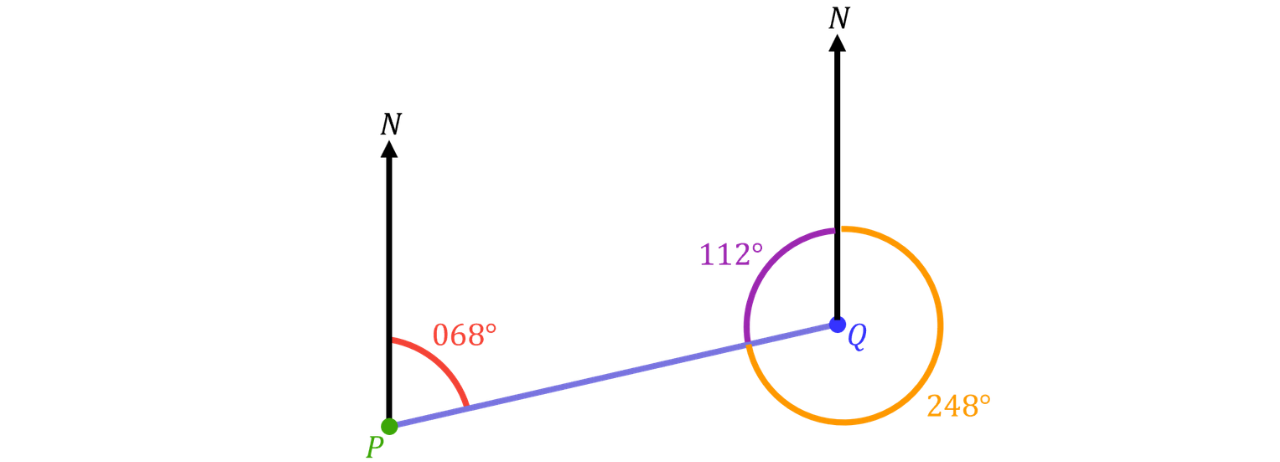
a) The bearing of from is Find the bearing of from
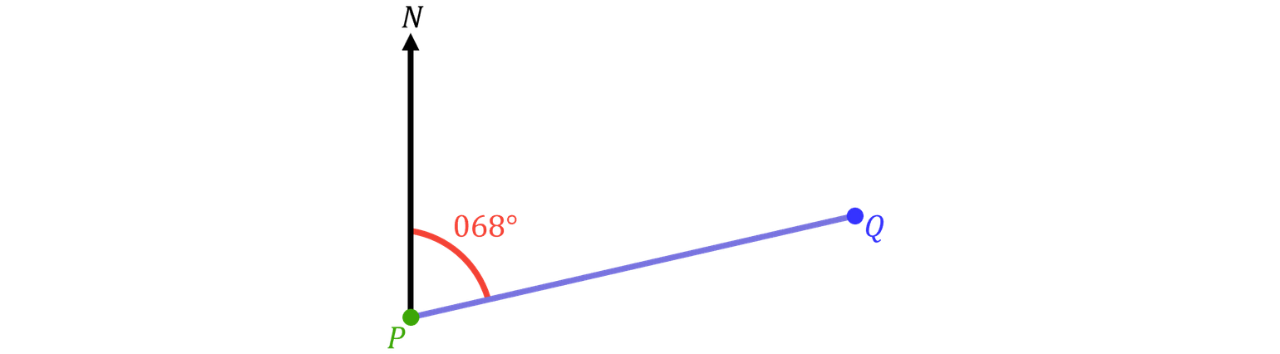
Step 1: Draw both North lines and find the co-interior angle at
Standing at the angle between the North line at and the line is co-interior with the at so the two angles add up to
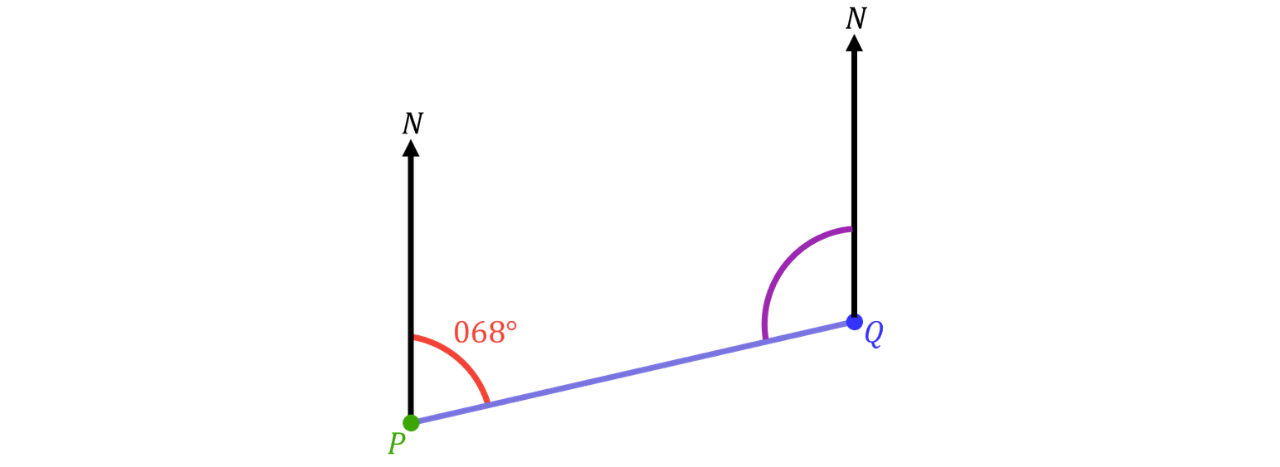
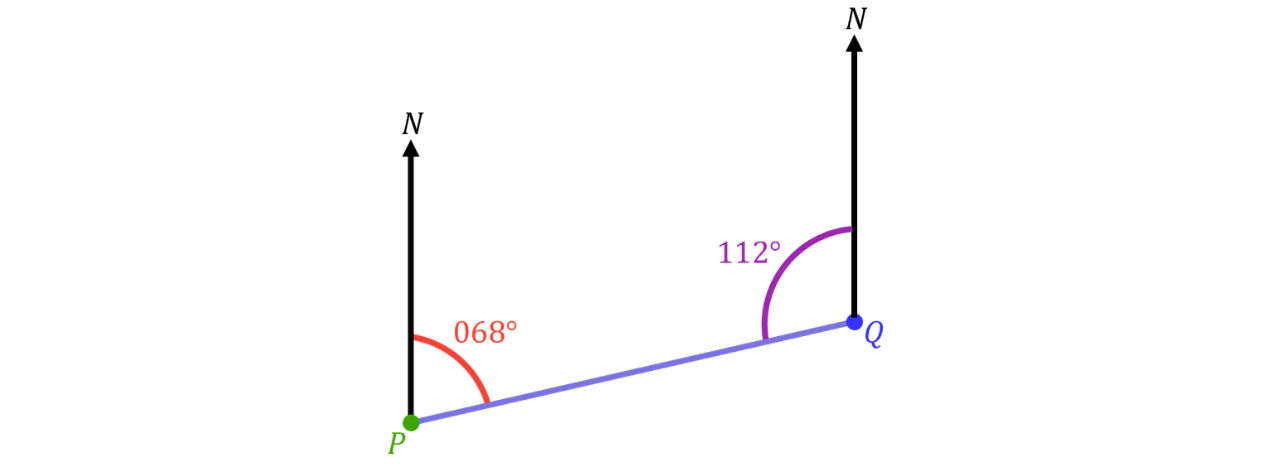
Step 2: Measure clockwise from North at
The is on the anticlockwise side of North, so the bearing of from is a full turn minus this angle:
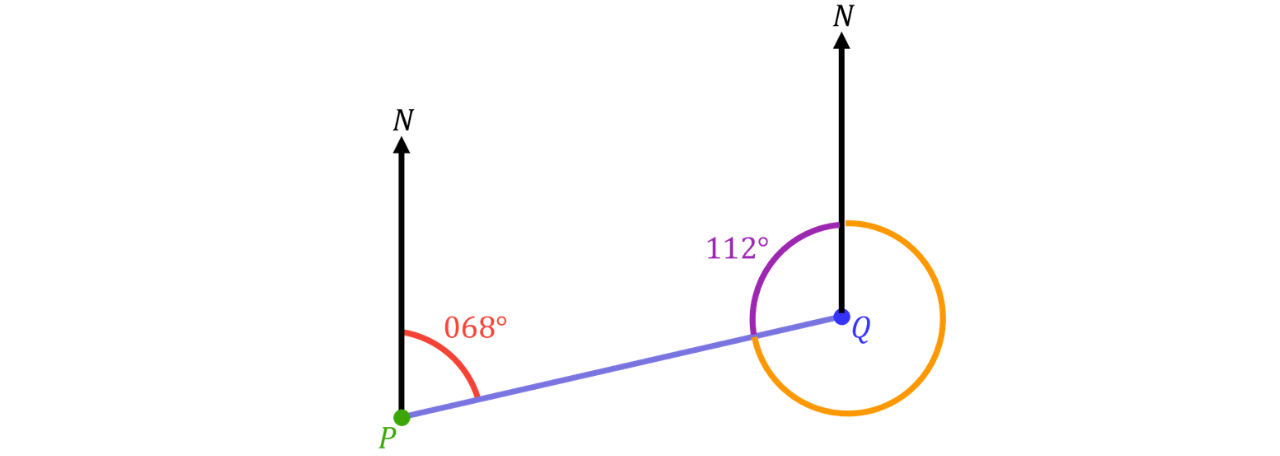
bearing of from
b) The bearing of from is Find the bearing of from
Step 1: When in doubt, draw it out!
1) First draw the bearing of from to
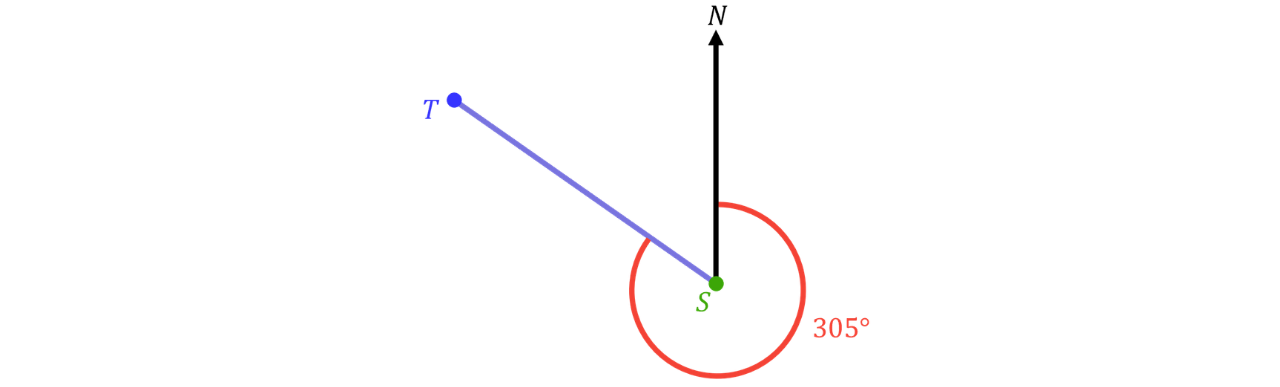
2) Add a North line at
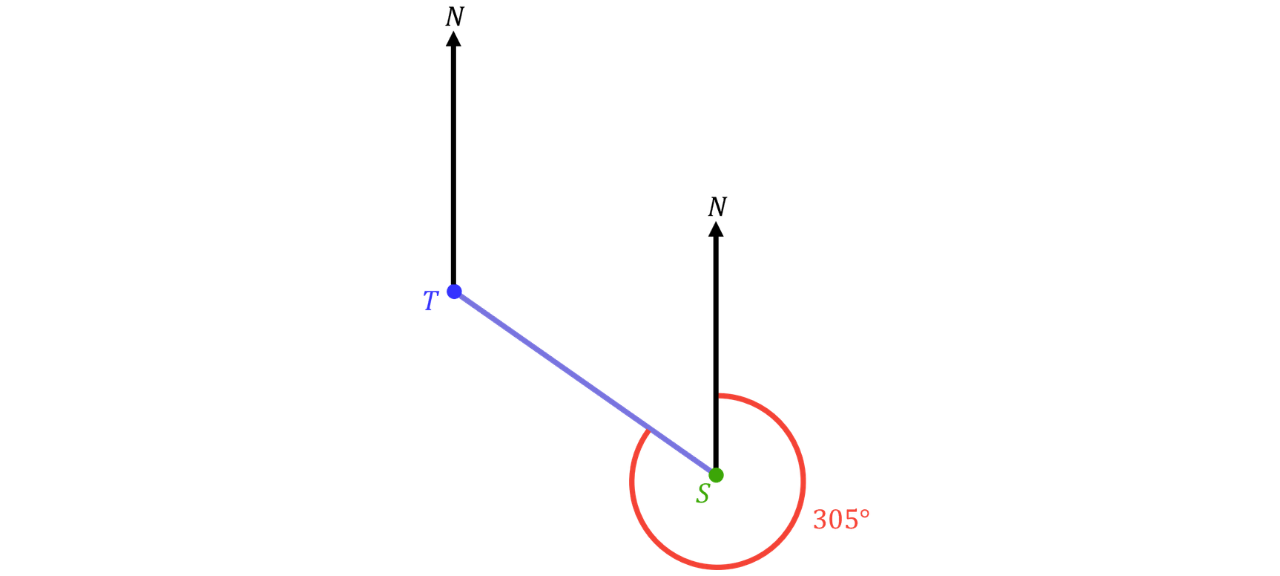
3) Draw the bearing of from
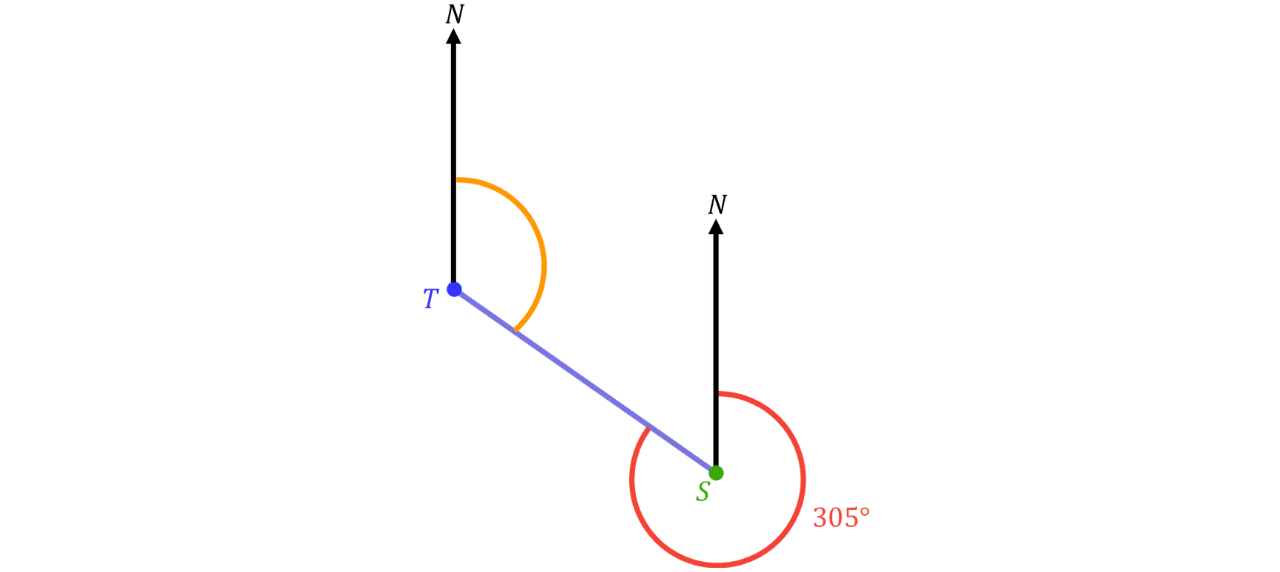
Step 2: Find the missing acute angle at
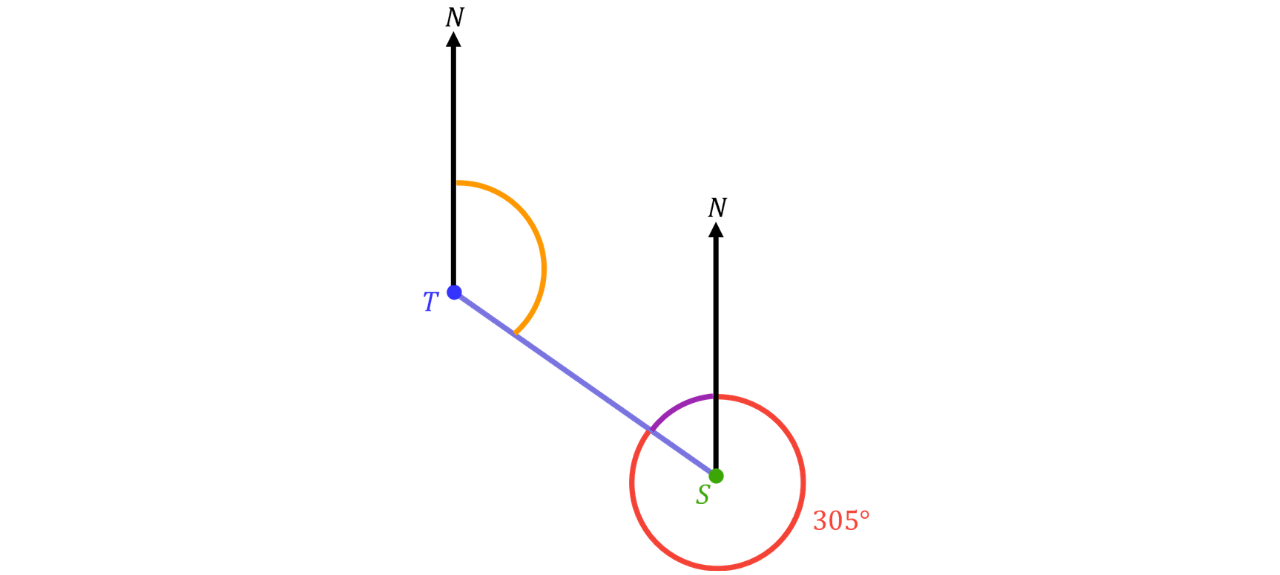
Acute angle at
Step 3: Use co-interior angles to find the bearing of from
Co-interior angles add to
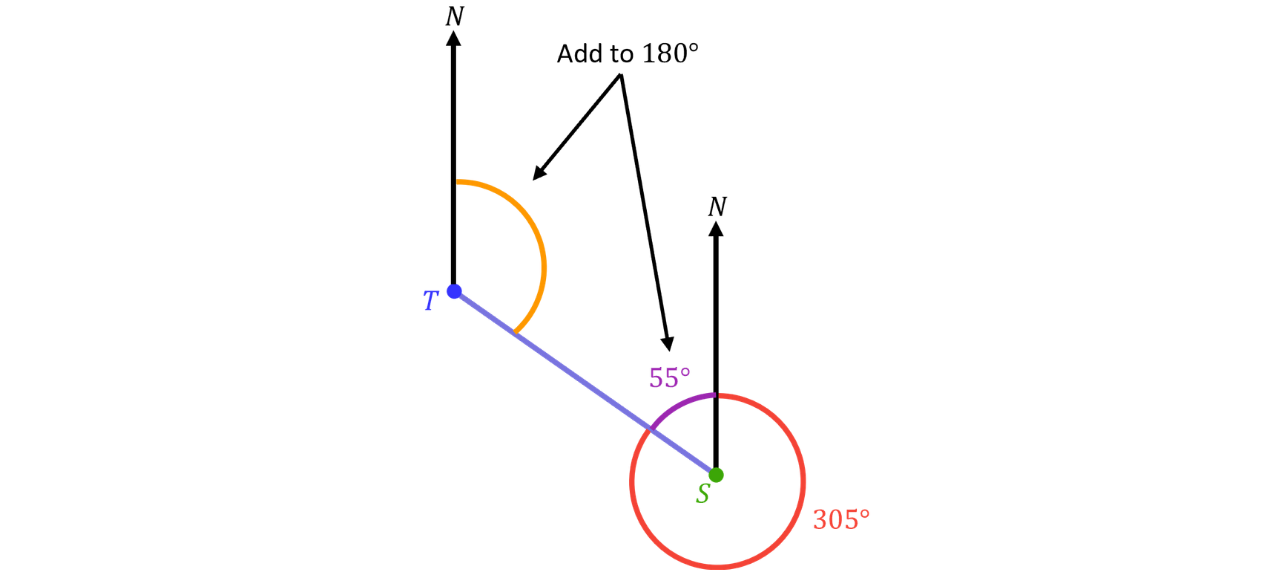
Bearing of from
Bearings and Right-Angled Trigonometry
Bearings questions are often combined with trigonometry. When the diagram contains a right-angled triangle, we can use SOHCAHTOA to find a missing angle and then convert that angle into a bearing using the North line.
SOHCAHTOA
For a right-angled triangle with an angle
Example 3:
The diagram shows the positions of a port and a ship The ship is km east and km south of the port.
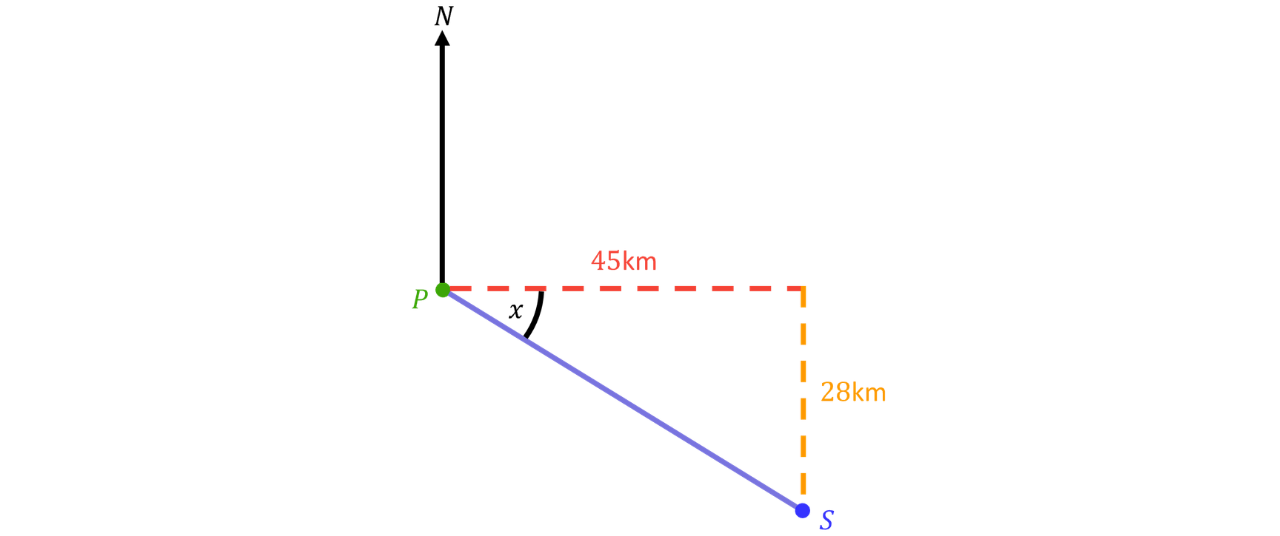
a) Find the size of angle Give your answer to decimal place.
Step 1: Label the sides of the right-angled triangle from the angle
Relative to the angle the side of length km is adjacent and the side of length km is opposite.
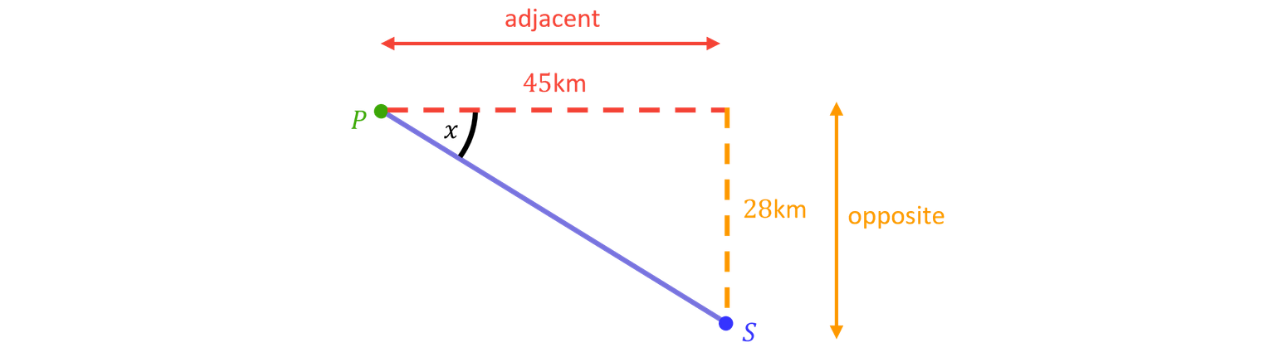
Step 2: Use SOHCAHTOA to find the size of angle
Oppositeand adjacent together mean we use the TOA part of SOHCAHTOA.
Now, we use our calculator to apply to both sides to isolate
Therefore, to decimal place.
b) Work out the bearing of from Give your answer to decimal place.
Single Step: Add to to form the required bearing.
The bearing of from is measured clockwise from North at round to the line
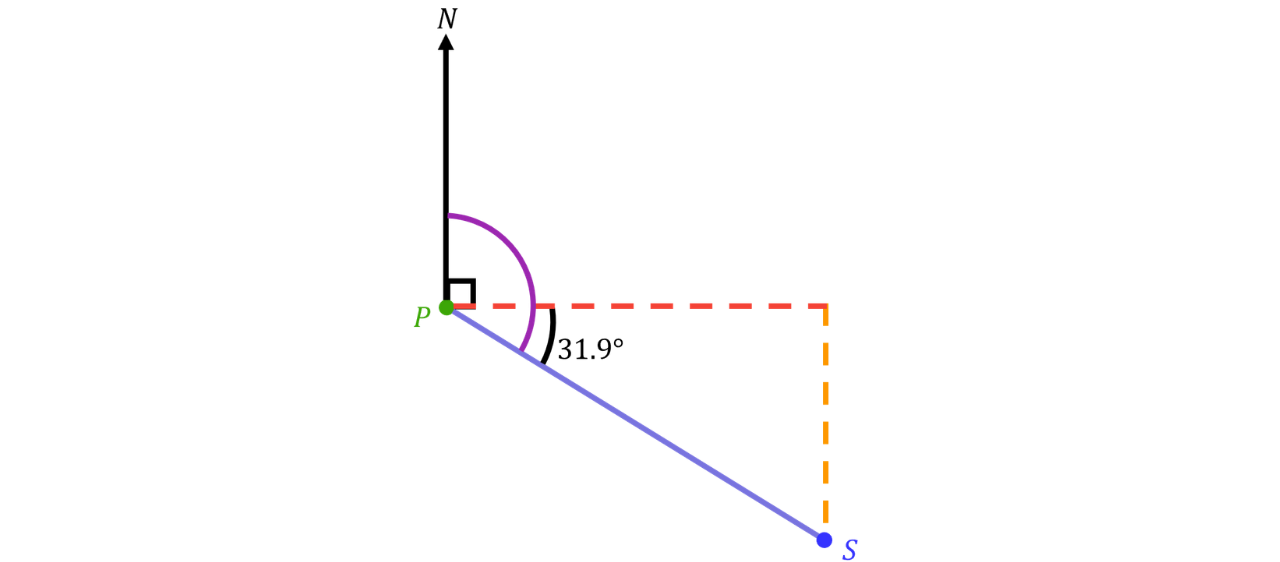
Notice, from the diagram, that the bearing of from is made up by and from a).
Bearing of from
Bearings with Angle Facts
Harder bearings questions weave in angle facts: angles on parallel lines, angles in a triangle and isosceles triangles. The parallel North lines are what let us move angles around the diagram, and equal distances are what create isosceles triangles.
Angle Facts You Will Need
Alternate angles on parallel lines are equal.
Co-interior angles on parallel lines add up to
Angles in a triangle add up to
The base angles of an isosceles triangle are equal.
Example 4:
From a coastguard station a ship is on a bearing of and a ship is on a bearing of The two ships are the same distance from the station.
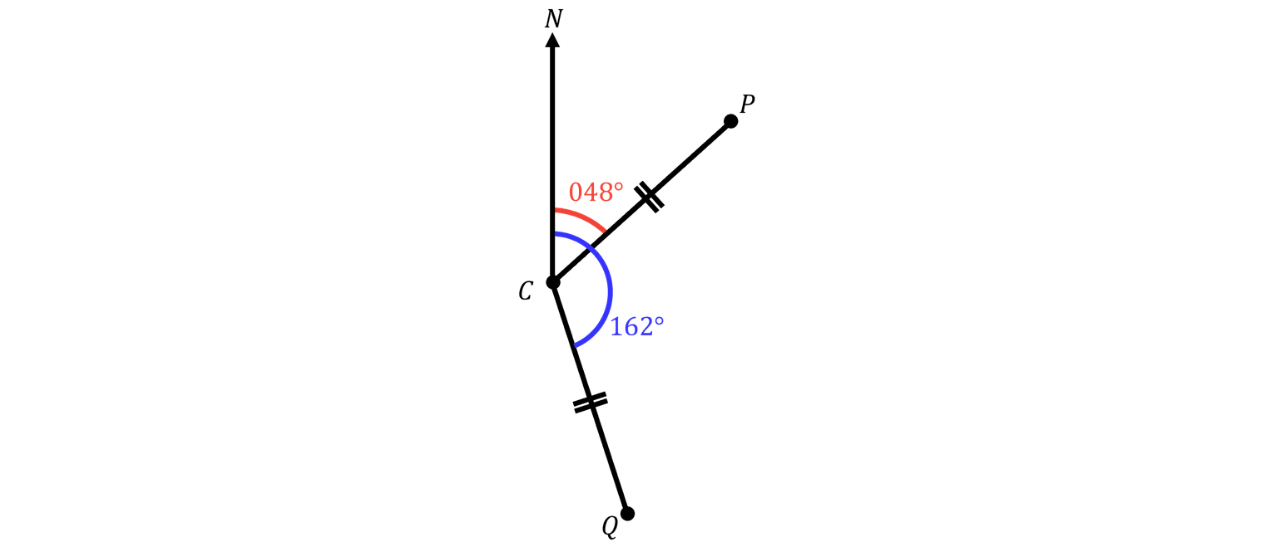
a) Find the angle
Single Step: Subtract the two bearings.
Both bearings are measured clockwise from the same North line at The line is round from North and the line is round from North, so the angle between the two ships, as seen from the station, is the difference.
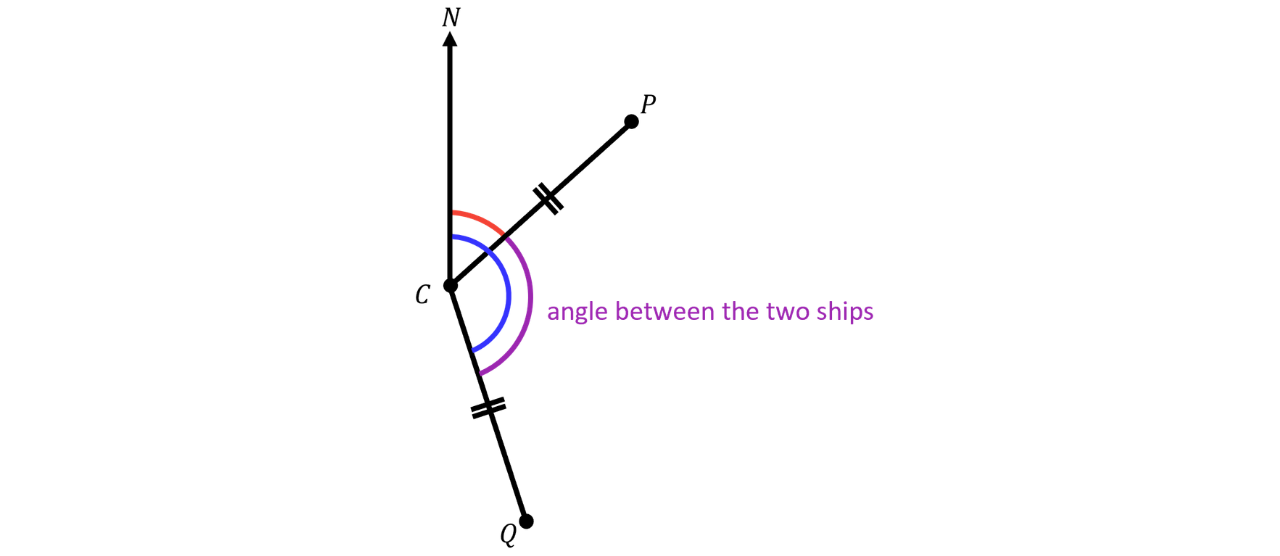
Angle
b) Work out the bearing of from
Step 1: Add a North line at and draw the angle measuring clockwise from the North line at to the line
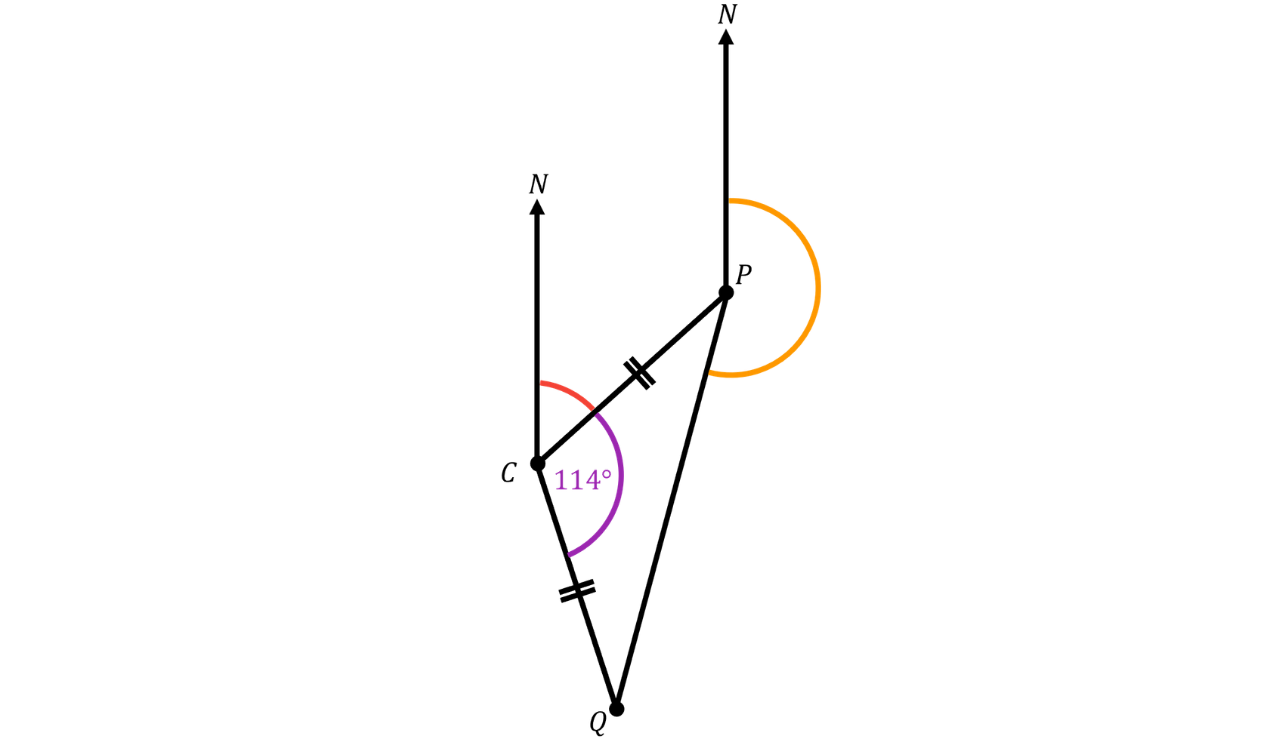
Step 2: Use the isosceles triangle to find angle
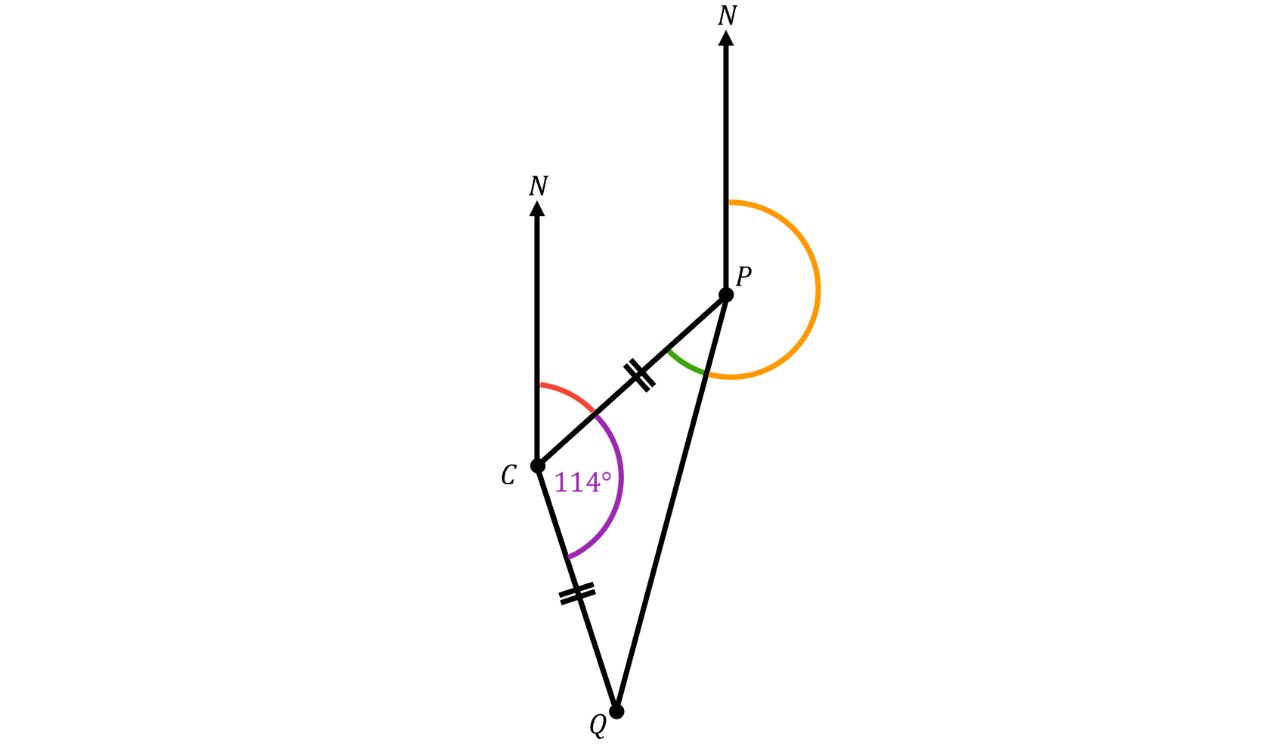
The two ships are the same distance from the station, so and triangle is isosceles. Its base angles are equal:
Angle Angle
Step 3: Use co-interior angles with to find the missing angle at
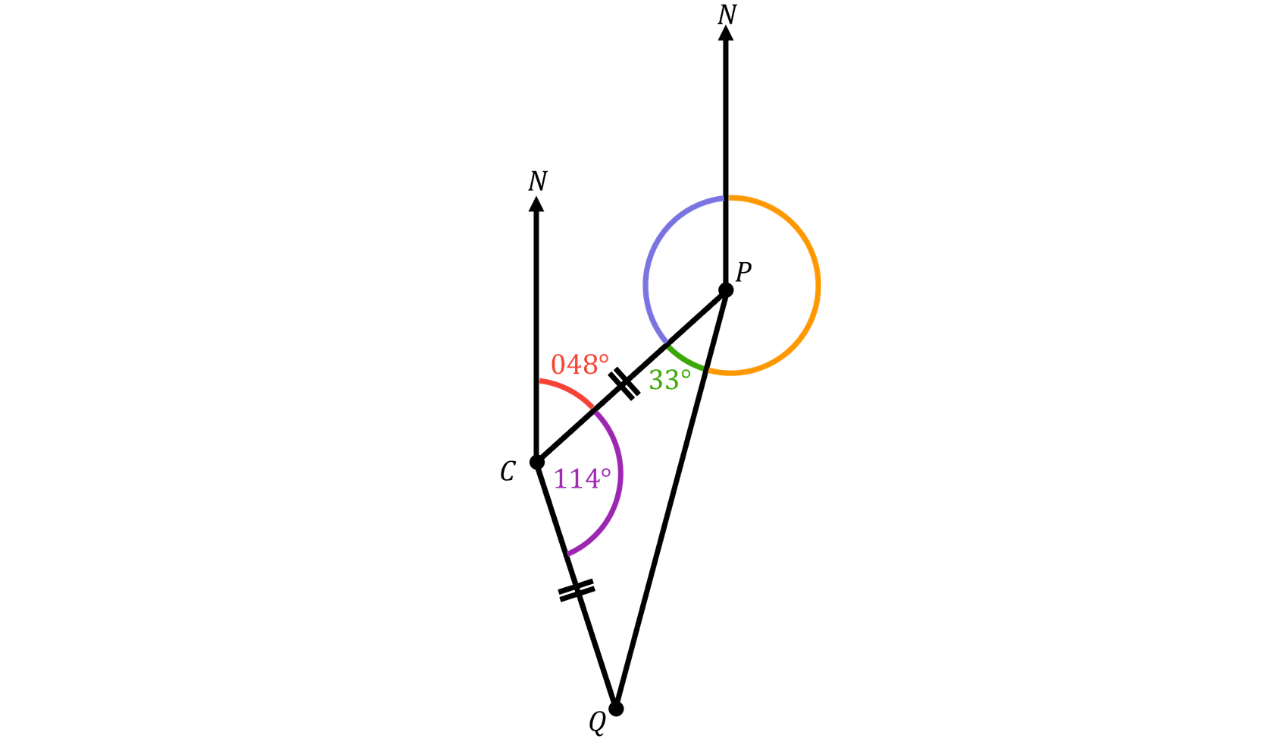
Missing angle at
Step 4: Use the fact that angles around a point add to
We have all the angles at point to complete the full circle.
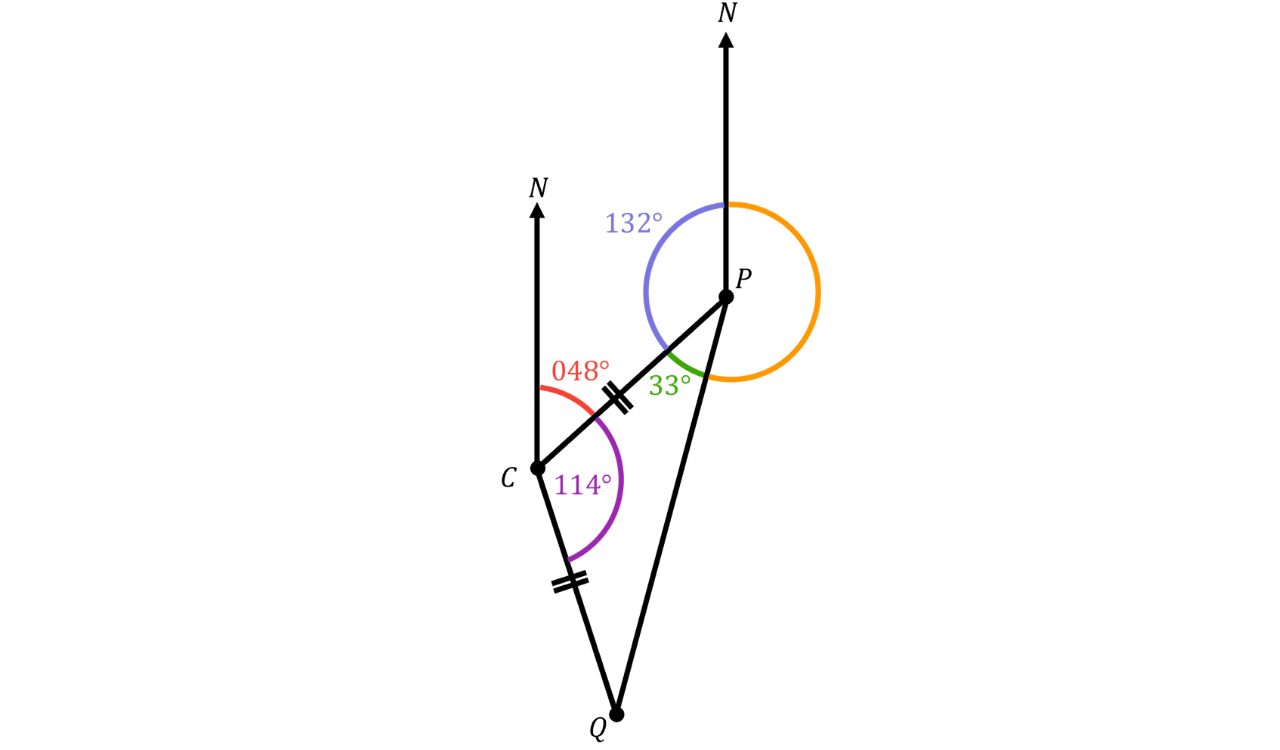
Bearing of from
Note: We could sense check our answer by observing the diagram. From point the line to points slightly south west. Since due south is at a bearing of the bearing of from should be slightly larger than So, is sensible.
Bearings with the Sine and Cosine Rules
Before you continue with the next example, you must be fully comfortable with the sine and cosine rules. We recommend that you read our cosine and sine rule notes.
A reminder of the rules:
The Sine Rule
When finding a missing length, the sine rule is given by
When finding a missing angle, we take the reciprocal of the above and the sine rule is given by
The Cosine Rule
When finding a missing length, the cosine rule is given by
When finding a missing angle, the cosine rule is given by
Example 5:
A yacht sails from a harbour on a bearing of for km to a buoy At the buoy, it changes course and sails on a bearing of for km to a lighthouse
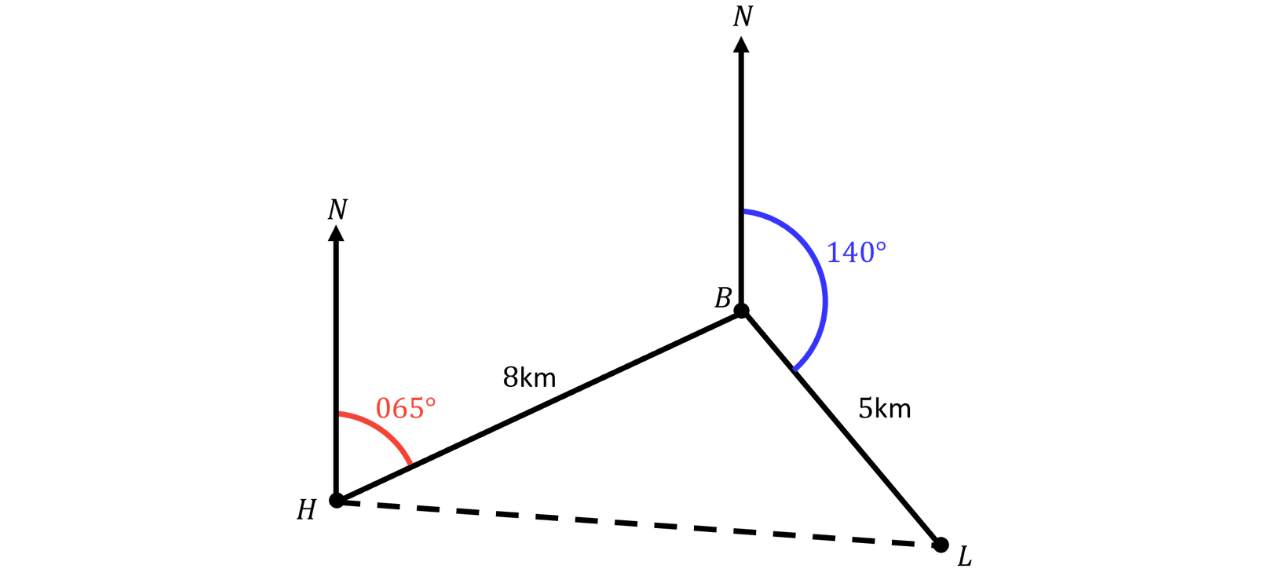
a) Show that angle
Step 1: Use co-interior angles with to find the missing angle at
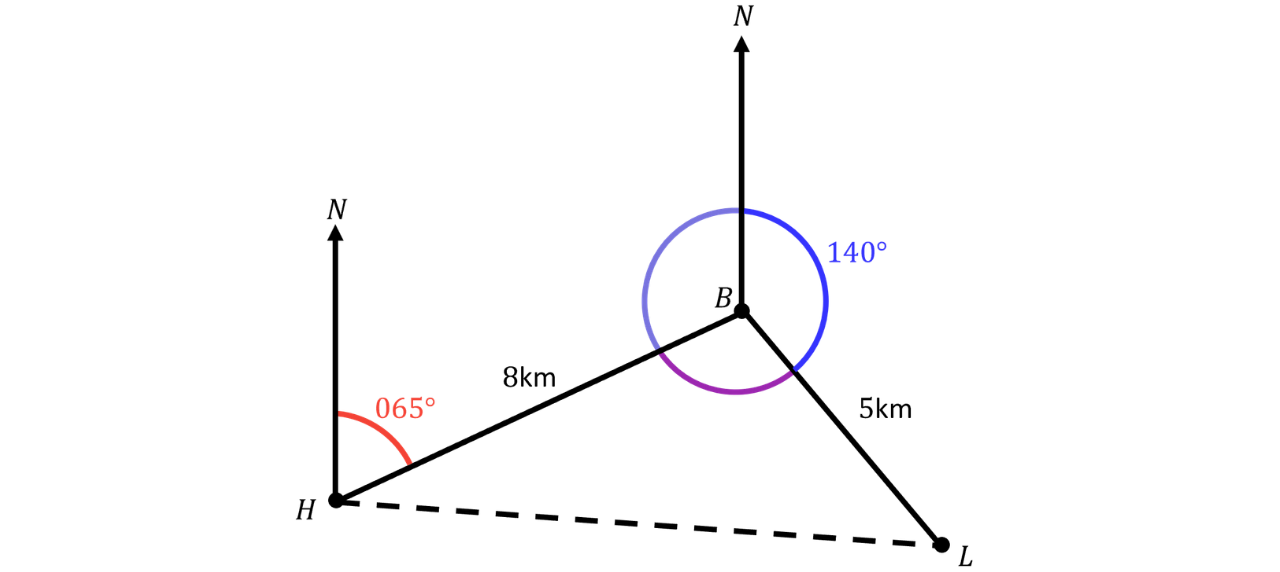
Missing angle at
Step 2: Use the fact that angles around a point add to
We have all the angles at point B to complete the full circle.
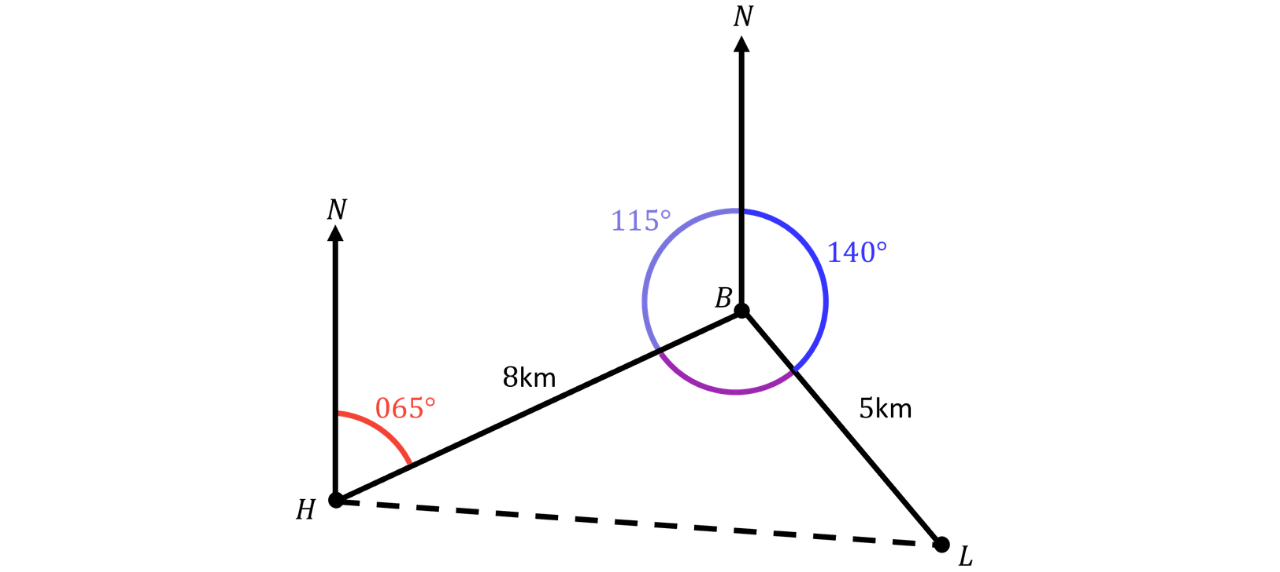
Angle
b) Find the distance Give your answer to significant figures.
Step 1: Draw a new triangle and then choose the correct rule.
Re-drawing the triangle without the messy angles and North lines will make it much easier to decide how to proceed with the problem. We can let since it is the unknown length we are trying to find.
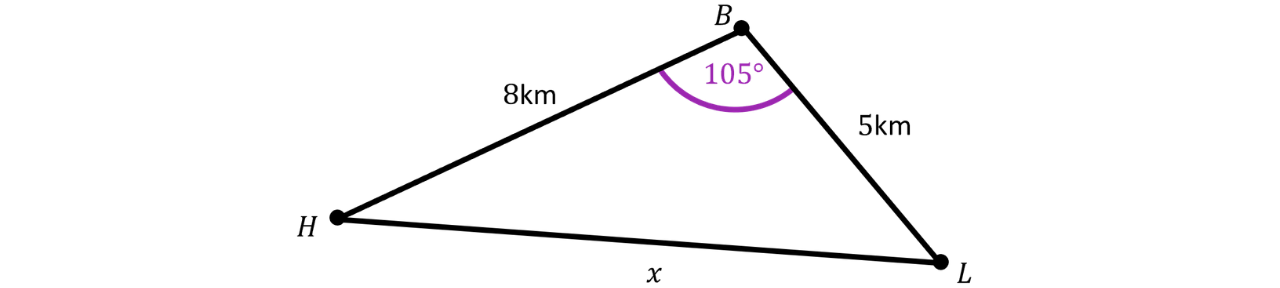
In triangle we know two sides, km and km, and the angle included between them, angle Two sides and the included angle means we use the cosine rule.
Step 2: Substitute into the cosine rule.
The cosine rule is
In this case, we have and
Note that it does not matter which of or we label as and which we label as because those lengths are on either side of the angle. It is only what we label as length that must be opposite the angle Substituting our values into the cosine rule:
Computing the right-hand side on our calculator,
Square rooting both sides,
Therefore, to significant figures, km.
c) Find the bearing of from Give your answer to the nearest degree.
Step 1: Draw a new triangle and then decide on which angle is required.
Since we are finding a bearing, we need to include the North line at again. We can also include the bearing of which makes up part of the bearing we are trying to find.
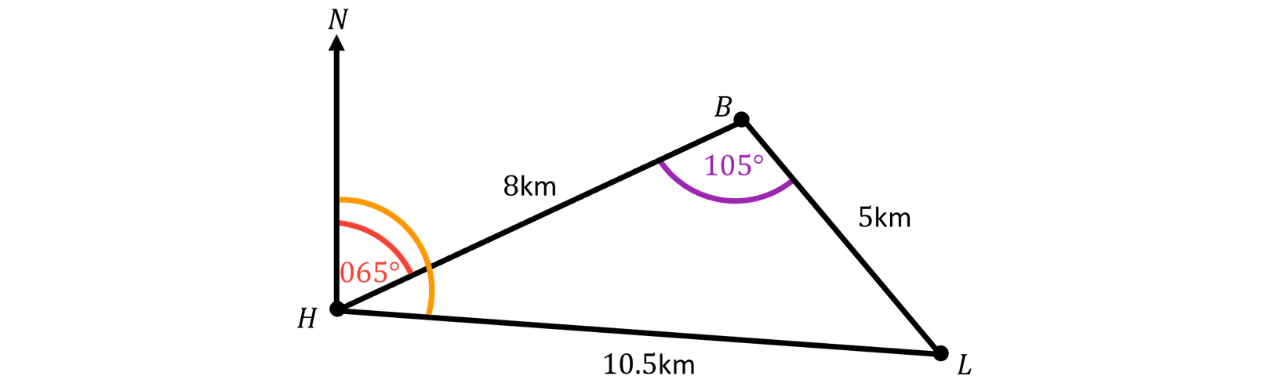
It is clear from the above diagram that angle is what we need to find.
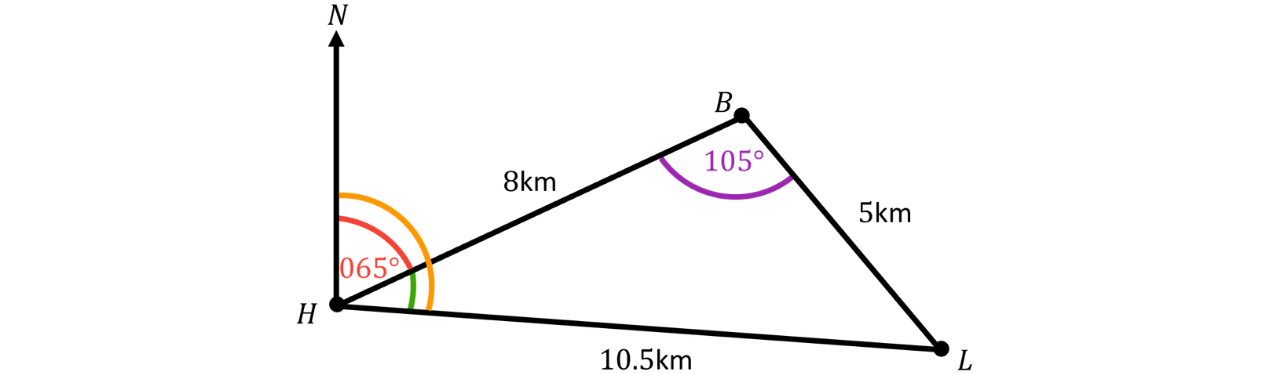
Step 2: Use the sine rule to find angle
In triangle we now have a full pair (the side opposite the angle ), and we want the angle at which is opposite the side km. Let’s let angle since it is the unknown angle we are trying to find.
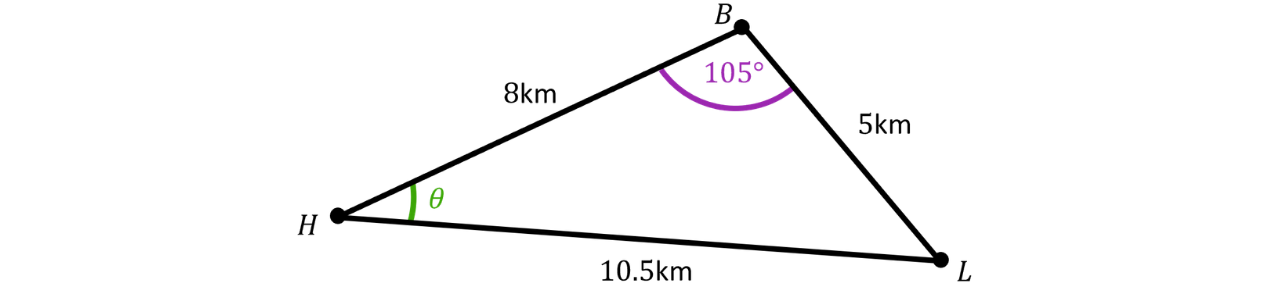
The sine rule, rearranged with the angle in the numerator, is
In this case, we have and
Substituting our values into the sine rule:
Note: Here, we can use the rounded length instead of the exact stored value of since the question asked us to round the value in part b). If parts b) and c) were combined, then we should not round any value until we get to the final answer.
Next, we multiply both sides by to bring it to the right-hand side and remove it from the denominator on the left-hand side.
Now, we use our calculator to apply to both sides to isolate
Step 3: Add this angle to
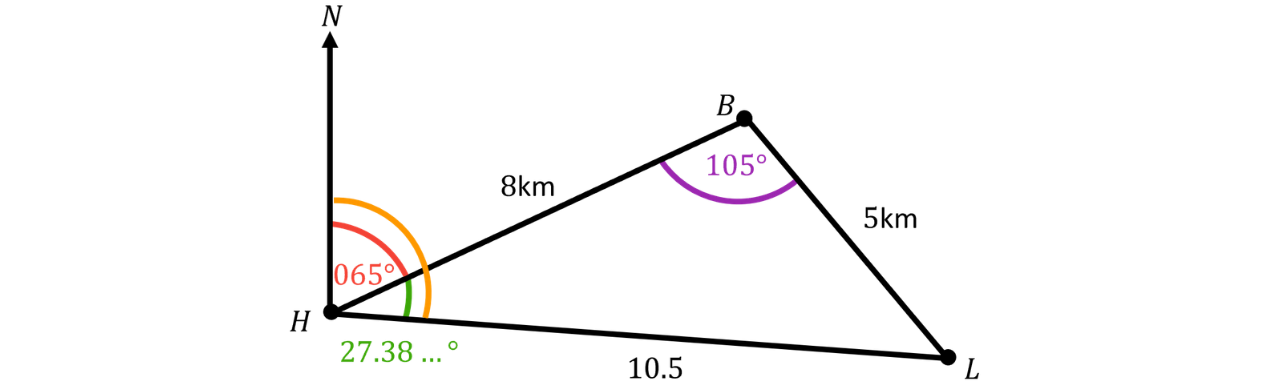
Bearing of from
Therefore, the bearing of from is approximately to the nearest degree.
Note: Do not forget the three figures rule: the final answer is written not
d) Find the shortest distance from the buoy to the line Give your answer to significant figures.
Step 1: The shortest distance is the perpendicular distance. Draw a new triangle showing this.
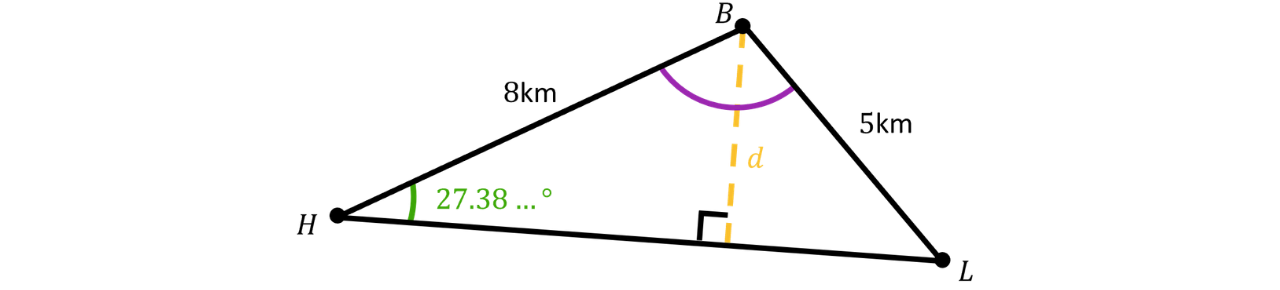
The shortest distance from a point to a line is always measured along the perpendicular to the line. This is the dashed distance labelled in the diagram, and it creates a right-angled triangle whose hypotenuse is km, with the angle at that we found in part c).
Notice that we are not using the rounded version of the angle at since part c) did not specifically ask us to find that value to a particular degree of accuracy.
Step 2: Use SOHCAHTOA with the right-angled triangle to find the distance
The distance is opposite the angle at and is the hypotenuse.
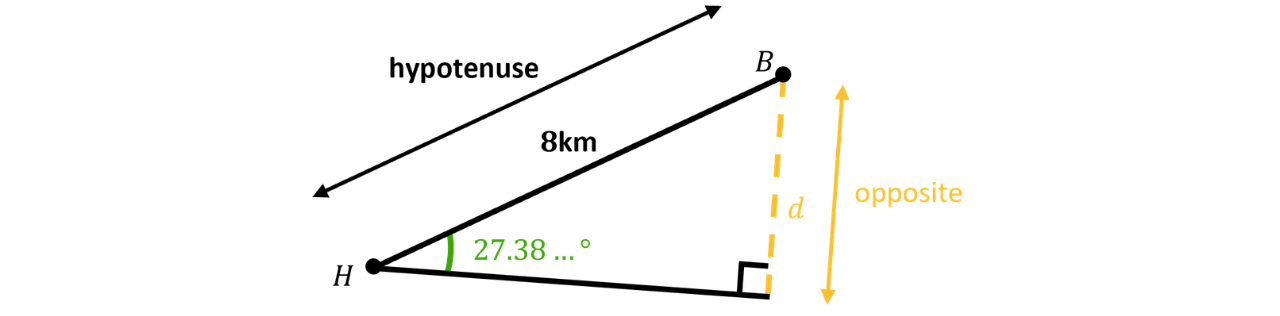
Opposite and hypotenuse together mean we use the SOH part of SOHCAHTOA.
Multiplying both sides by
km
Therefore, the shortest distance from the buoy to the line is approximately km, correct to significant figures.
Practice Question