Linear Sequences
Neil Trivedi
Teacher

Linear Sequences
A sequence is an ordered list of numbers, where each number is called a term. We use the letter to represent the position of a term in a sequence. For example, if we want to refer to the term, then
A linear sequence, sometimes called an arithmetic sequence, is a sequence where the difference between consecutive terms is constant. This constant difference is called the common difference.
For example, in the sequence the common difference is because each term is obtained by adding to the previous term.
The common difference can be positive or negative:
If it is positive, the sequence is increasing.
If it is negative, the sequence is decreasing.
We can describe any linear sequence using a rule called the term. The term is a formula that allows us to find any term in the sequence by substituting in the value of (the position of the term).
The term of a linear sequence is of the form which is very similar to the equation of a straight line being of the form We will explore further on in the note where the direct similarity is.
Using the Term to Find Specific Terms
We can use the term to find any term in the sequence. To find a specific term, we substitute the value of into the formula.
For example, suppose the term of a sequence is
To find the first four terms, we substitute and in turn.
For
For
For
For
So, the first four terms are

Notice that the difference between each pair of consecutive terms is which is the same as the coefficient of in the formula This is not a coincidence.
To see this more clearly, consider these three sequences:
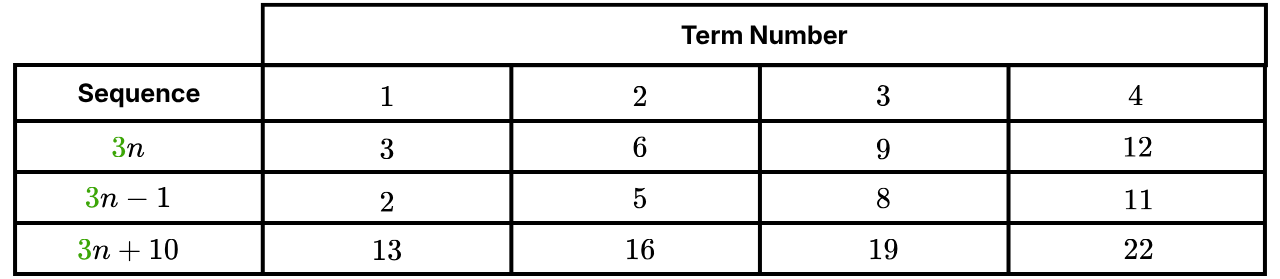
All three sequences have a common difference of which matches the coefficient of
The sequence represents the three times tables and any constant added or subtracted at the end simply shifts the sequence up or down.
If we observe the sequence again, it is just one less than the three times tables.
This brings us to a key insight that we will use throughout this topic:
For any linear sequence, the coefficient of in the term is equal to the common difference of the sequence.
The common difference tells us which multiplication tables we are working with.
The general form of a linear sequence is
where is the common difference and is a constant.
Finding the Term of a Sequence
We can use the key insight above to find the term of any linear sequence.
General Steps for Finding the Term of a Linear Sequence
Identify the common difference, between consecutive terms. This is the coefficient of
Compare the original sequence to the sequence (i.e. the multiples of
Add or subtract a constant to align the multiples of with the original sequence. This constant, combined with gives the term.
Let's walk through this with the sequence
Firstly, we find the common difference.

The difference between consecutive terms is so the coefficient of is
Next, we compare the sequence to the multiples of

Finally, we find the constant to add or subtract from to match the original sequence.

Each term in our sequence is less than the corresponding multiple of so we subtract from
Therefore, the term is
Example 1:
Find the term of the following sequences:
a)
Step 1: Find the common difference.

The difference between consecutive terms is so the coefficient of is
Step 2: Compare to the multiples of and find the constant.

Each term in our sequence is more than the corresponding multiple of so we add to
Therefore,
term
b)
Step 1: Find the common difference.

The difference between consecutive terms is so the coefficient of is
Step 2: Compare to the multiples of and find the constant.

Each term in our sequence is more than the corresponding multiple of so we add to
Therefore,
term
However, we prefer to place the positive term first which leaves us with:
term
c)
Step 1: Find the common difference.

The difference between consecutive terms is so the coefficient of is
Step 2: Compare to the multiples of and find the constant.

Each term in our sequence is less than the corresponding multiple of so we subtract from
Therefore,
term
Working with a Given Term
Sometimes, we are given the term of a sequence directly and are asked to find specific terms, or to check whether a particular value appears in the sequence.
Example 2:
The term of a linear sequence is
a) Write down the first three terms.
Single Step: Substitute and into the term formula.
For
For
For
Therefore, the first three terms are and
Note: We can do this process quicker by just finding the first term, then subtracting to find consecutive terms as we know the common difference is (the coefficient of
b) Determine whether is a term in this sequence. If it is, find its position.
Step 1: Set the term formula equal to and solve for
If is a term in the sequence, then there must be a value of for which the formula gives
Adding and to both sides (on the left side is on the right side),

Dividing both sides by
Step 2: Interpret the value of
Since is a positive integer, is a term in the sequence. It is the term.
Note: For a value to be a term in a linear sequence, the value of we find must be a positive integer. If we get a fraction, decimal, zero, or a negative number, the value is NOT a term in the sequence.
For example, if we check whether is in this sequence:
Since is not a positive integer, is not a term in this sequence.
Finding the Term from Two Non-Consecutive Terms
Sometimes, we are not given the sequence directly. Instead, we are given the values of two terms at specified positions, and we are asked to work out the term.
To do this, we use the fact that moving between two terms in a linear sequence involves adding (or subtracting) the common difference a certain number of times.
Example 3:
The term of a linear sequence is and the term is
a) Find the common difference of the sequence.
Single Step: Calculate the number of “steps" between the two terms and divide.

Since steps from the term to the term make a total change of one step (the common difference) is
common difference
b) Find the first term.
Single Step: Work backwards from the term using the common difference.

The term is To get from the term back to the term, we go back steps, subtracting the common difference of each time.
If step forward is (the common difference), then step backwards is
Therefore, two steps backwards is

term
Therefore, the first term is
c) Find the term.
Step 1: Identify the coefficient of
From part a), the common difference is so the coefficient of is
Step 2: Compare to the multiples of and find the constant.

Therefore, the term is
d) Find the term.
Single Step: Substitute into the term formula.
term
Therefore, the term of the sequence is
Comparing Two Linear Sequences
When we are working with two linear sequences at once, there are two different types of questions we might be asked, and it is important to recognise which is which because they need different methods.
Question Type 1: Find a common value that appears in both sequences.
The value must appear in both lists, but it can appear at different positions.
Question Type 2: Find the value of such that the term of both sequences is equal.
The two sequences must give the same value at the same position.
Example 4:
Consider the following two linear sequences.
Sequence A:
Sequence B:
a) Find the first value that appears in both sequences.
Step 1: List out more terms of each sequence and look for a match.
Sequence A:
Sequence B:
Looking at both lists, the value appears in both sequences. So, is a common value of both sequences.
Note: A common instinct here is to set the term of the two sequences equal to each other and solve. This is incorrect for this question. Equating the two terms finds the position where both sequences have the same value which is a different question, addressed in part b). In part a) we have found where the two sequences have the same value, but in different positions.
b) Find the value of such that the term of Sequence A is equal to the term of Sequence B.
Step 1: Find the term of Sequence A.
The common difference of Sequence A is so the coefficient of is

Each term in Sequence A is more than the corresponding multiple of so
term of sequence A
Step 2: Find the term of Sequence B.
The common difference of Sequence B is so the coefficient of is

Each term in Sequence B is more than the corresponding term in so
term of sequence B
Step 3: Set the two terms equal and solve for
We want the position where both sequences give the same value, so we set the two formulas equal to each other.
Adding and subtracting from both sides,

Dividing both sides by
Therefore, at the position, both sequences have the same value.
Step 4: Verify.
We can check this by substituting into both terms.
Sequence A:
Sequence B:
Both sequences have the value at position so is correct.
We can verify even further by writing our sequences up to the term.
Sequence A:
Sequence B:
Practice Question