Ratio
Neil Trivedi
Teacher

Contents
Ratio Essentials
A ratio compares the sizes of two or more quantities. For example, if the ratio of red counters to blue counters in a bag is then for every red counters, there are blue counters. A ratio does not tell us the actual number of counters, but only how the two amounts compare.
Before we tackle the harder questions in this note, there are three basic facts about ratios that we will lean on constantly.
Key Facts About Ratios
Equivalent ratios: multiplying or dividing every part of a ratio by the same number produces an equivalent ratio. For example,
Simplest form: to fully simplify a ratio, divide every part by the highest common factor (HCF). For example, dividing both parts by
Fractions from ratios: In the ratio there are parts altogether, so the first quantity is of the total while the second is
The first fact is the one this whole topic runs on: a ratio only records proportions, not actual amounts, so we are free to scale a ratio, however we like, provided we scale every part of it.
Combining Two Ratios
Many exam questions give us two ratios that share a common quantity and ask us to merge them into a single three-part ratio. For example, we might be told the ratio of dogs to cats and the ratio of cats to rabbits; notice that cats appear in both.
The catch is that the shared quantity must be worth the same number of parts in both ratios before we can join them together. We find this by scaling each ratio, using the lowest common multiple (LCM).
Combining Two Ratios
Identify the quantity that appears in both ratios.
Find the LCM of its two values.
Scale each ratio (every part of it!) so that the shared quantity equals this LCM.
Merge the two ratios into one combined ratio.
Example 1:
In an animal shelter, the ratio of dogs to cats is and the ratio of cats to rabbits is What percentage of the animals in the shelter are dogs?
Step 1: Identify the shared quantity and find the LCM of its two values.
Cats appear in both ratios: as in the first ratio and as in the second. The LCM of and is so we scale both ratios until cats are worth parts.
Step 2: Scale each ratio so that cats equal parts

Step 3: Merge the two ratios into one combined ratio.
Both ratios now agree that cats are worth parts, so we can line the ratios up at the shared cats column and join them into one:
Dogs : Cats : Rabbits
Step 4: Convert the dogs’ share into a percentage.
The total number of parts is and dogs account for of these parts.
We convert this to a percentage by multiplying the fraction by
Therefore, of the animals in the shelter are dogs.
Note: A very common error is to jump straight to “Dogs : Cats : Rabbits ” by gluing the ratios together without scaling. The and the both describe the cats, so they must be made equal first.
Example 2:
The points and lie in order on a straight line.
Work out
At first glance, there is no shared quantity here, but there is a hidden one. Both ratios split up the whole length so the whole length plays the same role that the cats played in Example 1.
Step 1: Compare the totals of the two ratios.
The first ratio splits into parts, while the second splits it into parts. The LCM of and is so we scale the first ratio by

Every length is now measured in twentieths of
Step 2: Find by subtracting known lengths.
The question wants us to find We currently have and so it remains to find A number-line can help us visualise this better.
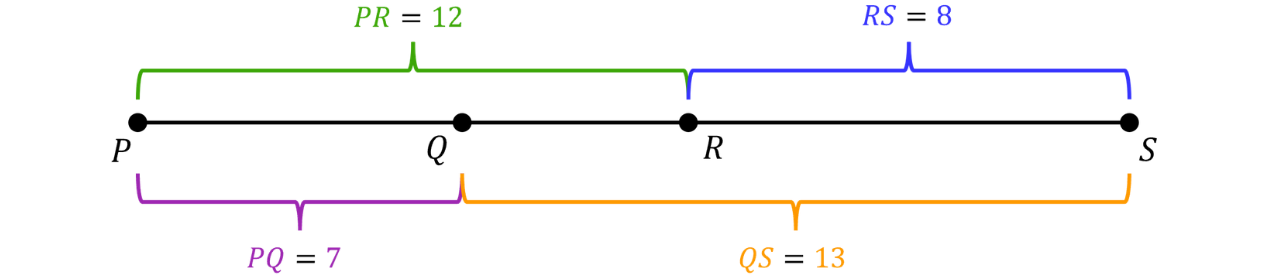
To find we will find the difference between the length of and the length of

Alternatively, we could have found by finding the difference between the length of and the length of

Step 3: Write down the required ratio.
Algebra with Ratios
Ratios and fractions are two versions of the same idea. Saying that two ratios are equal is exactly the same as saying that two fractions are equal. Once we have two equal fractions, we can solve using our typical algebraic techniques.
A nice way of remembering how to convert from a ratio to a fraction is that the : symbol in a ratio represents a symbol in much of continental Europe. The main European countries sticking with are the UK and Ireland.
The Link Between Ratios and Fractions
Suppose we are given the following ratio equation
Remembering that ∶ represents in continental Europe, we can rewrite the equation using fractions:
This is by dividing the first number by the second.
Or, by reciprocating each fraction:
This is the option whereby we are dividing the second number by the first. The choice depends entirely on where the unknowns are.
Example 3:
Given that calculate the value of
Step 1: Rewrite the ratio statement as a fraction equation.
The unknown is and we prefer for it to be in the numerator when solving with algebraic fractions. Therefore, in this case, we will divide the second term in each ratio by the first.

Step 2: Multiply through by a common denominator and solve.
The lowest common multiple of and is So, multiply both sides by to clear the fractions.
Dividing both sides by
Note: the answer does not have to be a whole number. Leave it as an exact fraction rather than rounding. The fraction is exact, while is not.
Example 4:
Cici is three times as old as her brother Topolino. In years’ time, the ratio of Cici’s age to Topolino’s age will be How old is Topolino now?
Step 1: Define the current ages using one letter.
Let Topolino’s current age be Since Cici is three times as old, Cici’s age now is
Step 2: Write the ages in years’ time and form the ratio equation.
In years, Cici will be and Topolino will be and these ages will be in the ratio
To form a fractional equation, we can divide the first by the second or the second by the first; in either case there will be an unknown in the denominator. We will divide the first by the second.

Step 3: Multiply through by a common denominator and solve.
The lowest common multiple of and is So, we multiply both sides by to clear the fractions.
Expanding the brackets on both sides,
Subtracting and then from both sides,
Dividing both sides by
Therefore, Topolino is 8 years old now (and Cici is ).
Cici may seem quite old for a cat (at the time of writing this note, she is years old), but, in my mind (as NeilDoesMaths), she will live forever.
If you need more practice on solving with algebraic fractions, check out our Solving with Algebraic Fractions note.

Ratios in Two-Way Tables
Some questions blend a ratio between two groups with percentages or fractions within each group. The slick move is to treat the parts of the ratio as if they were actual amounts, and to organise everything in a two-way table.
Do not worry if some entries turn out to be decimals, as the parts of a ratio only carry proportions, so a value like of a van is perfectly fine here.
Two-Way Tables from a Ratio
Use the parts of the ratio as the row totals.
Take the given percentage or fraction of each part to fill in the first column.
Subtract to complete each row, then add up the columns.
Convert the totals into whatever the question asks for: a percentage of the grand total, or a simplified ratio.
Example 5:
At a delivery depot, the ratio of cars to vans is of the cars are electric and of the vans are electric. What percentage of all the vehicles at the depot are electric? Give your answer to decimal place.
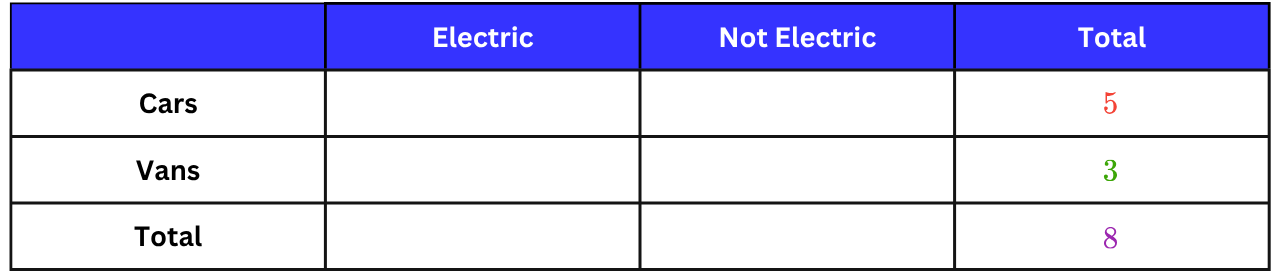
Step 1: Treat the parts of the ratio as actual amounts.
We pretend the depot holds exactly cars and vans, that is vehicles in total. We then use these as the row totals of a two-way table.
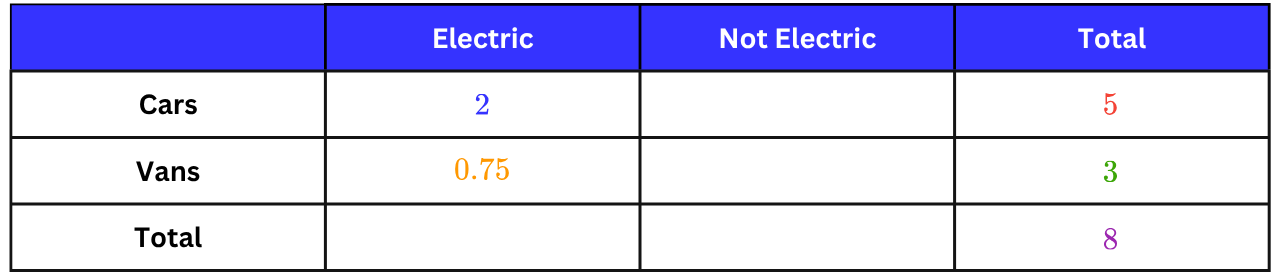
Step 2: Take the given percentage of each part.
Electric cars: of
Electric vans: of
Step 3: Complete the two-way table.
Each “Not Electric” entry comes from subtracting along its row, and the bottom row comes from adding down each column.
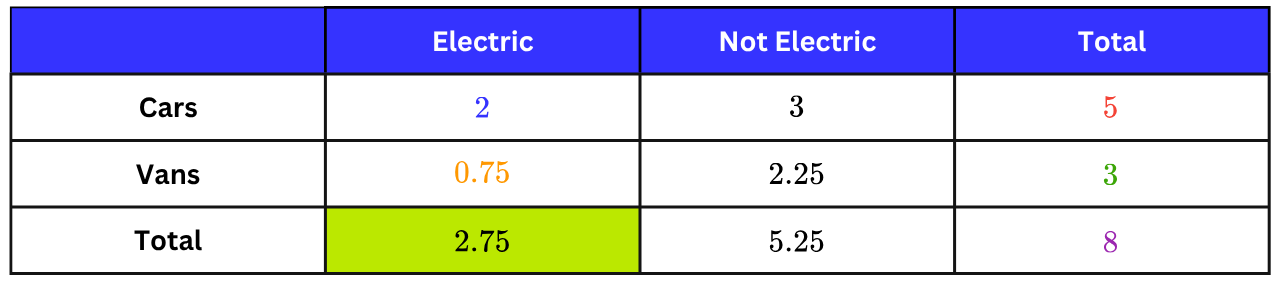
Step 4: Convert the electric total into a percentage of the grand total.
Therefore, approximately of the vehicles at the depot are electric, to decimal place.
Practice Question