Proportion
Neil Trivedi
Teacher

Contents
Proportion
In this note, we will learn how to work with quantities that are in proportion. The key idea of proportionality is that one quantity scales with another. We will meet two types of proportion: direct and inverse proportion. We will learn how to turn a proportion statement from a question into a formula that we can calculate with. We will finish by looking at how to recognise proportional relationships from their graphs.
Direct Proportion
Two quantities are in direct proportion when they increase or decrease together in the same ratio. For instance, if one quantity doubles, then the other doubles as well. Likewise, if one is multiplied by then so is the other. In other words, quantity is always the same multiple of quantity
We use the symbol to mean “is proportional to”. The statement “is directly proportional to ” is written as and it can be converted into an equation using a constant, which is normally denoted by
Direct Proportion
If is directly proportional to then
where is a fixed number called the constant of proportionality.
The statement in a question may also involve a power or a root of the variable. In every case, the translation works in the same way, that is, multiplies whatever is proportional to.
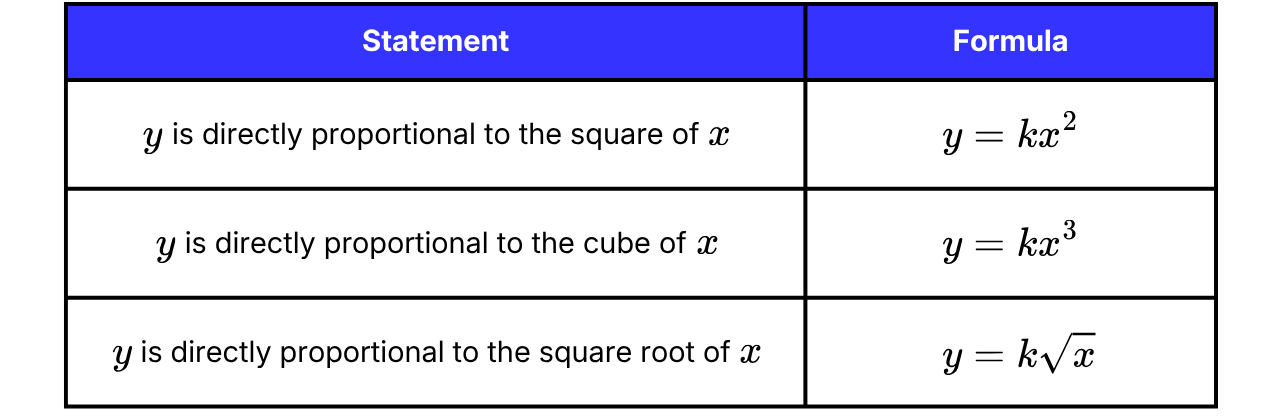
Every proportion question can be answered using the same four steps, so it is well worth learning them.
General Steps for Answering Proportion Questions
Convert the proportion statement into a formula using
Substitute the pair of values given in the question.
Solve the equation to find keeping its exact value.
Rewrite the formula using your value of and use it to answer the question.
Example 1:
is directly proportional to When
a) Find a formula for in terms of
Step 1: Convert the proportion statement into a formula using
We are told that is directly proportional to i.e. which means we multiply by to get
Step 2: Substitute the pair of values given in the question.
We are told that when We substitute these values into the equation.
Step 3: Solve the equation to find
Dividing both sides by
Step 4: Rewrite the formula using the value of
b) Hence, find the value of when
Single Step: Substitute into our formula.
Note: the statement contains no numbers, so it cannot be used for calculations on its own. The single pair of values given in the question is exactly enough to work out and turn the statement into a usable formula.
Example 2:
The kinetic energy in joules, of a moving trolley is directly proportional to the square of its speed in metres per second. When
Find the value of when
Step 1: Convert the proportion statement into a formula using
We are told that is directly proportional to the square of which means we multiply by to get
Step 2: Substitute the pair of values given in the question and then solve for
Substituting and into the equation,
Dividing both sides by
Step 4: Rewrite the formula using the value of
Step 4: Substitute into our formula to find
joules
Note: In Step 2, we square first, then multiply by (BIDMAS). A very common mistake is to multiply by and then square the whole thing, which turns into which is a completely different (and wrong) equation.
Example 3:
Given that is directly proportional to the cube root of and is a positive number, fill in the missing values and in the table below.

Step 1: Convert the proportion statement into a formula using
We are told that is directly proportional to the cube root of which means we multiply by to get
Step 2: The first column gives us a complete pair of values, so we substitute and and then solve for
The cube root is asking us, “What number, when written three times and multiplied together, gives us In this case, that number is
Dividing both sides by
Note: We have included a multiplication symbol before the cube root since without it, it looks rather strange.
Step 3: Work out the value of
For the middle column, we know that and want
Dividing both sides by
Then, cubing both sides to remove the cube root,
Step 4: Work out the value of
For the final column, we know that and want
Inverse Proportion
Two quantities are in inverse proportion when one increases in the same ratio as the other decreases. For instance, if one quantity doubles, then the other halves. Likewise, if one is multiplied by then the other is divided by
We say that scales with the reciprocal of which is why the variable now appears in the denominator of a fraction. In symbols, this is written
Inverse Proportion
If is inversely proportional to then
where is the constant of proportionality.
Powers and roots work in just the same way as before: they simply sit underneath
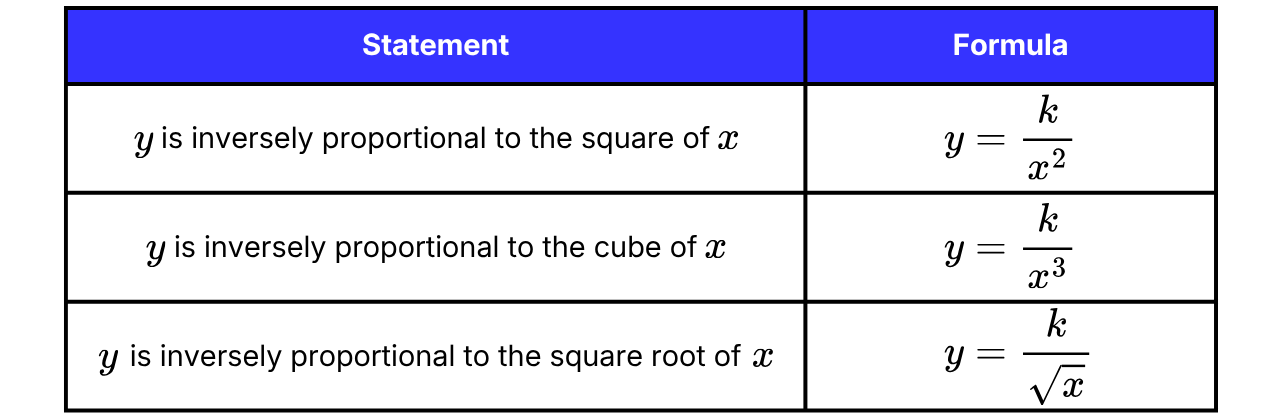
The four general steps are exactly the same as for direct proportion, but the only difference is that we now divide by the variable rather than multiplying by it.
Example 4:
A variable is inversely proportional to the square root of another variable
When
Find the value of when
Step 1: Convert the proportion statement into a formula using
We are told that is inversely proportional to the square root of which means we divide by to get
Step 2: Substitute and and then solve for
This is a great example to highlight the importance of writing in fraction form rather than decimals. Many students would calculate incorrectly, where they would get as an answer. However,if we write as we reduce the chances of such mistakes.
Therefore,
Multiplying both sides by
So,
Step 3: Substitute into our formula, and solve to find
Here, is trapped underneath the fraction, so we “swap” it with the We are actually multiplying both sides by and dividing both sides by
There are many ways we can go about dividing by The easiest way to think about it is that divided by is so divided by is
Squaring both sides,
Combining Direct and Inverse Proportion
Harder questions sometimes combine both types of proportion in a single relationship, with one quantity depending on two other variables at the same time.
Example 5:
A force is directly proportional to a mass and is inversely proportional to the square of a distance When and when
Find the value of when
Step 1: Write down two separate equations using two different constants of proportionality. We will use and
is directly proportional to a mass
is inversely proportional to the square of a distance
Step 2: For the first equation, substitute and to find
Dividing both sides by
(Equation 1)
Step 3: For the second equation, substitute and to find
Multiplying both sides by
(Equation 2)
Step 4: Substitute to find then use this value to find
We do not have an equation that directly connects and but we have which connects the two together.
(Equation 2)
Substituting into equation
Now, substitute into equation to find
(Equation 1)
Note: Alternatively, we could have found a formula for in terms of by substituting equation in place of the in equation
Then, we could have substituted into this formula to find
Proportionality Graphs
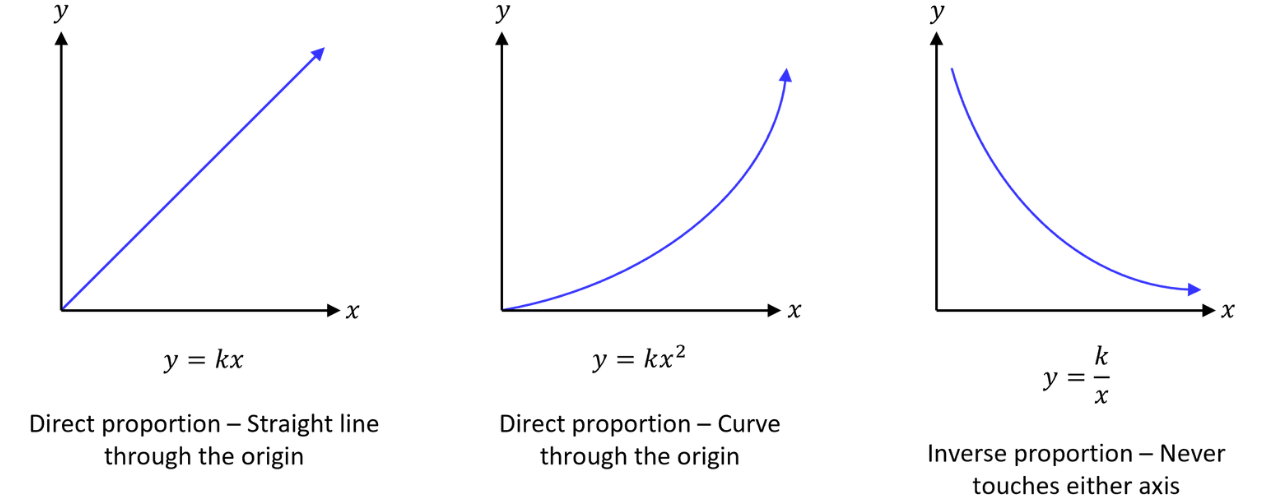
We can also recognise direct and inverse proportion from the shape of a graph. There are two questions to ask: does the graph pass through the origin, and is it a straight line or a curve?
Spotting Proportion from a Graph
Direct proportion: is a straight line that passes through the origin. Higher powers, such as and are curves that still pass through the origin.
The origin test: every direct proportion graph passes through because substituting gives
Inverse proportion: is a reciprocal curve. It gets closer and closer to the axes but never touches them. This is because cannot equal and can never reach See our Graphs of Functions study note for more on this.
Be careful with straight lines that miss the origin. A graph of the form with is a straight line, but is no longer a fixed multiple of so the two variables are not directly proportional.
Example 6:
Four graphs, to are sketched below. For each graph, decide whether it shows direct proportion, inverse proportion, or neither.
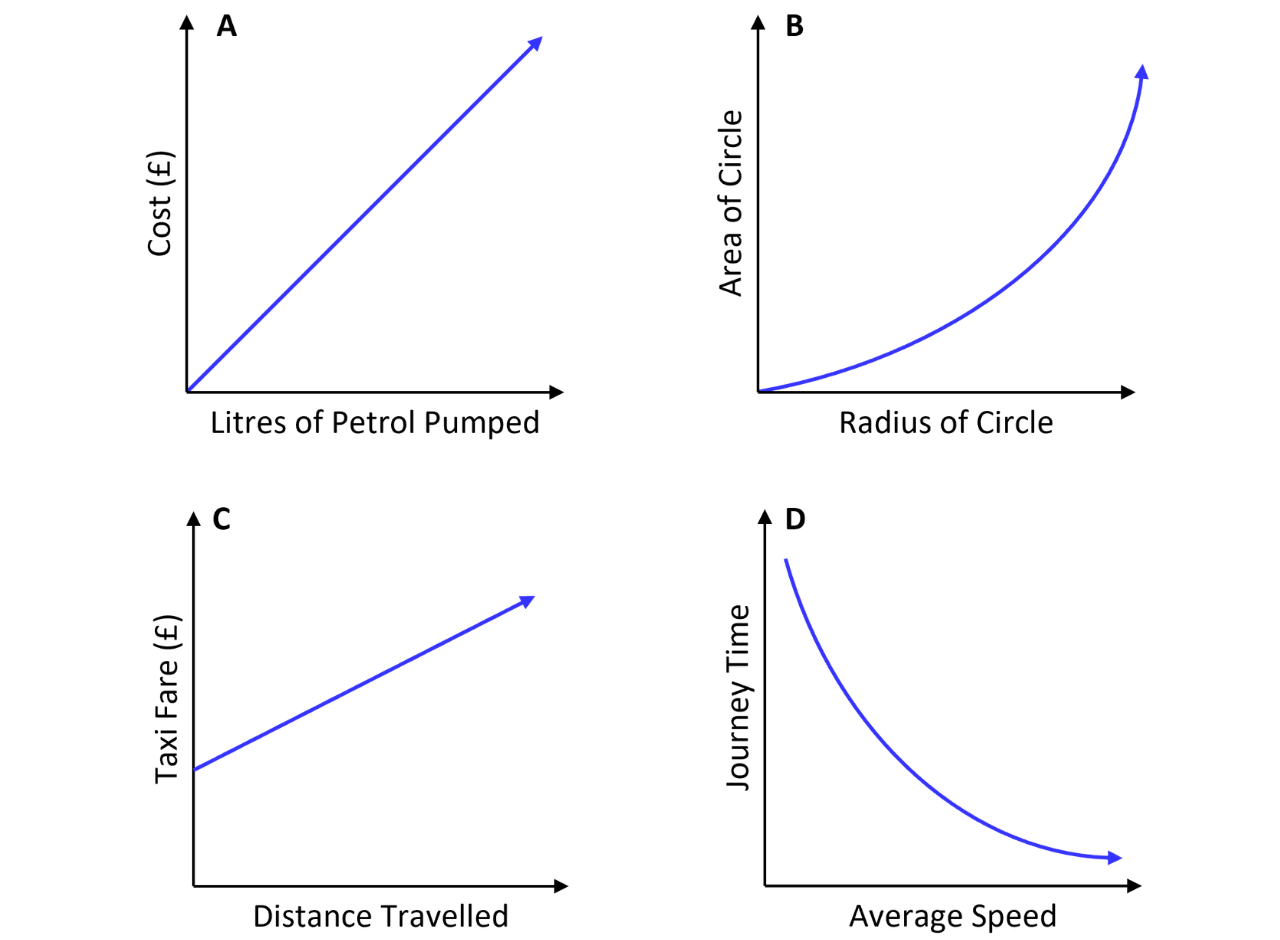
Graph A is a straight line that passes through the origin: the cost is a fixed multiple of the number of litres and pumping zero litres costs direct proportion
Graph B is a curve that passes through the origin. The area of a circle is so the area is directly proportional to the square of the radius which is why the graph curves. direct proportion (to the square)
Graph C is a straight line, but it does not pass through the origin. The fare starts at a fixed pick-up charge before you have travelled anywhere. It has the form with neither
Graph D is a reciprocal curve: increasing the average speed reduces the journey time in the same ratio, and the curve never touches either axis. inverse proportion
Challenging Question