The Quadratic Formula
Neil Trivedi
Teacher

The Quadratic Formula
Quadratic equations can sometimes be solved by factorising. However, not all quadratics factorise easily, or at all.
One method we can use, in these cases, is completing the square. Please read our Completing the Square note for more on this method.
In this note, we will look at the quadratic formula, which is another method used to solve any quadratic equation, regardless of whether they can be factorised.
The quadratic formula can be derived from the process of completing the square.
Suppose we want to solve the quadratic equation
When completing the square, we normally factorise out the coefficient of from the and
terms.
However, since the equation is equal to we can divide each term by instead.
This makes the coefficient of equal to making completing the square easier.
Dividing each term by we get
To complete the square, we halve the coefficient of which is Half of this is and we write that in the bracket.
Then, we subtract the square of this value, which will be
We then add the at the end.
Now, we solve for by rearranging the equation to isolate it.
First, we add to both sides and subtract from both sides to bring the constant terms to the right-hand side of the equation.

We simplify the right-hand side by combining each fraction into one. We recognise a common denominator of which means we need to rewrite by multiplying the numerator and denominator by giving us
Now that the denominators are equal, we can add the numerators and combine the fractions into a single fraction.
Square rooting both sides,
When taking the square root of a fraction, we take the square root of both the numerator and the denominator.
So,
Then, we subtract from both sides.
Finally, the denominators of the fractions on the right-hand side are equal, so we can add the numerators to combine them into a single fraction.
This is the quadratic formula.
Note: This derivation is included to help you understand where the quadratic formula comes from. In exams, you will just need to memorise the formula (even if it is on the formula sheet we recommend you still remember it) and apply it when solving problems involving quadratics. You will not be required to memorise the derivation.
The Quadratic Formula
The solutions of the quadratic equation
are
Example 1:
Solve the following using the quadratic formula:
a)
Single Step: Identify the coefficients in the equation and substitute them into the quadratic formula.
Here, we treat the coefficient of as
So, the coefficients are
Substituting these values the quadratic formula,
Simplifying the numerator and denominator,
Since
So,
or
Therefore, or
Note: Since the solutions have come out to be ‘neat’ answers, it tells us that the equation could have been factorised.
b)
Single Step: Identify the coefficients in the equation and substitute them into the quadratic formula.
The coefficients are
Substituting these values the quadratic formula,
Simplifying the numerator and denominator,
can be simplified to become
Each term in the numerator and denominator is divisible by so we can divide every term by
Therefore, or
Note: Since these solutions have got surds in them, it tells us that the equation could not have been factorised.
c)
Single Step: Identify the coefficients in the equation and substitute them into the quadratic formula.
The coefficients are
Substituting these values the quadratic formula,
Simplifying the numerator and denominator,
can be simplified to become
Each term in the numerator and denominator is divisible by so we can divide every term by
Therefore, or
Example 2:
The diagram shows a right-angled triangle.

Find the value of giving your answer to significant figures.
When we see a right-angled triangle with three lengths, we immediately think of Pythagoras’ Theorem.

Recall that
where is the length of the hypotenuse of a right-angled triangle and and are the other lengths.
We will use this theorem to form an equation and then solve for
Step 1: Form an equation using Pythagoras’ Theorem.
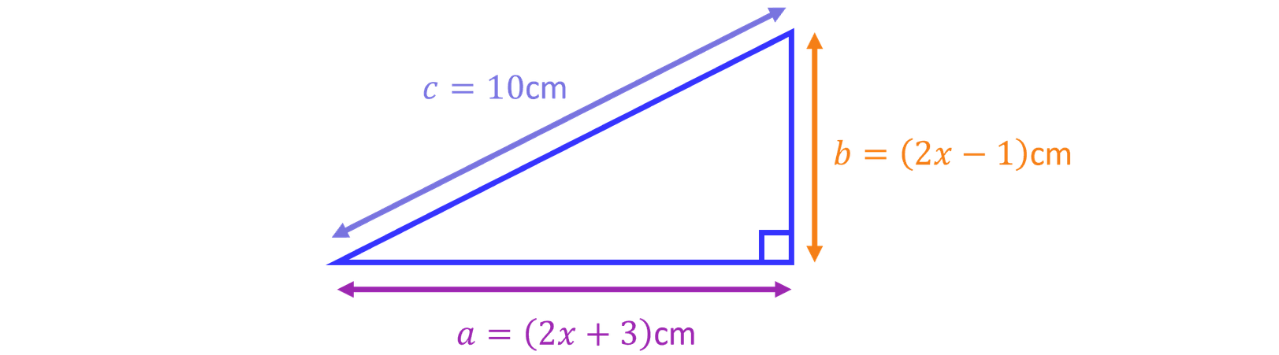
Applying Pythagoras’ Theorem,
Expanding the brackets on the left side,
Collecting the like terms on the left side,
Subtracting from both sides,
Every term is divisible by so we can divide all terms by
Step 2: Use the quadratic formula to find the value of
First, we identify the coefficients of the quadratic.
The coefficients are
Substituting these values into the quadratic formula,
Simplifying the numerator and denominator,
At this stage, we use a calculator to evaluate the two solutions. We could simplify the surd, but it isn’t necessary.
or
Of the two solutions, we can rule out because substituting this value would give negative side lengths for and in our original triangle, which is not possible.
Therefore, to significant figures,
Note: You can also solve the quadratic directly using your calculator. Here are some general steps:
1) Select the EQUATION option from the menu
2) Choose POLYNOMIAL, then select degree
3) Enter the coefficients of the quadratic equation and press equals to obtain the solutions.
You can then convert these to decimals if required.
To note, if you need help with solving quadratics using your specific type of calculator, you can search for the steps on the internet.
It is very important you do not use your calculator to go straight from the quadratic to the solutions without showing your method, you will gain no marks in the exam.
Challenging Question