EM Waves
Brook Edgar & Hannah Shuter
Teachers


Contents
Explainer Video
Types of Electromagnetic Waves
All electromagnetic waves:
Travel at the same speed in air ()
Are transverse waves, whose oscillations are perpendicular to the direction of energy transfer
Do not need a medium to travel (can travel in space, as the oscillations are from electric and magnetic fields, not from particles)
There are seven electromagnetic waves, ordered from longest wavelength to shortest wavelength:
Radio waves - Used for TV and radio broadcasting
Microwaves - Used for satellite communications, mobile phones and cooking food
Infrared (IR) - Emitted by all objects, but hotter objects emit more IR. Used for heaters, cooking food and infrared cameras
Visible light - The only part of the spectrum humans can see. Made of all colours of the rainbow (ROY G BIV). Used in cameras and in fibre optic communication
Ultraviolet (UV) - Used in energy-efficient lamps and sun tanning
X-rays - Used for medical imaging (e.g. checking broken bones)
Gamma rays - Used for treating cancer and sterilising medical equipment
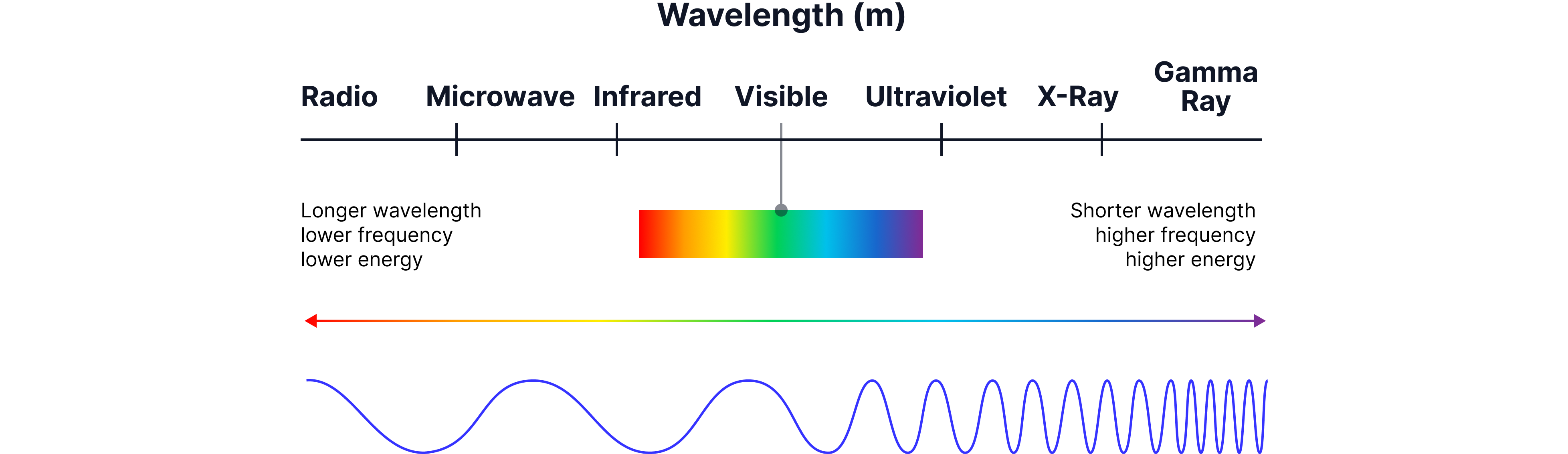
As the wavelength of electromagnetic waves decreases, their frequency increases, as seen in the image above. Radio waves have the lowest frequency, and gamma rays have the highest. As energy is related to frequency, gamma rays are the highest-energy part of the EM spectrum and thus are the most dangerous.
X-rays and gamma rays are ionising. This means they have enough energy to knock electrons off atoms, creating ions. They can have hazardous effects on humans. High exposure to X-rays and gamma rays can cause damage to cells and cause mutations, leading to cancer. Ultraviolet is also dangerous as it can cause skin burns, premature ageing, and skin cancer. Radiation dose is measured in Sieverts (). You do not need to remember this for your GCSE's, but you need to be able to recognise it. A Sievert is a large radiation dose, so milli-Sieverts () is most commonly used. For more information on ionising radiation, look back at topic 4.
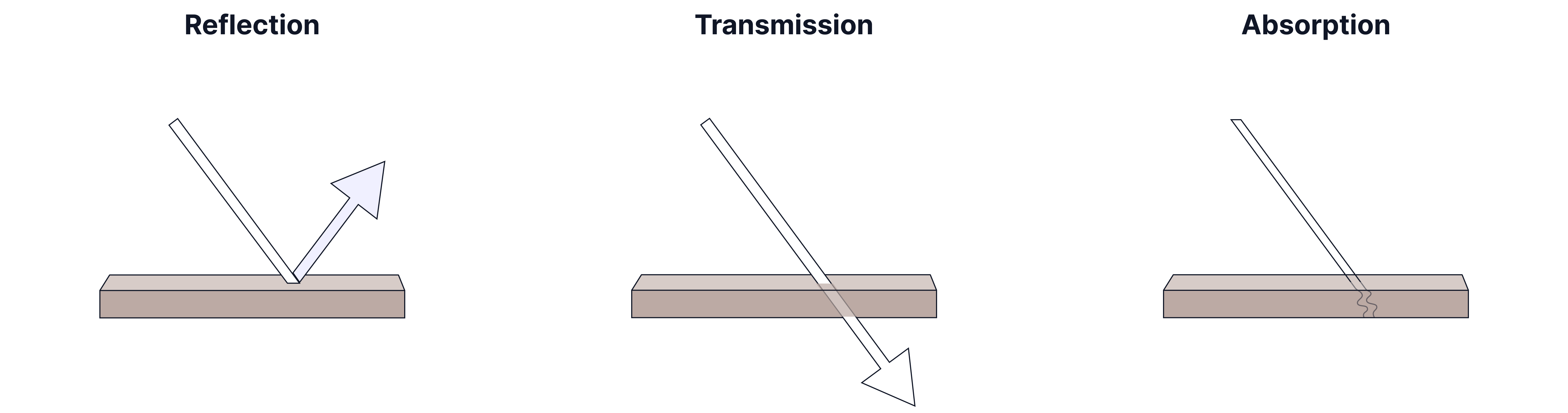
All EM waves can be reflected off a material, transmitted through a material, or absorbed. For example, light can be reflected by a mirror, transmitted through transparent objects like glass and absorbed by opaque objects, causing them to heat up.
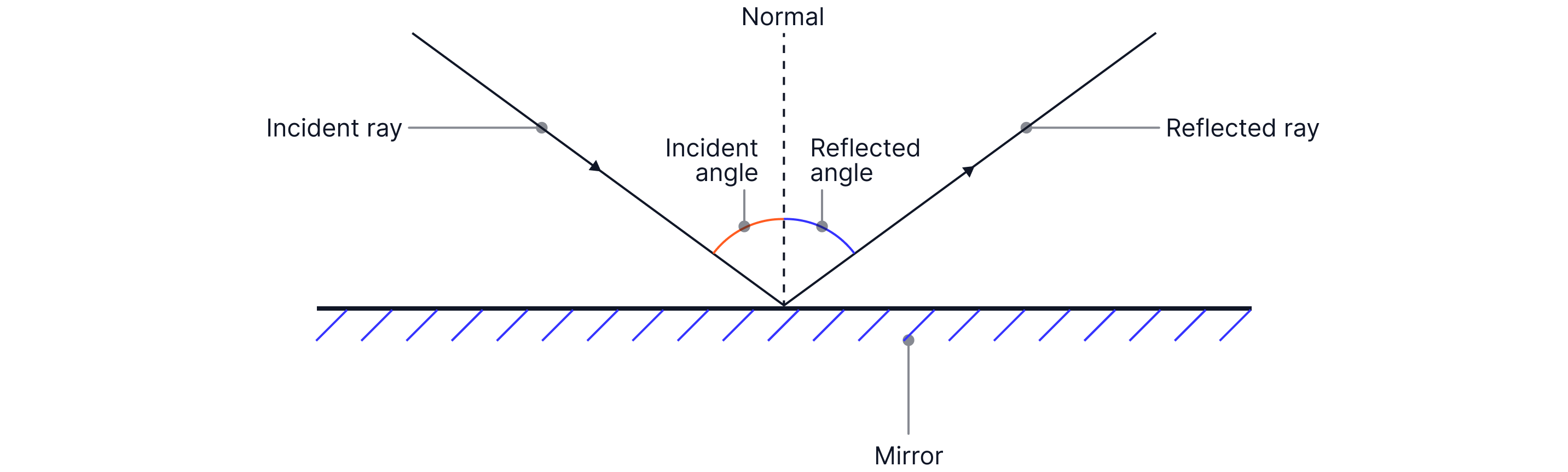
 You first learned about the law of reflection in lower school. Remember the incident angle is always equal to the reflected angle, and that angles are always measured from the normal using a protractor.
Worked Example:
State the part of the electromagnetic spectrum between microwaves and visible light.
Explain why gamma rays are more dangerous than radio waves.
Answer:
Infrared.
Gamma rays are ionising radiation, so they can damage cells and cause cancer. Radio waves are not ionising.
Worked Example:
Light is incident on different objects.
Name the process that occurs when light bounces off a mirror.
Name the process that occurs when light passes through a window.
Explain what happens to light when it hits an opaque object.
Answer:
Reflection
Transmission
Absorption
Refraction
When a wave is transmitted across a boundary, its speed changes - if it enters a more dense material, it will slow down, like if it enters glass. Light travels fastest in air. If the wave enters a different material along the normal (zero angle of incidence), it passes straight through, but if it hits the boundary at an angle, the change in speed causes it to change direction. This change in direction is called refraction.
Refraction is the change in direction of light as it enters a different medium (material).
In the diagram below, we can see that as the incident light ray travels into the glass block, it changes direction, bending towards the normal, and as it emerges out the other side of the glass block, back into the air, it changes direction again, bending away from the normal.
Notice the two rays of light in air are parallel to each other.
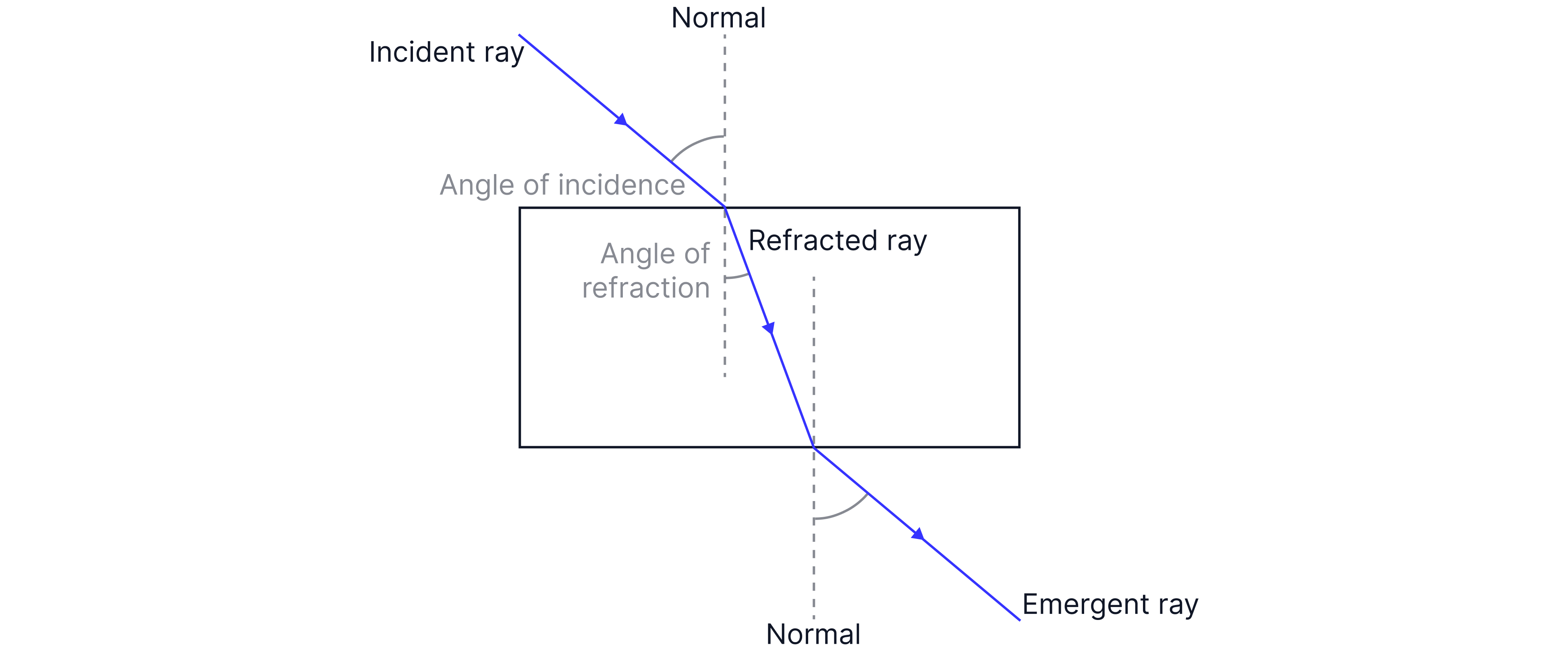
To understand why refraction happens, imagine driving in a car along a road. Suddenly, there is a deep puddle on the left-hand side of the road, and you cannot swerve around it. Your left wheel goes into the puddle, whilst the right wheel stays on the smooth road. This means your left wheel will slow down compared to the right wheel, and the car will spin to the left. This is exactly what happens in waves when they enter a denser medium. In the same way the car turned toward the puddle, waves bend toward the normal as they slow down. A useful way to remember this is the acronym FAST -> if the waves travel faster, they bend away from the normal; if the waves travel slower, they bend towards the normal, as shown in the diagram above.
We can imagine waves travelling in straight lines called wavefronts (the black lines in the image below) at right angles to the direction of travel (blue arrow). If one part of the wavefront slows down before the other, the waves will change direction.
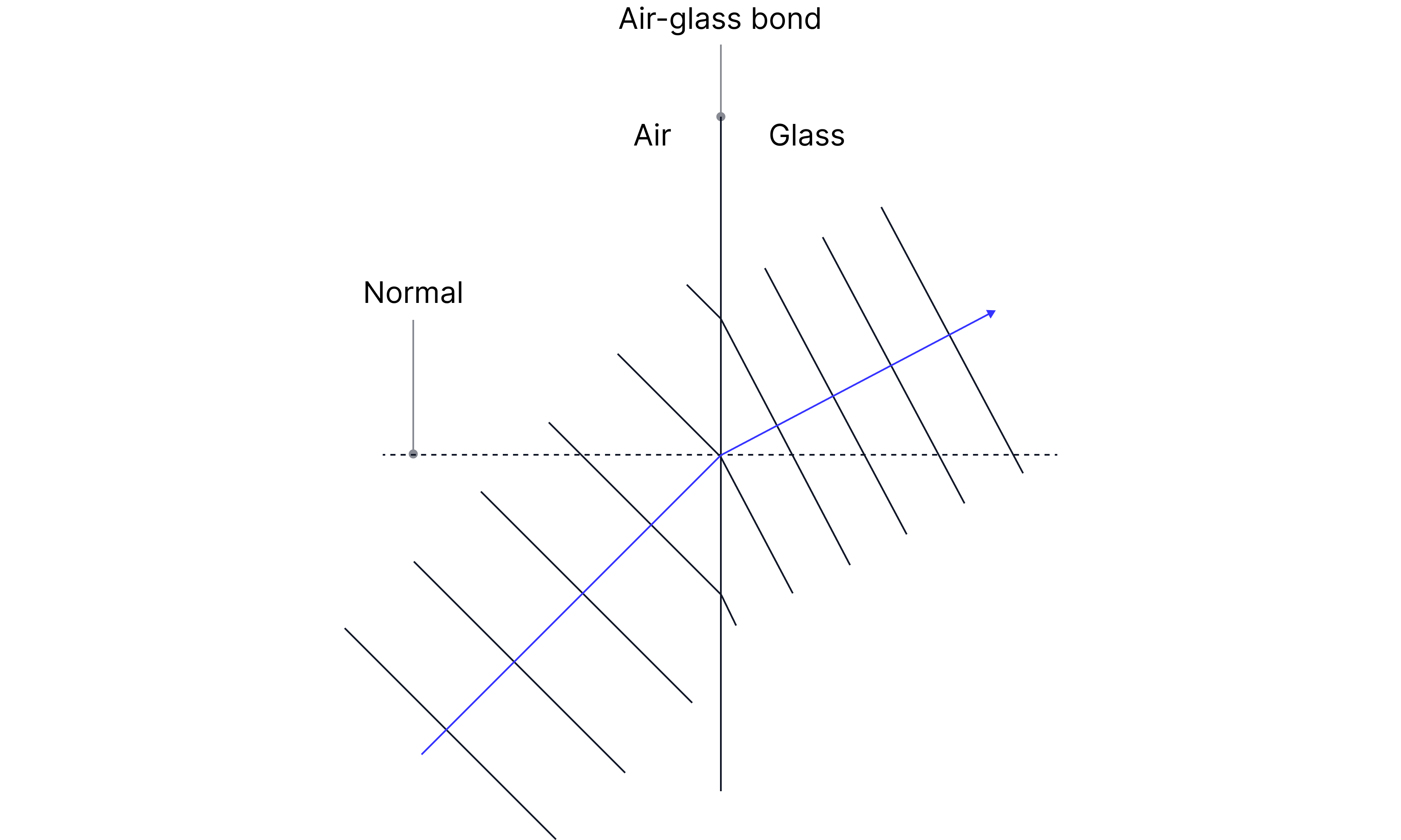
In the diagram above, the bottom part of the wavefront enters the glass first, so slows down before the upper part. This causes the wave to bend towards the normal. If a wave moves into a material where it travels faster, it bends away from the normal.
We can see in the diagram above that the wavefronts appear closer together in glass. This is because the wavelength of light decreases, while the frequency remains the same when the light ray enters a denser material and slows down.
Worked Example:
A ray of light travels from air into glass.
What is refraction?
Explain why the ray changes direction when it enters the glass at an angle.
A ray enters the glass along the normal. Describe what happens to its speed and direction.
Answer:
Refraction is the change in direction of a wave as it crosses a boundary into a different medium because its speed changes.
Light travels more slowly in glass than in air. When the ray hits the boundary at an angle, one side of the wavefront enters the glass first and slows down first. This causes the ray to bend towards the normal.
If the ray enters along the normal, its speed changes when it enters the glass, slowing down, but its direction does not.
Worked Example:
Water waves move from deep water into shallow water at an angle, slowing down.
Explain why the wavefronts change direction as they enter shallow water.
What happens to the wavelength and frequency as the waves enter shallow water? Explain your answer.
A wave enters a material where it travels faster. State which way it bends.
Answer:
The wave enters the shallow region at an angle. One part of the wavefront reaches the shallow water first and slows down first. The other part is still moving faster for a moment, so the wavefront changes direction.
The frequency stays the same. Therefore, if the waves slow down, the wavelength must decrease, . The wavefronts get closer together.
Use FAST: Faster -> Away from the normal, so the wave bends away from the normal.
Production of Electromagnetic Waves
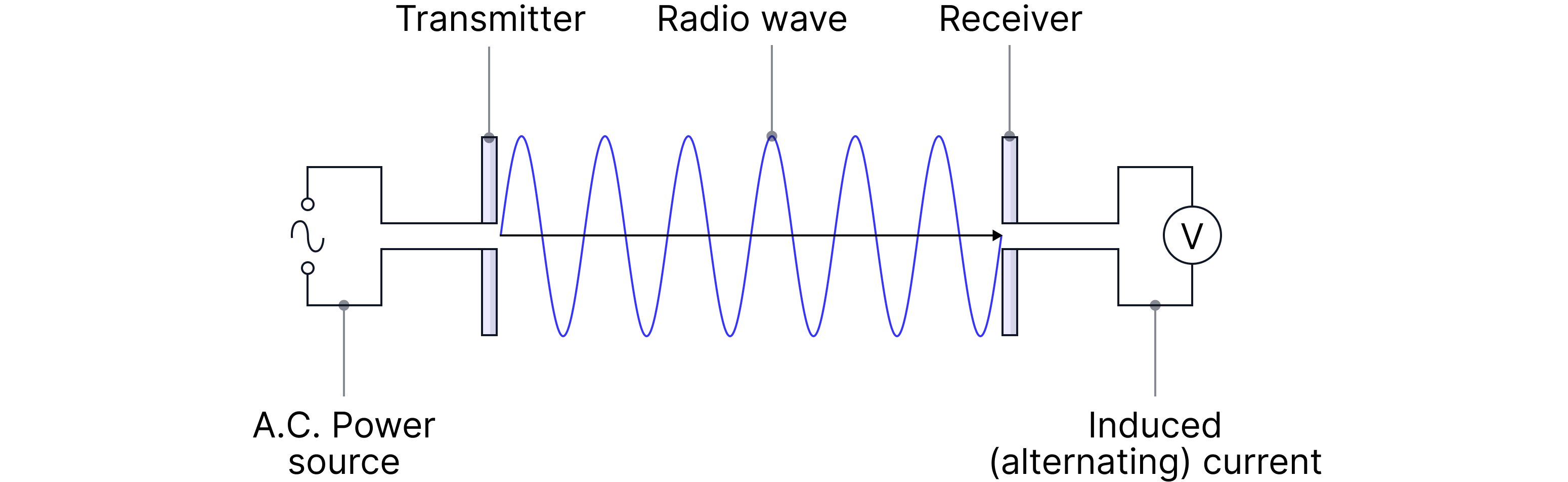
Radio waves are produced by oscillations in electric circuits. In a radio transmitter, an alternating current flows through an aerial (antenna). This causes the electrons in the aerial to vibrate back and forth, producing a radio wave. The radio wave produced will have the same frequency as the frequency of the alternating current.
When radio waves reach a receiver aerial, the oscillating electric and magnetic fields (electromagnetic waves) in the radio waves cause the electrons in the aerial to oscillate. The radio waves create an alternating current in the receiver at the same frequency as the radio waves. This alternating current is then converted to sound by a loudspeaker.
EM waves can be absorbed and released by atoms
Electrons orbit atoms in specific shells or energy levels. If EM radiation hits an electron in an atom, the electron can absorb the energy from the EM wave and move into a higher energy level, further away from the nucleus.

If an electron drops back down to a lower energy level, it will release energy in the form of an EM wave.

Gamma rays can also be released randomly from the nuclei of unstable isotopes, as detailed in topic 4.
Worked Example:
A radio station broadcasts a signal which is received by a radio.
Explain how radio waves are produced in the transmitter and how they are converted back into electrical signals in the receiver.
Answer:
In the transmitter, an alternating current flows, producing radio waves with the same frequency as the alternating current.
When the radio waves reach the receiver, they cause the electrons in the aerial to oscillate. This produces an alternating current with the same frequency as the radio wave.
Worked Example:
Explain how electromagnetic waves, such as X-rays, can be produced by atoms.
Answer:
When electromagnetic radiation hits an atom, an electron can absorb its energy and move to a higher energy level. When an electron falls back to a lower energy level, it emits energy as an electromagnetic wave.
Practice Questions
State the type of EM wave with the highest frequency.
Explain why ultraviolet radiation poses a greater biological hazard than infrared radiation.
-> Check out Brook's video explanation for more help.
Answer:
Gamma rays
Ultraviolet has a higher frequency/shorter wavelength than IR. It has more energy.
UV can cause skin cancer and skin burns.
The diagram below shows a ray of light entering a glass block from air at an angle.
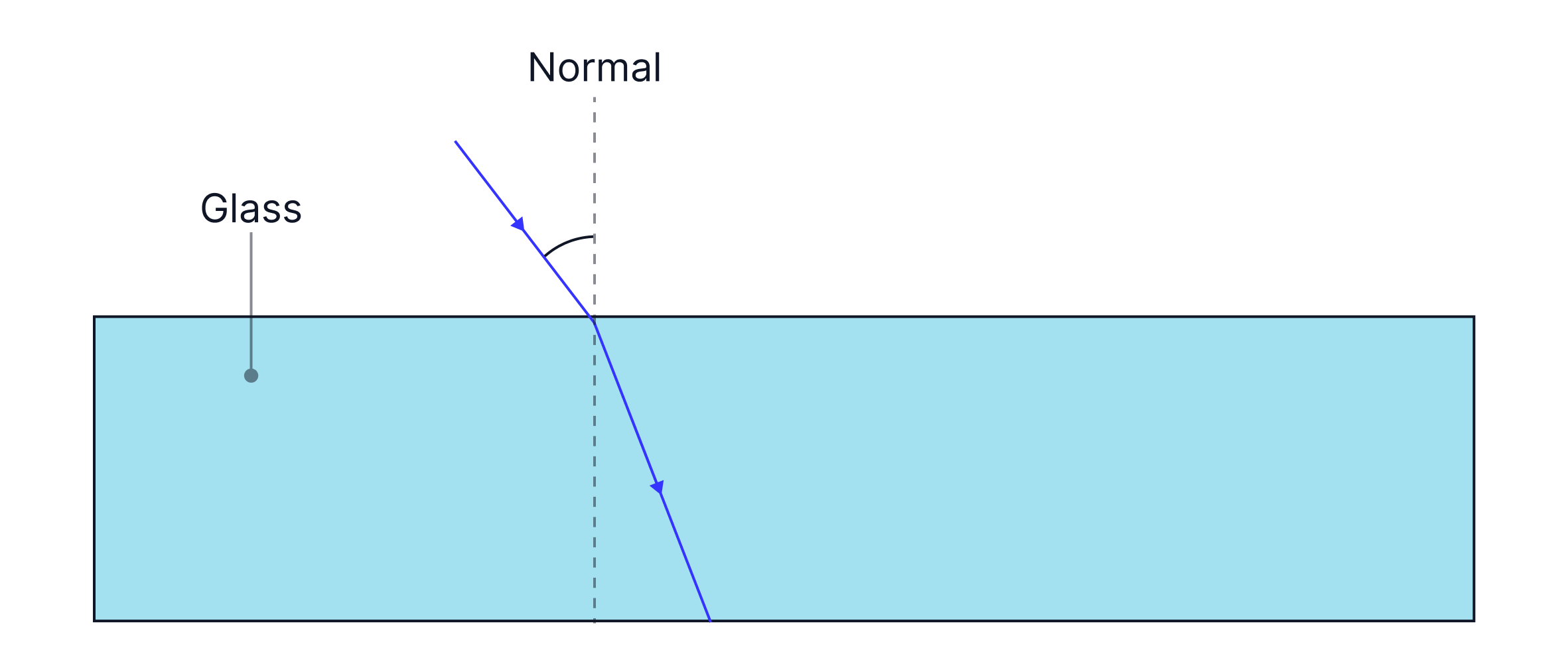
State what is meant by refraction.
Explain why the ray bends towards the normal when entering the glass from air.
-> Check out Brook's video explanation for more help.
Answer:
Change in direction of a wave as it crosses a boundary between two media.
Light slows down in glass because it is optically denser than air.
Because it slows down, its direction changes and bends towards the normal.
Different electromagnetic waves are produced and absorbed in different ways.
Describe how radio waves are produced in a transmitter circuit.
A hospital worker receives a dose of 3.0 mSv from medical X-ray exposure in one year. A colleague receives a dose of 12 mSv from industrial gamma-ray inspections. Compare their levels of risk.
-> Check out Brook's video explanation for more help.
Answer:
Alternating current causes oscillations of charges in a circuit, which produce radio waves with the same frequency as the alternating current.
The hospital worker receives a lower dose, so it is safer. They are less likely to get cancer. Also, gamma rays are more penetrating and more ionising than X-rays. So the industrial worker is more at risk.