Ultrasound and Seismic Waves
(Triple Only)
Brook Edgar & Hannah Shuter
Teachers


Explainer Video
Sound and Ultrasound Waves
Sound waves are longitudinal waves as they are caused by particles that vibrate parallel , to the direction of energy transfer . As sound waves can only travel by vibration of particles this means they can only travel through substances that contain particles, such as solids, liquids, and gases. Sound waves can not travel in a vacuum. Sound waves cannot travel in Space, as Space is a vacuum.
When the sound wave enters the ear, the vibrating air particles collide with adjacent air particles, causing them to vibrate and transfer energy along the ear canal to the eardrum, which vibrates. These vibrations are transmitted to the inner ear and then to the brain, where they are interpreted as sound. The range of human hearing is limited because the ear efficiently transmits and detects vibrations only within a certain frequency range. Humans can only hear sound waves with frequencies between .
Ultrasound
Sound waves with frequencies above are called ultrasound waves. Therefore, humans cannot hear ultrasound.
When ultrasound waves reach a boundary between two different materials, some pass through (are transmitted), some are absorbed, and some are reflected. Reflection of sound waves is useful for determining how far away an object is, using the time delay between the emitted and detected waves. This allows ultrasound to be used for depth measurements in both medical imaging and industrial testing. The device used to produce and detect ultrasound pulses is called a transducer.
Depth Measurement
Submarines and boats use ultrasound to measure the depth of water below them or to find treasure. This method is called sonar and is similar to echolocation, which animals such as bats and dolphins use to determine distances to prey.
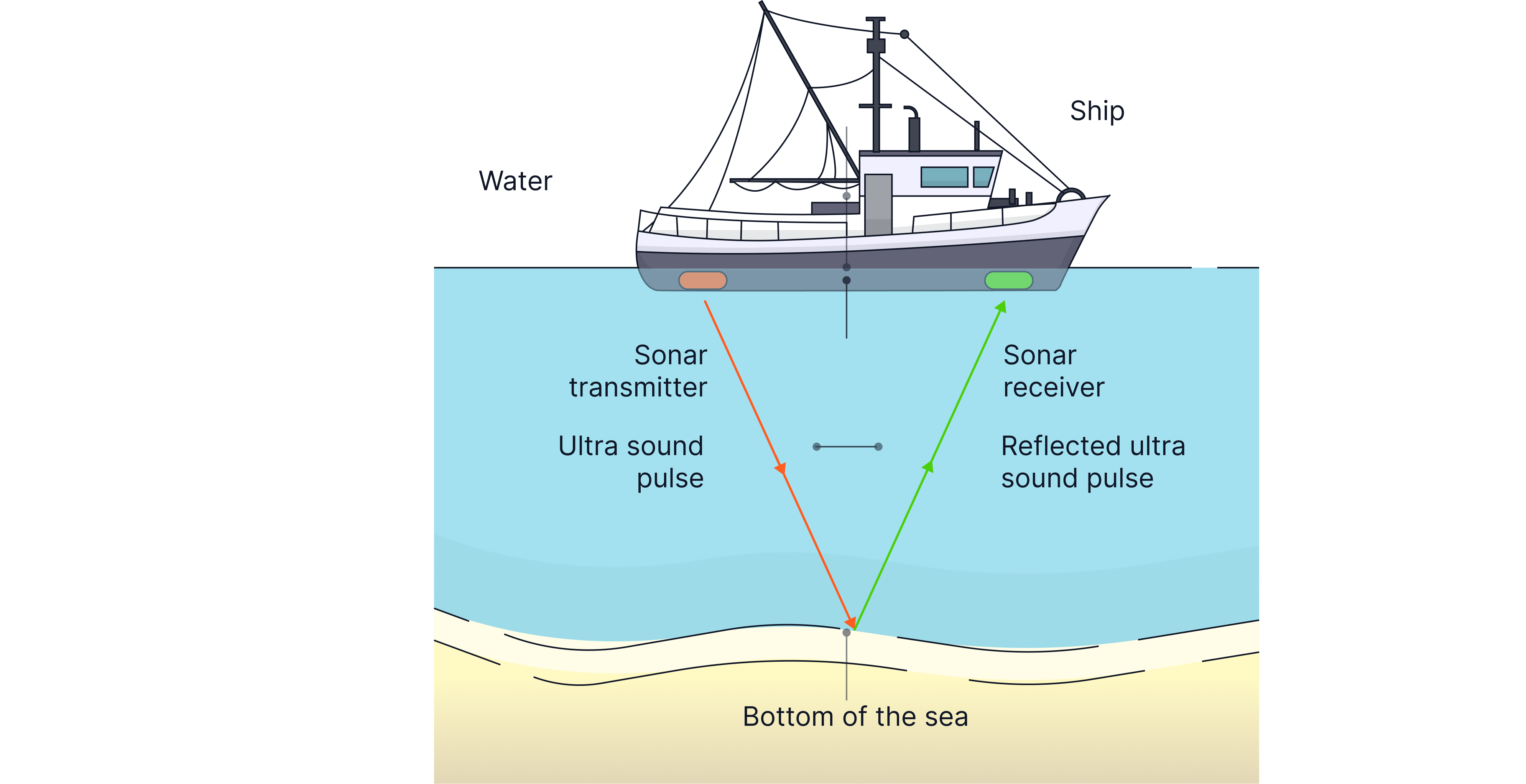
A boat sends out a pulse of ultrasound towards the seabed. The wave reflects off the seabed and returns to the boat. This reflected ultrasound wave is often called an echo. A computer measures the time taken for the wave to travel to the seabed and back.
Ultrasound travels at a constant speed in water, approximately , but will be different in different materials. For example, sound waves travel the slowest in air, at around .
The distance travelled by the wave is calculated using the equation:
Formula:
This equation is sometimes seen as, speed = distance time, , but is becoming less commonly used as the equation appears as seen above in your formula sheet.
The distance travelled by the wave is the total distance to the seabed and back, so the value must be divided by to find the depth of the water.
Example: A submarine releases a pulse of ultrasound and detects the echo later. Calculate the distance to the seafloor. Sound travels at in water.
*this is the total distance the ultrasound pulse travels (to the sea floor and back again), so if we just want the distance to the seafloor, we need to divide the answer by :
Medical Imaging
Ultrasound is commonly used for foetal scanning during pregnancy. This is because ultrasound is non-ionising, meaning it does not damage cells and is safe for an unborn baby. Remember, it is only high-frequency sound waves.
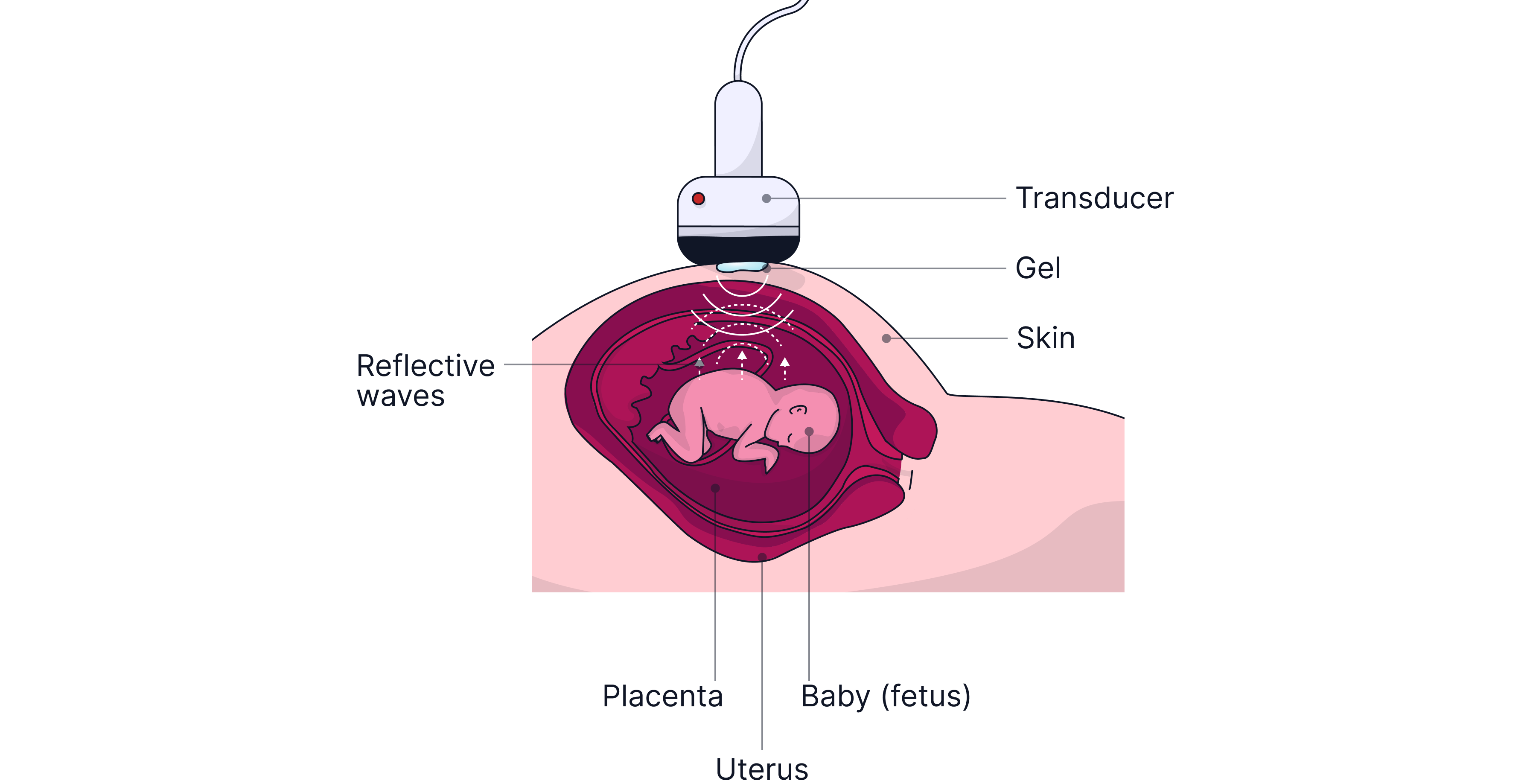
Ultrasound waves are transmitted into the body and are partially reflected at boundaries between different tissues, such as between the mother’s body and the baby. A computer measures the time it takes for the reflections to return and uses this information to build a computer-generated image of the baby. The higher the ultrasound frequency, the better the image quality, as more detail can be seen (higher resolution), but they are not always used because they cannot penetrate as deeply into the body.
Industrial Imaging
Ultrasound is also used in industry to detect cracks or flaws inside solid materials, such as metal.
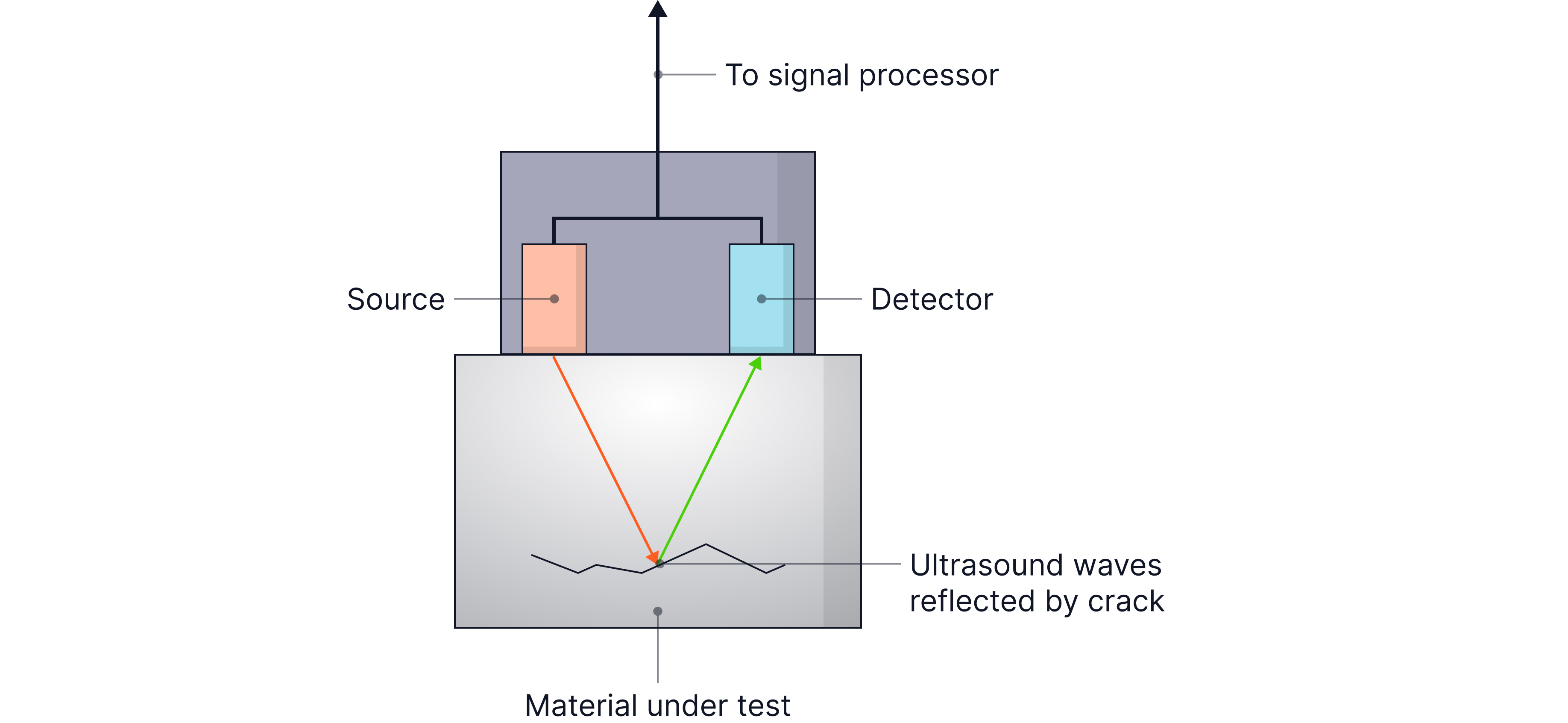
Ultrasound waves are sent into the material. They are reflected back when they hit the other end of the material, but if there is a crack, some of the waves will be reflected before this, when they reach the boundary between the solid material and the air inside the crack. These reflections allow engineers to determine the depth of the crack in the material and fix just that one part without damaging the rest of the material.
Worked Example:
A ship uses ultrasound waves to measure the depth of water beneath it.
An ultrasound pulse is sent from the ship to the seabed and the echo is received later.
The speed of sound in seawater is .
Explain why ultrasound is suitable for measuring the depth of the sea.
Calculate the depth of the water beneath the ship.
Answer:
Ultrasound waves will reflect off the seabed, and they travel at a known speed in water.
This is the distance the ultrasound pulse travels to the seabed and back to the ship, so to find just the depth of the water we need to divide our answer by .
Worked Example:
An ultrasound pulse is transmitted through a large aluminium girder that has a crack in it. The following trace is produced:
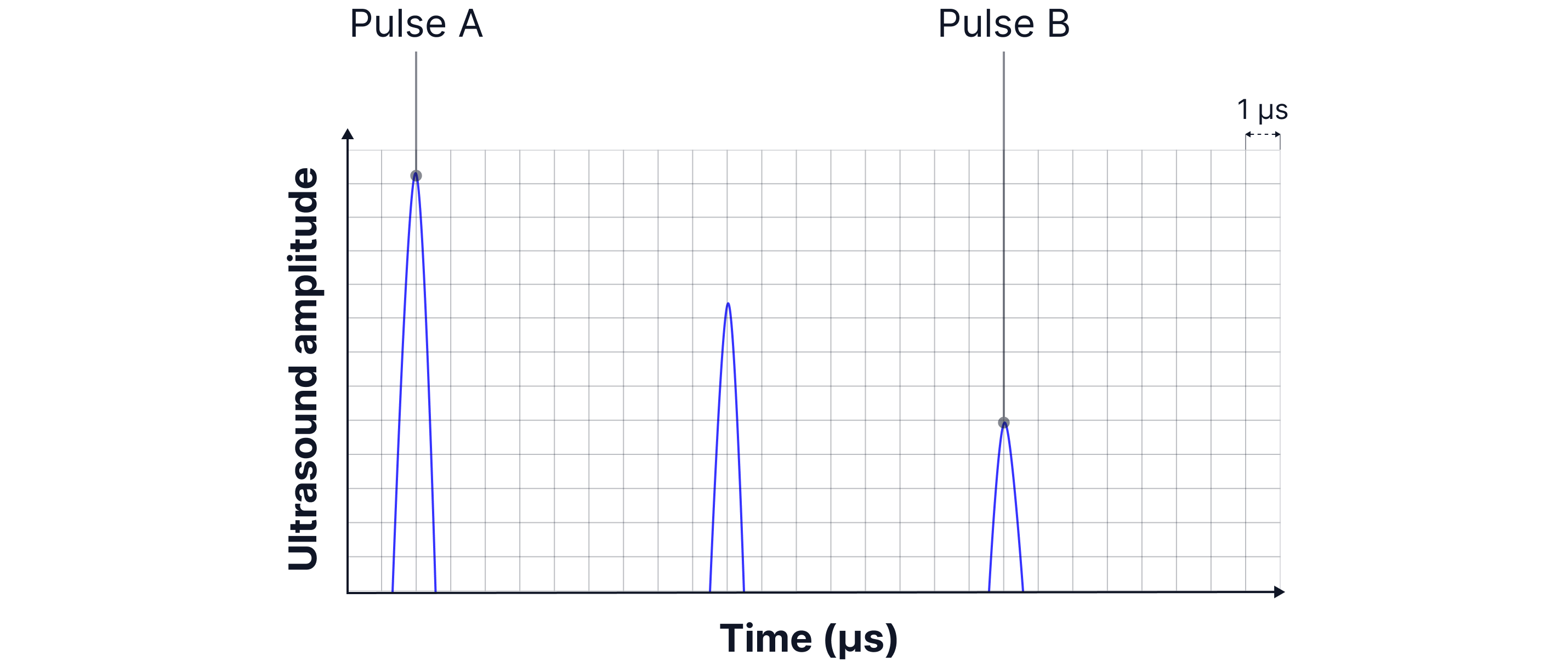
Pulse A is the pulse transmitted by the transducer, and pulse B is the pulse reflected from the end of the girder.
Calculate the depth of the crack in the aluminium girder. The speed of ultrasound in aluminium is .
Answer:
The middle pulse in the trace must be reflecting from the crack in the material. There are squares between the middle of the transmitted peak, pulse A, and the first reflected peak. We can find the time taken between the wave entering the material, hitting the crack and getting reflected back, as the diagram shows us that each box represents . Therefore, the time taken for the ultrasound wave to be reflected is:
We now convert microseconds into seconds, .
We are given the speed of the ultrasound wave, so we can calculate the distance,
This is the distance to the crack and back, so to find the distance to the crack, we need to divide our answer by :
Seismic Waves
Seismic waves are waves of energy that travel through the Earth from earthquakes. They are produced by the sudden movement of tectonic plates (the large, jigsaw-like pieces that make up the Earth’s crust).
There are two main types of seismic waves:
P-waves (primary waves) - travel the fastest, so they are always detected first. They are longitudinal waves, meaning the vibrations are parallel to the direction of energy transfer. P-waves can travel through solids and liquids, although their speed changes depending on the material they pass through.
S-waves (secondary waves) - S-waves travel more slowly than P-waves, so they arrive later at detection stations. They are transverse waves, meaning the vibrations are perpendicular to the direction of energy transfer. S-waves can only travel through solids.
Using Seismic Waves to Discover the Earth's Structure
Scientists use seismic waves, P-waves and S-waves produced by earthquakes to work out the internal structure of the Earth. Earthquakes are detected at different locations around the world using seismometers, which record ground vibrations.
Because P-waves are detected on the opposite side of the Earth, whereas S-waves are not (the shadow zone), as shown in the diagram below, scientists determined that there must be a liquid state inside the Earth—the outer core, as S-waves cannot travel in liquids.
Scientists also saw that the seismic waves appear to bend as they travel down through the Earth. This is called refraction, which we cover more on the next page. The wave changes direction, so it must have changed speed, suggesting it entered a different density. This is how we discovered there was a crust and a mantle with different densities. In the same way, we can see that P-waves changed direction again, moving from the outer core to the inner core, which is how we discovered this region also.
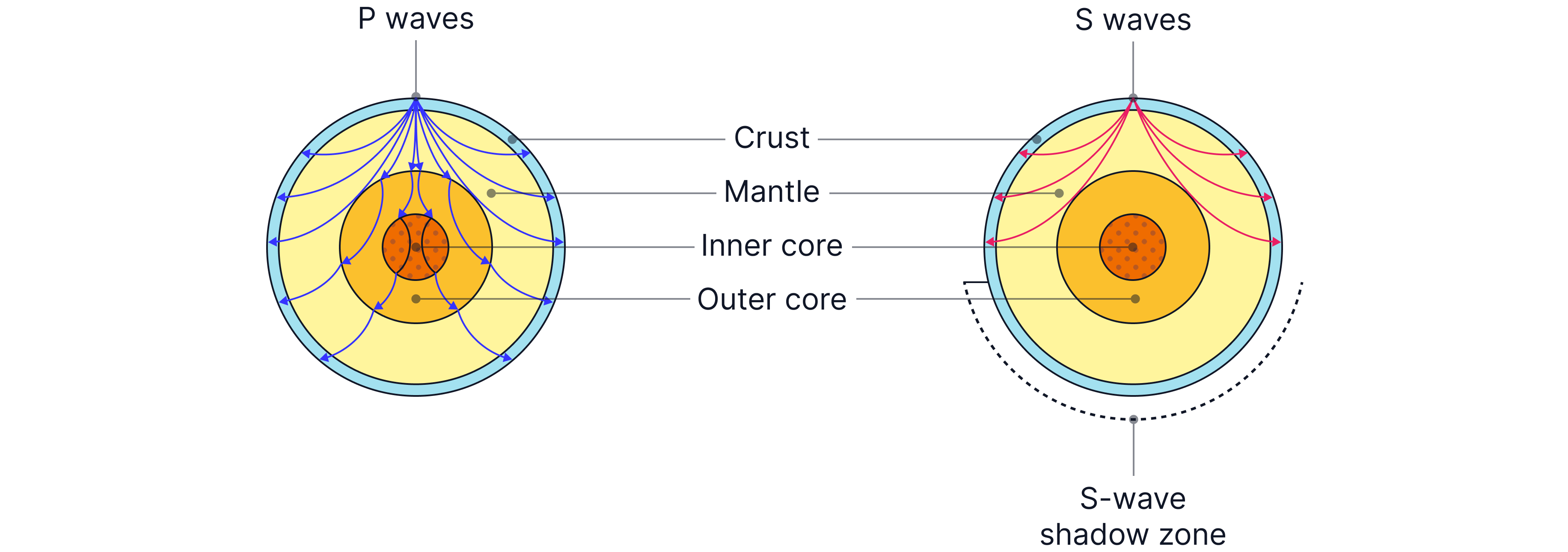
Scientists then concluded that the Earth is made up of four main layers:
Crust (around thick). The outermost layer of the Earth - the part we live on. Made of solid rock and is divided into tectonic plates that fit together like a jigsaw.
Mantle ( thick). A semi-solid layer underneath the crust. The mantle moves very slowly (a few centimetres per year). This movement causes the tectonic plates above to move, leading to earthquakes and volcanoes.
Outer core ( thick). A liquid layer made mainly of iron and nickel, discovered as S-waves can not travel through this region. The movement of the liquid outer core generates the Earth’s magnetic field.
Inner core ( radius). A solid sphere made mostly of iron and nickel. Although it is hotter than the outer core, it remains solid due to the extremely high pressures.

Worked Example:
Seismic waves produced by earthquakes can be used to study the internal structure of the Earth.
Describe the difference between P-waves and S-waves.
Explain why S-waves are not detected on the opposite side of the Earth from an earthquake.
Answer:
P-waves are longitudinal waves, while S-waves are transverse waves. P-waves can travel through solids and liquids, whereas S-waves can only travel through solids.
The outer core of the Earth is liquid, but S-waves cannot travel through liquids. Therefore, S-waves cannot pass through the outer core and are not detected on the opposite side of the Earth.
Worked Example:
The diagram shows the paths of seismic waves travelling through the Earth after an earthquake.
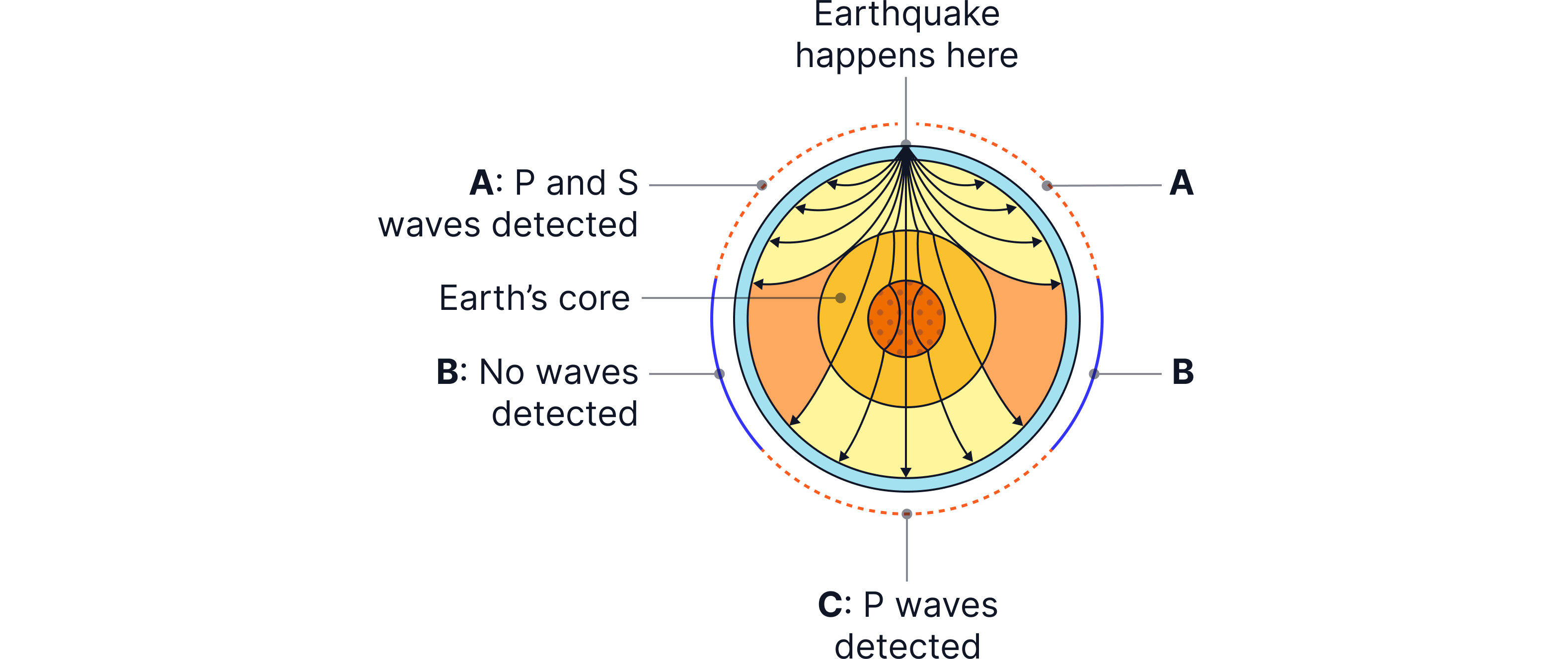
Explain how seismic waves provide evidence that the Earth has a liquid outer core.
Explain how the waves detected at the seisometers at locations A and C differ.
Answer:
Both P-waves and S-waves are produced by earthquakes. S-waves are only detected in certain regions of the Earth, so they cannot travel through parts of the Earth. Since S-waves cannot travel through liquids, this provides evidence that the outer core is liquid.
The seisometers at A are closer to the earthquake. Therefore, the P-waves will arrive much sooner than at the seismometers located at C, which is much further away. The amplitude of the vibrations of the P-waves recorded at A will also be much larger, as less energy will be lost as they travel through a smaller distance. As seen in the image, no S-waves are recorded at C as S-waves cannot travel through the liquid outer core of the Earth.
Practice Questions
Explain how ultrasound can be used to determine the distance to a boundary inside a material.
-> Check out Brook's video explanation for more help.
Answer:
Ultrasound waves are partially reflected when they meet a boundary between two different media.
The reflected pulse returns to a detector.
The time taken for the pulse to return is measured.
Distance to the boundary is calculated using (division by 2 because the wave travels to the boundary and back).
Seismic waves produced by earthquakes provide evidence about the internal structure of the Earth. Describe the differences between P-waves and S-waves and explain how these differences give information about the Earth’s core.
-> Check out Brook's video explanation for more help.
Answer:
P-waves are longitudinal and can travel through both solids and liquids; S-waves are transverse and cannot travel through liquids.
Seismometers detect P-waves on the opposite side of the Earth but do not detect S-waves there.
This indicates that part of the Earth (the outer core) is liquid, because S-waves are blocked while P-waves pass through but change speed.