Law of Reflection
(Triple Only)
Brook Edgar & Hannah Shuter
Teachers


Explainer Video
Reflection
When waves reach the boundary between two different materials, they can be reflected, transmitted, or absorbed.
Reflected: the wave bounces back from the boundary/surface into the original medium.
Transmitted: the wave passes through the boundary into the new material (often changing speed and direction).
Absorbed: the wave’s energy is transferred to the material, usually becoming thermal (heat) energy.
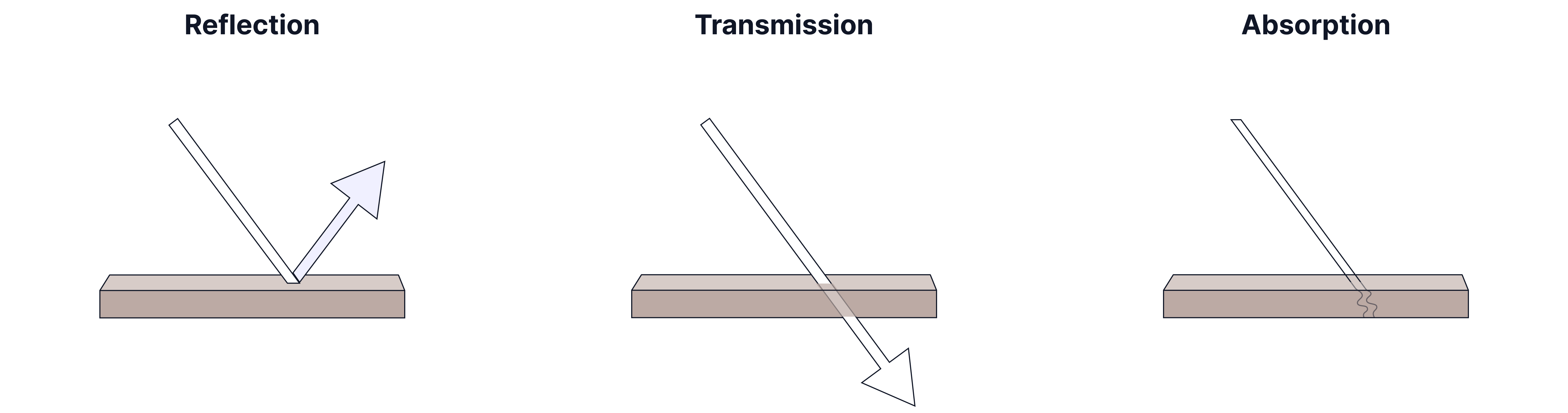
Reflection is how we are able to see our image in a mirror. When a ray of light hits the surface of a mirror, it is reflected back into our eyes.
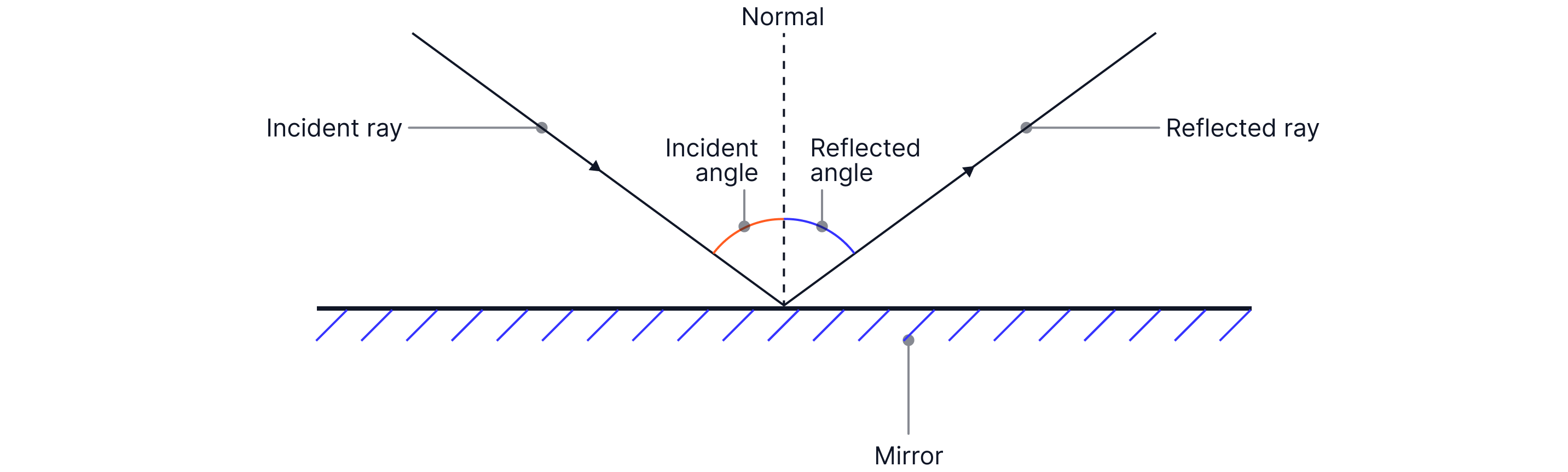
When drawing reflection diagrams, mirrors are represented using a straight line with shading on one side. The shading shows the non-reflective side, so it is clear which side of the mirror reflects the light. These are known as plane mirrors.

When drawing a reflection diagram, the incoming light ray is called the incident ray, and the light ray that rebounds is called the reflected ray. We also need to draw an imaginary, reference line at to the surface - this is called the normal. The normal is very important, as we measure the incident angle and the reflected angle against this line - not the mirror.
Law of Reflection
The law of reflection states that the incident angle equals the reflected angle, . For example, in the below diagram we can see that the incident angle is , so the reflected angle must also be . Always use a protractor when drawing and measuring these angles!

Specular and Diffuse Reflection
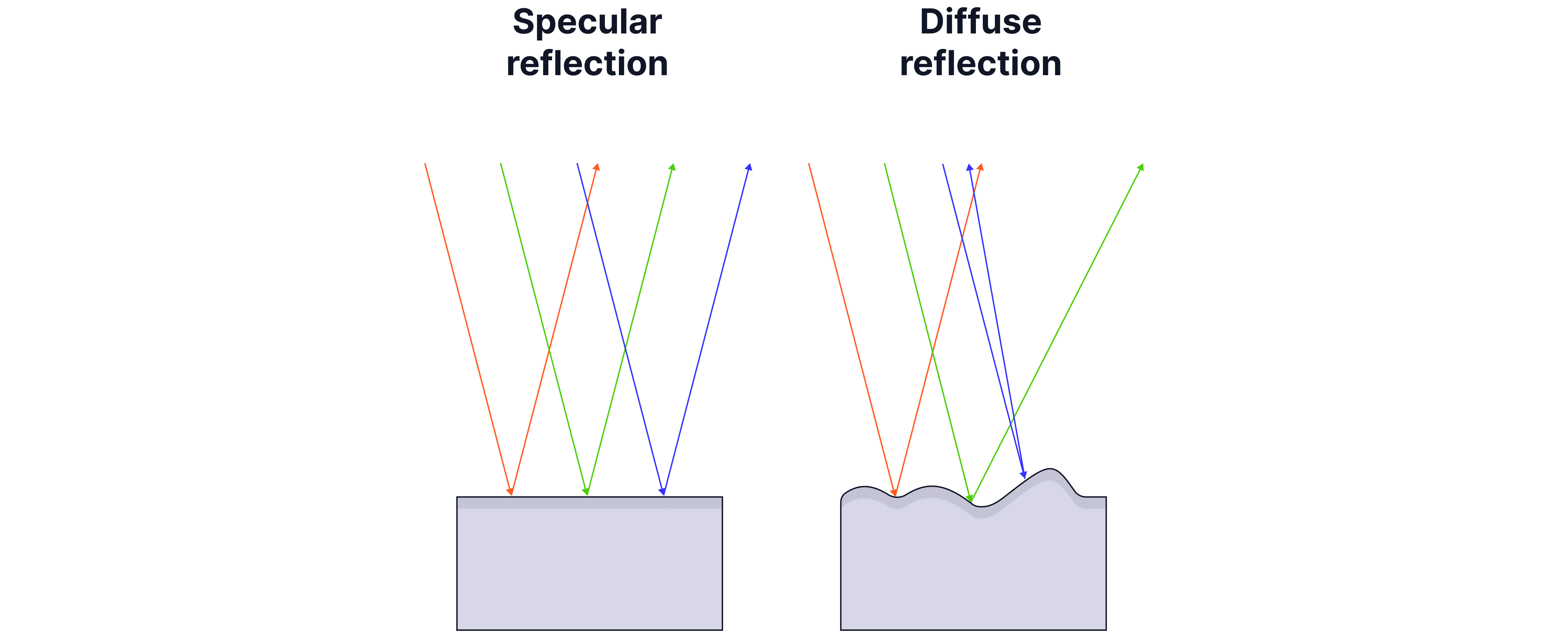
There are two types of reflection, specular and diffuse.
In specular reflection, incident rays of light that are parallel to each other are reflected parallel to each other, allowing a clear image to be seen. This occurs in mirrors, where the surfaces are smooth, and on calm water, where the lake or water surface is smooth, allowing you to see an image of yourself.
In diffuse reflection, the surface is uneven, resulting in incident rays of light that are all parallel to each other being reflected at different angles - the reflected light is scattered. The image is not clear, like when looking at an image of yourself in a lake when the surface is disturbed, such as if your friend jumps in, creating ripples across the lake.
Reflection Required Practical
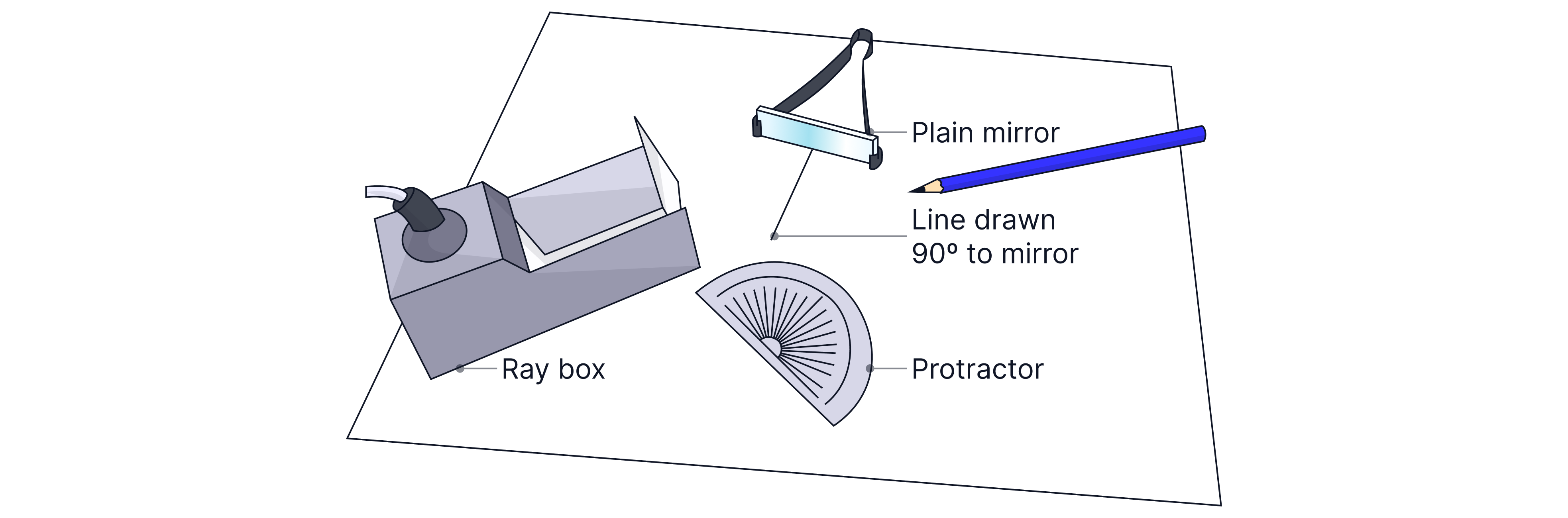
Place a plane mirror upright on a piece of paper and mark its position with a pencil
Use a ray box to shine a narrow beam of light at the mirror
Mark the incident and reflected light rays on the paper with crosses, so that when the light is turned off, you can connect the crosses to mark its path.
At the point where the ray meets the mirror, draw a normal at right angles to the mirror surface
Use a protractor to measure the angle of incidence and the angle of reflection
Repeat the steps above for different angles of incidence
The results show that the angle of incidence always equals the angle of reflection.
The experiment could be improved by checking the mirror surface for defects such as bumps or dents, as we need a smooth surface for specular reflection. Also, repeating the experiment for each angle of incidence at least three times and calculating the mean will improve the experiment's reliability.
We can adapt the experiment to see if different surfaces, such as polished metal or paper, also follow this rule. .
Worked Example:
A ray of light hits a plane mirror. The angle between the incident ray and the normal is .
Calculate the angle of reflection and explain how you know.
Answer:
The angle of reflection is , because the law of reflection states that the incident angle equals the reflected angle.
Worked Example:
A student investigates the reflection of light using a plane mirror.
Describe how the student could measure the angle of incidence and the angle of reflection.
State one way the student could ensure reliable results.
Answer:
Place the plane mirror upright on a sheet of paper and draw around it.
Shine a narrow beam of light from a ray box or laser at the mirror.
Draw a normal at the point where the light hits the mirror, at to the surface, and trace the paths of the incident and reflected rays on the paper.
Use a protractor to measure the angles between the rays and the normal.
Ensure the mirror surface is smooth and free of defects to achieve specular reflection. Or ensure that the beam of light is as thin/narrow as possible. Or repeat each measurement multiple times and find the mean.
Visible Light
Light emitted from the Sun or from light bulbs is called white light. White light is made up of seven different colours (the colours of the rainbow): Red, Orange, Yellow, Green, Blue, Indigo and Violet. These colours can be remembered using the mnemonic -> Richard Of York Gave Battle In Vain (or ROY G BIV).
Each colour of light has a different wavelength and frequency. Red light has the longest wavelength and violet light the shortest. We know white light is made of these colours, as when white light passes through a glass prism, the different colours spread out and can be seen as they travel at different speeds through the glass. This process is called dispersion. More on this on the EM waves page.
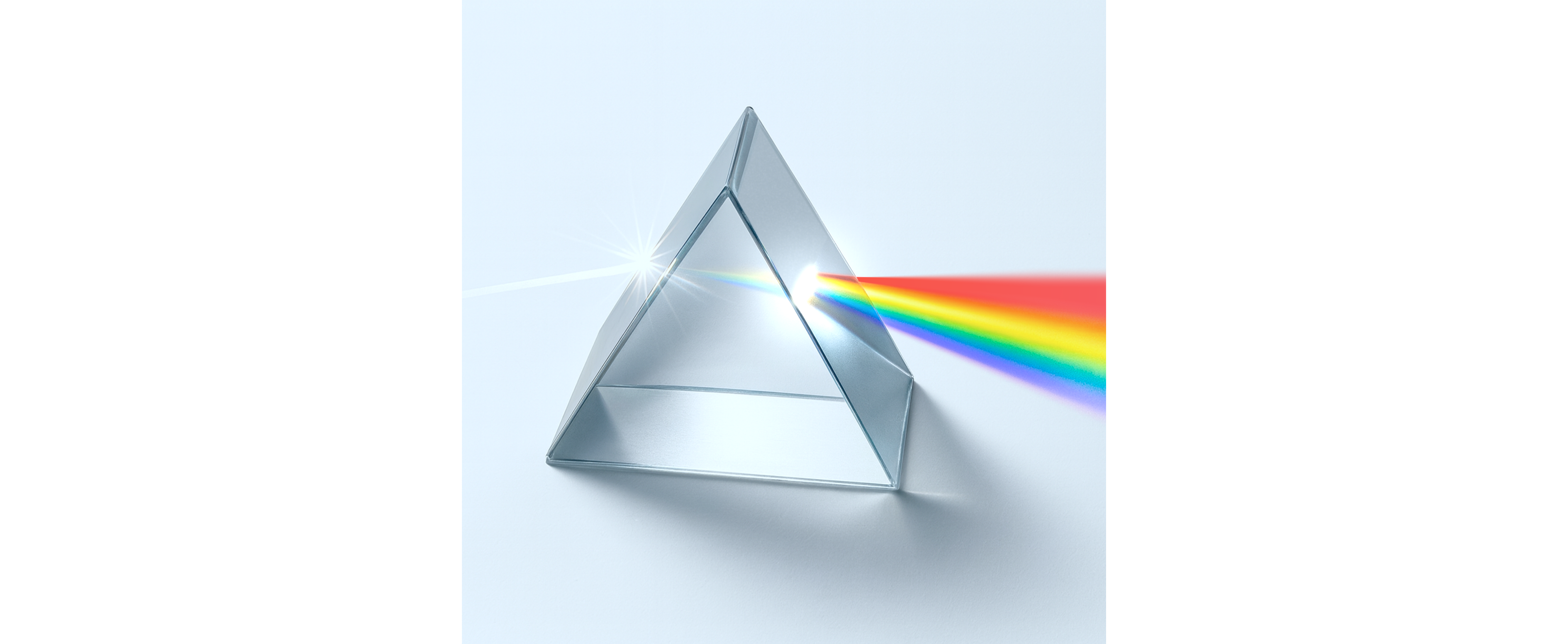
Transparent objects allow all incident light to pass through, and thus can be seen through clearly (e.g., clear glass).
Translucent objects allow some of the incident light to pass through, but not all, which is why they appear blurred (e.g., frosted glass).
Opaque objects allow no light to pass through them; either all incident light is absorbed by the material, causing it to heat up (like black objects), or all incident light is reflected away, and none is absorbed (like white objects). Coloured objects absorb all incident light except the colour that is reflected into our eyes (e.g., a red apple absorbs all colours of light except red light that it reflects into our eyes).
Coloured Filters
Coloured filters work by absorbing some colours of light and transmitting others. For example, A red filter transmits red light and absorbs all other colours. This means only red light passes through the filter. All objects viewed through this filter will appear shades of red, depending on whether they reflect the incident red light into our eyes or absorb it, appearing black to us (as no light is reflected into our eyes, as red light is the only colour incident on the object when viewed through a red filter).
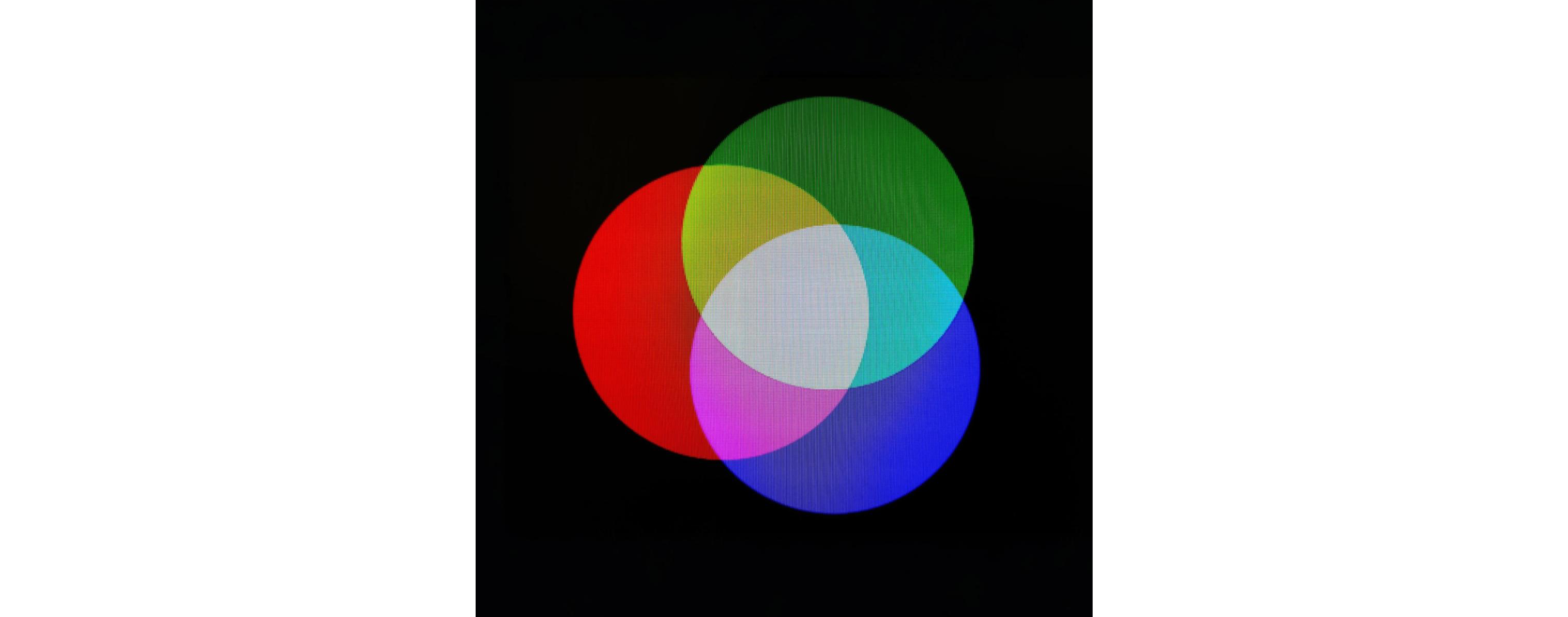
The primary colours of light that our eyes can detect are red, green and blue, which can be combined to make the secondary colours as shown in the image below. When all colours are combined equally, they produce white light.
Worked Example:
White light is made up of different colours.
State which colour of visible light has the longest wavelength and which has the shortest wavelength.
Explain why a red object appears red when illuminated with white light.
Answer:
In the visible spectrum, red light has the longest wavelength and violet light has the shortest wavelength.
White light contains all wavelengths of visible light. A red object appears red because it reflects the red wavelengths of light and absorbs the other wavelengths of light. The reflected red wavelengths enter our eyes, so the object is seen as red.
Worked Example:
A blue filter is placed in front of a white light source and shines onto a green apple.
What colour light passes through the filter?
What colour does the apple appear, and why?
Answer:
A blue filter works by transmitting blue light and absorbing all other colours of white light. Therefore, only blue light passes through the filter.
A green apple normally appears green because it reflects green light and absorbs other colours. However, in this situation, only blue light is shining on the apple. The apple absorbs blue light and does not reflect it so it appears black.
Practice Questions
The diagram shows an incident ray striking a plane mirror at an angle of 35° to the normal.

State the law of reflection.
Complete the diagram to show the reflected ray.
-> Check out Hannah's video explanation for more help.
Answer:
Angle of incidence = angle of reflection.
Reflected ray drawn at on the opposite side of the normal, same distance from the normal as the incident ray.
The diagram shows a ray of light striking a plane mirror. The angle of incidence is .

Draw and label the reflected ray on a ray diagram.
State one difference between diffuse reflection and specular reflection.
-> Check out Hannah's video explanation for more help.
Answer:
Correct normal drawn at to the mirror; Reflected ray drawn so angle of reflection .
Diffuse reflection scatters light in many directions because the surface is rough; specular reflection reflects light in a single direction from a smooth surface.