Waves RP
Brook Edgar & Hannah Shuter
Teachers


Explainer Video
Waves in a Ripple Tank
In the waves required practicals, you investigate how to measure the speed of a wave using the equation:
Therefore, to find the wavespeed, we need to describe how to measure the frequency and wavelength of the waves, including the equipment used.
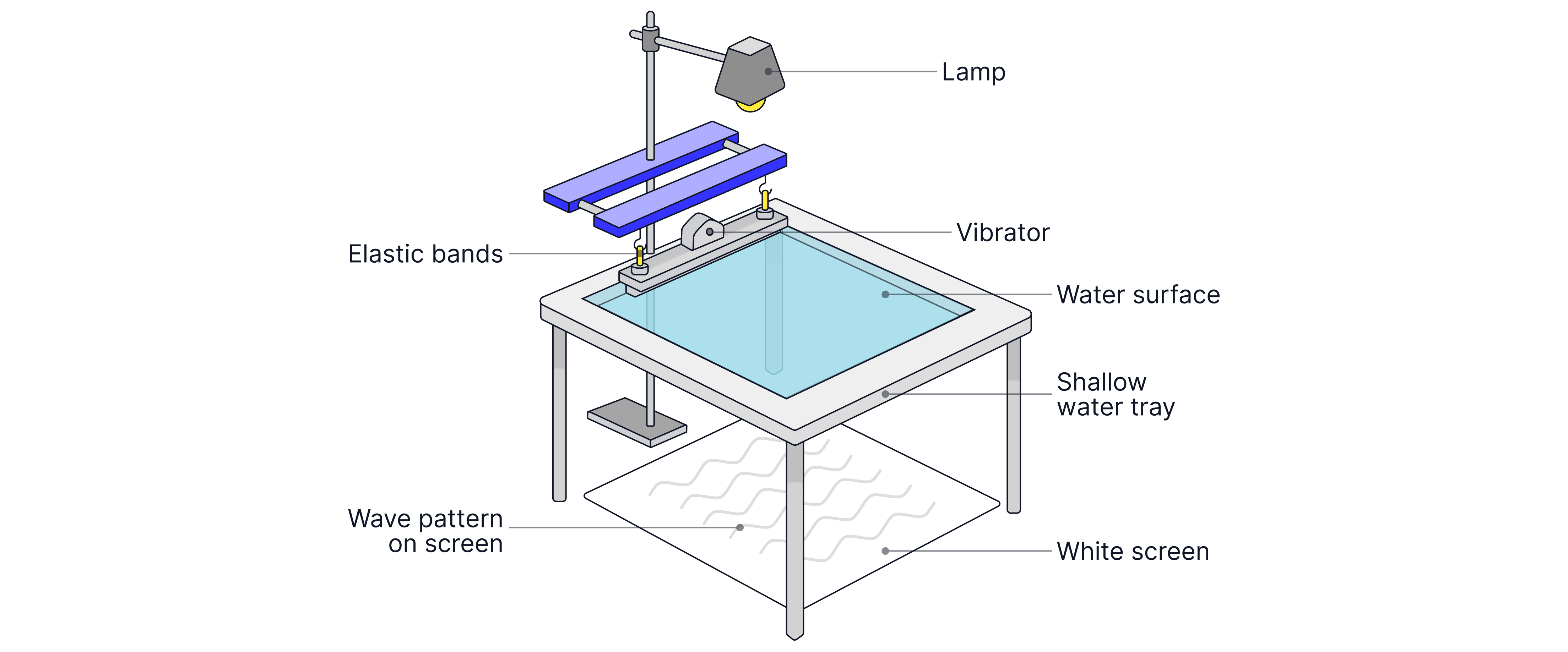
A ripple tank is a piece of equipment with a dipper that can be used to make waves in a shallow dish of water. A light is then shone through the dish so the shadow of the waves can be projected onto the surface below.
Measuring Frequency
Choose a fixed point in the ripple tank.
Use a stopwatch to measure the time taken for 10 waves to pass this point.
Divide the total time by 10 to find the time period () for one wave.
Calculate the frequency using:
Measuring Wavelength
Use a ruler to measure the distance covered by 10 waves.
Divide this distance by 10 to find the wavelength of one wave ().
Calculating Wave Speed
Use the wave equation:
Improving the Experiment
Measuring more than ten waves when recording the time taken for the waves to pass, so that it will be a longer time measured, meaning that your reaction time (the time it takes you to respond and hit the stopwatch) will be a smaller fraction of the total time.
Repeating measurements and calculating a mean improves reliability.
Worked Example:
In a ripple tank, it takes for waves to pass a fixed point.
The distance covered by waves is .
Calculate the speed of the water waves.
Answer:
First, we need to calculate the time period for one wave, given that it takes eight seconds for ten waves to pass.
Next, we need to calculate the frequency:
We know the distance covered by waves is - so the length of one wave would be,
To find the speed, we need to use the equation:
Worked Example:
A student wants to know how fast waves in a ripple tank are moving. The student measures the wavelength to be , what other measurement should they make? Include details of how the student should do so accurately.
Answer:
The student needs to measure the frequency of the waves.
They should time how long it takes waves to go past a point, then divide this number by . This will give them the time period of one wave.
They should then use the equation to calculate the frequency.
Waves on a String
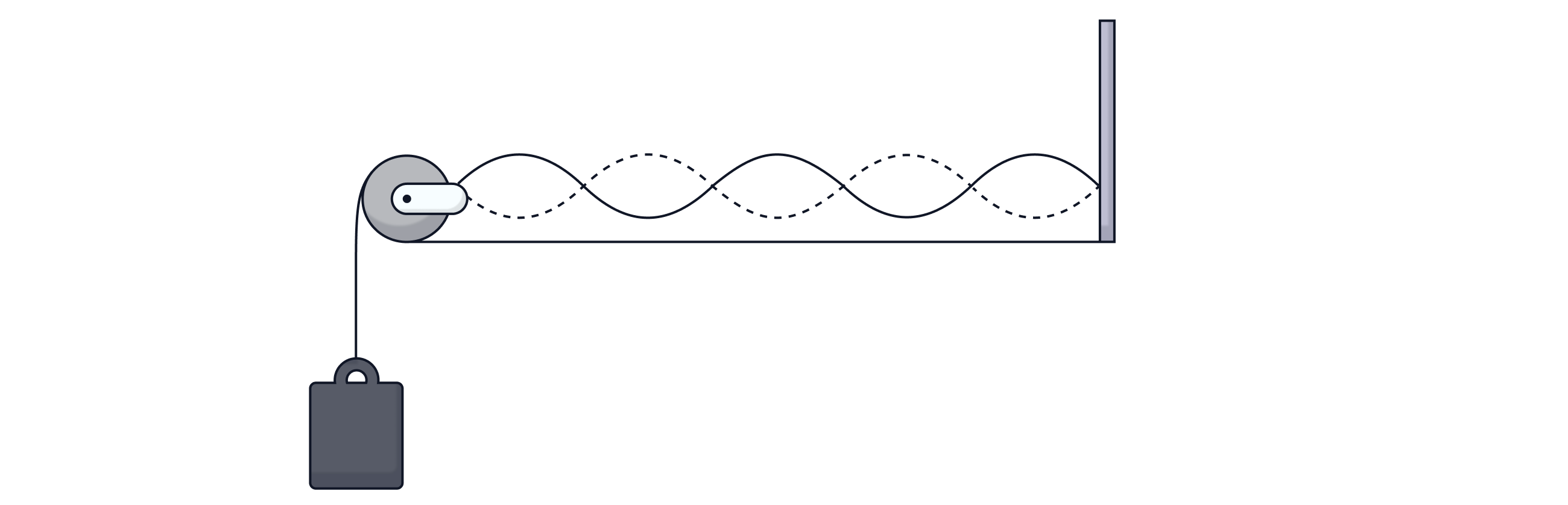
If we vibrate a string attached between two points as shown below, at a certain frequency, a wave will be produced on the string that looks like the one shown below. It oscillates about these points. It is called a standing wave. The string is made to vibrate using a vibration generator. The frequency of vibration is controlled using a signal generator that is connected to the vibration generator. A hanging mass is attached to the string, hung over the edge of a table to keep the string taut (tight).

Method
Set up the equipment as shown.
Turn on the signal generator and adjust the frequency until a clear standing wave pattern is observed.
Measure the length of the vibrating section of the string.
Count the number of loops in the standing wave pattern.
Calculating Wavelength
To calculate the wavelength, we need to know how many waves are on the string. Each loop on the string represents half a wavelength, as shown in the image above. To calculate the number of waves, we multiply half a wavelength by the number of loops.
For example, in the image above, there are loops, so the number of waves would be:
Now that we know the number of waves, we can calculate the wavelength by dividing the length of the string by the number of waves. For example, if we measured the length of the string to be 3 metres,
Measuring Frequency
The frequency can be read directly from the signal generator
Calculating Wave Speed
To calculate the speed of the wave, use the equation:
Problems with the Experiment
The string is moving, making it very hard to count the loops or measure its length.
The string may be longer than a metre, making its length hard to measure with a metre ruler.
Worked Example:
A standing wave is formed on a string of length .
The standing wave has loops as shown below.

The frequency shown on the signal generator is .
Calculate the speed of the waves on the string.
Answer:
Each loop represents half a wavelength, so if there are 6 loops,
The string is long, which has three waves on it, so to find the wavelength of one wave:
We were given the frequency in the question, so we can calculate the wave speed:
Worked Example:
A string below has a length of .

The wave on the string is travelling at . Calculate the frequency that should appear on the frequency generator.
Answer:
Since each loop is a half wavelength and there are loops,
The string is long, which has two waves on it, so to find the wavelength of one wave:
We know the wave speed, so we can calculate the frequency
Practice Questions
A student uses a ripple tank to measure wavelength and frequency in water waves. They measure a distance of 18 cm across 6 waves on the card, and count 22 waves passing a fixed point in 10 seconds.
Calculate the wavelength of the waves.
Calculate the frequency of the waves.
Calculate the speed of the waves.
State one improvement to reduce measurement error in wavelength.
-> Check out Hannah's video explanation for more help.
Answer:
Any one of: measure the distance across more waves; use a set square/ruler at right angles; ensure the image is sharp; measure centrally.
A student investigates waves on a vibrating string to determine wave speed. They adjust the string until the clear standing wave shown below is produced.
The measured length of the string is 1.00 m and the vibration generator is at 75 Hz.
Calculate the wavelength.
Calculate the wave speed.
-> Check out Hannah's video explanation for more help.
Answer: