Free GCSE Physics revision resources
GCSE Physics is the study of the forces that govern our universe, covering everything from electricity to magnetism.
As part of our 2026 GCSE revision week, our expert Physics teachers, Brook Edgard and Hannah Shuter, are opening up their collection of step-by-step video explanations, detailed revision notes and practice questions - in short, everything you need to walk into your GCSE Physics exam feeling full of confidence and ready to show off what you know.
AQA GCSE Physics revision materials
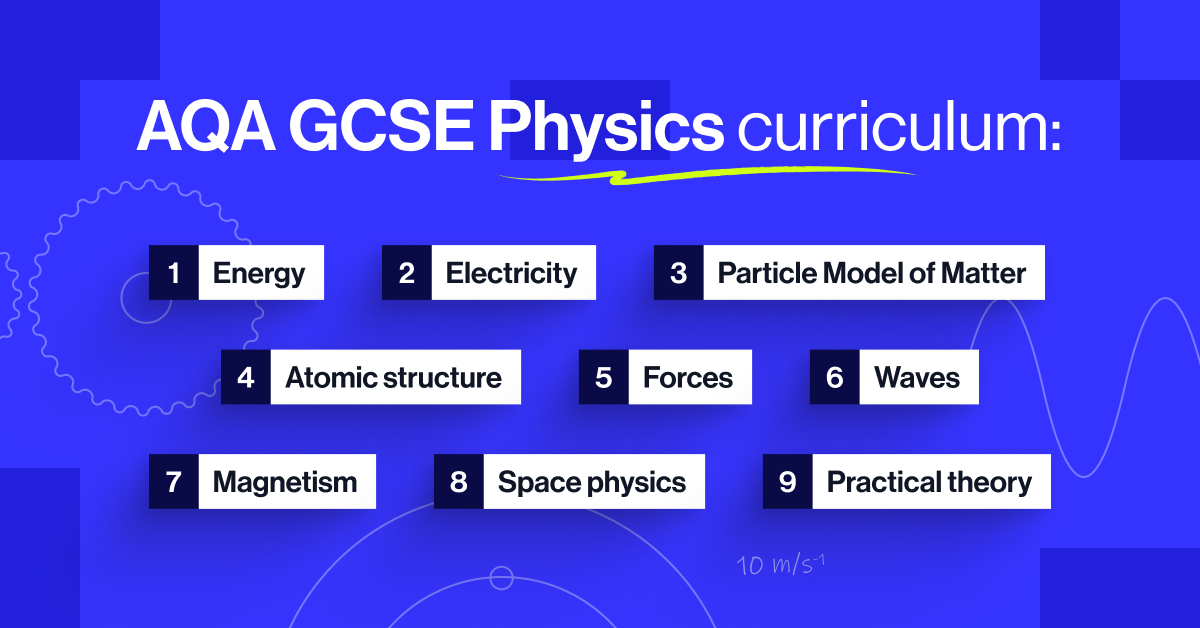
The resources are split into nine modules, covering the full UK, AQA GCSE Physics curriculum:
-
Energy
-
Electricity
-
Particle Model of Matter
-
Atomic structure
-
Forces
-
Waves
-
Magnetism
-
Space physics
-
Practical theory
Each module is further broken down into topics and sub-topics.
For example, in module 3 - Particle Model of Matter, students will cover density RP, changes in state, particle motion in gases, pressure in gases, internal energy, specific latent heat, and specific heat capacity.
Each sub-topic details everything the student will need to know, plus simple explanations for key terms, finishing with a practice question.
For example, here is Hannah explaining changes in state:
Followed by a practice question:
A solid metal object is heated and does not melt (remains a solid). Explain what happens, if anything, to the arrangement and movement of particles in the metal.*
The correct answer can then be revealed (see below) so the student can both see where they stack up and note down anything they missed which the examiner would be awarding marks for.
While these notes are invaluable, this is just the start.
To give yourself the best possible chance of achieving an 8 or 9 in your GCSE Physics exams, we’d recommend you sign up now for our Year 10 or Year 11 GCSE Physics course.
Alongside high-quality resources like these, on the Year 11 Physics (Higher) course you’ll enjoy two live 60-minute lessons with Brook or Hannah per week, where you’ll cover everything from elastic potential energy to EM waves.
You can see the benefits of signing up in the results our most recent cohort of students achieved last year.
-
Three times more MyEdSpace students achieved GCSE grade 9 than the national average
-
Over one-third of our students achieved GCSE grades 8 or 9 (35%), compared to just 12% nationally
-
Well over half of our students achieved GCSE grade 7 or above (56%), compared to under 25% nationally (22%)
With results like those, it’s a no-brainer to sign up and get started ASAP.
Get ahead this summer with our GCSE Physics Summer School
Summer's great. But, in those long, lazy days between July and September, momentum is lost and people can quietly fall behind.
Summer School fixes that without taking over the summer holidays. 6 hours of lessons, spread over 3 weeks - which you can join from anywhere - isn't a big ask, but it comes with big gains. Head into the new year months ahead of schedule and save yourself having to play catch-up later. Find out more and get ahead this summer.
* Particles in a solid vibrate around fixed positions. As the solid is heated up, the particles will gain kinetic energy and their vibrations will increase, but the arrangement of the particles will not change. They still have a fixed, regular arrangement.