Elimination Reactions of Alcohols
Lajoy Tucker
Teacher

Contents
Introduction & Definitions
Alcohols are converted into alkenes by the removal of a water molecule.
This is a dehydration reaction through an elimination mechanism.
This is an acid-catalysed process.
The alkenes formed can be used as monomers for addition polymers, offering a renewable route to polymers that avoids crude oil-derived alkenes.
Acid-Catalysed Elimination of Alcohols
General Reaction:

Example:
No answer provided.
Reagents/Conditions:
Reagent: Concentrated sulfuric or phosphoric acid
Conditions: Heat under reflux
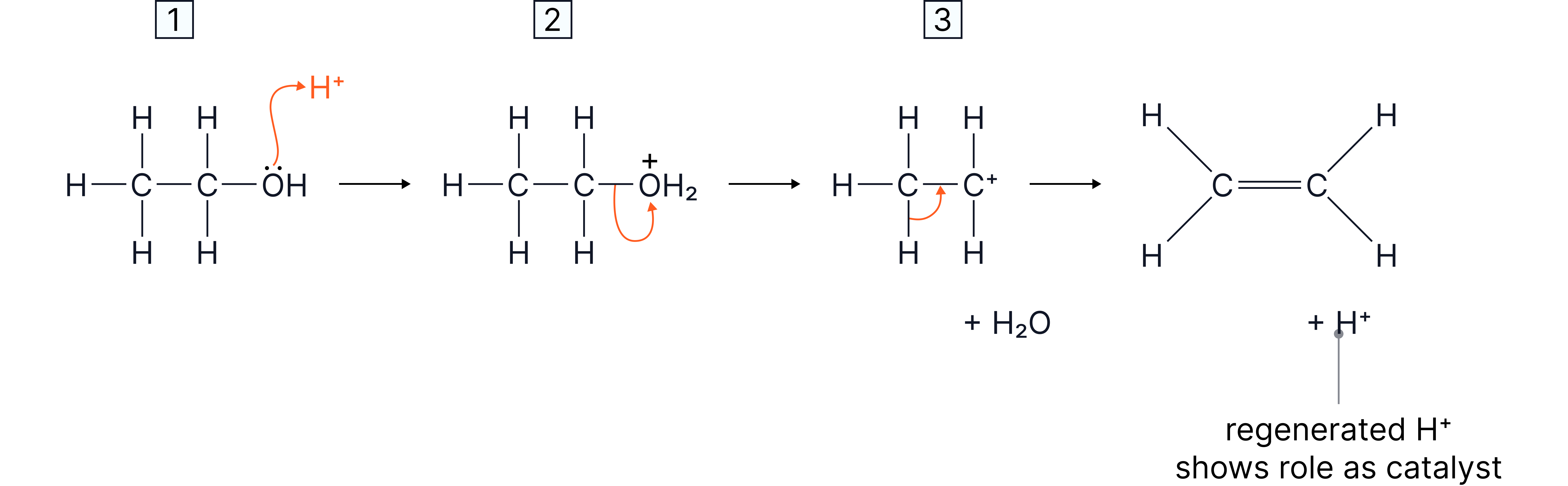
Mechanism of Elimination
1. Protonation of the group (making it a better leaving group as )
2. Loss of to form a carbocation intermediate
3. Loss of a proton from an adjacent carbon to form the C=C double bond
Diagram
Formation of Different Isomers
If there is more than bond adjacent to the , dehydration can occur at more than one position, producing a mixture of alkenes.
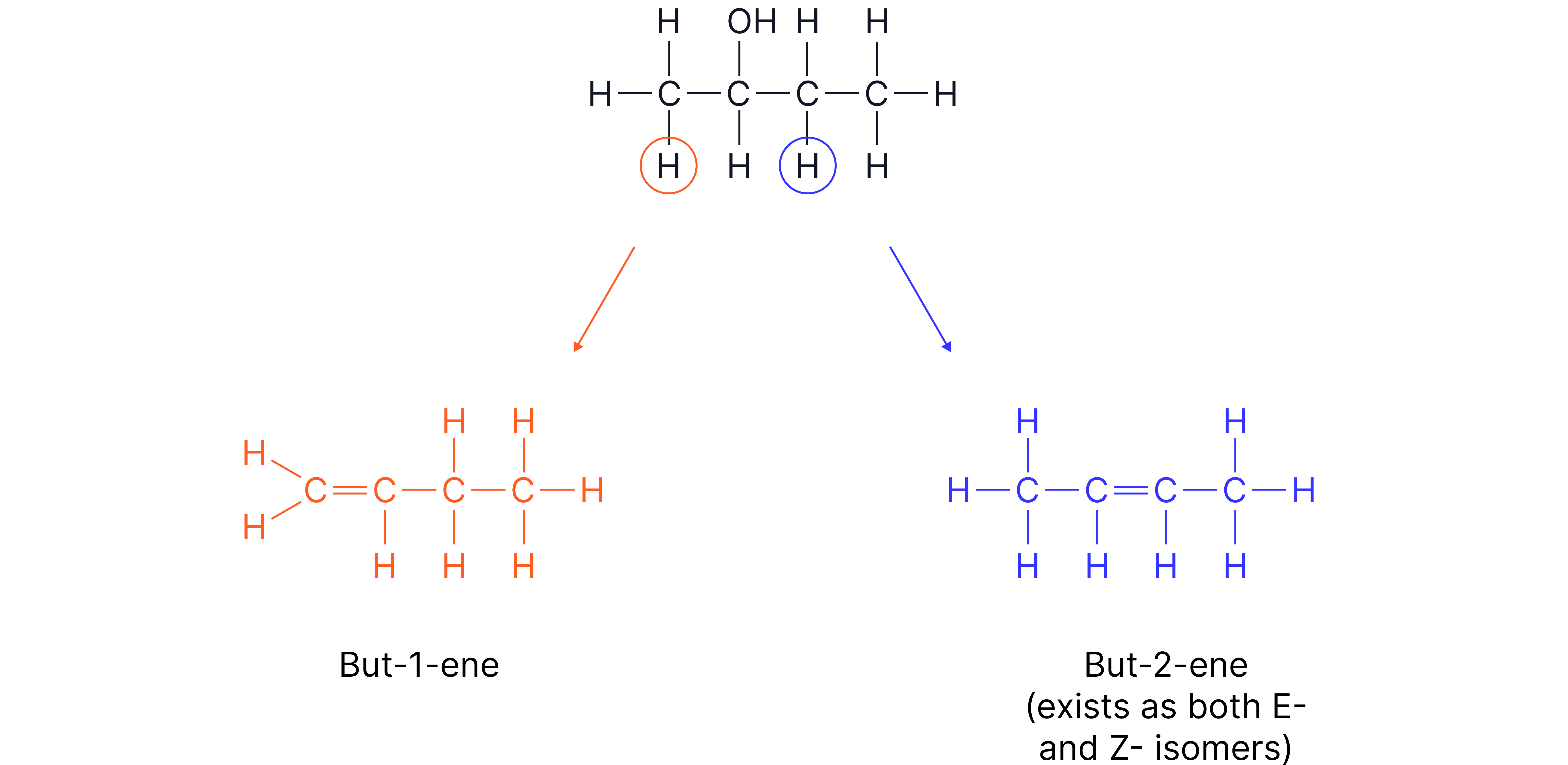
Dehydration of butan-2-ol will give a mixture of but-1-ene and but-2-ene which are structural isomers (specifically position isomers).
But-2-ene can also exist as E/Z stereoisomers.
Exam Tip!
When producing alkenes, always look out for position isomers based on removing different AND isomerism in the products
No answer provided.
Worked Example
Why can the elimination of pentan-2-ol produce three isomeric alkenes?
Answer
Hydrogen can be removed from either adjacent carbon to the , giving structural isomers, pent-1-ene and pent-2-ene.
Pent-2-ene exists as stereoisomers due to restricted rotation around the double bond and two different groups attached to each C of the double bond.

Practice Questions
Question 1
Name the mechanism for the reaction that occurs when ethanol is heated with concentrated phosphoric acid.
Answer
Elimination
Question 2
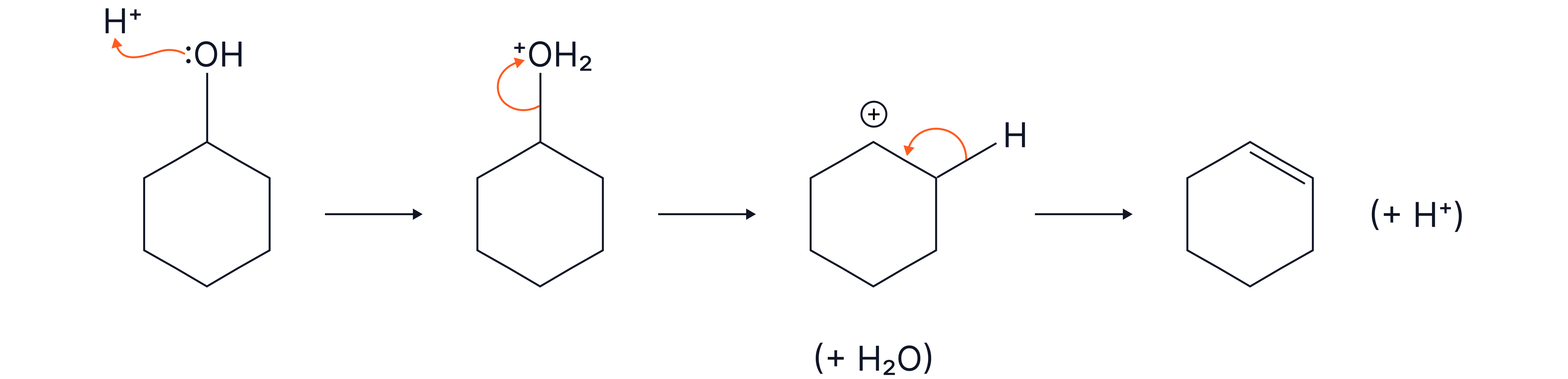
Outline the mechanism for the acid-catalysed elimination of cyclohexanol. Show all relevant curly arrows and lone pairs

Answer
Tips
Heat and acid are both essential for dehydration.
If the group is on a carbon with more than one adjacent , expect isomer formation.
Elimination forms unsaturated products (alkenes) that can undergo electrophilic addition later or addition polymerisation.
No answer provided.