RP10 - Preparing an Organic Liquid
Lajoy Tucker
Teacher

Practical Method
Aim: To synthesise and purify a sample of an organic liquid (e.g. cyclohexene from cyclohexanol).
Apparatus & Reagents:
Round bottom flask
Reflux condenser
Distillation apparatus
Separating funnel
Measuring cylinder
Thermometer
Beaker
Anti-bumping granules
Organic reagents (e.g. cyclohexanol, )
Drying agent (e.g. anhydrous )
Sodium hydrogencarbonate solution
Water
Ice bath
Procedure
A. Reflux (for reaction completion)

Add the organic reactant and acid catalyst to a round bottom flask.
Add anti-bumping granules.
Assemble the reflux apparatus with a vertical condenser.
Gently heat the mixture for ca. 30 minutes.
B. Distillation (isolate the product)
Rearrange the apparatus for distillation.
Collect the fraction boiling near the expected boiling point of the desired compound.
C. Purification (washing & drying)
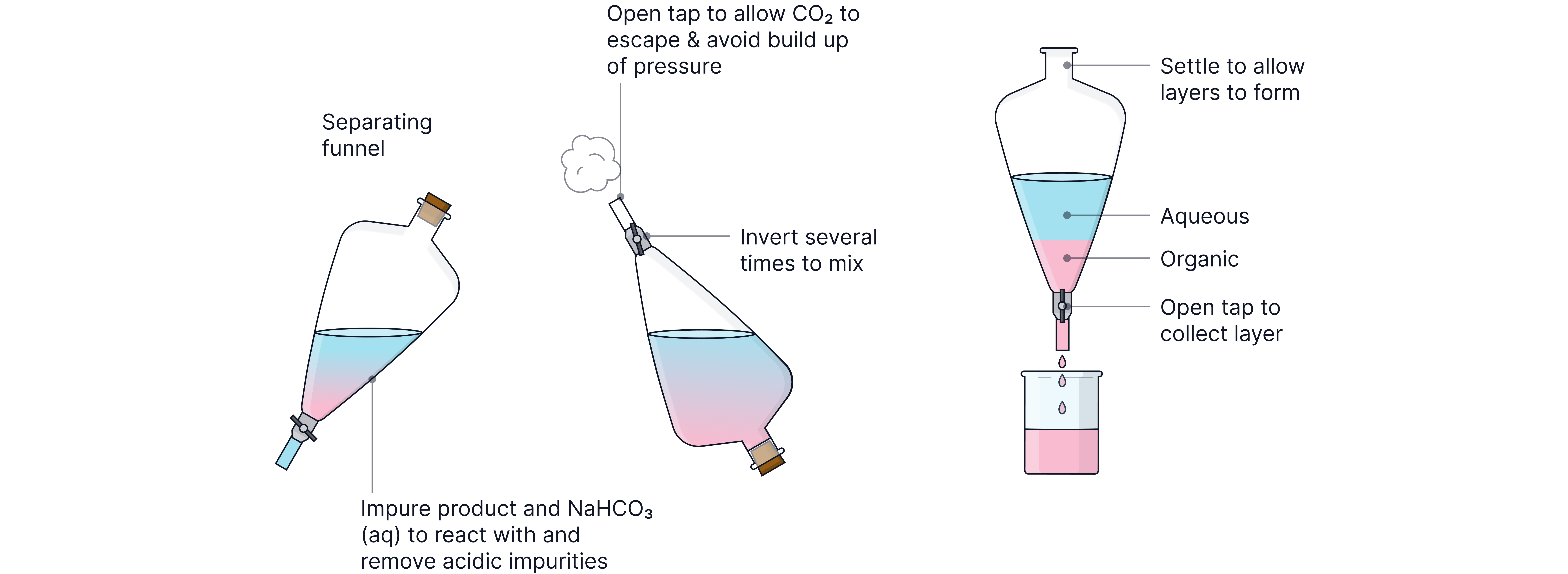
Transfer the distillate to a separating funnel.
Add sodium hydrogencarbonate solution to neutralise any remaining acid. (Release pressure by inverting and opening the tap.)
Remove aqueous layer; retain organic layer.
Wash the organic layer with water and discard the aqueous layer again.
Add anhydrous or to remove water. Swirl until liquid goes from cloudy to clear.
Decant the dry liquid into a clean, dry container.
Redistil to obtain a pure product (collect at boiling point).
Preparing an Organic Liquid Explained
Practice Question
Question 1
A student prepares cyclohexene from cyclohexanol. The mass of cyclohexanol used is . The student collects of cyclohexene. . Calculate the percentage yield.
Answer:
1. Moles of cyclohexanol
2. 1:1 ratio so moles cyclohexene
3. Theoretical yield
4.
Question 2
Why is a reflux condenser used in the preparation of an organic liquid?
Answer:
To prevent loss of volatile substances by condensing vapours back to liquid
Question 3
During purification, why is it important to release pressure when shaking the separating funnel?
Answer:
To avoid pressure build-up from gas released
Key Tips and Reminders
Clamp all glassware securely when heating.
Ensure water flows from bottom to top in condensers.
Do not seal reflux or distillation apparatus – pressure may build.
Always wash organic product to remove acid and aqueous impurities.
No answer provided.