Defects of Vision and lens equations
Brook Edgar & Hannah Shuter
Teachers


Contents
Brook Edgar
Teacher
Hannah Shuter
Teacher
Explainer Video
Ray Diagrams
The lens is responsible for accommodation, the process by which the eye changes the shape of the lens using the ciliary muscles to focus light from objects at different distances onto the retina.
The normal eye has a near point (the closest distance at which an object can be focused clearly) of when relaxed and a far point of infinity. When the ciliary muscles contract, the power of the lens increases and we can see objects much closer than . The near point of the eye becomes .
Some people's eyes cannot focus clearly at these distances because of defects in vision, such as myopia (short-sightedness) or hypermetropia (long-sightedness). These conditions can be corrected using glasses or contact lenses, which alter the path of incoming light rays so that they are focused correctly on the retina. You should be able to draw ray diagrams for the different types of corrective lenses.
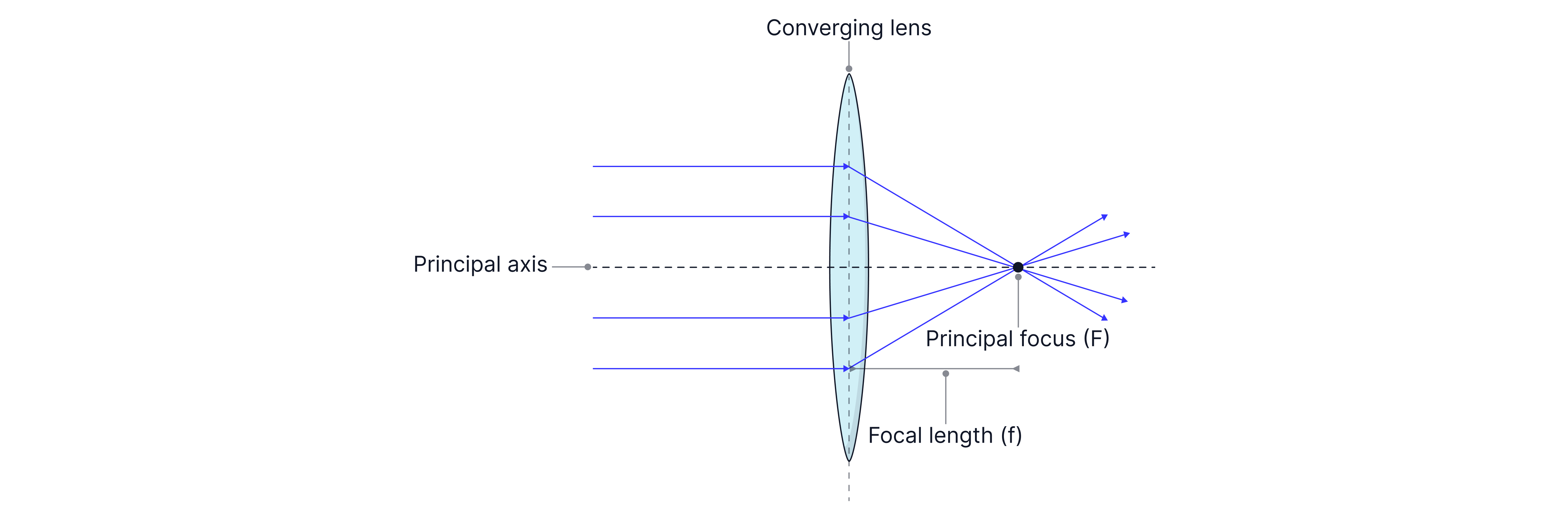
Convex lenses converge light rays, bringing them to a focus at the principal focus. Convex lenses are used to correct long-sightedness (hypermetropia), a condition in which nearby objects cannot be seen clearly. This is because the eye's lens does not converge the light rays sufficiently, causing the image to form behind the retina. A convex lens in glasses or contact lenses begins converging the light rays before they enter the eye, allowing the eye's lens to focus the image onto the retina.
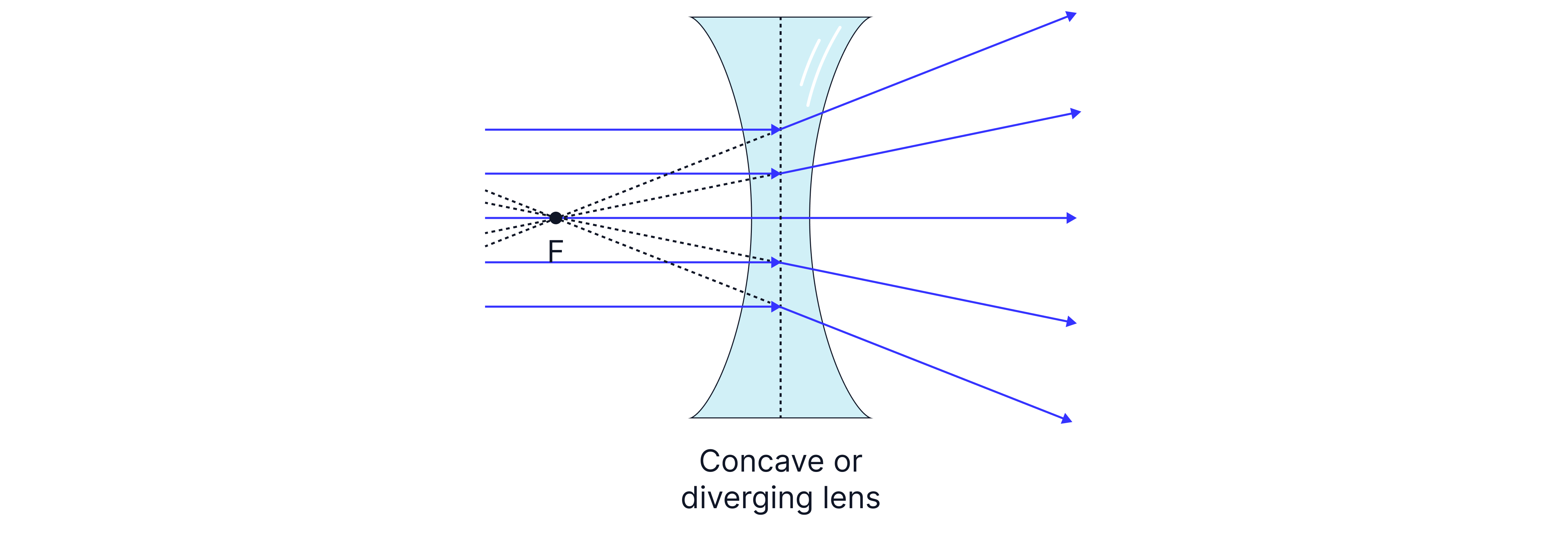
A concave (diverging) lens causes parallel rays of light to diverge. The point from which the rays appear to come from is the principal focus/focal point. Because light rays do not actually meet but appear to come from a point, the image formed is virtual and cannot be projected onto a screen. Diverging lenses are used to correct short-sightedness (myopia), a condition in which distant objects cannot be seen clearly because the eye's lens is too powerful or the eyeball is too long. As a result, parallel rays of light from distant objects are focused in front of the retina. A concave lens fitted in glasses diverges the light rays before they enter the eye, allowing the eye's lens to focus the image correctly onto the retina.
The power of a lens is measured in dioptres, D.
Formula:
A more powerful lens has a shorter focal point, so it can focus light closer to the lens. In the eye, a convex lens, the distance from the lens to the back of the eye is typically (sometimes referred to in exams as the diameter of the eye).
The power of a diverging lens is negative because the focal point lies on the opposite side of the eye.
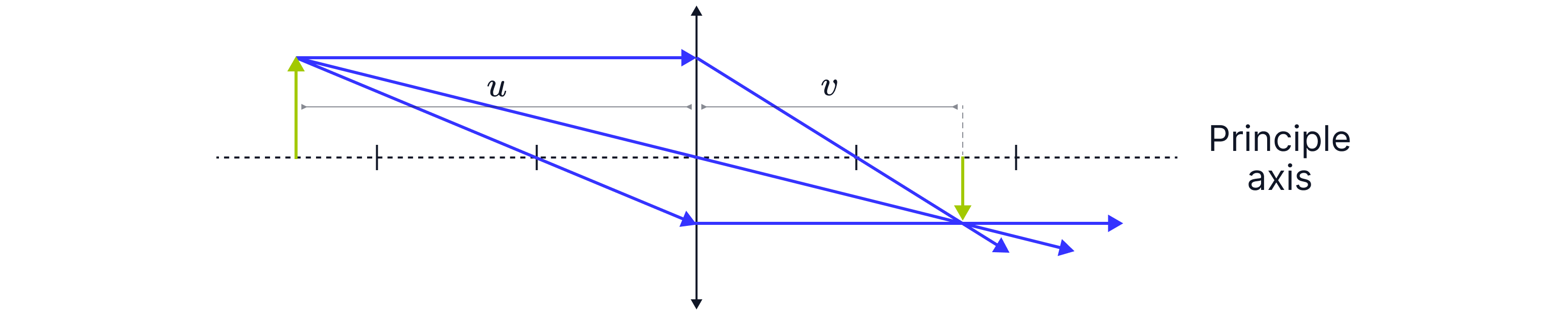
Reminder: You need to be able to draw ray diagrams for the different types of lenses in your exam. You were first taught this in GCSE. The rules to remember are shown below.  See GCSE page: https://myedspace.co.uk/myresources/gcse/physics/aqa/revision-notes/refraction-rp-lenses-triple-only
Magnification is the process of making an image appear larger than the actual object.
Formula:
Worked Example:
An object is positioned in front of a converging lens. The lens forms a virtual image from the lens.
Determine the power of the lens.
Determine the magnification produced by the lens.
Identify the vision defect that can be corrected using this lens.
Answer:
Long-sightedness
Worked Example:
A diverging lens has a focal length of , forming an image from the lens that is tall. What is the size of the object?
Answer:
To find the object height, we need to calculate the magnification of the lens using the equation, .
We then need to calculate , the object distance from the lens first.
Because it is a diverging lens, the image is formed on the same side of the lens as the object, therefore , which represents image distance is negative.
->
If the magnification is and the image is tall, the object must be,
Myopia, Hypermetropia and Astigmatism
There are three main defects of vision that you need to be aware of:
Myopia
Myopia, or short-sightedness, means you can only see objects that are close up. The eye cannot bring parallel light rays from distant objects into focus because the eye's lens is too powerful or the eyeball is too long. As a result, the light rays are focused in front of the retina. The far point (the furthest distance at which an object can be seen clearly) is less than infinity. Myopia is corrected using concave (diverging) lenses, which diverge the incoming parallel light rays before they enter the eye, allowing the eye's lens to focus the image onto the retina.

Parallel light rays from distant objects are diverged by the concave lens so that they appear to come from the person's far point. The focal length of the correcting lens is equal to the person's far point, but is assigned a negative value because the lens is diverging (the focal point is on the same side as the object).
For example, if a person's far point is
Focal length:
Power:
An alternative way to do this calculation is to note that, in correcting lenses, the object is always at the corrected point and is real, forming a virtual image at the uncorrected point.
Hypermetropia
Hypermetropia, or long-sightedness, means that you can see objects only when they are far away. Light rays from nearby objects cannot be focused onto the retina because the eye's lens is not powerful enough, or the eyeball is too short. As a result, the light rays are brought to a focus behind the retina. The near point (the closest distance at which an object can be seen clearly) is greater than . Hypermetropia is corrected using a convex (converging) lens, which begins converging the light rays from nearby objects before they enter the eye. This makes the rays appear to originate from an object farther away, allowing the eye's lens to focus the image onto the retina
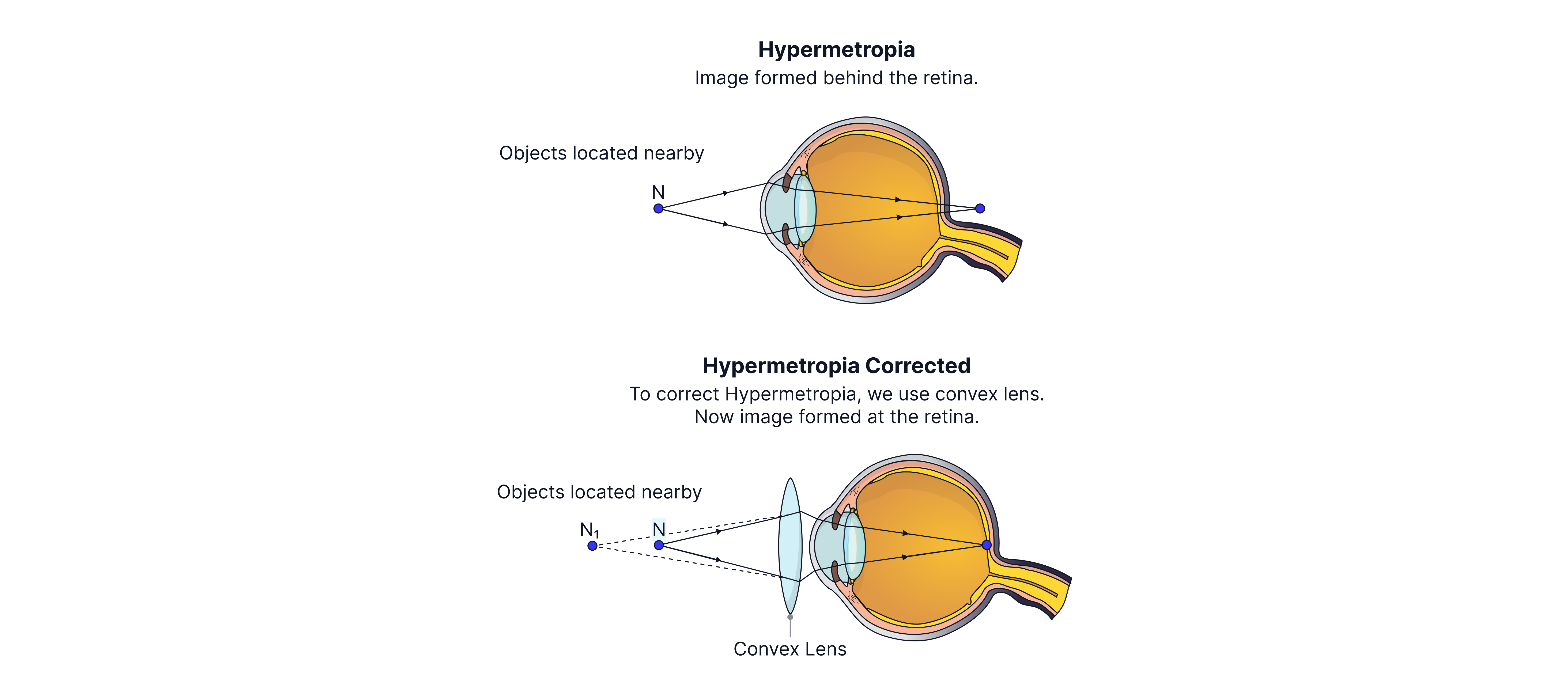
For nearby objects to be seen clearly, the image must be focused on the retina, which is approximately behind the eye's lens. A converging correcting lens causes the light rays from a nearby object to begin converging before they enter the eye, allowing the eye to focus the image on the retina. The combined power of the lens and the correcting lens must give a focal length of .
For example, suppose a person's near point is . To read comfortably at the normal viewing distance of , the correcting lens must form a virtual image of the object at the person's near point (). We can then calculate the power of the correcting lens using the lens equation.
An alternative way to do this calculation is to calculate the power of a healthy person's eye and this person's eye, and compare the difference. We know that for a healthy eye, the near point is and the diameter of the eye is ,
We now compare this with the person's eye power. Their lens can form an image on the retina at the back of the eye from an object away.
We can see that the person's eye needs to increase in power by . So, the power of the lens required to correct their vision is .
Astigmatism
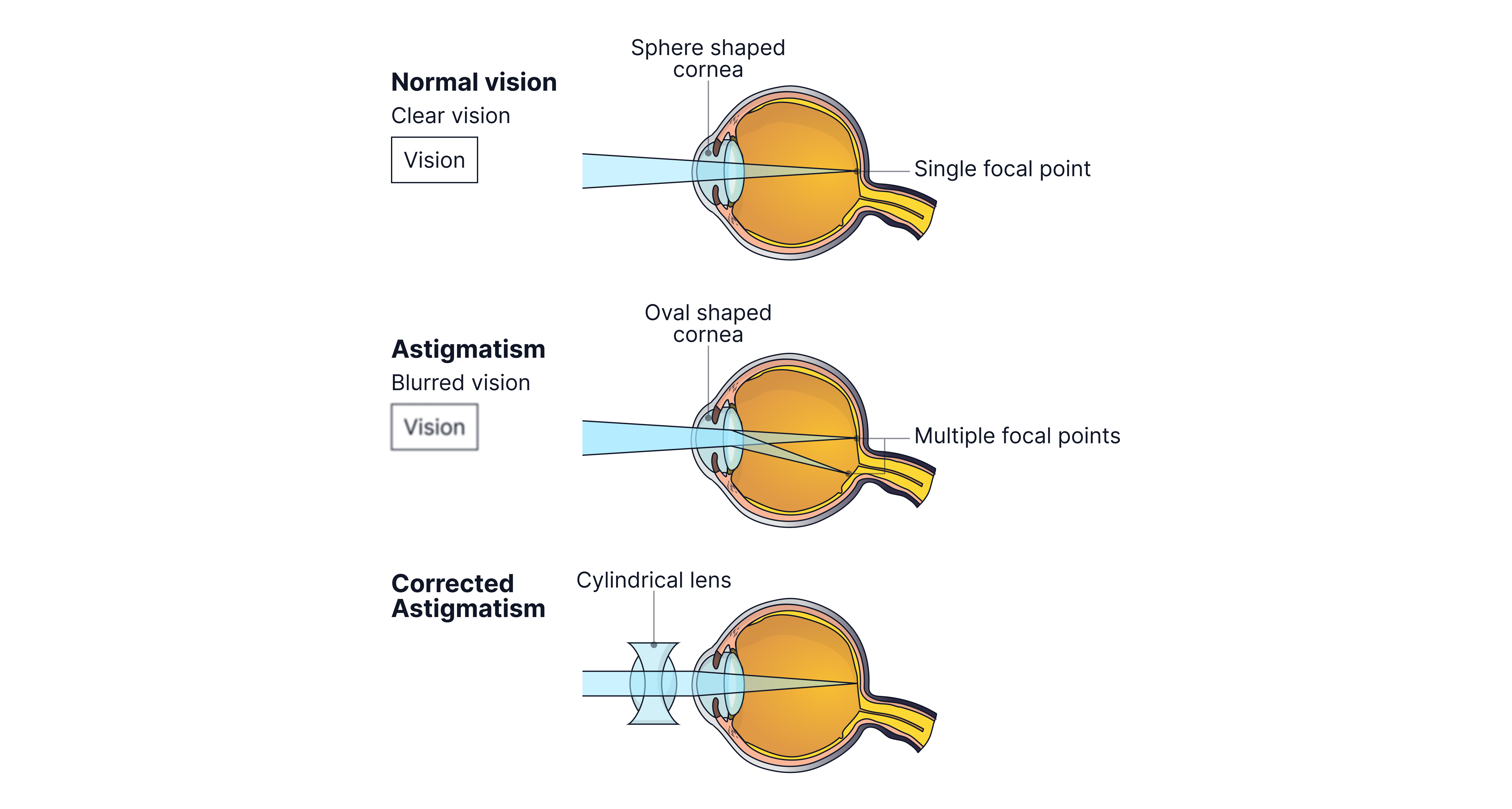
This occurs when the cornea is not spherical. Different parts of the cornea will have different curvatures and thus different powers. Instead of a single focal point, astigmatism causes light to be focused in one plane but not in the perpendicular () plane, resulting in blurred or distorted vision. This is corrected with cylindrical lenses, which provide different refractive powers in different directions to compensate for the cornea's uneven curvature.
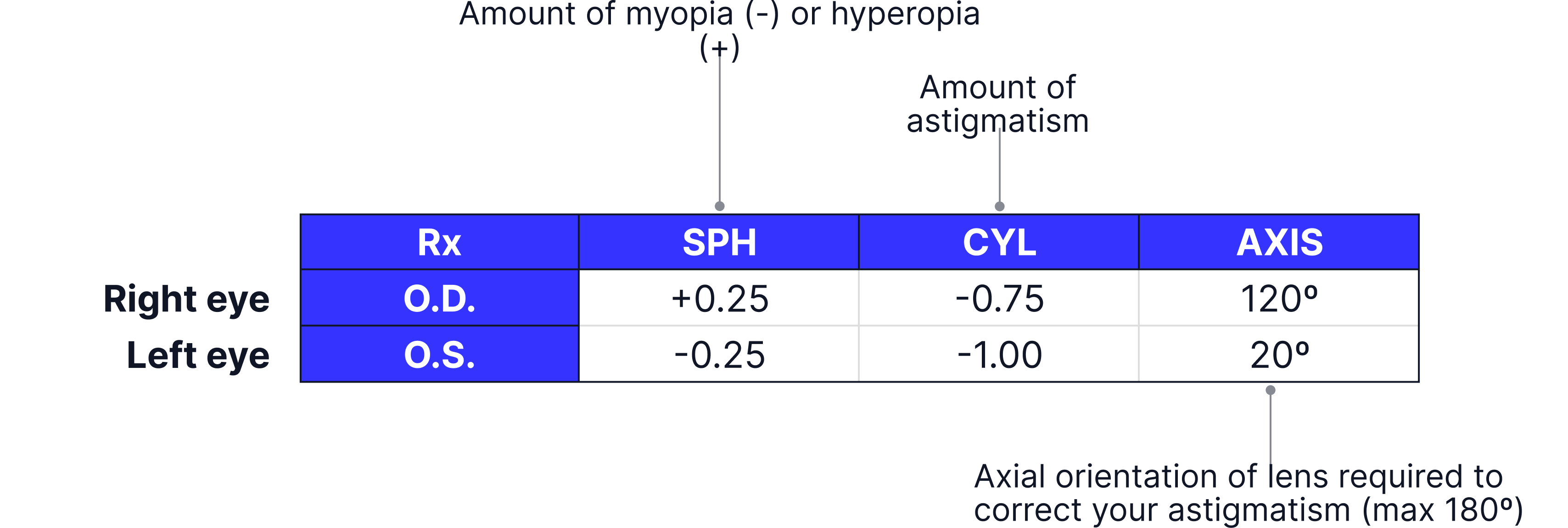
The prescription will include the spherical power required to correct myopia or hypermetropia, the cylindrical power required to correct astigmatism, and the axis angle of the lens (measured in degrees), which specifies the cylinder's orientation.
Worked Example:
Which would be a correct lens prescription for a person with hypermetropia and astigmatism?
Answer:
Prescriptions are written in order of spherical (myopia/hypermetropia), cylindrical power and axis of rotation.
The axes of rotation of and are aligned in exactly the same direction (horizontal). So rotating a cylindrical lens by gives the same effect, so angles beyond would just repeat and are therefore not used.
They have hypermetropia; they are long-sighted, which means they cannot see objects close up. The light rays need to be converged before they enter the eye, so a convex lens with positive power is used -> rows B or D.
The axis of rotation is always between, so option B is correct.
Worked Example:
A patient has been diagnosed with astigmatism.
Explain the cause of astigmatism, describe its effect on vision, and outline how it is corrected.
State two pieces of information required to manufacture lenses that correct astigmatism.
Answer:
Cause: non-spherical cornea. Effect: focus in one plane, out of focus in the plane at , blurred vision. Correction: cylindrical lens.
Power and axis of defect
Practice Questions
A human eye has a far point of .
State the name of this defect of vision and the correcting lens required.
An eye with astigmatism requires the following prescription:
Identify the meaning of each number.
-> Check out Brook's video explanation for more help.
Answer:
Far point should be at infinity; they can not see this far, so they are short-sighted -> myopia. They require a diverging lens.
Spherical power is negative, so they need a diverging lens; they are short-sighted. Cylinder power is the next number, and finally, the axis of rotation.
Car drivers must be able to read a speedometer at a distance of and a number plate at a distance of .
A driver has an unaided far point of and an unaided near point of .
An optician is considering using one of three different corrective lenses. Which of the following does the optician use?
-> Check out Brook's video explanation for more help.
Answer:
Option