Feynman Diagrams
Brook Edgar
Teacher

Contents
Explainer Video
Feynman Diagrams for Weak Nuclear Interactions
Feynman diagrams are pictorial representations of particle interactions, introduced by Richard Feynman to simplify complicated interactions.
To draw the Feynman diagram for beta-minus decay, we start by writing out the equation.

We know that the exchange particle involved in a weak nuclear interaction is the boson, either or . We use the Feynman diagram to determine which.
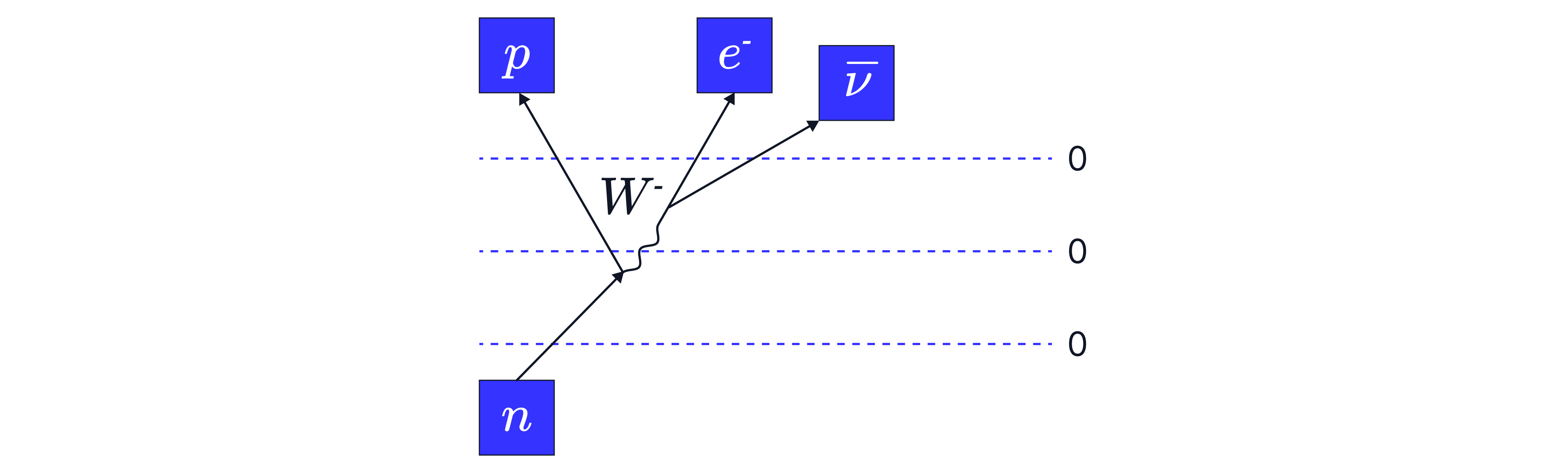
To draw the Feynman diagram above to determine the exchange particle involved:
Sketch the neutron coming in at an angle and coming back out after the interaction as a proton.
Draw the exchange particle at an exaggerated angle (if not drawn at an exaggerated angle, it is hard to determine the exchange particle involved in the decay). Exchange particles have momentum, so momentum is conserved in the interaction.
Sketch timestamps (dotted lines below) to determine the charge at different stages and ensure this is conserved. For example, on the bottom timestamp, the dashed line only crosses a neutron, which has zero charge, so the total charge of that stage is zero; therefore, the total charge of all other stages must also be zero.
Determine the charge of the exchange particle by passing a timestamp through the middle. For example, in this case, the total charge of the stage is zero. The dotted line passed through the line representing a proton and the exchange particle only. A proton has a positive charge, so in order to conserve charge, the exchange particle must have a negative charge.
Remember: A quick trick to determine the exchange particle in decay equations is that the charge of the boson matches the type of decay. Beta-minus decay has the exchange particle , whereas beta-positive decay has the exchange particle .
Feynman Diagrams for EM Interactions
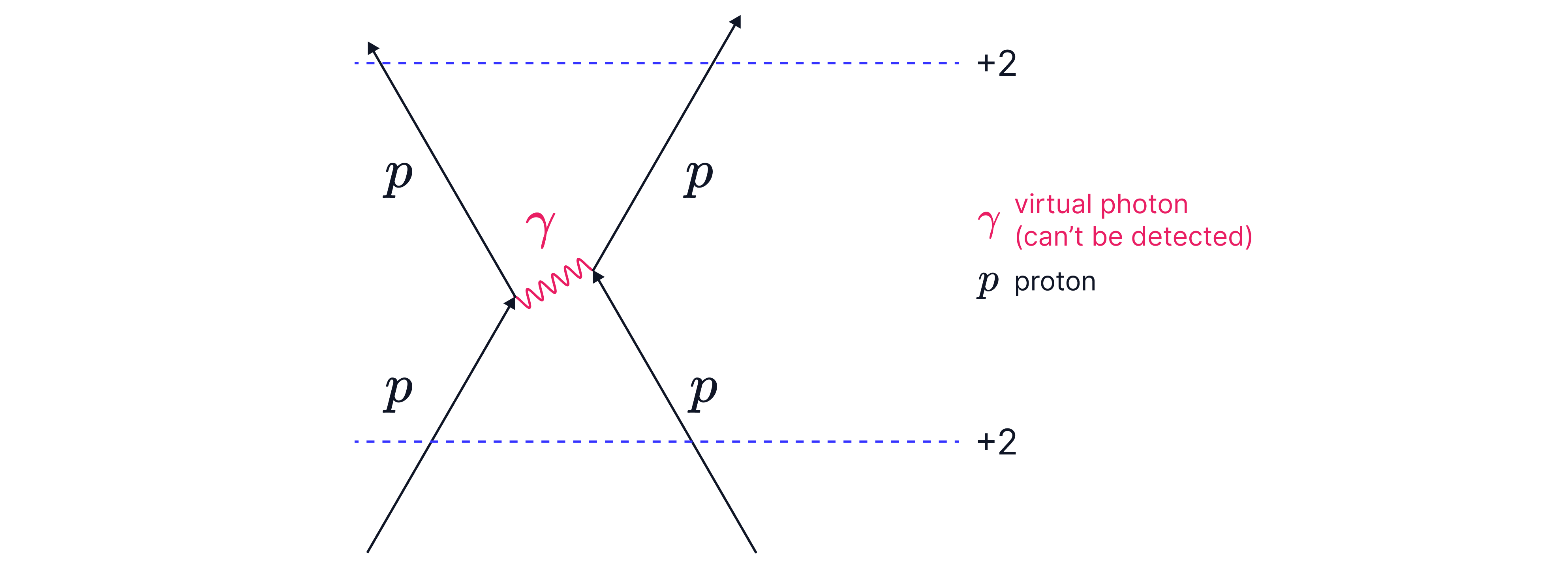
In the EM interactions, the exchange particle involved is a virtual photon. It is virtual because it can't be detected.
Here, the Feynman diagram represents the repulsion between two positively charged protons. Since both protons are present at the beginning, we need two arrows coming in at the start, each representing a proton. Remember to ensure that the exchange particle, responsible for the interaction, is drawn at an exaggerated angle between them.
Worked Example
Draw a Feynman diagram for electron capture.
Answer:
We start by drawing out the equation to determine all particles involved.
Here, both an electron and a proton are present to begin with, so we represent each with an arrow coming in at the start, with an exaggerated line between them representing the exchange particle responsible for the interaction.
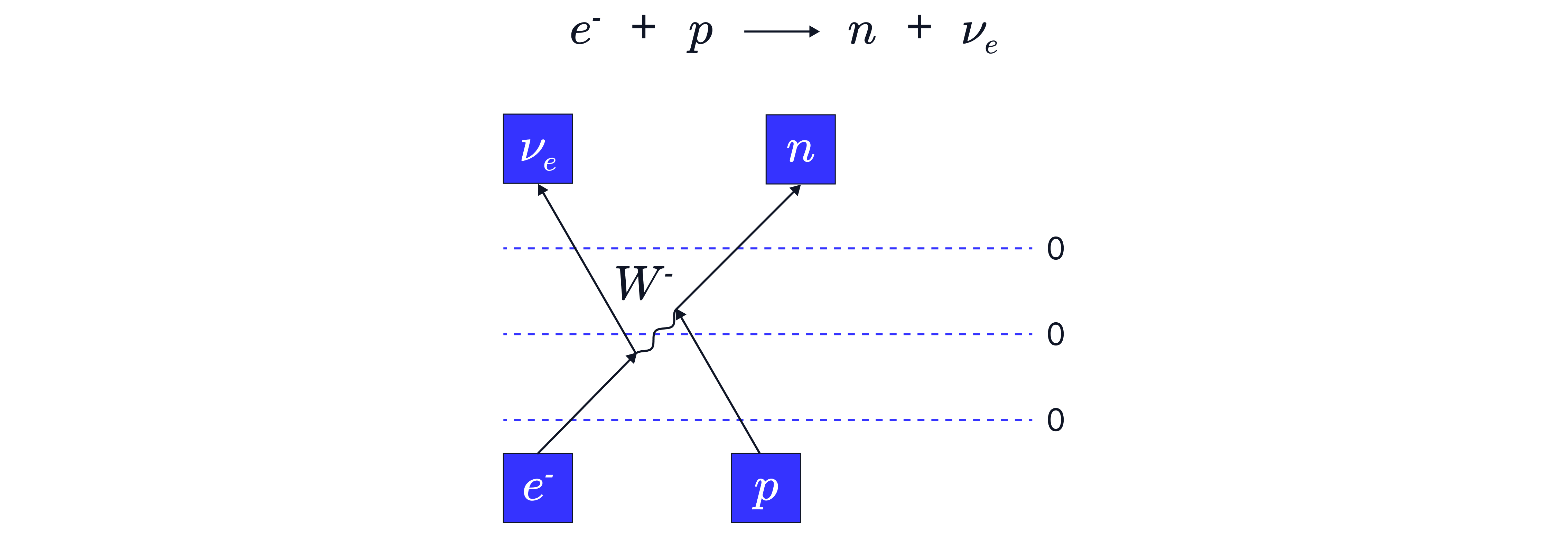
We can see from the first timestamp, which crosses an electron (negative charge) and a proton (positive charge), that the total charge at that stage is zero. We can check this by drawing a timestamp across the end to ensure that the total charge of each timestamp is zero.
To determine the charge of the boson responsible for this weak interaction, we sketch a timestamp through the exchange particle. We can see that it crossed the line representing the neutrino(zero charge) and the line representing the proton (positive charge). The boson must then have a negative charge so that the total charge at this stage is zero.
Practice Question
Sketch a Feynman diagram for a neutron and a neutrino interaction and state the exchange particle involved.
-> Check out Brook's video explanation for more help.
Answer:
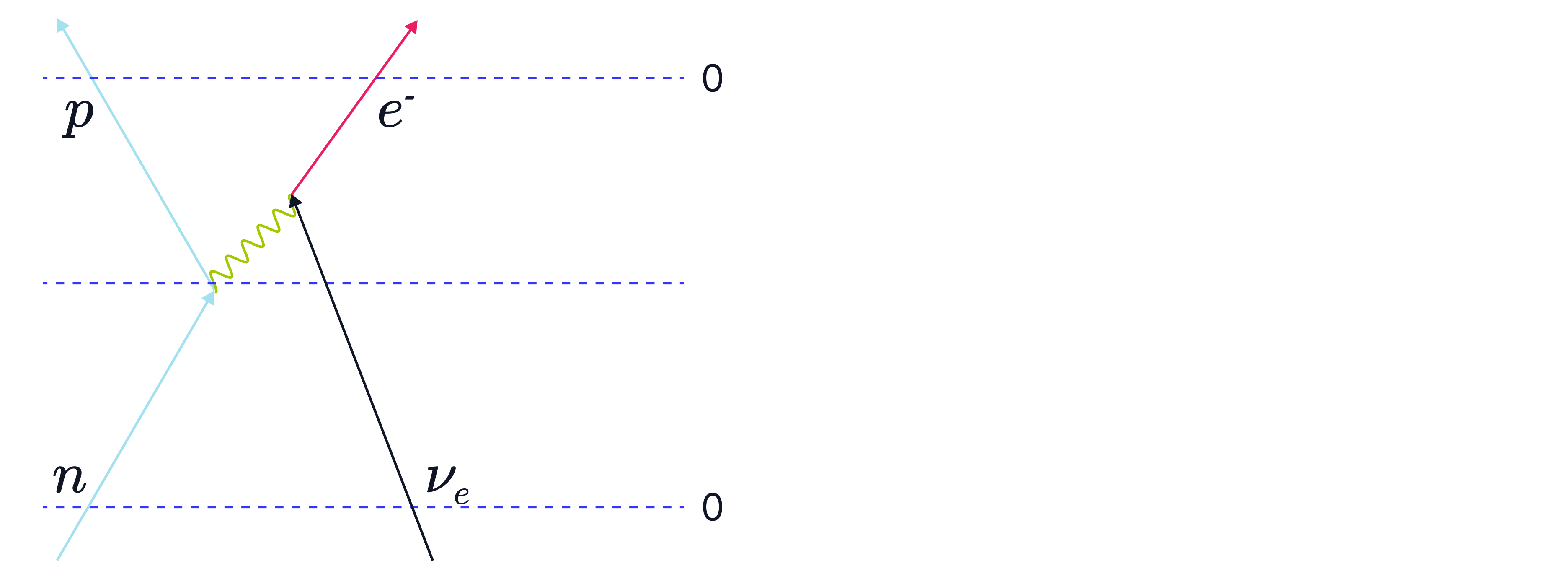
boson