Micrometers and Vernier Callipers
Brook Edgar
Teacher

Contents
Explainer Video
Micrometer
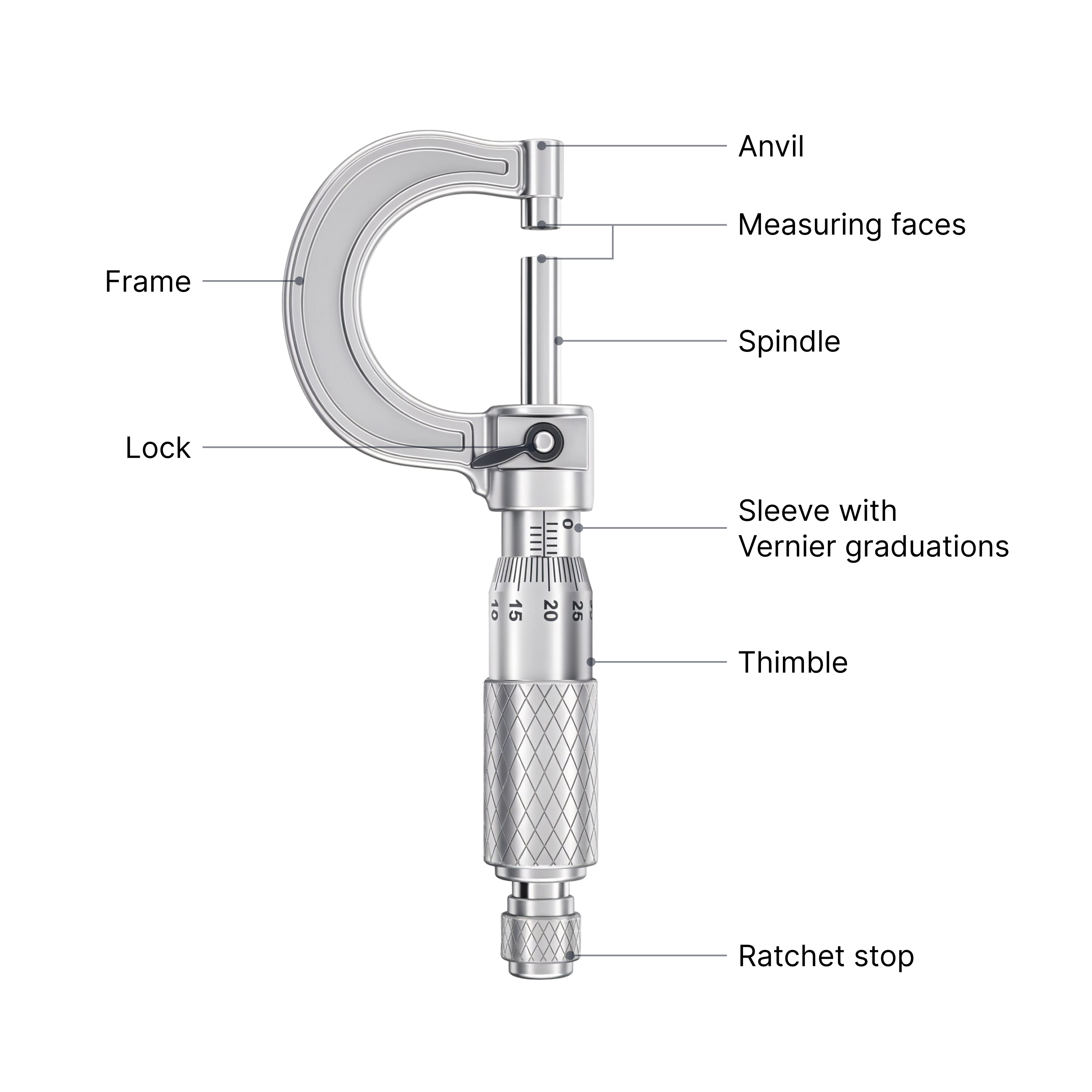
We use micrometers to measure things like slit separation in Young’s double slit experiment or the diameter of wires as they have a much better resolution than rulers. They can give us a much more precise reading.
When using one, you should always check for zero errors first, as these are very common with micrometres.
To take a reading, you close the spindle using the thimble first, and then the ratchet towards the end of the tightening process. The ratchet slows down the turning speed, giving you more control, so that you do not distort the wire being measured.
To measure the diameter of a wire, take readings at multiple locations and orientations, then calculate the mean diameter.
To take a reading on a micrometer we first look at the scale on the sleeve.
Here, we can see three and a half lines on the left hand side scale = .

The reading is but as we cannot see the fourth division on the sleeve.
We then use the scale at the side, looking for the number lined up with the scale line on the sleeve.
Here we can see it reads , so if the value is between and it must be .
How to read a micrometer
Vernier Calliper
We use vernier callipers to measure things like fringe spacing in Young’s double slit experiment as they have a better resolution than a ruler. They can also be used to measure the inner and outer diameters of hollow objects, such as tubes.
To read a vernier calliper, you first read where the zero on the bottom scale lines up with the top scale. This provides your rough measurement.
Here, the zero is between and , so the reading is bigger than but less than .

We then look at the bottom scale to find which line on the bottom scale aligns with one of the lines on the top scale.
Here we can see that the seven on the bottom scale lines up best with a line on the top scale. So, if the reading is between and it must be .
Worked Example
State the readings on the verniers below.
1)
2) 
Answer:
-> the 0 is between and , so, the reading is bigger than but less than , the four on the bottom scale lines up best with a line on the top scale.
-> the 0 is between and , so, the reading is bigger than but less than , the five on the bottom scale lines up best with a line on the top scale.
Practice Question
A student uses a digital vernier calliper to measure the diameter of a cylindrical metal rod.
The reading on the vernier when the rod is placed between the jaws of the calliper = . The reading when the jaws of the vernier are closed fully, when the rod is removed = .
Calculate the diameter of the rod and describe the relevant procedures to limit the effect of random errors.
-> Check out Brook's video explanation for more help.
Answer:
Diameter is
To reduce the effect of random error, repeat the recording by taking measurements at different locations and orientations along the rod and then calculate the mean.