Uncertainties
Brook Edgar
Teacher

Contents
Explainer Video
SI Base Units Revisited
There are seven SI base quantities that you need to know. First introduced in Topic .
-> Mass (), Temperature (), Length (), Current (), Amount of substance (), Time () and Luminous Intensity ().
All other units can be expressed in terms of their SI base units.
For example, to write the unit for emf in terms of its SI base units, we first need to find an equation that involves the term of interest -> and rearrange to make the subject ->.
Energy is measured in joules, which is not an SI base unit, and charge is measured in coulombs, which is also not an SI base unit. we need to use two more equations to easily express these two units in terms of their SI base units.
and
Substitute in units, as current is measured in amps, times in seconds, mass in kilograms and velocity in metres per second, all SI base units, we just need to simplify now.
Worked Example
Electric field strength, , is defined as force per unit charge on a positive test charge.
State the units for and express it in terms of its SI base units.
Answer:
Electric field strength = .
A newton and a coulomb are not SI units. we need to break the components of the equation down, using different equations to easily identify the SI base unit for newton, , and coulomb, .
Resolution and Uncertainties in Recorded Data
Resolution is the smallest change in quantity being measured. It is a measure of the equipment's sensitivity.
The resolution of a standard ruler is /. This means all readings are within . So if a value is recorded as , its actual value could be anywhere from . The resolution of the equipment tells you the absolute uncertainty of your measured value e.g. .
Worked Example
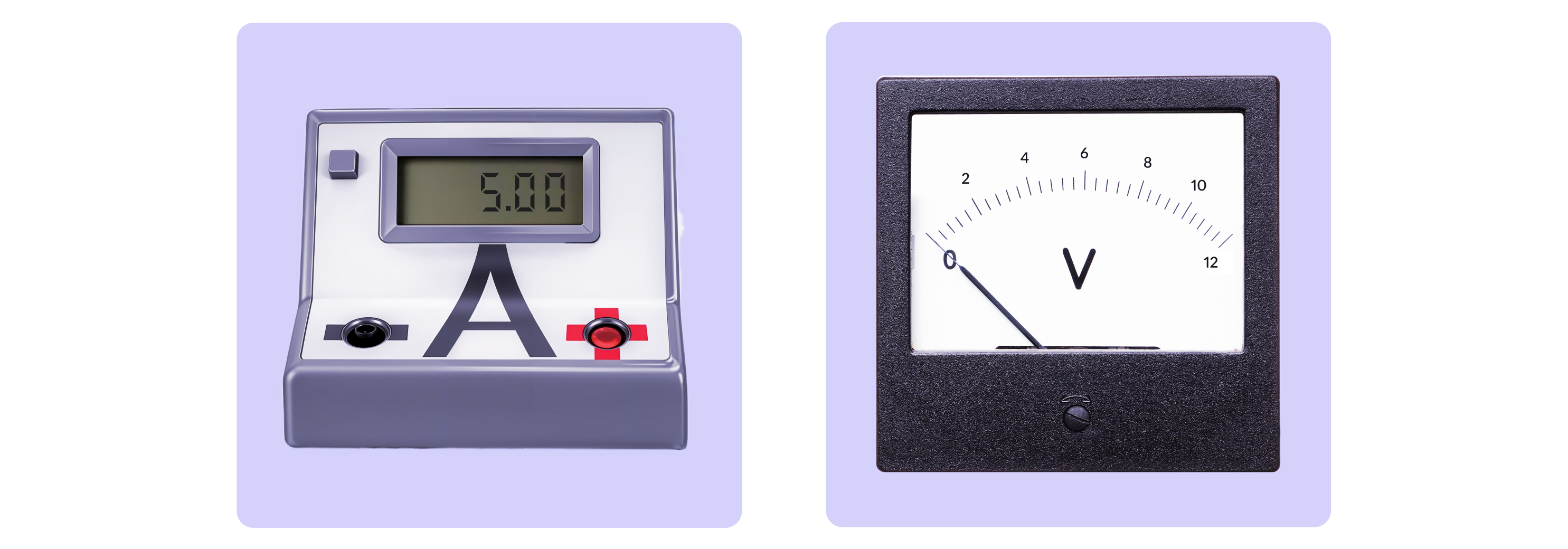
State the resolution of the ammeter and voltmeter shown.
Answer:
For the ammeter, the smallest decimal place is the resolution, the smallest change in quantity that can be recorded ->.
For the voltmeter, the smallest division on the scale is , is the resolution.
Remember: When recording potential difference with a voltmeter, the reading may fluctuate; therefore, when recording results, take multiple readings and calculate the mean.
When recording results, you need to ensure all recorded data is to the same number of decimal places, as this tells you about the resolution of the equipment used.
We always repeat measurements because it reduces the effect of random error –> we can spot anomalies (outliers) more easily and thus ignore them from our results when calculating the mean. When we repeat a measurement, the absolute uncertainty in the mean will no longer be due to the equipment's resolution but will instead equal half the range of the measured values. The uncertainty needs to have the same number of dp as the final answer.
For example, in the table below, we can see that the experiment was repeated four times, the resolution of the equipment is , but to calculate the absolute uncertainty in the results, we find half the range of the measured values.

All data is recorded to the absolute uncertainty,
To calculate the percentage uncertainty in our results, we use the equation, .
This shows that the larger the recorded value, the lower the percentage uncertainty. This is why we don’t time one oscillation but many, and why we wouldn't measure the thickness of just one piece of paper but many. The percentage uncertainty is usually quoted to two significant figures.
For example, using the data below, we want to calculate the absolute uncertainty and the percentage uncertainty in our results when determining the wire's diameter.

First, we notice that is an anomaly. We ignore this from our results.
Worked Example
Calculate the mean diameter of this wire and the uncertainty.

Answer:
Note the significant figures in the results table and ensure your answer is to the same number of sf.
, data in table recorded to answer is .
, which = to .
Calculating Uncertainties
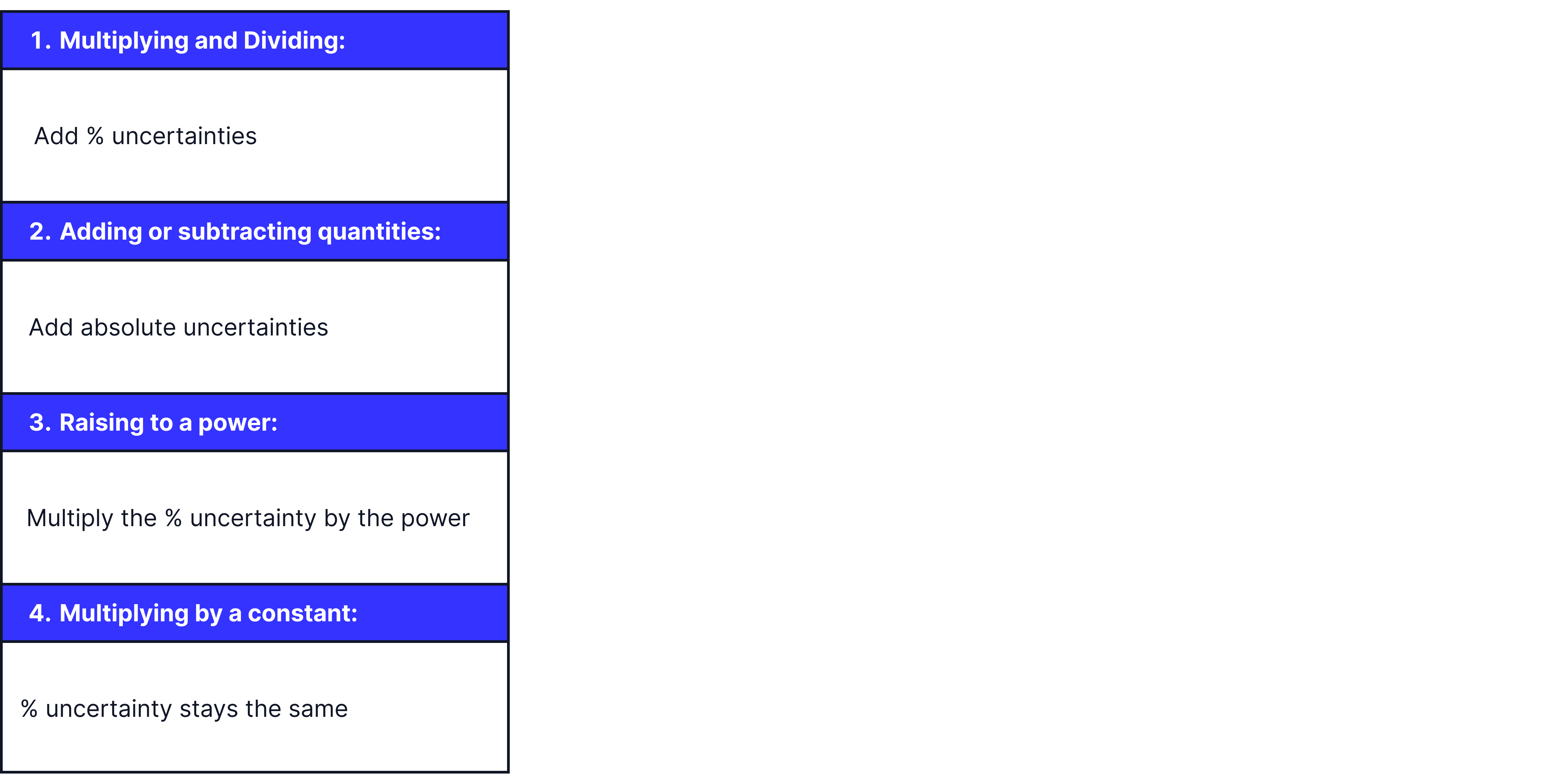
When calculating uncertainties, we use the rules below. You need to memorise these rules!
Examples:
To find , we first multiply the values to get, , quoted to the worst sf in the data (2 sf). To find the absolute uncertainty in , as we are multiplying, we need to calculate the percentage uncertainties for and and add them. We then work backwards to find the absolute uncertainty from knowing the percentage uncertainty and value.
% U in %
% U in %
% U in %
To find , we first square five, . To find the absolute uncertainty in , as we are multiplying by a power, we need to calculate the percentage uncertainty for and multiply by the power, two. We then work backwards to find the absolute uncertainty from knowing the percentage uncertainty and value.
% U in %
% U in = % U in %
Note: absolute uncertainty to have the same number of dp as the final value.
Worked Example
Calculate the uncertainty in the volume of the ball.

Answer:
To calculate the volume of a ball we use the equation, .
First calculate the value of the volume of the ball, .
Answer to 3 sf as the measured value is given to 3 sf.
To find the absolute uncertainty in the volume, we must first find the percentage uncertainty in volume first. We ignore the constants as these don't affect % uncertainty. As we are raising by a power, we need to calculate the percentage uncertainty for and multiply by the power, three. We then work backwards to find the absolute uncertainty from knowing the percentage uncertainty and value.
Absolute uncertainty in is the resolution of the equipment, which is .
% U in %
% U in
Volume =
The number of dp in the uncertainty matches the number of dp in the final value.
Worked Example
Calculate the mean, the absolute uncertainty and the percentage uncertainty from the data below:

Answer:
Remember: The final value needs to have the same number of sf as the worst sf data provided. The absolute uncertainty must have the same number of decimal places as the final answer.
Practice Questions
Student's results for the diameter of a ball: , ,
1. Name a suitable measuring instrument
2. Calculate the mean diameter and the absolute uncertainty
3. Calculate the density of the ball, mass =, and state the percentage uncertainty
Answer:
1. Vernier calliper
2. , uncertainty
3. ,
Calculate the final value and uncertainty of
Answer:
Calculate the mean and the percentage uncertainty of the following amplitude readings from a pendulum [3]:
Answer:
,