Unit Conversions And Orders Of Magnitude
Laura Armstrong & Joe Wolfensohn
Teachers


Topic Explainer Video
Check out this @JoeDoesGCSEBiology video that explains unit conversions and orders of magnitude, then read the study notes. Once you’ve gone through them, don’t forget to try the practice questions!
Unit Conversions and Order of Magnitude
Many questions in Biology require you to carry out unit conversions, this study note covers the most important ones!
Length Conversions:
Kilometres (km), Meters (m), Millimetres (mm), Micrometres (µm), and Nanometres (nm)
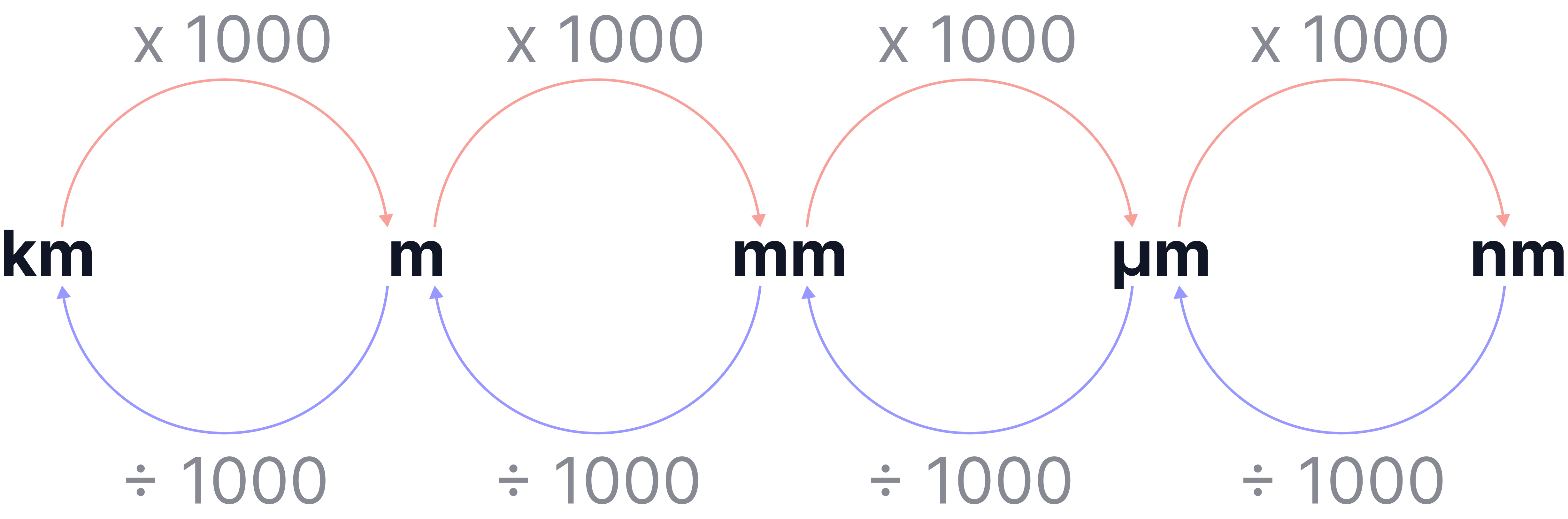
Each step up or down the scale represents a factor of 1000.
- 1 km = 1000 m
- 1 m = 1000 mm
- 1 mm = 1000 µm
- 1 µm = 1000 nm
Conversion Strategy:
- To convert to a smaller unit, multiply by 1000 for each step down.
- To convert to a larger unit, divide by 1000 for each step up.
Examples:
Convert 5 mm to µm
5 mm x 1000 = 5000 µm.
Convert 5000 µm to mm
5000 µm / 1000 = 5 mm.
Time Conversions:
Day, Hours, Minutes, and Seconds
- 1 day = 24 hours
- 1 hour = 60 minutes
- 1 minute = 60 seconds
- Therefore, 1 hour = 60 x 60 = 3600 seconds.
Conversion Strategy:
- To convert from hours to seconds, multiply by 60 and then 60 again, so multiply by 3600.
- To convert from seconds to hours, divide by 60 and then 60 again, so divide by 3600.
Examples:
Convert 2.5 minutes to seconds.
2.5 x 60 = 150 seconds.
Convert 1.75 hours to minutes.
1.75 x 60 = 105 minutes.
Convert 7 days into minutes.
7 x 24 = 168 hours x 60 = 10,080 minutes.
Mass conversions:
Kilograms (kg), grams (g), milligrams (mg), micrograms (µg) and nanograms (ng)
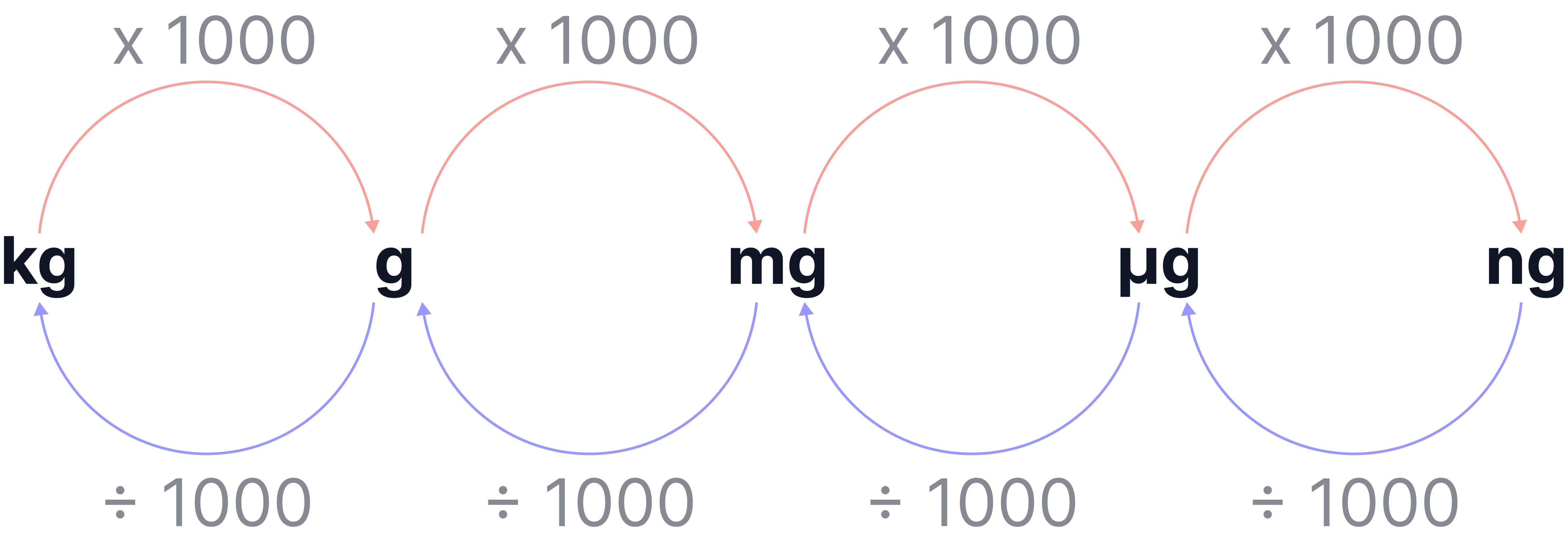
- 1 kg = 1000 g
- 1 g = 1000 mg
- 1 mg = 1000 µg
- 1 µg = 1000 ng
Conversion strategy:
- Bigger unit → smaller unit: multiply by 1000
- Smaller unit → bigger unit: divide by 1000
Examples:
Convert 0.5 g to mg
0.5 g x 1000 = 500 mg
Convert 250 mg to g
250 mg ÷ 1000 = 0.25 g
Convert 5 g to µg
5 g x1000 = 5000 mg x 1000 = 5,000,000 µg
Magnification:
When calculating magnification, ensure both image size and actual size are in the same unit before dividing.
- Units in Answers:
Always check if your answer needs to be in a specific unit (e.g., µm, mm). - Use common sense:
After converting, check if your answer is larger or smaller than the original value, as expected.
What are Orders of Magnitude?
- Used to estimate and compare very different sizes.
- Shows how many times bigger or smaller something is.
- Each order of magnitude is a 10x increase or decrease.
- 1 order of magnitude = x10, 2 orders = x100, 3 orders = x1000, and so on.
Example: Comparing Sizes
|
Structure |
Approximate Size |
|
Animal cell |
10 µm |
|
Bacterium |
1 µm |
|
Virus |
0.1 µm |
|
DNA molecule |
1 nm |
How to Compare
Step 1: Write both sizes in the same units.
Step 2: Work out how many times bigger one is than the other.
Step 3: Express it in powers of ten.
Example 1
Q: How many orders of magnitude bigger is a typical animal cell (10 µm) than a bacterium (1 µm)?
10 / 1 = 10 = 101
Answer: 1 order of magnitude bigger.
Example 2
Q: How many orders of magnitude bigger is an animal cell (10 µm) than a virus (0.1 µm)?
10 / 0.1 = 100 = 102
Answer: 2 orders of magnitude bigger.
Example 3
Q: How many orders of magnitude bigger is an animal cell (10 µm) than a DNA molecule (1 nm)?
First, convert units:
1 µm = 1000 nm
So, 10 µm x 1000 = 10,000 nm.
10,000 nm / 1 nm = 10,000
10,000 = 104
Answer: 4 orders of magnitude bigger.
No answer provided.
Practice Questions
Question 1: The diameter of a plant cell is 0.04mm. A chloroplast is about 4 µm wide. Estimate how many orders of magnitude bigger the cell is than the chloroplast. (2 marks)
Question 2: A cell has an image size of 50mm when magnified 800 times.
Calculate the real width of the cell. Give your answer in micrometres (µm). (3)
Model Answer 1:
Need to convert units first! 0.04 mm x 1000 = 40 µm
40 µm ÷ 4 µm = 10 → 10¹
Answer: 1 order of magnitude bigger
Model Answer 2:
Actual size = Image size / magnification
50 / 800 = 0.0625mm
0.0625 x 1000 = 62.5 µm
More Practice
Try to answer these practice questions from the TikTok videos on your own, then watch the videos to see how well you did!