Parallel Vectors and Collinearity
Neil Trivedi
Teacher

Contents
Parallel Vectors and Collinearity
Vectors really come into their own when we start using them to prove things about shapes. In this note, we'll pin down exactly what it means for two vectors to be parallel, and then use that idea to show that three points sit on a single straight line, a favourite of examiners. This goes by the name collinearity.
Parallel Vectors
First, here’s a reminder of what happens when we multiply a vector by an ordinary number (a scalar). Multiplying every component by the same number keeps the vector's direction but scales its length, and that is the whole story of parallel vectors.
Example 1:
Three parallel vectors are drawn on the grid below. Write vector and vector as multiples of vector
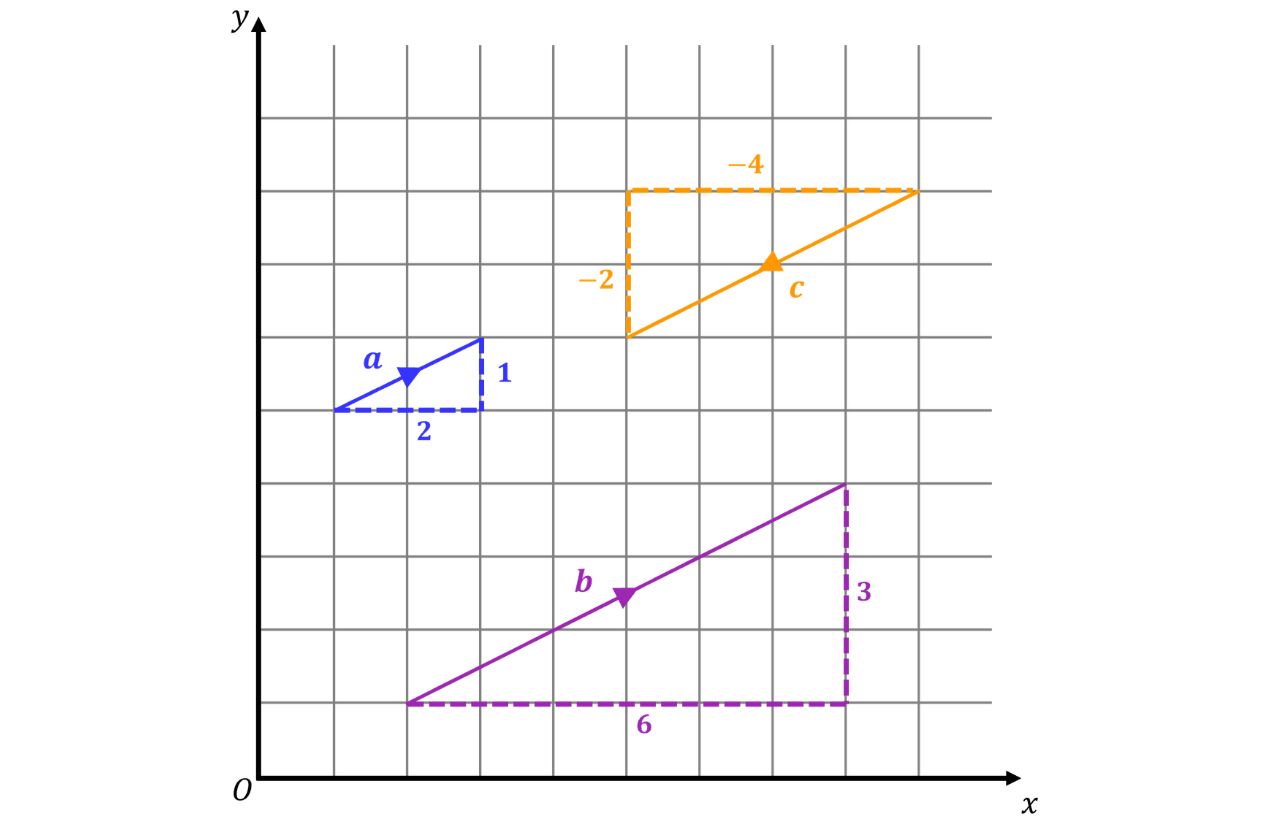
Step 1: Read each vector off the grid as a column vector — first across, and then up.
Step 2: Compare with
Each component of has been multiplied by
Step 3: Compare with
This time, each component of has been multiplied by
Reminder: a negative multiple flips the direction. On the grid you can see vector pointing the opposite way to vector but all three arrows are still parallel.
Parallel Vectors
Two vectors are parallel when one is a scalar multiple of the other:
where and are parallel vectors and is the scalar multiple.
If then and point in the same direction.
If then and point in opposite directions.
Vectors written in terms of letters follow the same rule, so the only job is to spot the multiplier.
Example 2:
Decide whether each pair of vectors is parallel. If they are, state the scale factor.
a) and
Single Step: Identify if one vector is a scalar multiple of the other.
Therefore, the two vectors are parallel with a scalar multiple of
b) and
Single Step: Identify if one vector is a scalar multiple of the other.
The coefficient of has doubled from to whereas the coefficient of hasn’t changed.
Therefore, the vectors are not parallel.
c) and
Single Step: Identify if one vector is a scalar multiple of the other.
We want to see whether the second vector can be written as a multiple of the first vector.
Therefore, the two vectors are parallel with a scalar multiple of
Showing Two Vectors are Parallel
Exam questions rarely give us the vectors directly; we usually have to build them from a diagram first.
The good news is that the plan is always the same.
The Four-Step Plan
Write each vector as a journey in terms of and
Simplify by collecting the and the
Factorise.
If one vector is the other, where is a scalar, they are parallel.
Example 3:
In triangle and The point lies on with
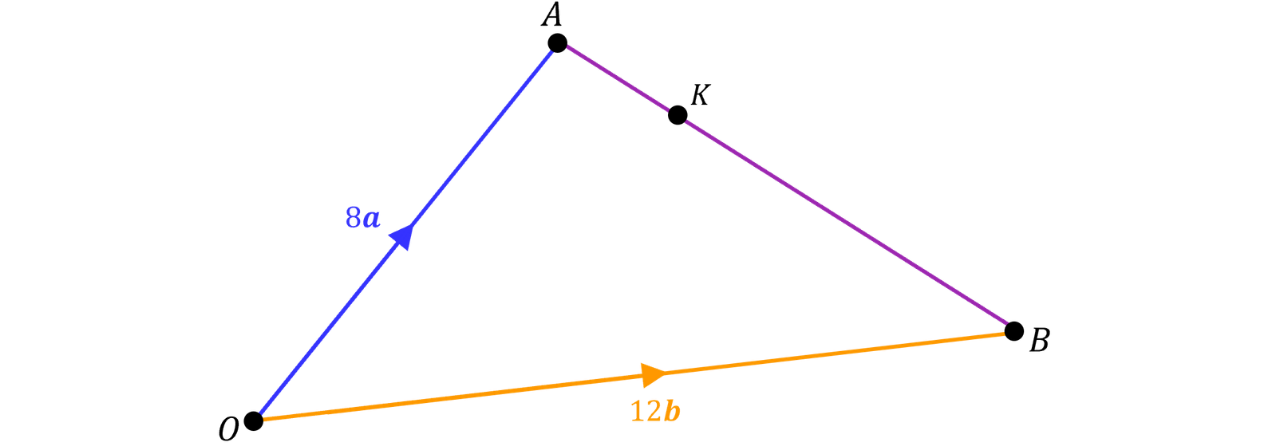
a) Find in terms of and
Single Step: We take the route
The first leg is the reverse of so it picks up a minus sign.
or
b) Show that is parallel to
Step 1: We take the route
Step 2: Find
We turn the ratio into a fraction. The parts total has reached of them, so
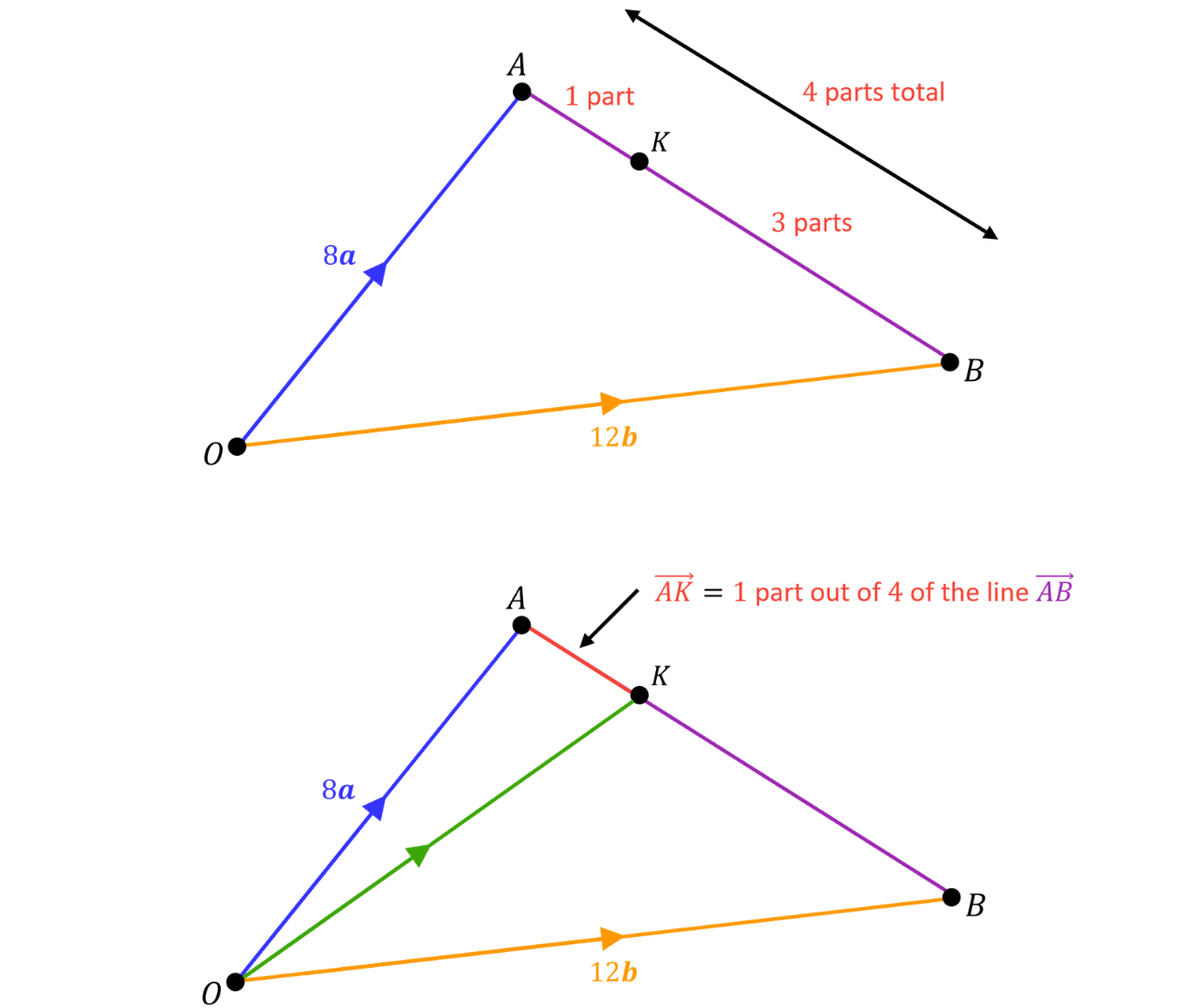
Step 3: Find
Step 4: Re-write as a multiple of by factorising.
Since is a scalar multiple of it is parallel to
Collinearity
Collinear is just maths-speak for “lying on the same straight line”. Any two points are automatically collinear as you can always join two dots with a line. The interesting question is whether a third point lands on that same line.
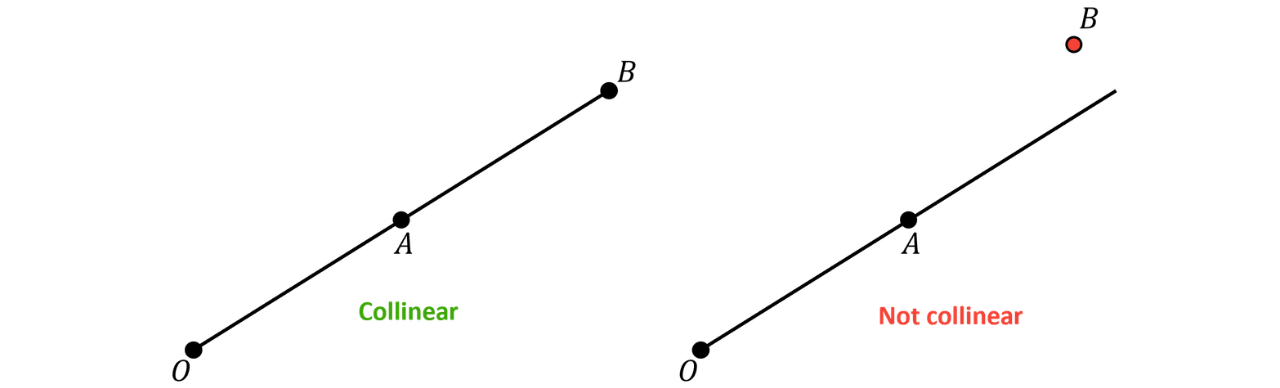
Collinear Points
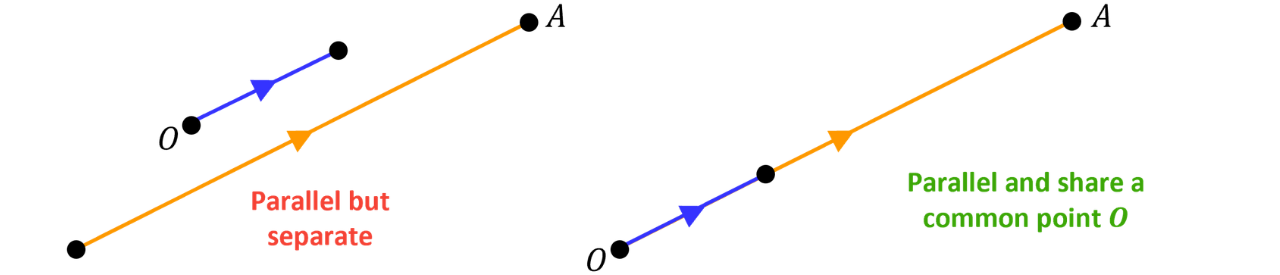
To prove that three points and B lie on one straight line, show both of these:
Show two of the joining vectors are parallel e.g.
State that the two vectors share a common point (following our first point that point would be
Showing that two vectors are parallel on its own isn't enough, the shared point is the glue that puts both vectors on the same line.
Example 4:
is a triangle with and is the midpoint of The point lies on extended so that and lies on with Prove that and are collinear.
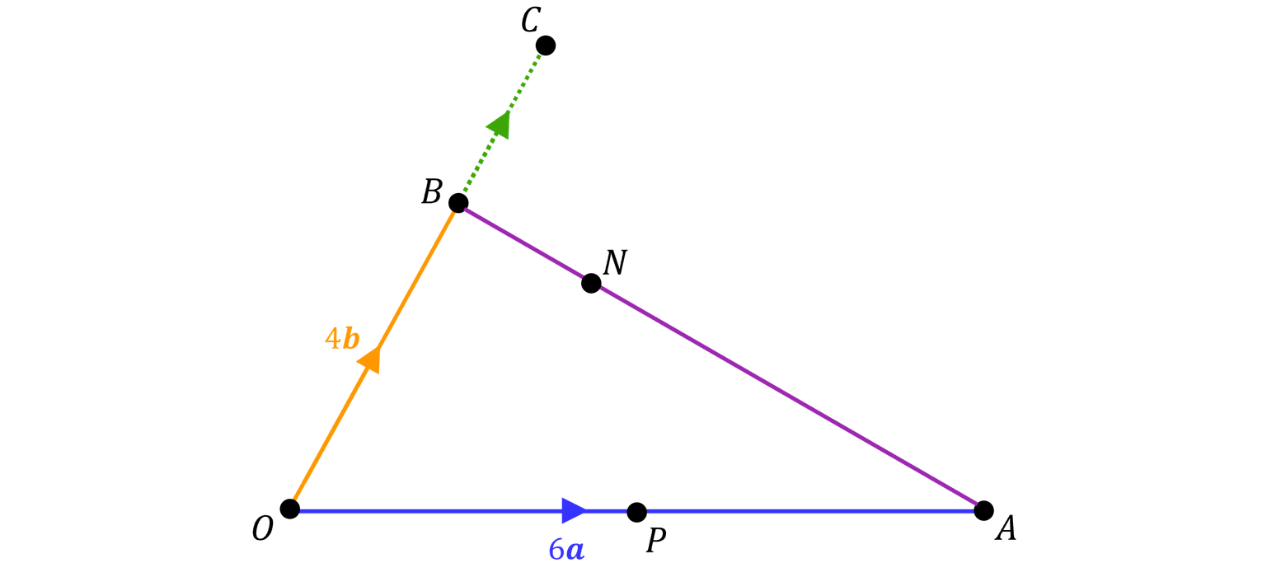
Step 1: Starting with the definition of collinearity, decide which vectors need to be found.
To prove that and are collinear, we need to show that two vectors, with a common point, are parallel to each other.
It is common for some students to choose the vectors and However, these are not the most efficient choices since is the easiest vector to find out of the three. In general, we pick one of our vectors to be the vector that connects the endpoints which, in this case, are and
In this example, we will show that the vectors and are parallel to each other.
Step 2: To find we need to find the missing vector
The question states that which means that is twice the length of
Therefore, if and it is twice the length of then
Step 3: To find we need to find the missing vector
The question states that which means that is of the vector it sits on, which is
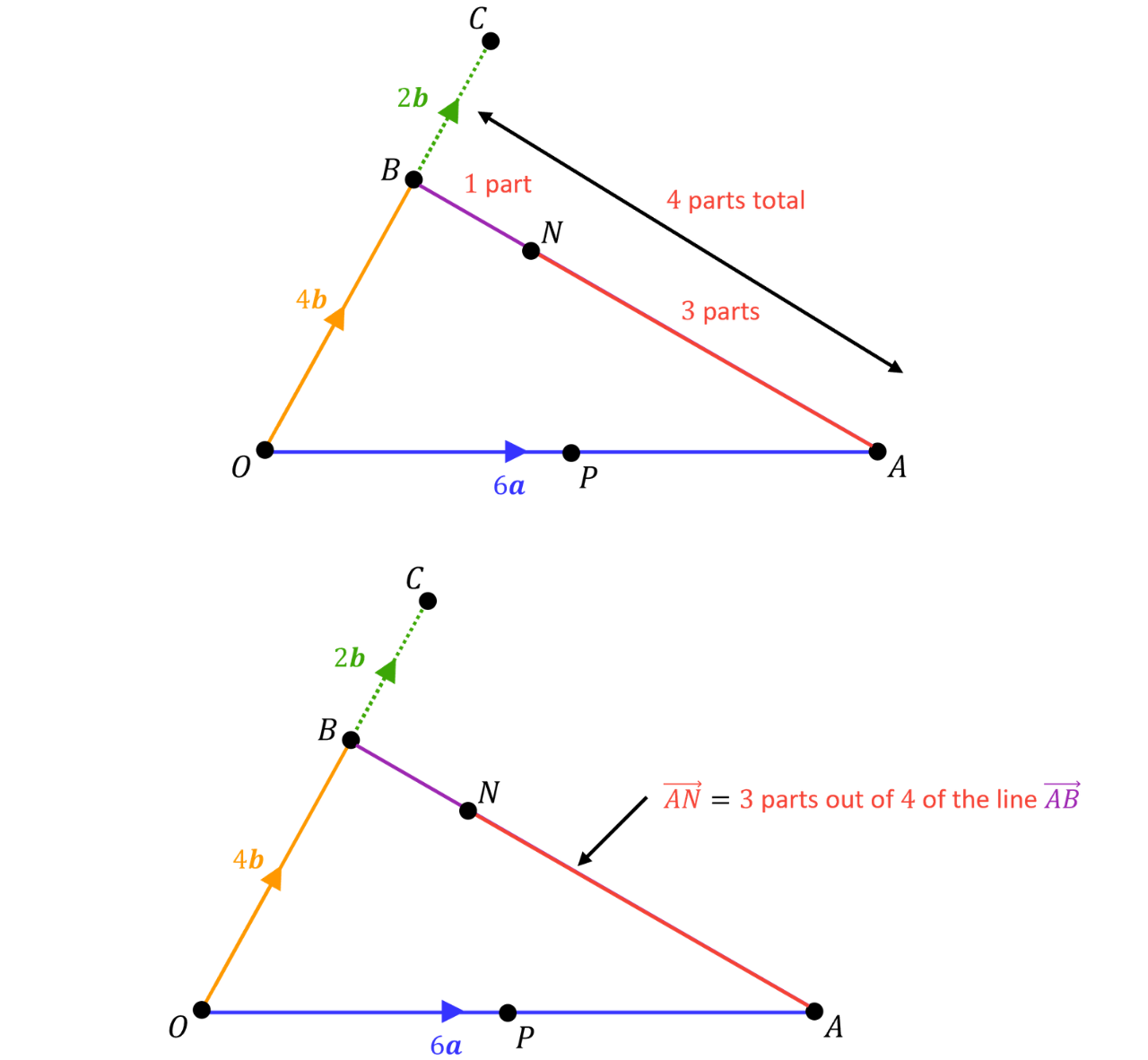
Since we must first find the vector
or
Now, we can find
Expanding the bracket,
Step 4: Find and
For the route we will take is
Remember that is the midpoint of so
Hence, because it points in the opposite direction.
or
For the route we will take is
In the same way that as is the midpoint, the vector
or
Step 5: Show that both and are parallel by showing that they are multiples of the same vector or that they are scalar multiples of each other by factorising.
There are two ways we can state that the vectors are parallel.
Both and are multiples of and are, therefore, parallel.
which means that they are scalar multiples of each other and are, therefore, parallel.
Step 6: Write the final conclusion.
and are parallel to each other and share a common point therefore, and are collinear.
Challenging Questions