Vectors and Unknown Ratios
Neil Trivedi
Teacher

Contents
Vectors and Unknown Ratios
This note picks up exactly where Collinearity and Vectors left off. In that note, we finished by proving that three points sit on one straight line. Examiners love to run that logic in reverse, where they tell us that the points are in a straight line and ask us to work out an unknown, which will either be a missing number inside a vector, an unknown position along a line, or a mystery ratio like In this note, we'll build a reliable routine for all three, using nothing more than parallel vectors and some careful coefficient- comparing.
Two Facts That Do All the Work
Every question in this topic leans on the same two ideas, so let’s put them up front where we can see them.
The Straight-Line Fact
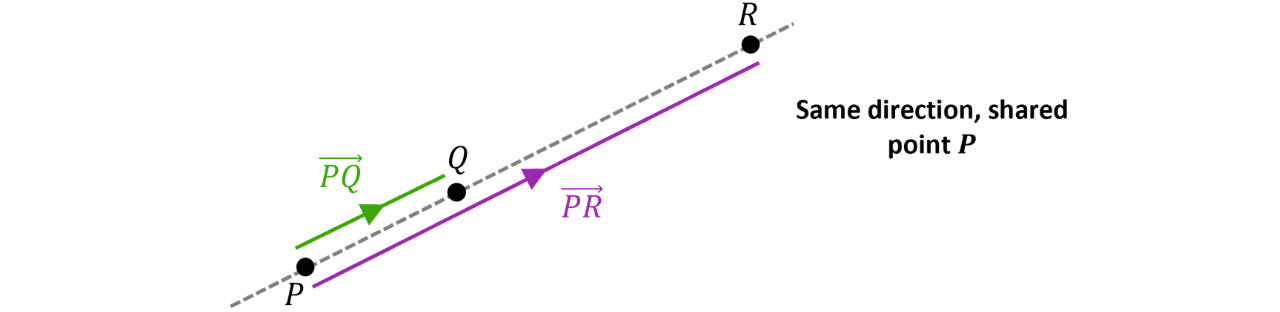
If three points and lie on a straight line, then any two vectors joining them are parallel.
For example, for some number
They point in the same direction and share the point and parallel vectors through a shared point make one straight line.
Comparing Coefficients
If the vector is parallel to the vector (and are not parallel to each other), then:
The first vector is lots of the second: and
Dividing one equation by the other removes and leaves
That leaves one tidy equation with no in sight.
Let’s warm up with the friendliest version of the topic: no shapes yet, just vectors with a number missing.
Example 1:
Find the value of the unknown in each case.
a) The vectors and are parallel. Find the value of
Step 1: Parallel means that one vector is a scalar multiple of the other (whole number or fraction).
Expanding the brackets on the right-hand side,
Step 2: Compare the coefficients to work out
Step 3: Compare the coefficients.
Substituting
Check: the same vector, scaled by
b) Points and have position vectors and Given that and lie on a straight line, find the value of
Step 1: The line passes through so must be a multiple of
Expanding the brackets on the right-hand side,
Step 2: Compare the coefficients.
Step 3: Compare the coefficients.
Unknown Positions on a Straight Line
Now for the classic setup: a point sits somewhere along a line inside a shape, its position is controlled by an unknown multiplier and we are told that three points make a straight line. Our job is to work out The routine never changes:
The Five-Step Plan
Mark everything on the diagram, including the unknown.
Pick the two vectors that share a point on the straight line.
Write each of them in terms of and
Straight line parallel compare coefficients.
Solve, then sanity-check the answer against the diagram.
Example 2:
is a triangle with and is the midpoint of and is the midpoint of The point lies on so that Given that is a straight line, find the value of
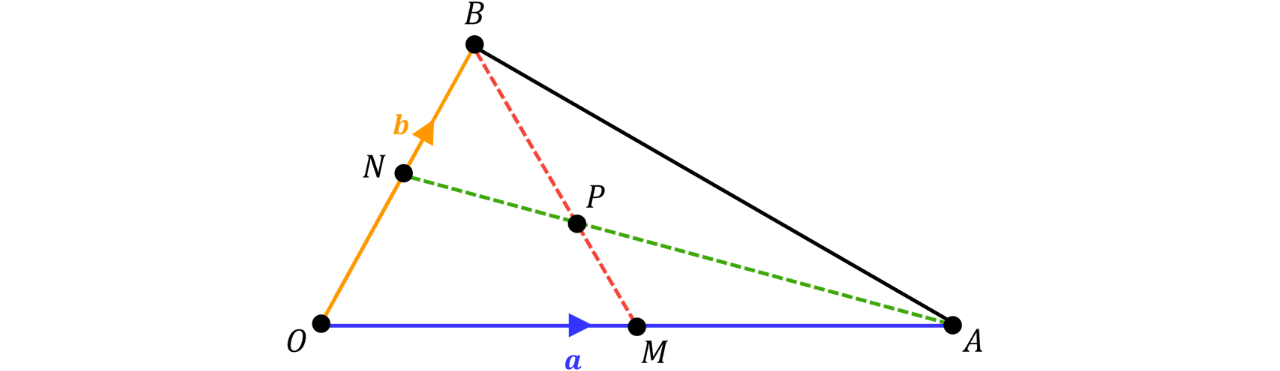
Step 1: Write both midpoints (halfway) in terms of and
and
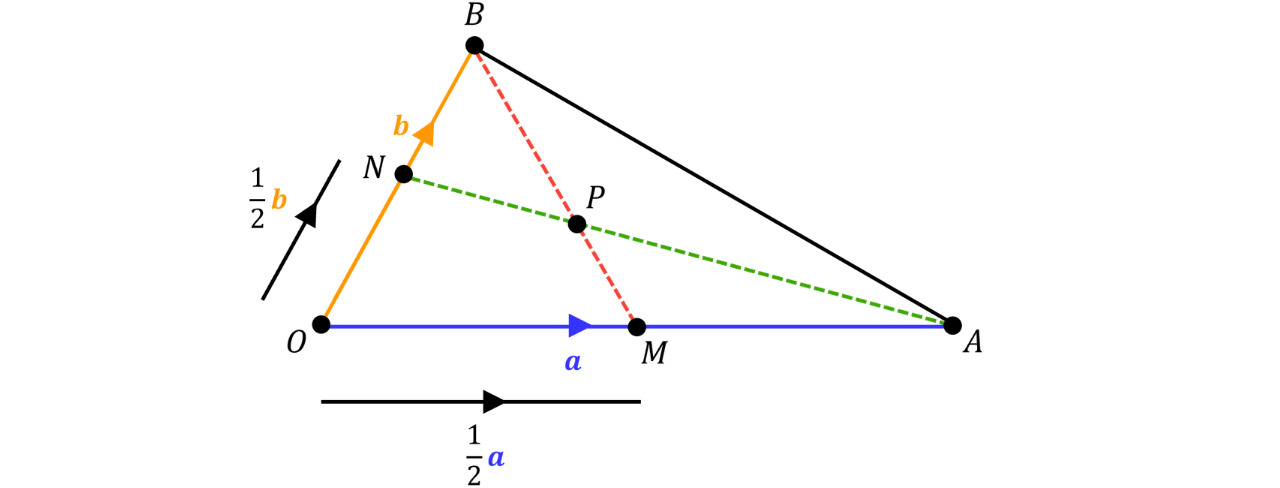
Step 2: The question states that so let’s find by first finding
or
Now, we find
Expanding the brackets on the right-hand side,
Step 3: is a straight line, so and are parallel and they share the point
is, by far, the easier vector to find:
To find using vectors already on our diagram, we have to move anti-clockwise around our triangle.
Notice there are multiple and terms in We factorise the common vectors so that we can write the vector where and appear once.
Step 4: Parallel vectors have proportional coefficients, so write the coefficients of and as fractions of each other and then solve.
From the second yellow box at the beginning of our note:
If the vector is parallel to the vector then
which, in English, says: Dividing the coefficients of is equal to dividing the coefficients of provided the order of division is kept the same.
In our case:
Let’s divide the coefficients of by the coefficients of so that we keep the unknown, , in the numerator.

Now, we can solve for
For the first fraction, we can divide each term by and for the second fraction, we can multiply the numerator and denominator by to get rid of the in the denominator.
Expanding the brackets on the right-hand side,
Now, we can solve for by adding to both sides and subtracting from both sides.

Multiplying both sides by
Note: is no accident. and are both medians, so is the centroid, and the medians of any triangle cross two-thirds of the way along each one, measured from the vertex.
When the Ratio Itself Is Unknown
Sometimes, the unknown is not a multiplier at all, it is the ratio itself, usually presented as The tool we need is the “dividing a line” fact from Vector Basics and Ratios, with on board now.
Dividing a Line in the Ratio
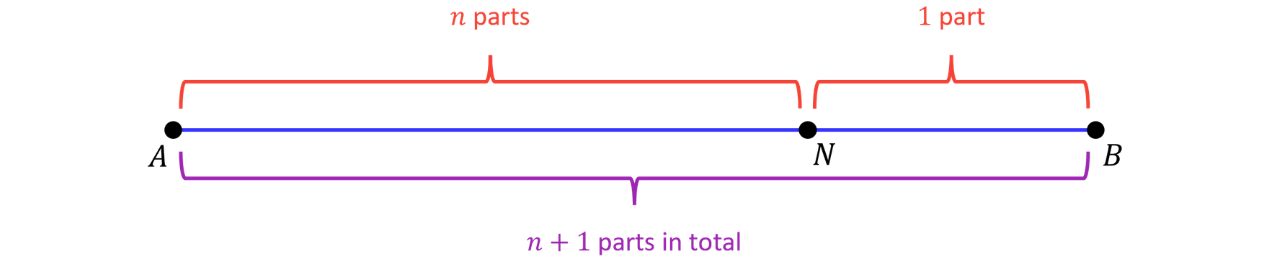
If lies on with then makes up parts of the total parts along
Example 3:
is a parallelogram with and lies on with and lies on the diagonal with Given that is a straight line, find the value of
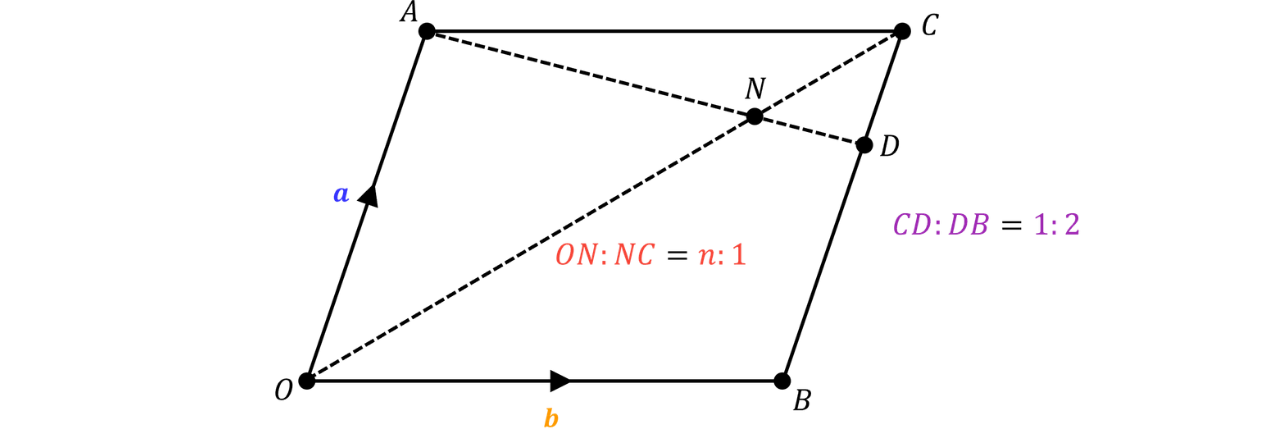
Step 1: The question tells us that is a straight line, so and are parallel and they share the point So, find those two vectors.
1) The vector is the easier vector to find as and are the endpoints of
The vector is parallel and of equal length to
The question tells us so is part out of a total of of the line it sits on,
The vector is parallel and of equal length to but it points in the opposite direction.
Now, we can write down
or
2) The vector is tougher to find as we must use the unknown ratio.
The question tells us that so is parts out of a total of of the line it sits on,
We don’t have the vector yet, so let’s find that first.
Now, we can find in terms of
Expanding the coefficient into the bracket,
Now, we can find
Like Example 2, notice that there are two coefficients of So, we factorise it out.
Even though this is with and appearing once, unfortunately, the coefficient of looks horrible. We should bring everything to one fraction by finding a common denominator. In this case that is For more practice on this, see our Simplifying Algebraic Fractions note.
Firstly, we can rewrite as Then, we multiply the numerator and denominator of that fraction by so that we both fractions have the same denominator.
Now that the denominators are the same, we can combine the fractions.
Expanding the brackets on the numerator and cancelling the
Now, let’s write a simpler version of
Step 2: Parallel vectors have proportional coefficients, so write the coefficients of and as fractions of each other and then solve.
From the second yellow box at the beginning of our note:
If the vector is parallel to the vector then:
which, in English, says: Dividing the coefficients of is equal to dividing the coefficients of provided the order of division is kept the same.
In our case:
Let’s divide the coefficients of by the coefficients of so that we are not dividing by an unknown fraction.

For The first fraction, we can multiply top and bottom by to get rid of the in the denominator. The second fraction is being divided by so, we can ignore it.
Multiplying in the it just multiplies with in the numerator to give
Since both denominators are equal, it must mean that the numerators are equal. Or, you can think of it like you are multiplying both sides by to clear the fractions. In either case, we are left with our final answer, which is
Challenging Questions