Vector Basics and Ratio
Neil Trivedi
Teacher

Contents
Vector Basics and Ratio
Vectors is one of those topics that look intimidating at first, but once you see what they really are, everything clicks. In this note, we will build up from the very basics: what a vector is, how we write it down, and how we add vectors together. Then, we'll use those ideas to solve the kind of geometry and ratio problems that show up in every GCSE paper. We'll work through everything together, step by step, so don't worry if it feels new right now.
What is a Vector?
So far, in your maths, coordinates have told you where a point is, a fixed position on a grid, like A vector is different: it describes a movement from one place to another. A vector has two things involved in it:
a direction (which way you go)
a magnitude (how far you go)
It doesn’t matter where you start; the same vector can be drawn anywhere on the grid.
We usually write a vector in column form. The top number tells us how far we move across (right is positive, left is negative), and the bottom number tells us how far we move up or down (up is positive, down is negative).
Column Vectors
A column vector written
means: move across, then up.
A positive top number is right; negative is left.
A positive bottom number is up; negative is down.
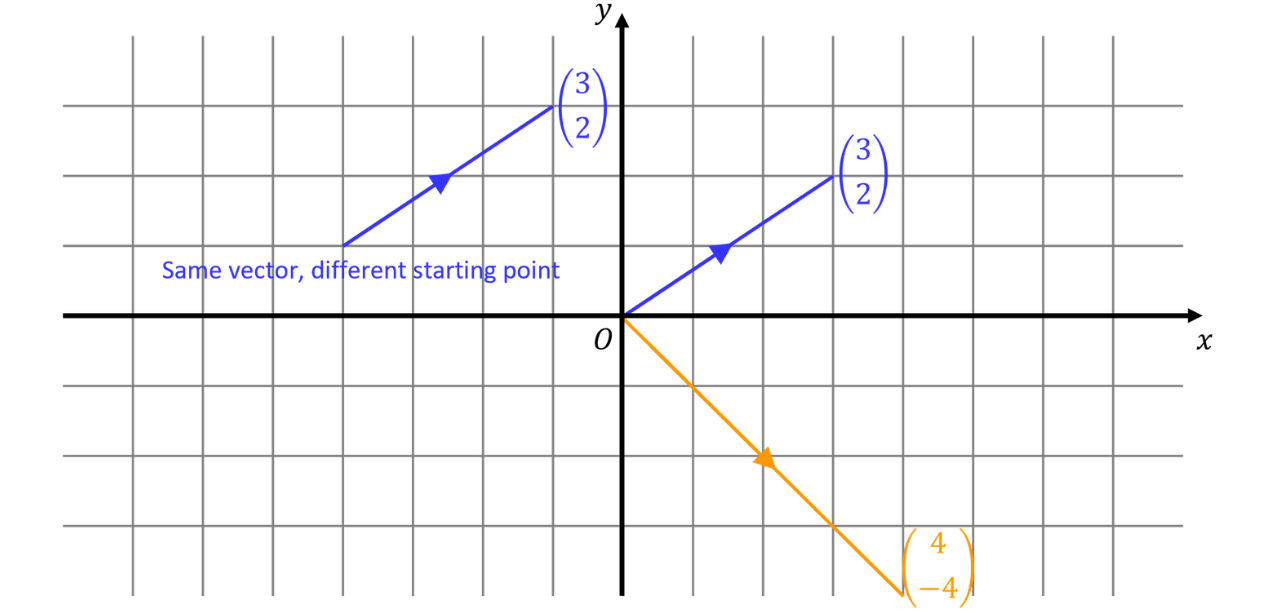
Note: When you see capital letters on coordinate axes, that represents a specific point, like representing the origin. When you see that represents the length between the two points and If there is an arrow on top like that represents the vector that takes you from the point to the point
Notice how on the above grid an arrow is used also when representing a vector, which is why direction is also described. Reversing a vector keeps the same magnitude but points it in the opposite direction. In symbols, This little fact does a lot of heavy lifting in the harder questions later.
Example 1:
Working with column vectors:
a) Write units right and units upas a column vector.
Single Step: Right is positive across, up is positive up, so we read straight off the description.
b) Write units left and units downas a column vector.
Single Step: Left means the top number is negative, and down means the bottom number is negative too.
c) Given write down
Single Step: Going from to is the exact reverse of going from to To reverse a vector, we just flip the sign of both numbers.
and
d) Add the column vectors and
Single Step: To add column vectors, add the top numbers together and the bottom numbers together.
Three Ways to Write a Vector
Before we go further, let's get the notation straight, because exam questions mix all of it. As we have already discussed, points are labelled with capital letters while a vector itself is usually given a lower-case letter or the point direction notation, e.g. used previously.
There are three common ways to write the same vector, and you should be comfortable with reading all three:
Three Notations for One Vector
With an arrow over two capitals: which means “the vector from to ”
As a bold lowercase letter: which is common in printed textbooks and exam papers.
As an underlined lower-case letter: which is the version you write by hand, since you can't easily make a letter bold with a pen. Watch any video below and you will see NeilDoesMaths write with underlined letter notation.
Throughout these notes we'll use for a vector between named points, and bold for vectors given their own name.
Adding Vectors: Following a Path
Here's the single most useful idea in the whole topic. If you want to get from to you don't have to go directly, you can take a detour through another point as shown in the diagram below. Travelling from to then from to lands you in exactly the same place as going directly from to
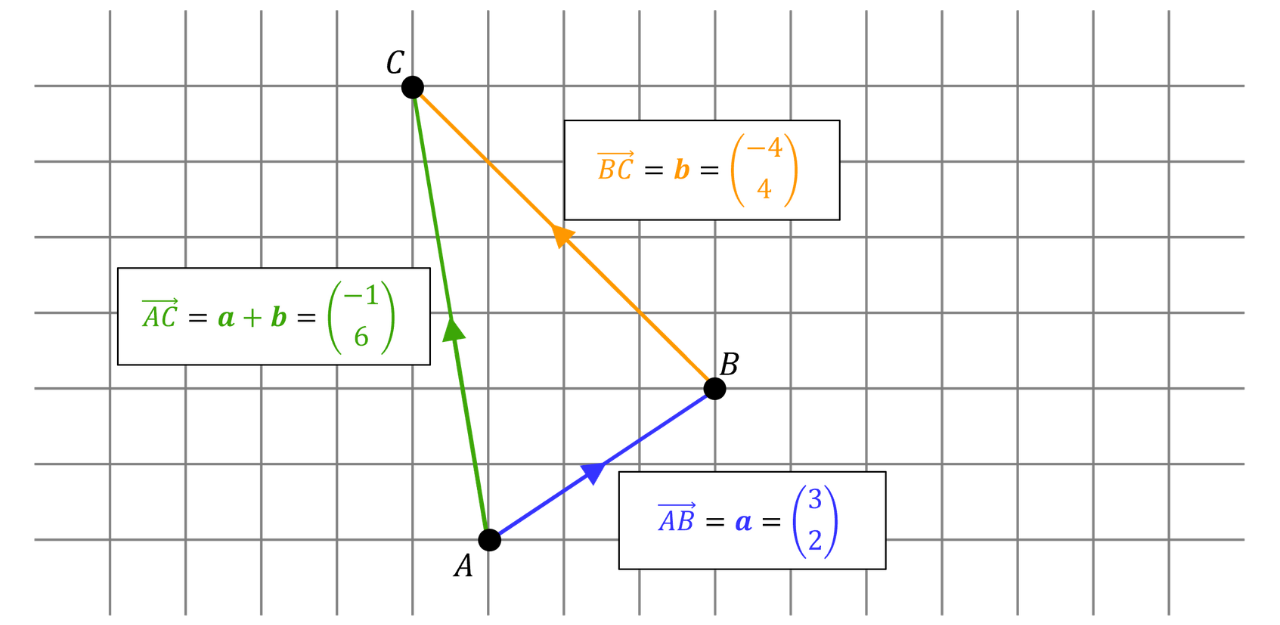
In the triangle above, we can see that
and
Adding these vectors gives
This matches the direct movement from to which, on the graph, is square to the left and then squares up.
Therefore,
The Path Rule (Triangle Law)
To add vectors, join them nose-to-tail. Reading across the outer letters give the start and the finish and the middle letter must match up.
Vectors in Geometric Figures
Now, we put the path rule to work inside a shape. The trick is always the same: find a route made only of vectors you already know and then add them up. A regular hexagon is a favourite exam shape because its opposite sides are equal and parallel, so they represent the same vector, but they’re just pointing the opposite way when you travel around the shape.
Example 2:
is a regular hexagon. The sides are given by and
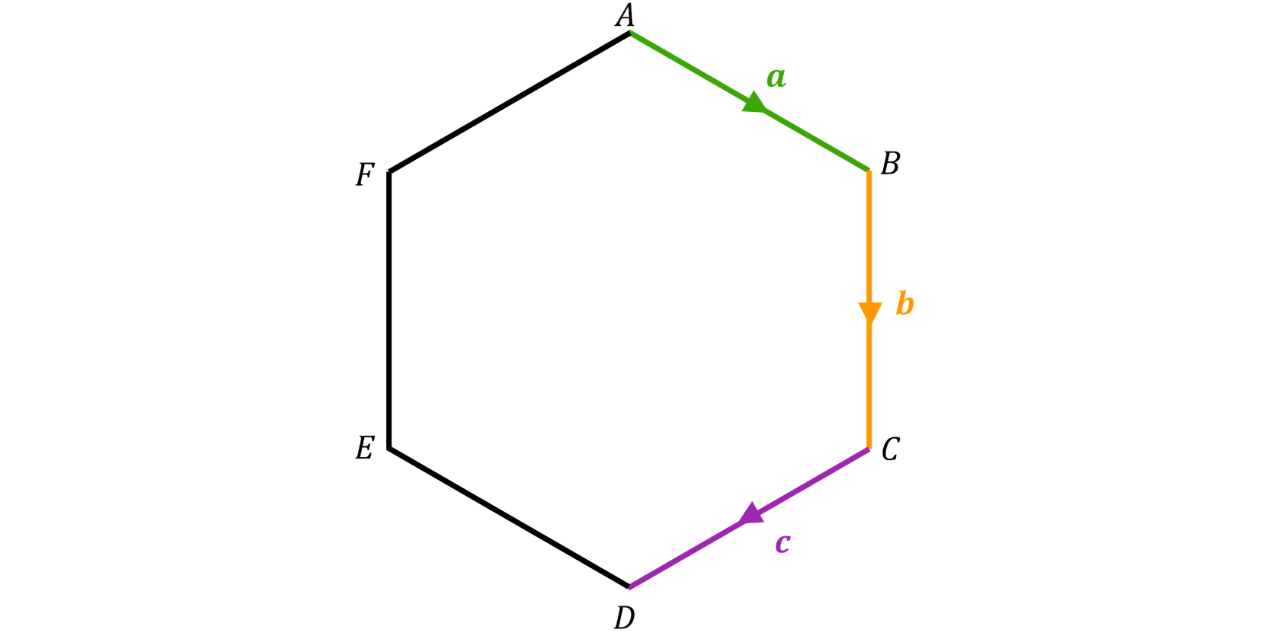
Find each of the following in terms of and
a)
Route: so we add the first two sides.
b)
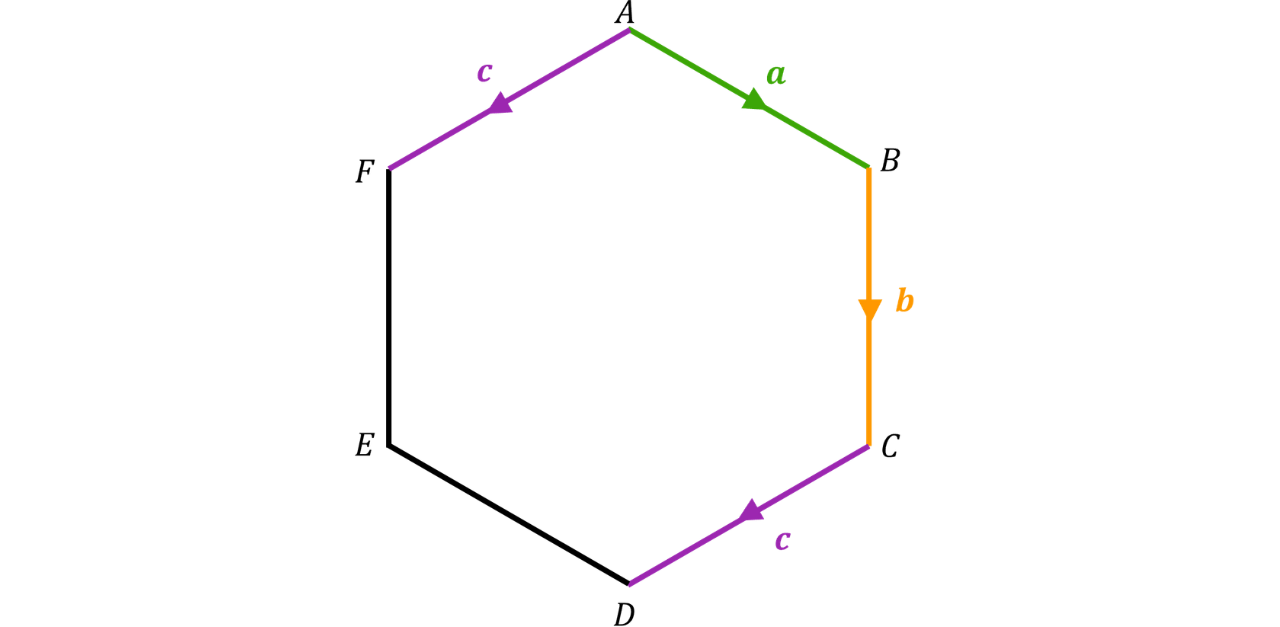
Route: Side is opposite to and since it is a regular hexagon, the two vectors are equal in size, parallel and point the same way. Therefore, they are equal.
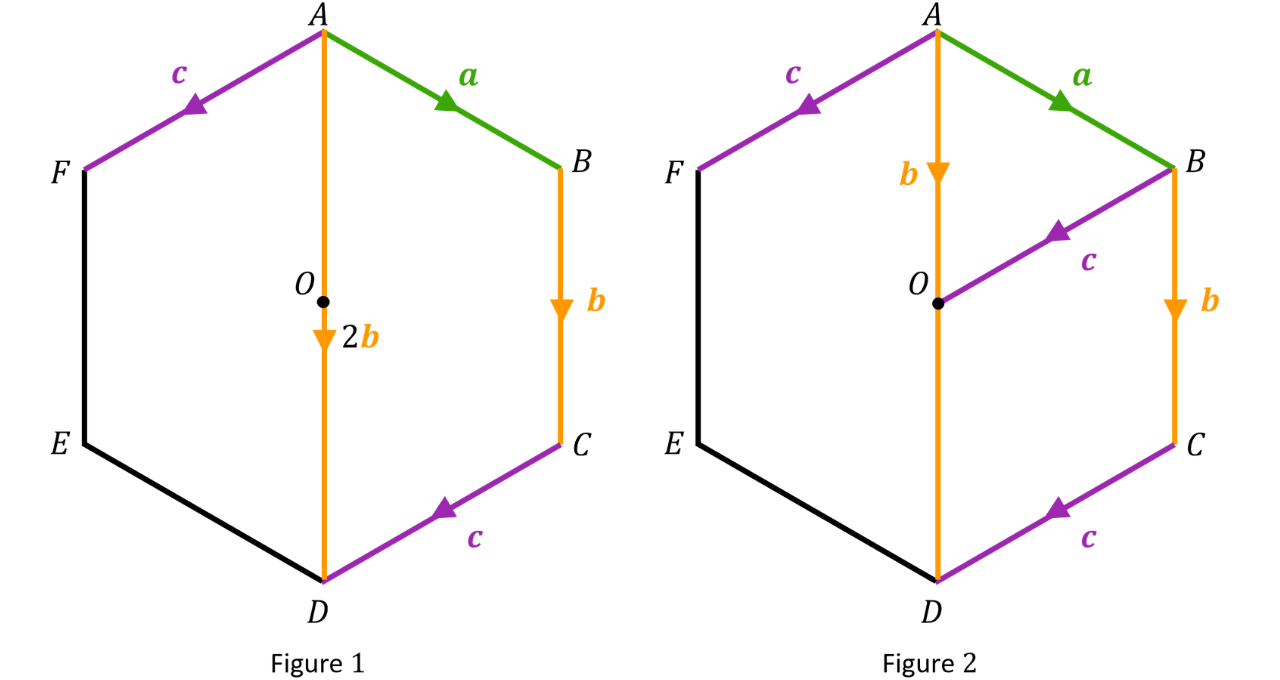
c) (the long diagonal)
Route:
Note: In a regular hexagon the long diagonal is parallel to the side and exactly twice its length, so as well (Figure 1). This means the pathway that we originally found must equal Equating the two and subtracting from both sides gives a handy relation: (Figure 2). This relationship is easier to see once the centre of the hexagon is marked, as in the figures below.
d)
Route: Side is parallel to and has the same magnitude, but it points in the opposite direction, so it is the negative of
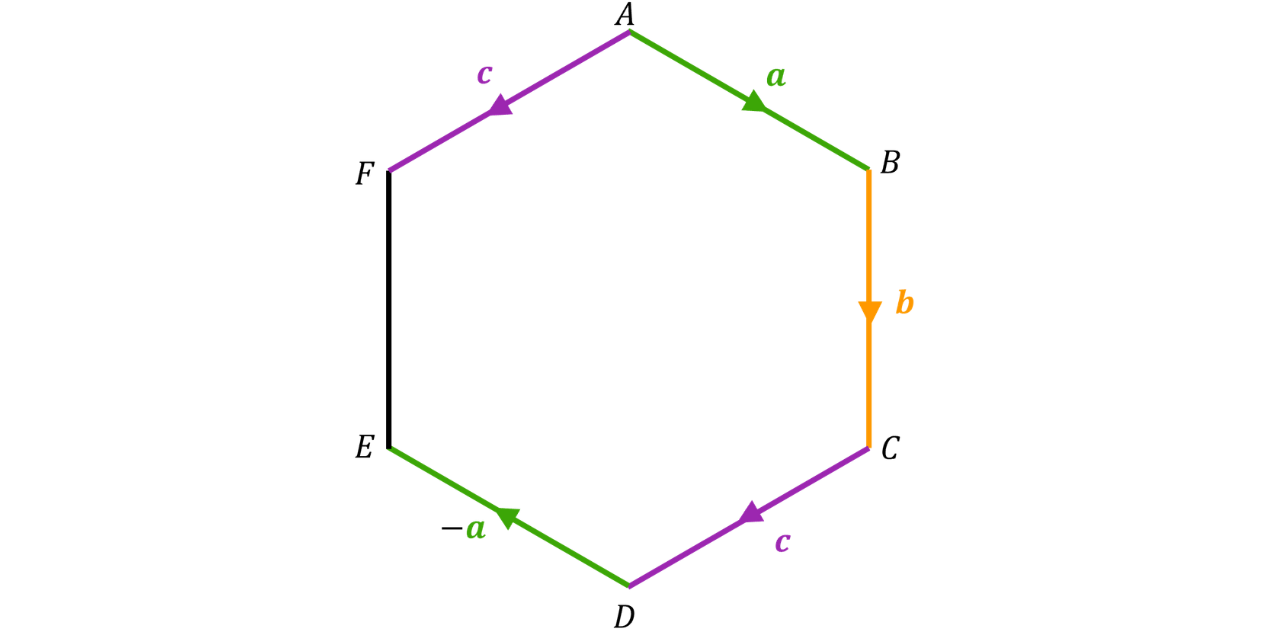
Note: The most common mistake in these questions is getting a direction wrong. Always read the letters in order: goes from to so if you travel the opposite way you must put a minus sign in. When in doubt, write the route out letter-by-letter before you substitute.
Vectors and Ratios
The typical vector question on a GCSE paper usually comes in two parts. Part a) asks for a straightforward vector, often a side of a triangle. Then, part b) introduces a point that divides a line in a given ratio, and you build a route to it using your answer from part a). Get the ratio step right and these become very doable.
The key skill is turning a ratio into a fraction. If a point lies on so that then is out of every parts of the way along.
Dividing a Line in a Given Ratio
If then:
The denominator is the total number of parts; the numerator is the part you've reached.
Example 3:
In triangle and is the midpoint of and lies on with
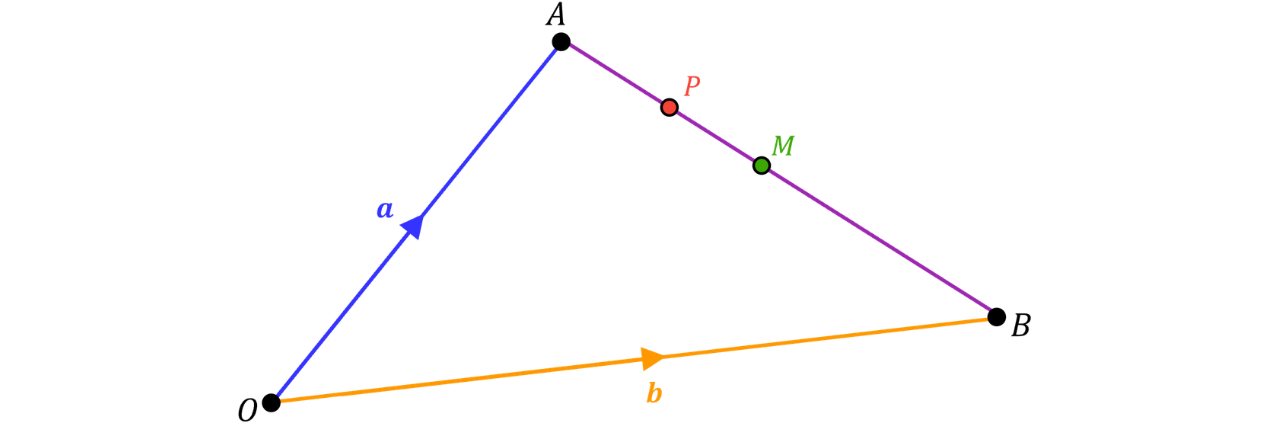
a) Find in terms of and
Route: The first leg is the reverse of so we must make it negative.
b) Find
Step 1: is the midpoint of so
Step 2: Take the route
We can collect like vectors as we do with algebraic terms.
c) Find
Step 1: Take the route
We know that However, we need to find
Step 2: Find
We turn the ratio into a fraction. The parts total and has reached of them, so
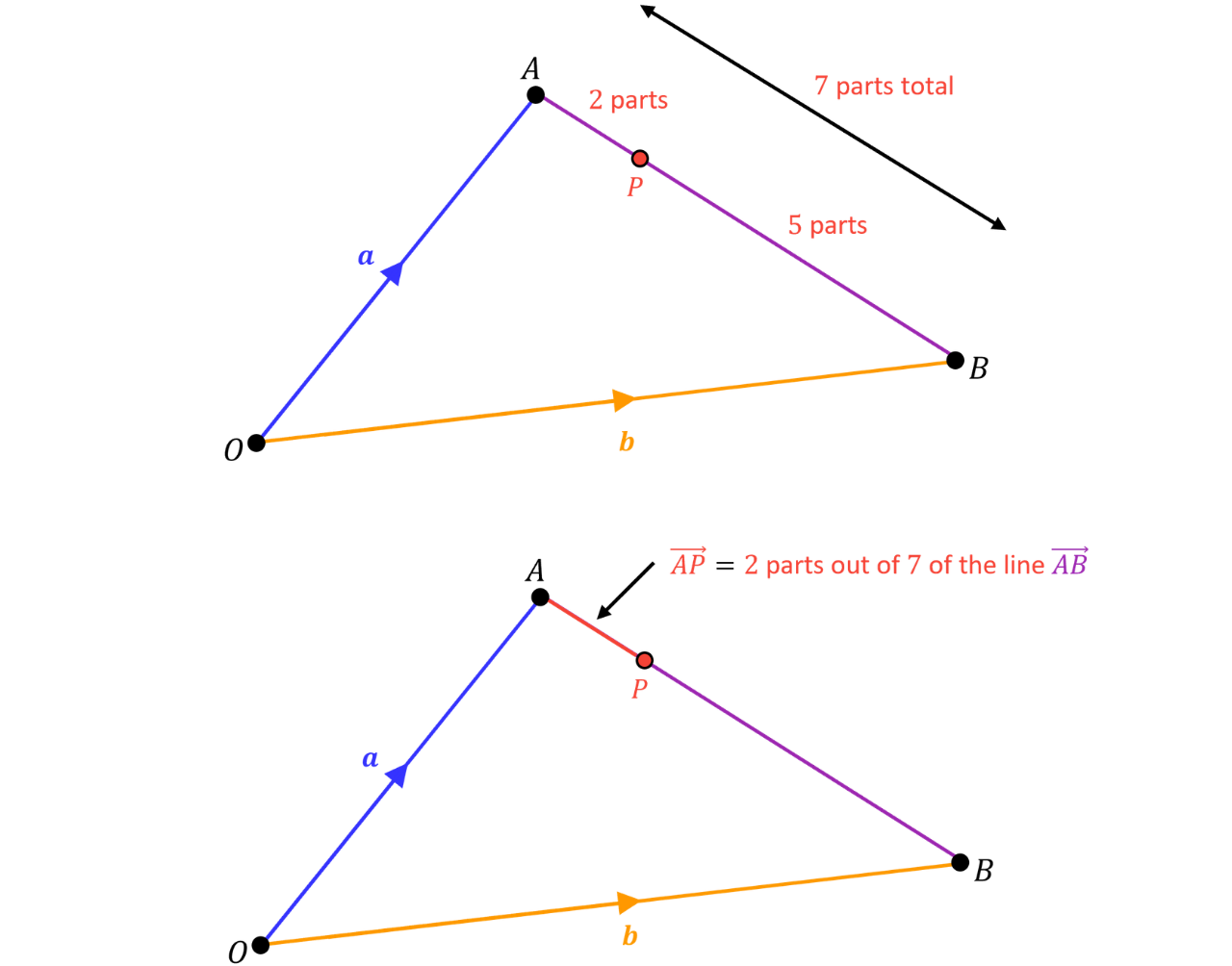
Step 3: Find
Note: If we go the other way, which is then we have which gives the identical answer We opted to go with the route since we found in part a).
d) A different point lies on with Find the ratio
Step 1: This is part c) in reverse. Let’s first write down the route we would take if the question had asked us to find first.
The route would be
Step 2: By subtracting from both sides, we can find
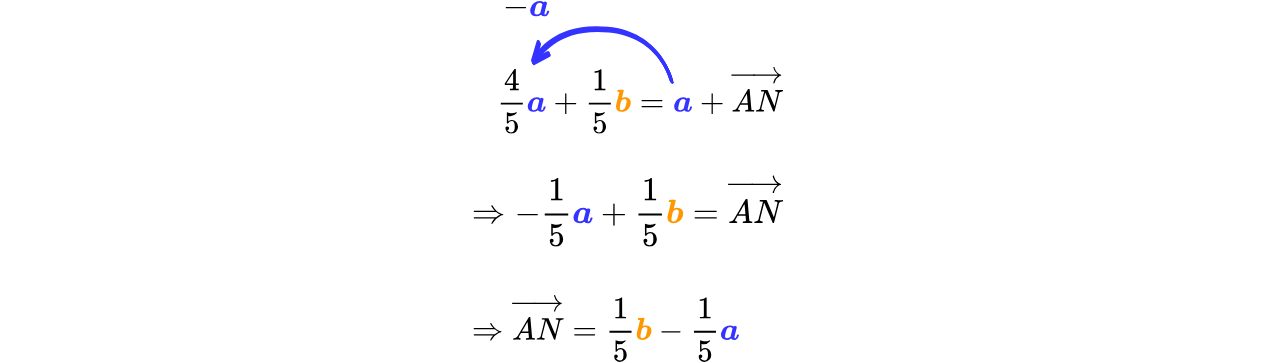
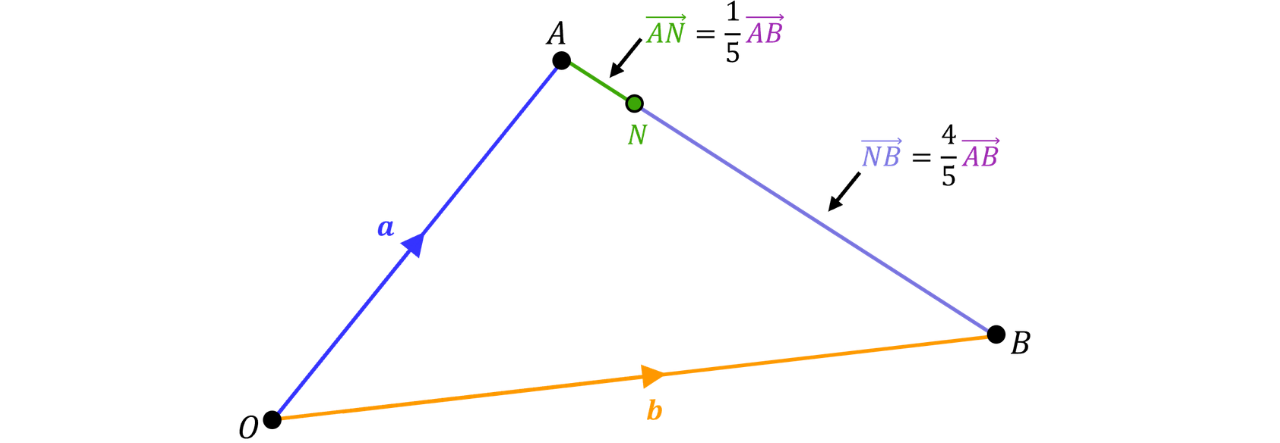
Step 3: Notice that is of
The question stated that lies on
Factorising from the right-hand side,
This means that the other side of is of
Step 4: Write and simplify the ratio.
Multiplying both parts by
Challenging Question