Perpendicular Lines
Neil Trivedi
Teacher

Contents
Finding the Perpendicular Gradient
Two lines are perpendicular if they meet at a right-angle (i.e.
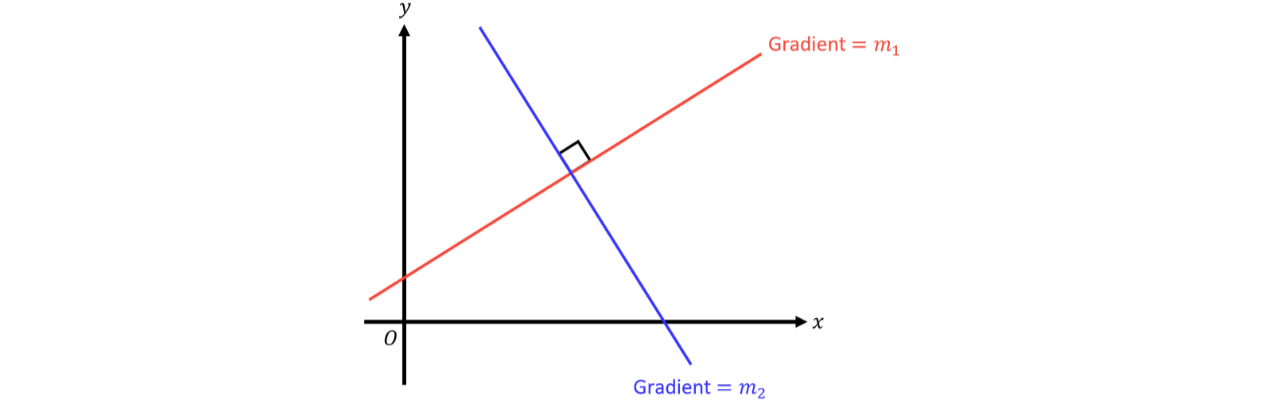
For perpendicular lines, the gradients have a special relationship where the product is always
If two lines with gradients and are perpendicular, then
This means that, given the gradient of one line, we can find the gradient of any line perpendicular to it by taking the negative reciprocal.
If then we can divide both sides by to give
We follow the following steps to find the perpendicular gradient:
Reciprocate the gradient (i.e. flip the fraction).
Change the sign
For example, consider a line with gradient To find the perpendicular gradient:
We reciprocate it to give
Then, we change the sign to give
Therefore, the perpendicular gradient, is
We can verify this by working out
Note: If the gradient is an integer, such as we can think of it as Reciprocating gives changing the sign gives
Similarly, if we start with reciprocating gives which we can simply write as then change the sign to give
Example 1:
Find the gradient of the line that is perpendicular to a line with gradient:
a)
Single Step: Reciprocate the gradient and then change the sign.
The gradient is which we can write as Reciprocating gives and then changing the sign gives
b)
Single Step: Reciprocate the gradient and then change the sign.
The gradient is Reciprocating gives and then changing the sign gives
c)
The gradient is which we can write as Reciprocating gives and then changing the sign gives us a positive fraction, but we do not need to include the sign.
Therefore,
d)
Single Step: Reciprocate the gradient and then change the sign.
The gradient is Reciprocating gives and then changing the sign gives
Example 2:
The line with equation is perpendicular to the line with equation
Find the value of the constant
Step 1: Find the gradient of each line by rearranging into the form
For the first equation:
Subtracting from both sides and adding to both sides,
Dividing each term by
Remember that the gradient is represented by the value of Therefore, the gradient of this line is
For the second equation:
We rearrange for by first adding to both sides.
Then, we divide each term by
So, the gradient of this line is
Step 2: Use the rule which states that where and are the perpendicular gradients, to form an equation, in terms of and solve it.
Multiplying the fractions on the left-hand side and cancelling the negatives on both sides,
Multiplying both sides by
Dividing both sides by
Finding the Equation of a Perpendicular Line
We are often asked to find the equation of a line that is perpendicular to a given line and passes through a specific point. For these questions, we’d use the following general equation of the line
Where is the known point that the line passes through, is the gradient, and is any other point on the line. See our previous note on Straight Line Graphs for more information on this form of a line.
Steps to Finding the Equation of a Perpendicular Line
Find the gradient of the original/given line, rearranging into the form if necessary.
Find the perpendicular gradient by taking the negative reciprocal.
Use the formula with the perpendicular gradient and the given point.
Rearrange the equation into the form required by the question.
Example 3:
Find the equation of the line which is perpendicular to and passes through the point Give your answer in the form where and are integers.
Step 1: Find the gradient of the given line.
To find the gradient of the line we rearrange it into the form
Subtracting from both sides and adding to both sides,
Dividing each term by
Therefore, the gradient of is
Step 2: Find the perpendicular gradient.
To find the perpendicular gradient, we first reciprocate to give Then, we change the sign to give
Step 3: Use the formula with the perpendicular gradient and the given point.
Substituting and into the formula,
Step 4: Rearrange the equation so that it’s in the form as required by the question.
Firstly, we multiply every term by to get rid of the fraction.
Expanding the brackets on the right-hand side,
Next, we move all terms to the left-hand side.

Therefore, the equation of the perpendicular line is
Note: The order of the terms is not important. For example, would be fine or, if we moved all terms to the right-hand side instead, These are all accepted forms of the equation.
Problem-Solving Question
Here is a problem-solving question that combines perpendicular lines with finding intercepts with the coordinate axes and the area of a triangle.
Example 4:
A straight line has equation A straight line is perpendicular to and passes through the point
a) Find the equation of in the form
Step 1: Identify the gradient of
The equation of is already in the form so we can identify the gradient directly. The gradient is
Step 2: Find the perpendicular gradient.
To find the perpendicular gradient, we reciprocate to give Then, we change the sign to give
Step 3: Use the formula with the perpendicular gradient and the given point.
Substituting and into the formula,
Step 4: Rearrange the equation so that it’s in the form as required by the question.
Expanding the brackets on the right-hand side,
Then, we move all terms to the left-hand side.

So, the equation of is
The line crosses the axis at the point and the axis at the point
b) Find the coordinates of and
Single Step: Find the and intercepts of by substituting and respectively.
The line crosses the axis when which we substitute into the equation.
Adding to both sides,
Dividing both sides by
Therefore, the coordinates of are
The line crosses the axis when which we substitute into the equation.
Adding to both sides,
Therefore, the coordinates of are .
Given that is the origin,
c) find the area of triangle
Step 1: Sketch the triangle to identify the base and the height.
We draw a sketch of the line and its intersections with the coordinate axes. From part b), the line crosses the axes at and Triangle is formed by these points and the origin and it’s shown shaded in the diagram.
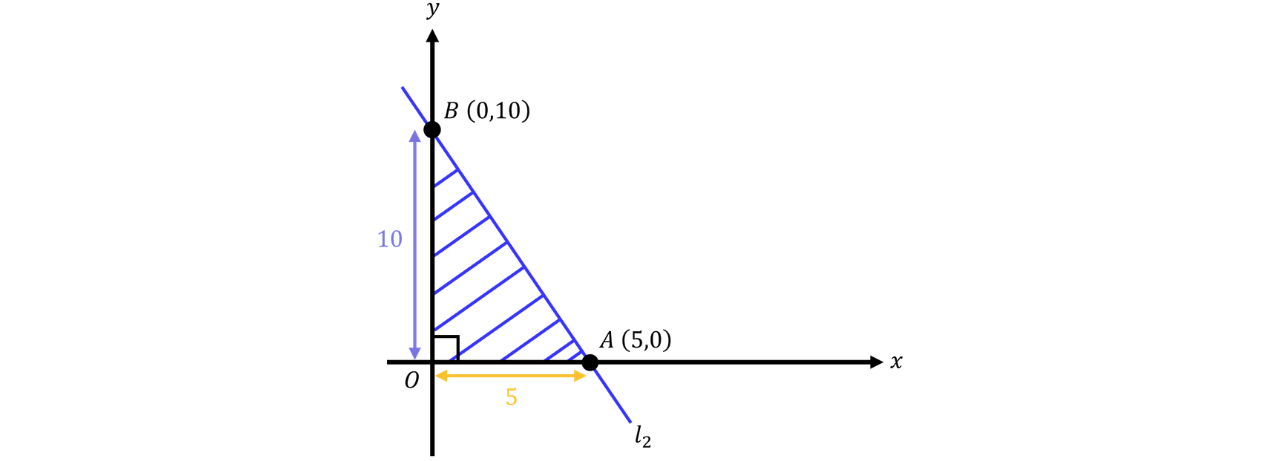
To note, since lies along the axis and lies along the axis, the angle at is a right-angle. So, triangle is a right-angled triangle, where is the base and is the height.
Here, and
Step 2: Find the area of the triangle.
To find the area of the triangle, we use the formula
Area base height
Substituting the base and height,
Area
Therefore, the area of triangle is square units.
Challenging Questions