Straight Line Graphs
Neil Trivedi
Teacher

Contents
Straight Line Graphs
A straight line graph is a graph where all the points lie on one straight line. Straight line graphs are usually written using equations involving and The equation tells us which points lie on the line.
In this note, we will look at how to find the gradient of a straight line, use the equation of a straight line, and find the equation of a line from given information.
We will also apply these skills to problem-solving questions, including finding where two straight lines intersect.
The Equation of a Straight Line
A common form of the equation of a straight line is
where:
is the gradient of the line. This tells us how steep the line is.
is the intercept of the line. This is where the line crosses the axis. At the axis, the value of is so the intercept is the point
Finding the Gradient Between Coordinates
The gradient, of a straight line tells us how steep the line is. Suppose a straight line passes through two points and
To find the gradient, we work out the change in and divide it by the change in The change in is found by subtracting the two coordinates, and the change in is found by subtracting the two coordinates.
So,
Note: When working out the changes in and the coordinates must be subtracted in the same order. So, if we do in the numerator, then we must do in the denominator.
Example 1:
Find the gradient of the line segment joining each pair of points:
a) and
Step 1: Work out the change in and the change in
We are moving from to We can find the change in by subtracting the first coordinate from the second coordinate.
So, the change in will be
Similarly, the change in is found by subtracting the first coordinate from the second coordinate.
Therefore, the change in will be
Step 2: Divide the change in by the change in to find the gradient of the line segment.
We have
Therefore, the gradient of the line segment is
To note, you can also find the changes in and by subtracting the second coordinates from the first coordinates. The signs would just change during the working out, but the final answer would be the same.
If we did it this way, we would get the change in to be and the change in to be Then, dividing the change in by the change in we would get
b) and
Step 1: Work out the change in and the change in
We are moving from to
The change in will be
Similarly, the change in will be
Step 2: Divide the change in by the change in to find the gradient of the line segment.
We have
Therefore, the gradient of the line segment is or
Note: You can write the answer as either a fraction or a decimal. However, writing the answer as a fraction is preferred because It keeps exact values for fractions like and fractions are easier to rearrange later.
Example 2:
The line joining and has a gradient of Work out the value of
For this question, one of the coordinates contains an unknown. We will find the change in and the change in then use the gradient formula to form an equation and solve for
Step 1: Work out the change in and the change in in terms of
We are moving from and
The change in will be
The change in will be
Step 2: Divide the change in by the change in to get the gradient of the line which is equal to
So,
We are told that the gradient is so we write
Step 3: Solve for
First, we multiply both sides by
Then, we subtract from both sides.
We have seen that the equation of a straight line is often written in the form Another common form of a straight line equation is where and are integers. We prefer this form particularly when the gradient is a fraction.
We can rearrange an equation from the form into the form and vice versa.
To note, the in represents the intercept. However, the in is just the constant term in that form.
Example 3:
A straight line has equation
a) Identify the gradient and intercept of the line.
Single Step: Compare the equation with the form to identify the gradient and intercept directly.
Recall that in the equation
the represents the gradient and the represents the intercept.
Our equation is
Comparing this with we can see that and
Therefore, the gradient of the line is and the intercept is
b) Express in the form where and are integers.
Step 1: Eliminate all denominators so that all coefficients are integers.
We get rid of the fractions by multiplying every term by to eliminate all denominators.
Step 2: Rearrange the equation to get it into the required form.
We want the equation in the form
So, we move all the terms to one side. Let’s move all terms to the left-hand side by adding to both sides and subtracting from both sides,
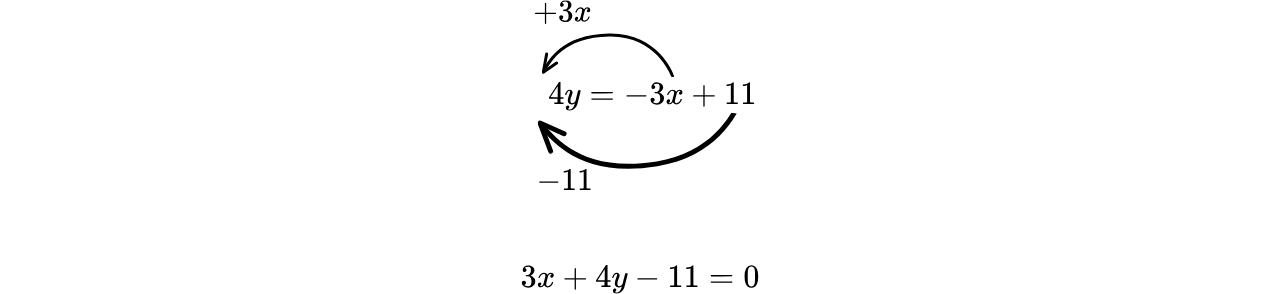
Therefore, the equation of the line can be written as where and
Note: We could have moved the to the right-hand side, which would give us This is still correct, but not preferable as there are more negative terms.
Another Form of the Equation of a Straight Line
An equation in the form is useful when we want to identify the gradient and intercept quickly.
However, there is another useful form of the equation of a straight line. This form is especially helpful when we know a point on the line and the gradient of the line.
Here, we will derive this equation below.
Suppose a straight line has gradient and passes through the known point
Now, suppose is any other point on the same line.
Since both points lie on the same straight line, the gradient between and must also be
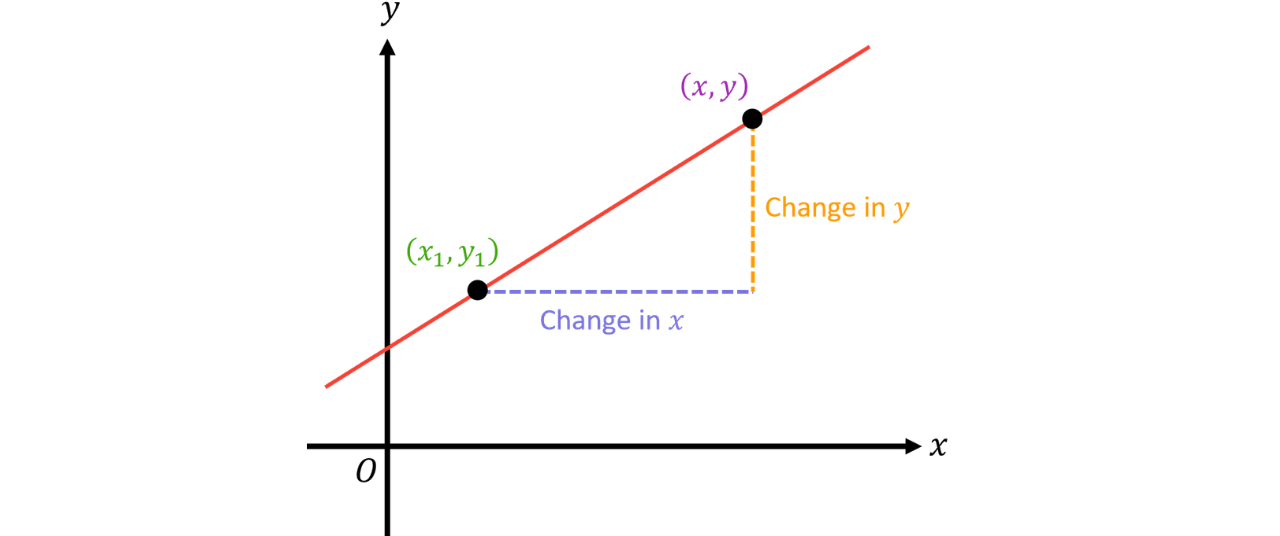
First, we find the gradient of the line that joins the points and
The change in is
The change in is
To find the gradient, we divide the change in by the change in
So,
Then, we multiply both sides by to get
This is known as the point-gradient form of a straight line.
A neat way to think about this formula is:
"minus the coordinate gradient (minus the coordinate)"
Note: We recommend that you use this form of a straight line as it is more versatile, especially with fractional gradients. However, if you are used to then continue to use it.
The Point-Gradient Form of a Straight Line
The point-gradient form of a straight line is
where:
is the gradient of the line. This tells us how steep the line is.
is a known point
is any other point on the line.
Example 4:
Find the equation of the line that goes through and has a gradient of
a) Using
Step 1: Use the information given in the question to substitute values into the equation
Since the gradient is
The point lies on the line, so we substitute and into the equation. We get
Step 2: Find the value of
We subtract from both sides,
Rewriting as so we could combine the fractions on the left-hand side,
Therefore, an equation of the straight line is
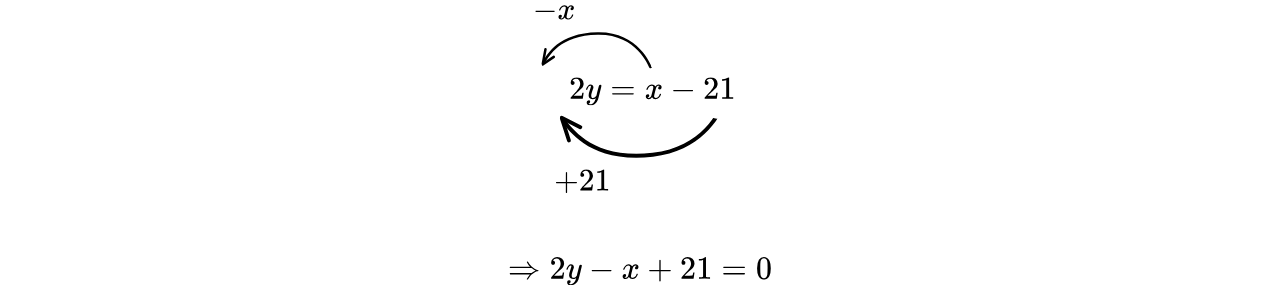
If we are asked to rearrange the equation to put it in the form we first need to multiply every term by
Then, we can move all terms to the left-hand side.
b) Using
Step 1: Use the information given in the question to substitute values into the equation
We have and Substituting these values into the equation, we get
Step 2: Rearrange the equation to get it into the form
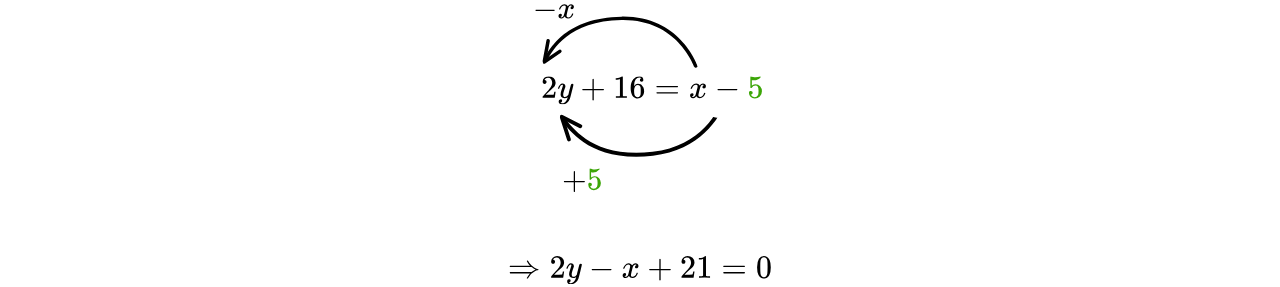
Firstly, we multiply every term by to cancel out the
Finally, we move every term to the left-hand side.
Note: If we rearranged so that all terms are on the right-hand side, the equation of the straight line would be
We can see that when the gradient of a line is a fraction, it is faster to use With we’d need to add or subtract fractions whereas here, we can multiply through by a whole number to cancel the fraction early on.
Problem Solving Question
Example 5:
A straight line has a gradient of and passes through the point with coordinates
a) Find the equation of the line
For this question, we will use the formula.
Step 1: Use the information given in the question to substitute values into the equation
The gradient of is so Also, we have so and
Substituting these values into the equation, we get
Step 2: Rearrange the equation to get it into the form
Expanding the brackets on the right-hand side,
Adding to both sides,
Therefore, an equation of the straight line is
The straight line passes through the points with coordinates and
b) Find the equation of giving your answer in the form where and are integers.
Step 1: Find the gradient between the two coordinates.
We are moving from to
The change in will be
Similarly, the change in will be
Next, we divide the change in by the change in to find the gradient.
Simplifying the fraction by dividing the numerator and denominator by
Therefore, the gradient of is
Step 2: Use the formula to find the equation of
We found the gradient of to be so
For our we could choose either point given in the question.
Let’s choose So, and
Substituting these values into the equation, we get
Then, we multiply all terms by to get rid of the denominator.
Expanding the brackets on the right-hand side,
Finally, we move all terms to one side so that the equation is in the form
We will move all the terms to the right-hand side.
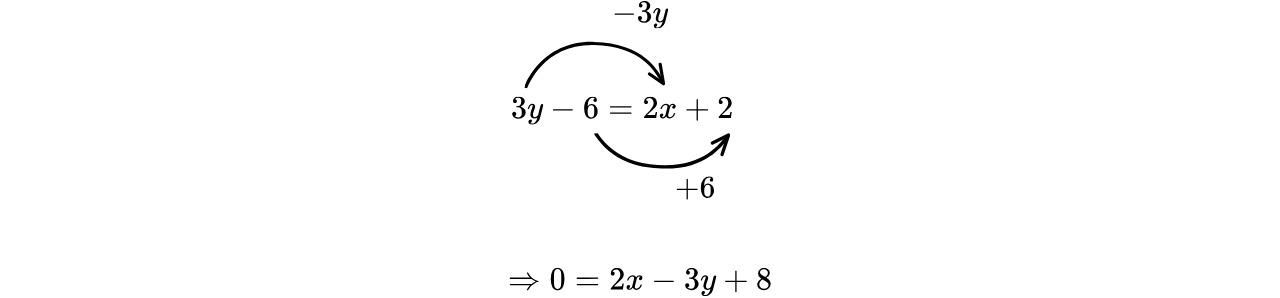
Therefore, an equation of the line is
The lines and intersect at the point
c) Find the coordinates of
The point of intersection of two straight lines is found by solving their equations simultaneously.
Here are our equations:
Step 1: Solve these equations simultaneously, finding the value of one of the variables first.
Here, we will use the substitution method. Equation already has as the subject.
So, we substitute into equation
Substituting into
Expanding the brackets,
Collecting like terms,
Adding to both sides,
Dividing both sides by
Step 2: Find the corresponding coordinate.
Now, we substitute into one of the equations to find the corresponding coordinate. We will use equation
Rewriting as so that both terms on the right-hand side have a denominator of
Therefore, the point of intersection between the straight lines and is or, if we are to convert it to decimal form,
Practice Question