Tangents to Circles
Neil Trivedi
Teacher

Tangents to Circles
A tangent to a curve at a particular point is a straight line that just touches the curve at that point. In this note, we will focus specifically on tangents to circles, and we will learn how to find the equation of the tangent line at a given point on a circle.
Before we can do this, we need to recall the equation of a circle.
For a circle centred at the origin the equation is
where is the radius of the circle.
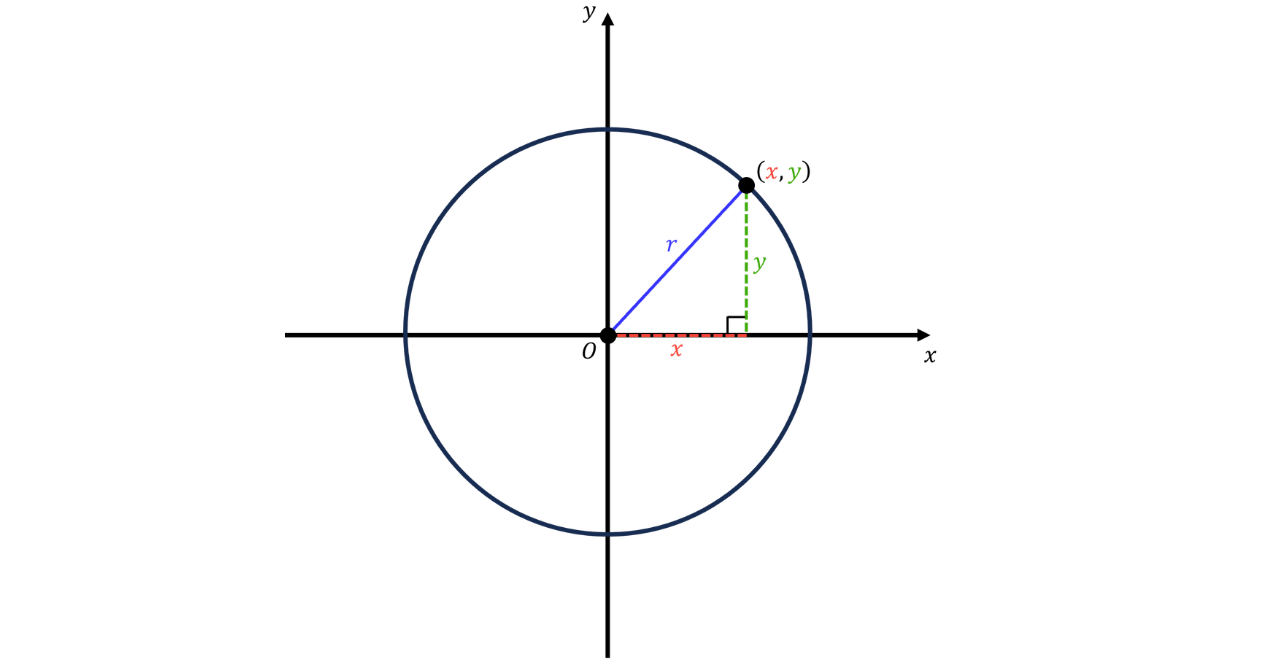
This equation comes directly from Pythagoras' Theorem. Take any point on the circle.
The horizontal distance from the origin to that point is and the vertical distance is
The straight-line distance from the origin to the point is the radius,
These three lengths form a right-angled triangle, so, by Pythagoras' Theorem,
As a quick example, the equation of a circle centred at the origin with radius is found by substituting into the equation above:
The Key Property of a Tangent to a Circle
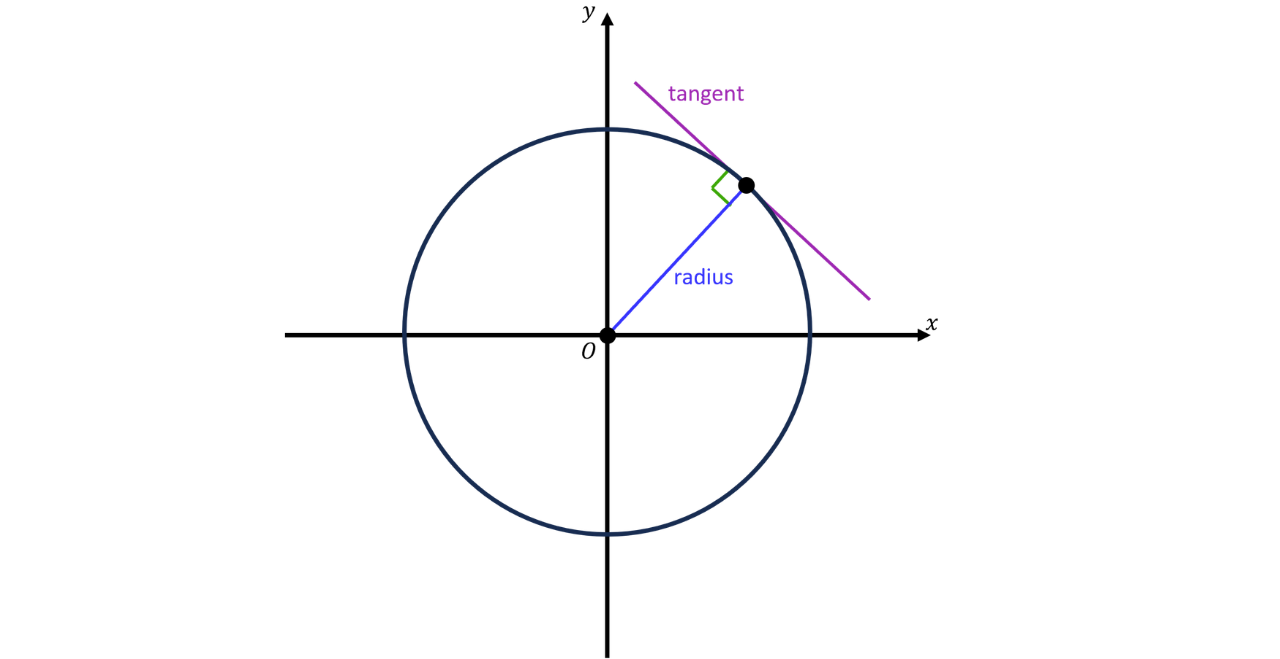
To find the equation of a tangent to a circle, we use one extremely important property:
The tangent to a circle at a point is perpendicular to the radius drawn from the centre to
That is, the tangent to a circle and its radius meet at
Recall that two lines are perpendicular when the product of their gradients is (read our study note titled Perpendicular Lines).
Equivalently, if one line has gradient any line perpendicular to it has gradient This is called the negative reciprocal.
This is the bridge between the gradient of the radius and the gradient of the tangent: once we know one, we can find the other.
Method for Finding the Equation of a Tangent to a Circle
Find the gradient of the radius from the centre of the circle to the point of tangency (the point at which the tangent touches the circle). The gradient is the change in divided by the change in
Find the gradient of the tangent by taking the negative reciprocal of the gradient of the radius.
Use the equation with being the coordinates of the point of tangency (see our study note Straight Line Graphs), and being the gradient of the tangent, to write the equation of the tangent line.
We recommend that if a question does not provide a picture, draw one, it will make your life a lot easier!
Example 1:
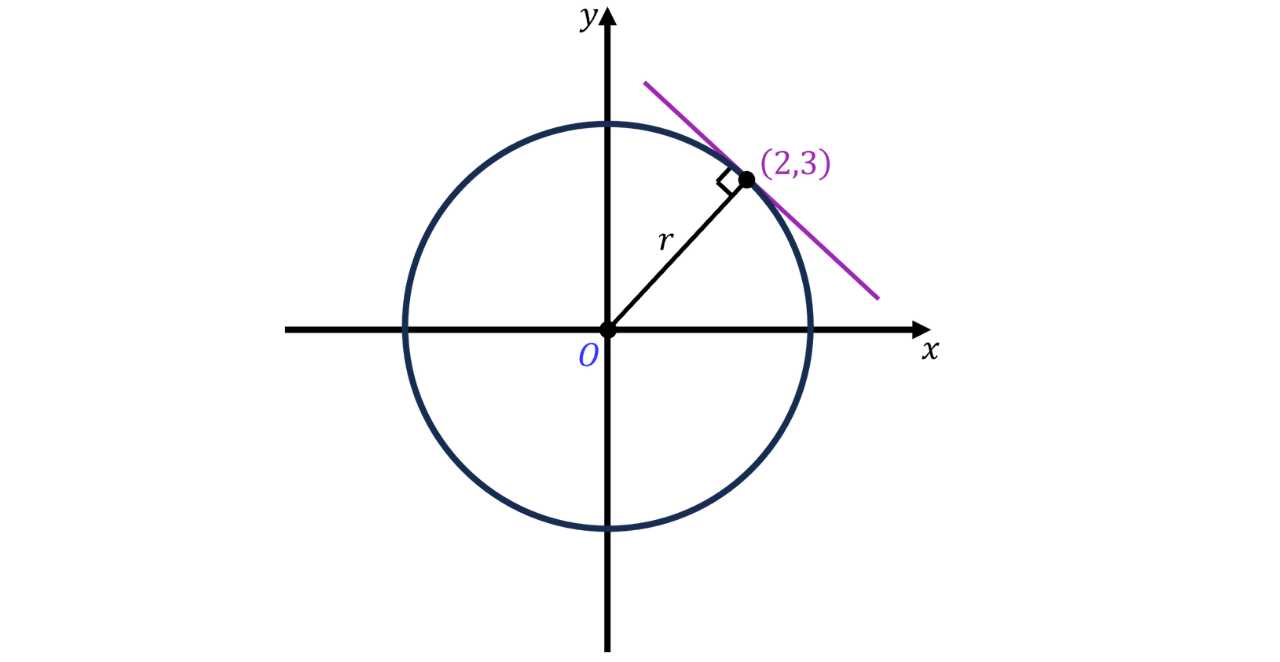
Find the equation of the tangent to the circle at the point
Step 1: Draw a quick sketch of the circle, the point and the tangent to that point.
Step 2: Find the gradient of the radius.
The radius goes from the centre to the point of tangency The gradient is:
gradient of radius
Step 3: Find the gradient of the tangent (negative reciprocal).
Flipping upside down gives and changing the sign gives:
gradient of tangent
Step 4: Use to write the equation of the tangent .
Here, and
We multiply each term by to clear the fraction. The right-hand side is only one term, so we only have to multiply by
Expanding the brackets on the right-hand side,
Next, we rearrange to make the equation cleaner. Here, we will move the to the left-hand side where it will become and move the to the right-hand side where it will become The exam will typically tell you what form they would like you to leave your answer in.
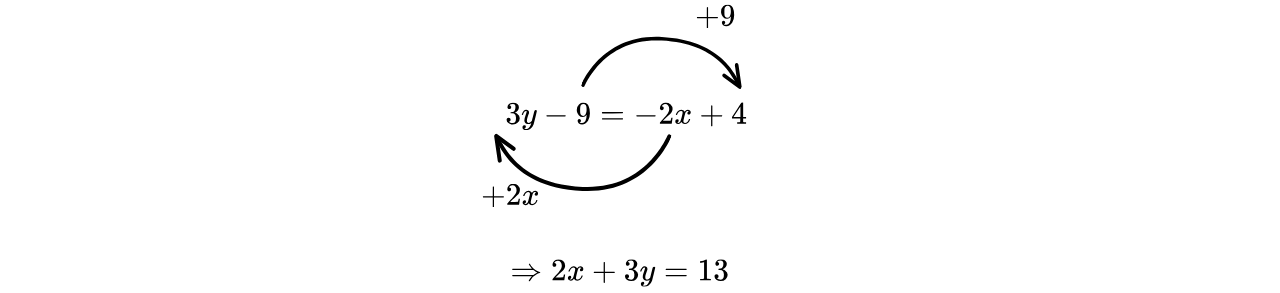
That is the equation of the tangent. We will use this same four-step method in every example below.
Example 2:
The circle has a tangent at the point which crosses the axis at the point Determine the area of triangle where is the origin.
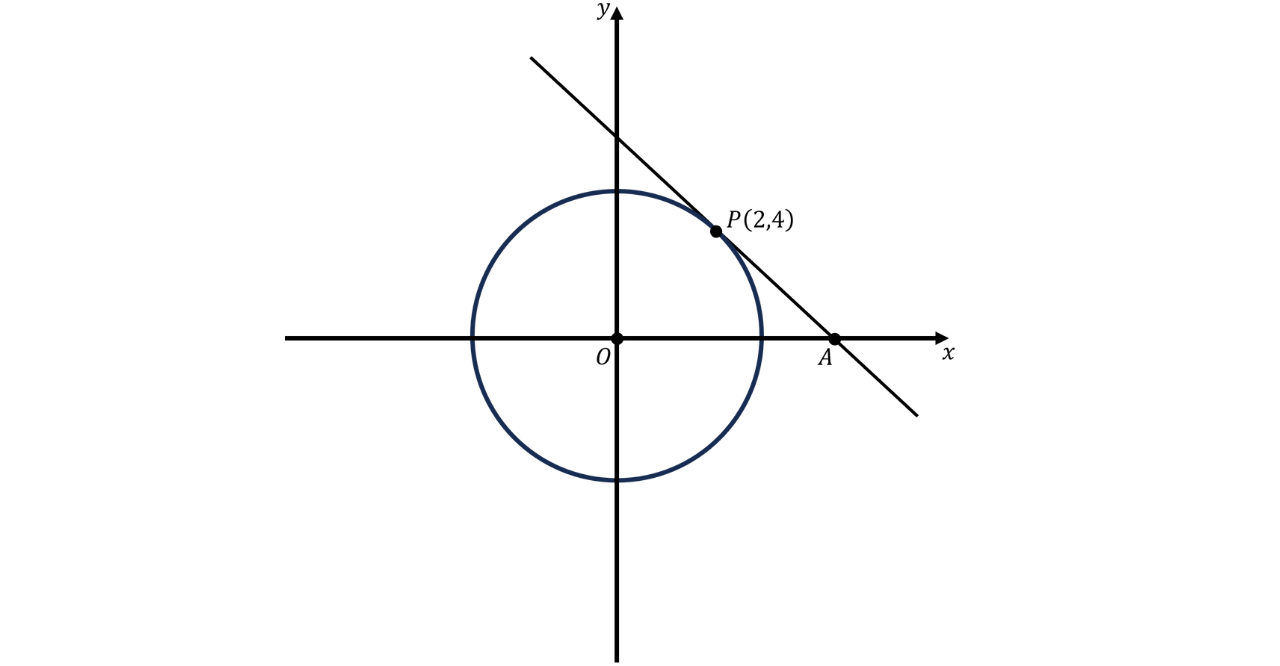
Step 1: Annotate the diagram to include the radius and perpendicular angle where the tangent meets the radius.
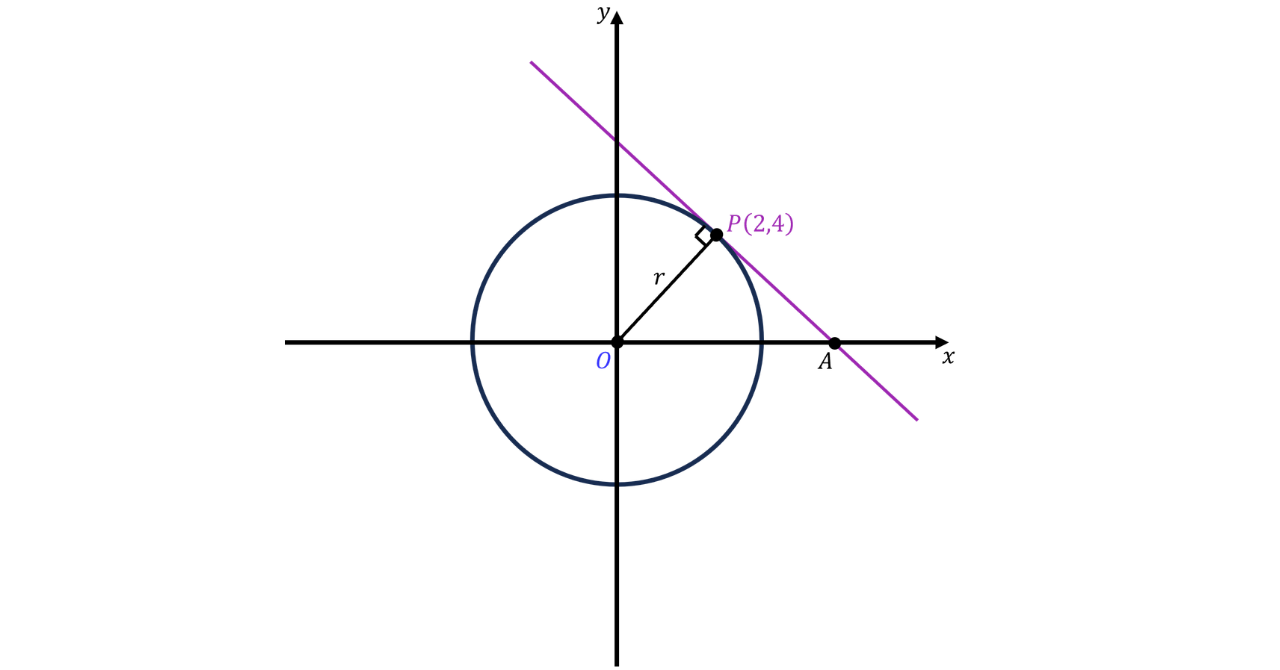
Step 2: Find the gradient of the radius.
The radius goes from the centre to the point of tangency The gradient is:
gradient of radius
Step 3: Find the gradient of the tangent (negative reciprocal).
Reciprocating gives and changing the sign gives:
gradient of tangent
Step 4: Use to write the equation of the tangent.
Here, and
If we wanted to find a clean, final equation of the tangent, we would multiply each term by to clear the fraction. However, we are only interested in the tangent to find where it crosses the axis.
Step 5: Find the coordinates of by setting to find where the tangent crosses the axis.
Multiplying both sides by to cancel the
Adding to both sides,
Step 6: Find the area of triangle
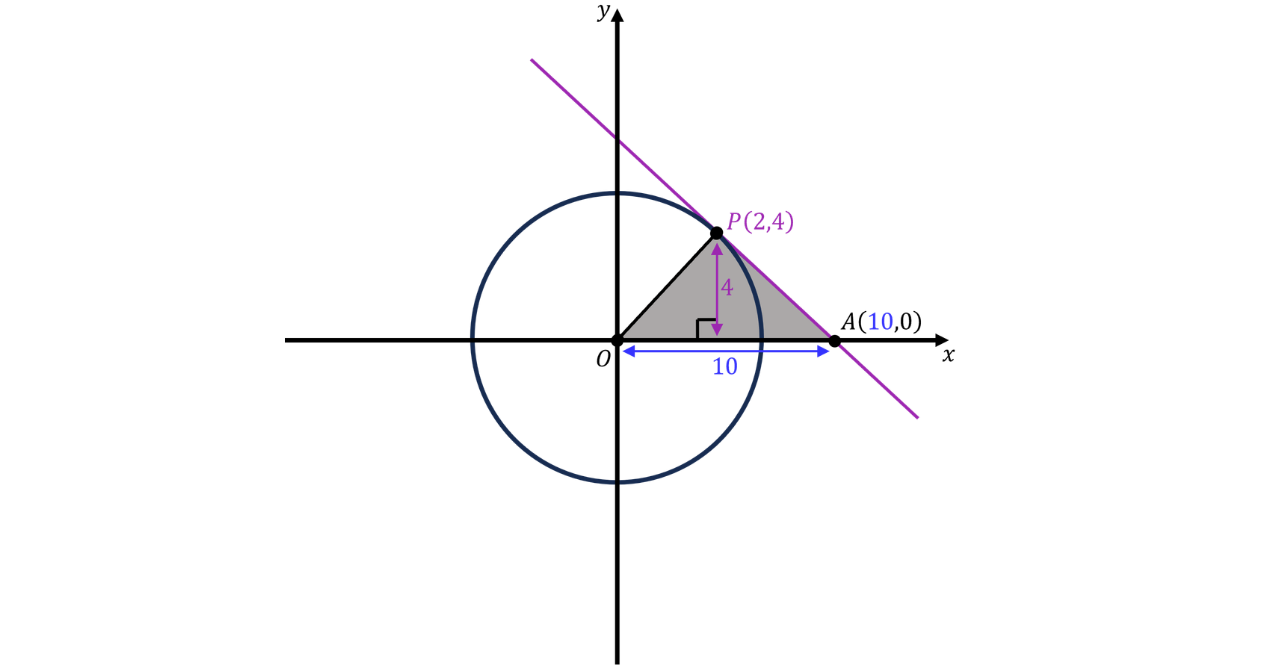
The triangle has vertices and Since lies along the axis, we take as the base.
Base
The perpendicular height from to the axis is the coordinate of
Height
We now use the formula for the area of the triangle.
Area base height
Area
Therefore, the area of triangle is square units.
Example 3:
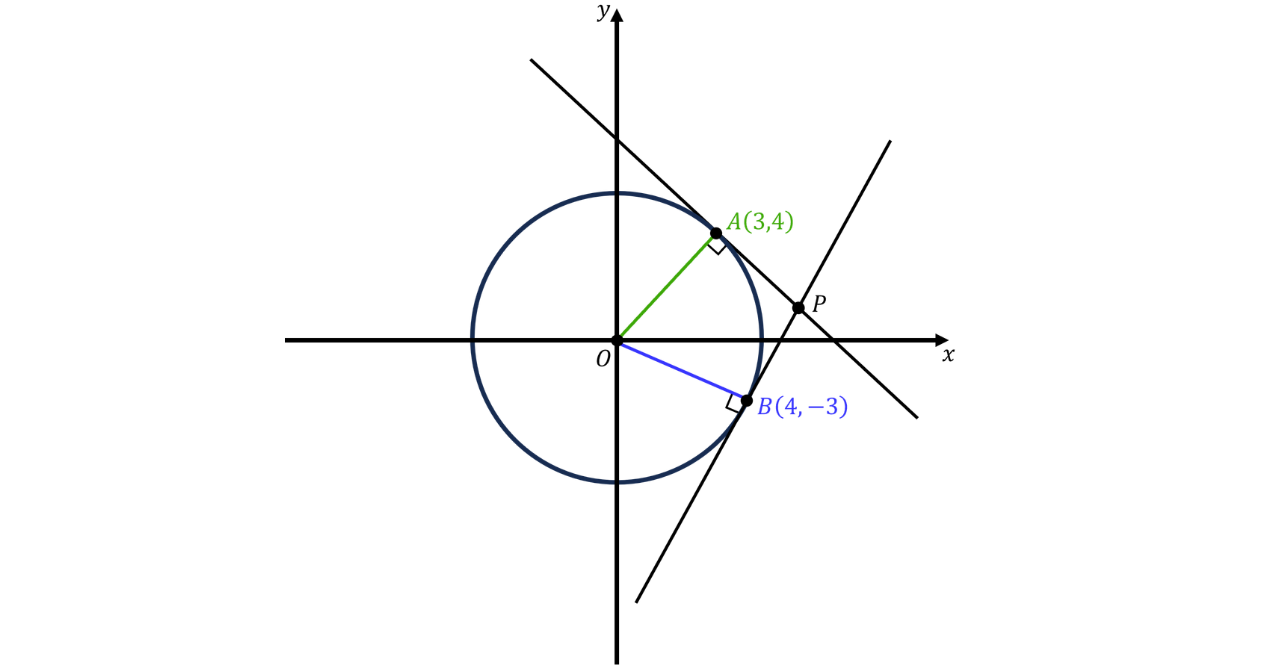
The diagram shows the circle The circle has tangents at the points and The two tangents meet at the point Find the exact length of
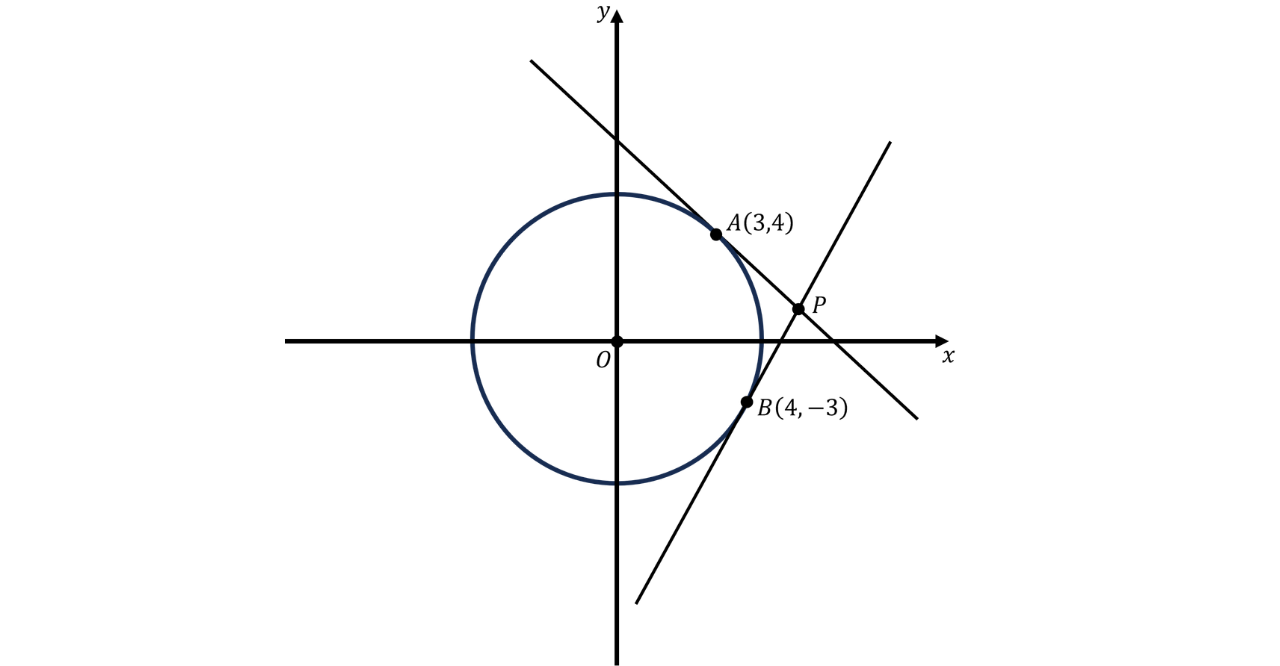
Step 1: Find the equations of the tangents at and
To find we first need the coordinates of We do this by finding the equations of the two tangents and then solving them simultaneously. is the point that lies on both lines.
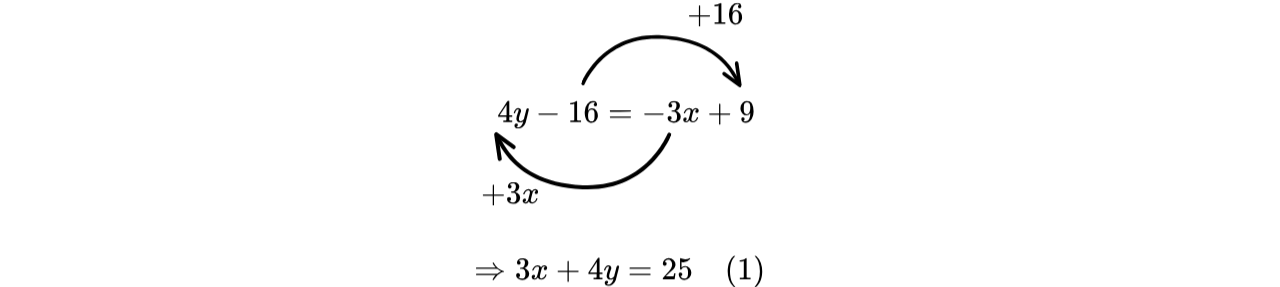
For the tangent at
The radius goes from to so
gradient of radius
Reciprocating to become and then changing the sign, we get the gradient of the tangent to be
gradient of tangent at
Using with and
Multiplying both sides by to clear the fraction,
Expanding the brackets on the right-hand side,
Rearranging by adding and to both sides (bringing all the and to the left-hand side and the constants to the right-hand side to prepare for simultaneous equations),
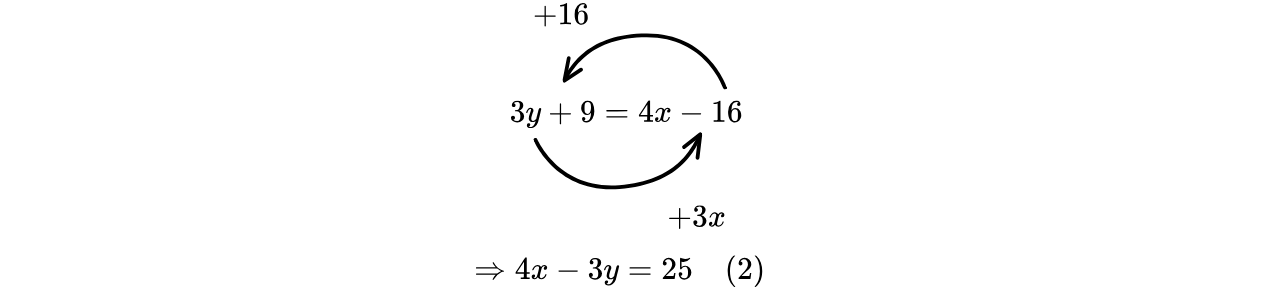
For the tangent at
The radius goes from to so
gradient of radius
Reciprocating to become and then changing the sign,
gradient of tangent at
Using with and
Multiplying both sides by to clear the fraction,
Expanding the brackets on the right-hand side,
Rearranging by subtracting and adding to both sides,
Step 2: Solve equations and simultaneously to find
We will eliminate
To do this, we make the coefficients equal and opposite in sign by multiplying equation by and equation by

Dividing both sides by
Substituting into equation to find
Subtracting from both sides,
Then, dividing both sides by
Therefore,
Step 3: Find the length using the distance formula.
We now have and We substitute these coordinates into the distance formula, which is
where and
Simplifying inside the brackets,
Note: We can also think of the distance illustratively. Here is the line segment,
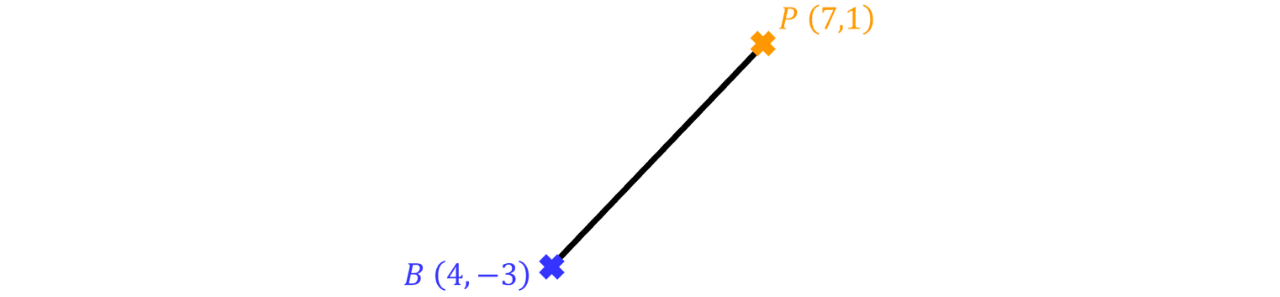
To find the distance, we first need to find the change in which is represented by and the change in which is represented by
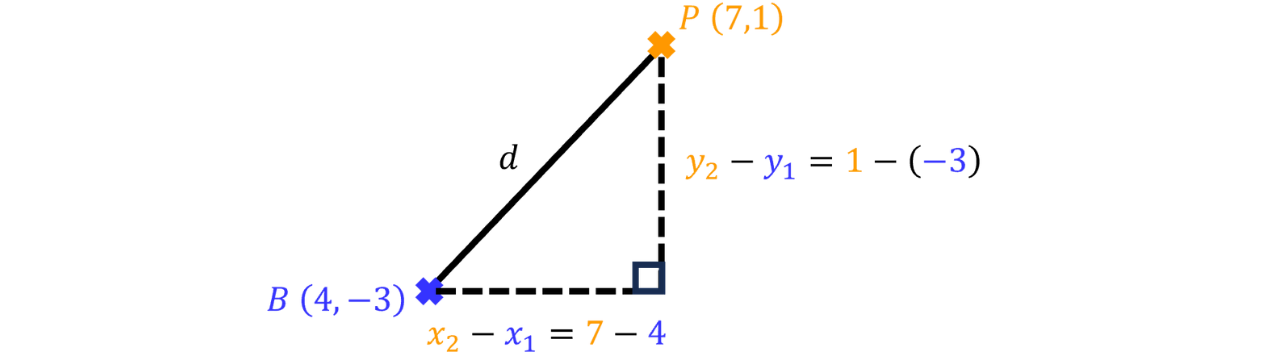
Notice that we formed a right-angled triangle. To find the length, which is the hypotenuse of this triangle, we use Pythagoras’ Theorem.
Then, square rooting both sides, we get the distance formula.
Challenging Question