Probability
Neil Trivedi
Teacher

Contents
Probability
Probability measures how likely something is to happen. Every probability takes a value between (impossible) and (certain), and can be written as a fraction, a decimal, or a percentage.
In this note, we cover how to count outcomes, how to calculate probabilities, the difference between the theoretical and the experimental probability, and how to combine events that are independent or mutually exclusive.
Counting Outcomes (Combinatorics)
Combinatorics is the name given to counting the number of different ways something can happen or can be arranged. Being able to count the total number of possible outcomes is the first step towards calculating probabilities, and the key tool for doing it is the product rule for counting.
The Product Rule for Counting
If there are ways of making one choice and ways of making a second choice, then there are
ways of making both choices. This extends to any number of choices; multiply the number of options available at each stage.
Note: Sometimes, we need to adjust after multiplying. For example, if the order does not matter, we may have counted the same outcome more than once (usually twice). In these cases, we divide to correct for double counting. We will encounter this in example 2.
Example 1:
A café meal deal consists of one sandwich, one drink and one snack. There are sandwiches, drinks and snacks to choose from.
a) How many different ways are there of choosing a sandwich and a drink?
Single Step: Multiply the number of options for each choice.
Each of the sandwiches can be paired with any of the drinks. Using the product rule,
Therefore, there are different ways of choosing a sandwich and a drink.
b) How many different meal deals are possible in total?
Single Step: Extend the product rule to all three choices.
A meal deal is made by choosing a sandwich, then a drink, then a snack. We multiply the number of options at every stage:
Therefore, different meal deals are possible.
Example 2:
There are players in a chess club. Each player plays every other player exactly once. Work out the number of games that take place.
Step 1: Pair every player with every opponent.
Each of the players can be matched against other players, giving
Step 2: Correct for double counting, since the order of the players does not matter.
The question states that each player is playing the other exactly once. Doing counts every game twice: “Amy vs Ben” is the same game as “Ben vs Amy”.
Since the order of the two players does not matter, we divide by
Therefore, games take place.
Calculating Probabilities
Once we can count outcomes, we can calculate probabilities. To find the probability of an event, we note down which of the possible outcomes are favourable (the outcomes we are looking for) and compare this with the total number of outcomes.
Probability of an Event
This formula only works when all outcomes are equally likely.
Example 3:
A bag contains red counters, blue counters and green counters. One counter is taken from the bag at random.
a) Find the probability that the counter is blue.
Step 1: Count the total number of outcomes.
Step 2: Divide the number of favourable outcomes by the total.
There are blue counters, and each counter is equally likely to be picked. So,
(blue)
b) Find the probability that the counter is not green.
Step 1: Count the favourable outcomes.
“Not green” means that the counter is red or blue, so there are favourable outcomes.
Step 2: Divide the number of favourable outcomes by the total.
(not green)
Note: the probabilities of “green” and “not green” add up to since one of the two must happen.
Example 4:
The fair spinner shown has three equal sections, numbered and The spinner is spun twice.

a) List all of the possible outcomes.
Single Step: We record each outcome as (spin, spin).
A table keeps the list organised:
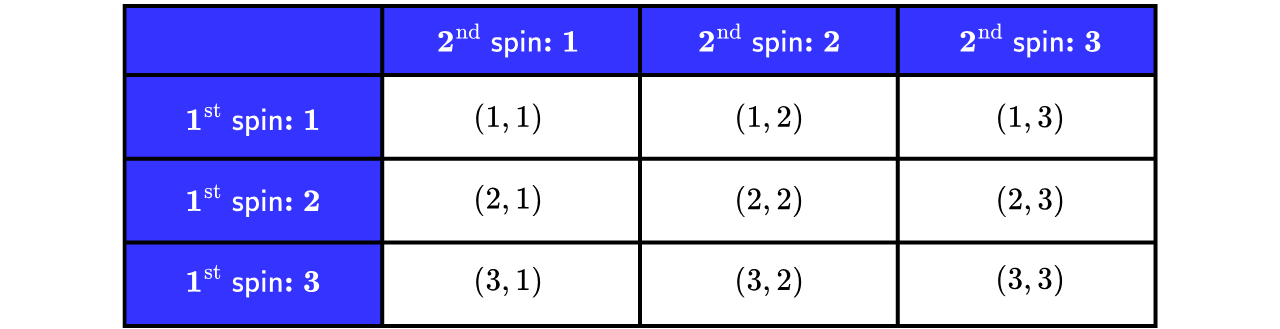
There are equally likely outcomes; exactly as the product rule for counting predicts (possible outcomes on the first spin and possible outcomes on the second spin).
b) Find the probability that both spins land on the same number.
Single Step: Pick out the favourable outcomes and divide by the total number of outcomes.
The favourable outcomes are and that is outcomes out of
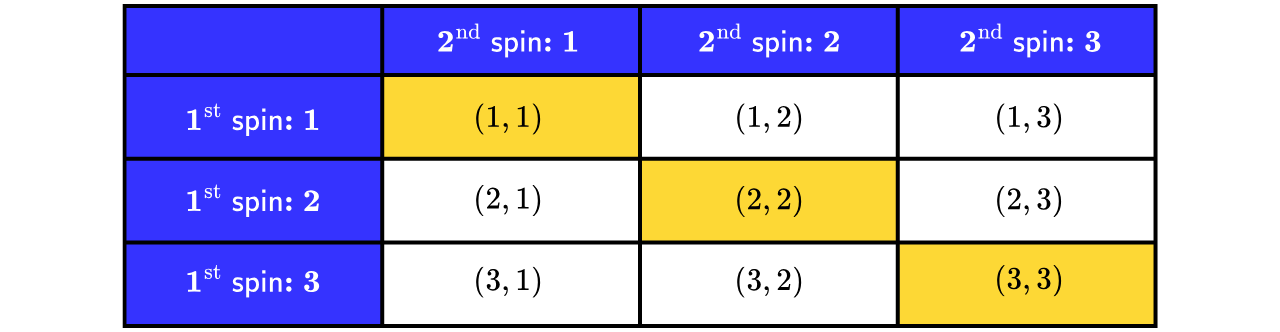
(same number)
c) Find the probability that the two spins have an even total.
Single Step: Pick out the favourable outcomes and divide by the total number of outcomes.
Adding the numbers in each cell of the table, the outcomes with an even total are and
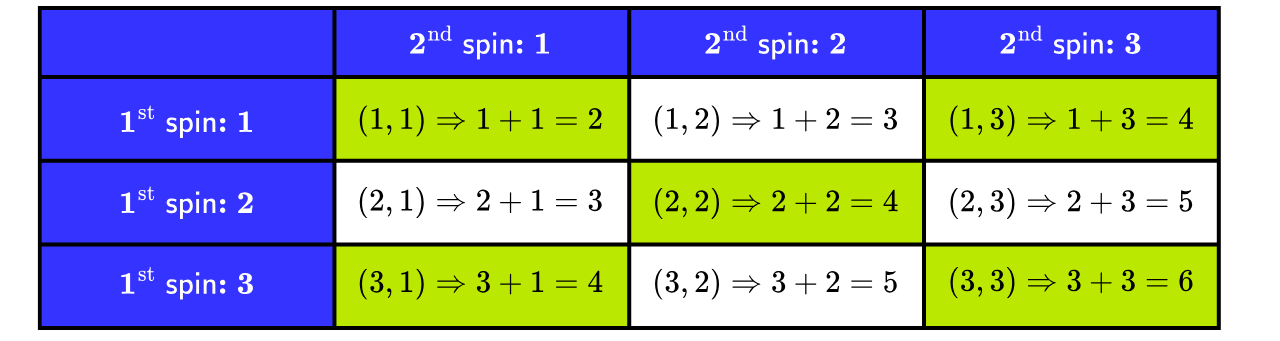
This is outcomes out of
(even total)
Theoretical vs Experimental Probability
If we toss a fair coin, we know that the probability of landing heads is this is a theoretical probability. In reality, we could toss a coin times and see heads instead of the expected heads and tails. Based on that experiment, the experimental probability of heads would be (heads out of tosses). These two ideas are closely related but are calculated in different ways.
Theoretical vs Experimental Probability
Theoretical probability: found by reasoning about equally likely outcomes, using
(event)
Experimental probability: also known as the relative frequency, found by observing the outcome in an experiment, using
(event)
The more trials we carry out, the closer the experimental probability is expected to get to the theoretical probability.
Example 5:
Wayne Rooney rolls a fair six-sided die times. The table shows his results.

a) Write down the theoretical probability of rolling a
Single Step: Divide the number of favourable outcomes by the total number of outcomes.
The die is fair, so all six outcomes are equally likely and one of them is a
Note: die is the singular of dice. However, using dice even when referring to the singular is acceptable.
b) Find the experimental probability of rolling a
Single Step: Divide the frequency of the outcome by the total number of trials.
From the table, a occurred times out of the rolls.
c) What could Wayne Rooney do to bring the experimental probability closer to the theoretical probability?
Single Step: Use your understanding of theoretical and experimental probabilities to explain the connection between them.
He should increase the number of trials as the more times the die is rolled, the closer the relative frequency is expected to get to
Probabilities also let us predict how often an outcome will occur. If we know the probability of an outcome, we can estimate how many times it will happen in a given number of trials.
An easy example is to ask yourself, “If I flip a coin times, how many heads would I expect to see?”. You will quickly answer since you know that the theoretical probability of landing on heads is and
Expected Frequency
Expected frequency Probability Number of trials
Example 6:
A biased four-sided spinner has sections labelled A, B, C and D. The table shows the probability of the spinner landing on each section. The probability of landing on C is equal to the probability of landing on D.

a) Find the value of
Step 1: Use the fact that the probabilities add up to
The spinner must land on one of the four sections, so the probabilities sum to
Step 2: Solve for
Subtracting from both sides,
Dividing both sides by
b) The spinner is spun times. Estimate the number of times it lands on D.
Single Step: Multiply the probability of landing on D by the number of trials.
The probability of landing on D is
Expected frequency
Therefore, we expect the spinner to land on D times.
Independent vs Mutually Exclusive Events
Exam questions often involve combining two or more events. Two special relationships between events come up again and again: events can be independent, or they can be mutually exclusive. It is important to not mix these up.
Independent Events
Two events are independent if the outcome of one does not affect the outcome of the other. If and are independent, then
and
Mutually Exclusive Events
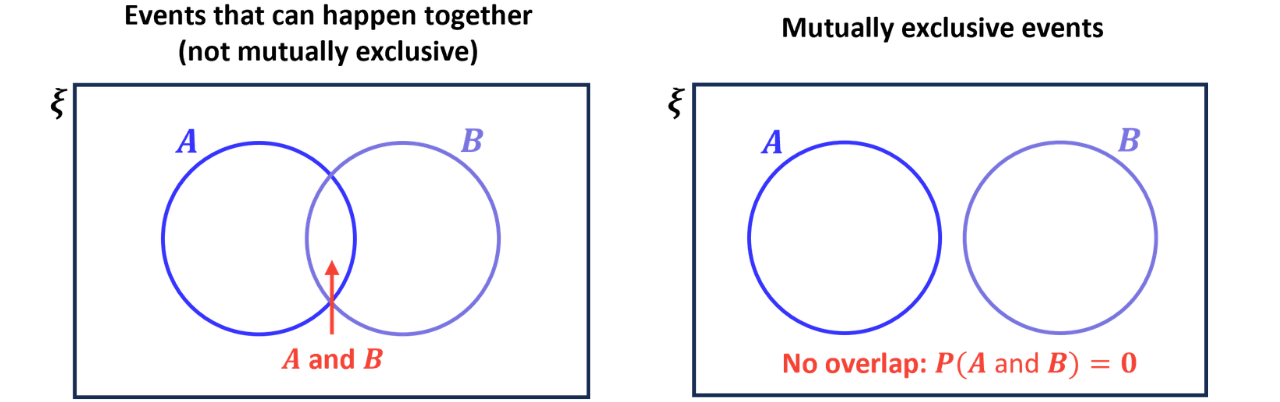
Two events are mutually exclusive if they cannot happen at the same time. If and are mutually exclusive, then
and
Venn diagrams can show whether events are mutually exclusive. If two events can happen together, their circles overlap, and the overlap represents and
If two events are mutually exclusive, their circles do not overlap because it is impossible for both events to happen at once.
Note: overlapping circles only show that two events can happen together. They do not tell us whether the events are independent.
Some examples of each type of event:

Example 7:
a) A fair six-sided die is rolled twice. Find the probability that it lands on six both times.
Single Step: Check the events are independent, then multiply.
The result of the first roll does not affect the second roll, so the two events are independent, and we can multiply their probabilities:
(six and six)(six) (six)
b) A fair six-sided die is rolled and a fair five-sided spinner, numbered from to is spun. Find the probability that the die lands on six and the spinner lands on an odd number.
Step 1: Find the probability of each event.
For the die, (six)
2) For the spinner, the odd numbers are and which are out of a possible outcomes. Therefore, (odd)
Step 2: Multiply the probabilities, since the events are independent.
The result of rolling a die does not affect the outcomes of spinning the spinner. So,
(six and odd)
Example 8:
The probability that it rains in Bognor Regis on Saturday is The probability that it rains in Bognor Regis on Sunday is
Dom says: “The probability that it rains on both days is ”
Explain why Dom’s method may not give the correct probability.
Single Step: Explain what Dom assumed to be true, then explain why his assumption may not be correct.
Dom has assumed that the two events are independent as the multiplication rule, and only works for independent events.
Whether it rains on Saturday and whether it rains on Sunday are not necessarily independent: the weather on one day affects the weather on the next (for example, a weather system that brings rain on Saturday may still be there on Sunday). So, multiplying the probabilities may not give the correct answer.
Example 9:
Ten cards are numbered from to Two cards are taken at random, one after the other, without replacement. Find the probability that the first card shows an even number and the second card shows an odd number.
Step 1: Find the probability that the first card is even.
The even numbers are and These are favourable outcomes out of the cards, which means that
(even on first pick)
Step 2: Find the probability that the second card is an odd number.
The odd numbers are and and since the first card was even, all odd numbers are still in the pack.
Also, since the first card was taken without replacement, the number of cards left is So, there are favourable outcomes out of the remaining cards, which means that
(odd on second pick)
Step 3: Multiply the two probabilities.
We multiply the probability of the first event by the probability of the second event after the first event has happened.
(even, then odd)
Note: For questions like this, we could also use a tree diagram. For more practice on this, please read our tree diagram study note.
Practice Question