Tree Diagrams
Neil Trivedi
Teacher

Contents
Tree Diagrams
A tree diagram is a way of mapping out every possible outcome of two or more events, one branch at a time. Each set of branches represents one event, and the probability of each outcome sits on its branch.
Tree diagrams are especially powerful when one event affects the next, which is exactly what happens when we pick objects out of a bag and do not put them back.
Before we worry about bags of counters, let’s look at the anatomy of a tree diagram, using something simple: two flips of a fair coin.
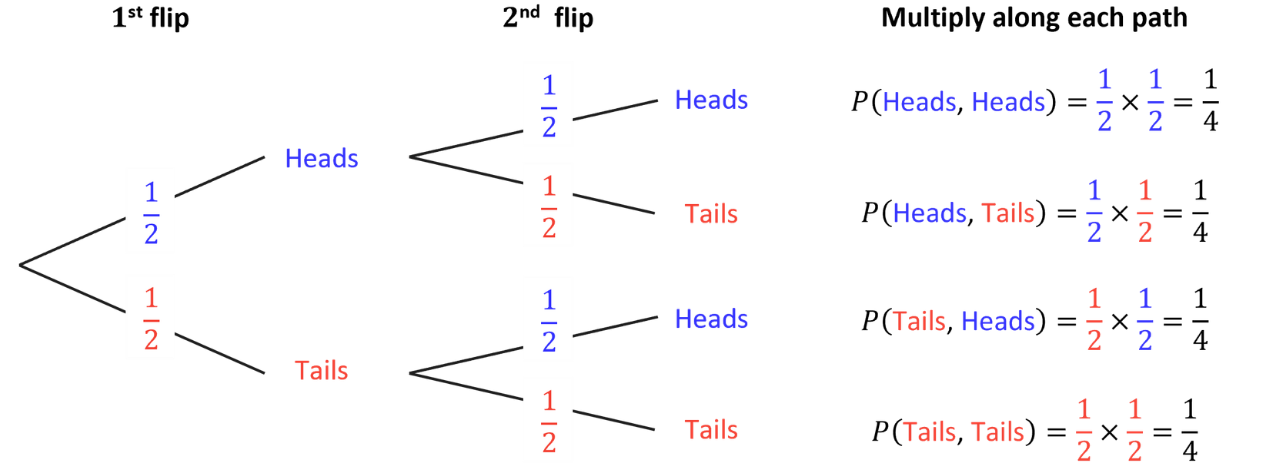
To find the probability of a whole path, we multiply along the branches: the probability of heads then heads is If more than one path gives us what we want (for example, heads and tails in no particular order), we add those paths together. That is really all a tree diagram ever asks of us.
The Golden Rules of Tree Diagrams
Multiply along the branches: moving through a path means “this and then this”, and “and” means multiply.
Add between the paths: wanting one path or another means add.
Branches from a single point always add up to something must happen on every pick.
Note: The probabilities at the ends of all the paths also add up to This is a brilliant way to check that a tree has been drawn correctly.
Without Replacement
In most exam questions, once an object has been taken out, it stays out. This is called picking without replacement, and it changes the tree in two ways: after the first pick, there is one fewer object in the bag, so on the second set of branches, every denominator drops by and the numerator of whichever type was just removed also drops by Everything else stays the same.
Very important: Do not simplify until after all probabilities have been found.
Example 1:
Sofia has blue pens and red pens in her pencil case. She takes two pens out at random, one after the other, without replacement. Find the probability that she takes one pen of each colour.
Step 1: Draw the tree.
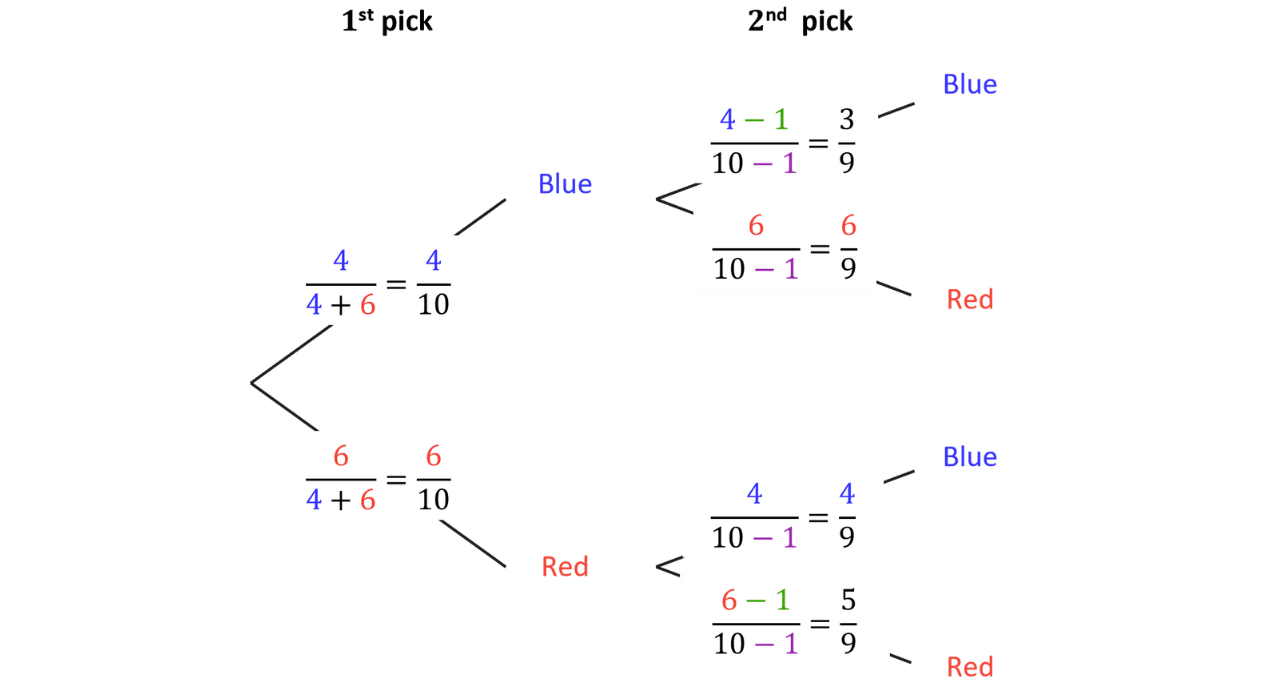
Now that we have found the probabilities for all branches, we can simplify the fractions. Re-drawing the tree neatly,
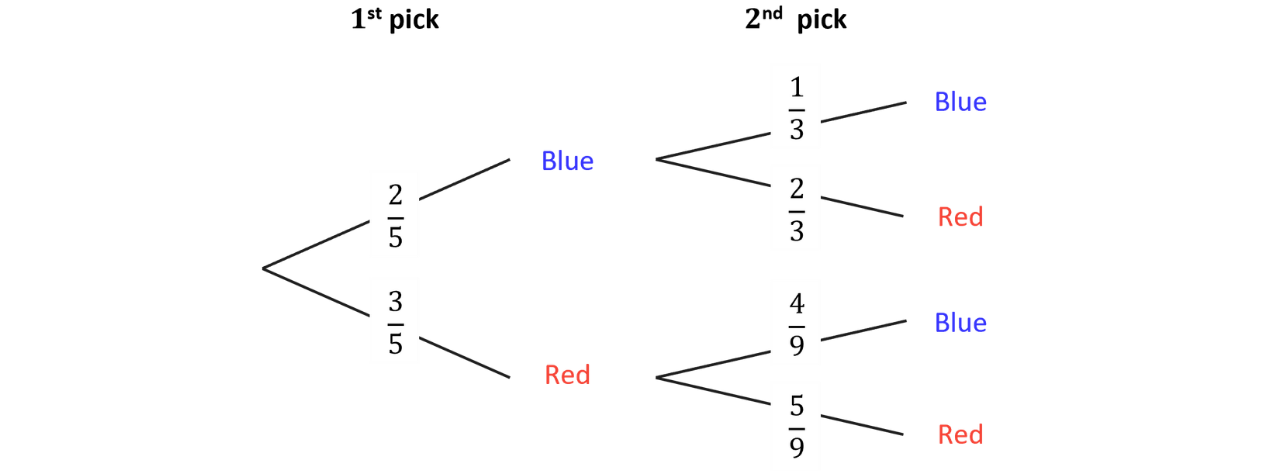
Note: We do not always need to simplify fractions straight away. Sometimes, it is better to leave fractions unsimplified, especially when we need to add probabilities together, because they may already have a common denominator, which makes adding easier. However, once all the branch probabilities have been found, we can simplify the fractions to make the tree easier to read and multiplying along the branches easier.
Step 2: Pick out the useful paths and multiply them.
Two paths give one pen of each colour: blue then red, or red then blue.
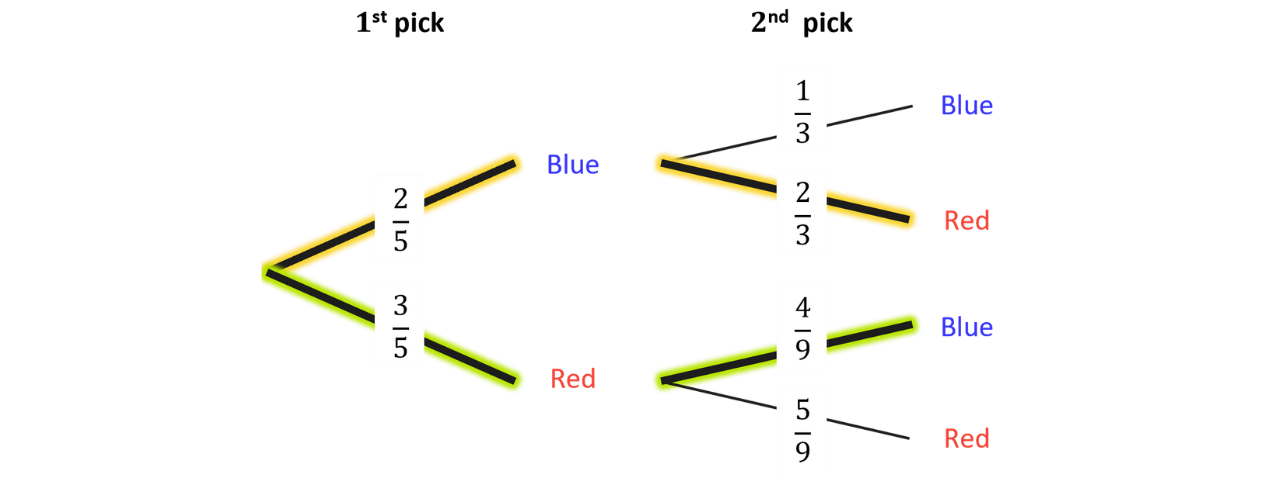
Multiplying along each path,
(B, R)
(R, B)
Step 3: Add the paths together.
(one of each)
Therefore, the probability that Sofia takes one pen of each colour is
Note: The two “mixed” paths always have the same probability as they are the same outcomes but just in a different order. They multiply the same numbers, so we can jump straight to:
Example 2:
A box of chocolates contains milk chocolates and dark chocolates. Leo takes three chocolates at random and eats them.
a) Find the probability that the chocolates are all the same type.
Step 1: Draw the tree.
This is a great example to see how out of control a tree diagram can become with more than two picks!
Reminder: The coloured subtraction shows what has been removed from the bag. After each pick, there is one fewer chocolate in the box, so on each subsequent set of branches, every denominator drops by and the numerator of whichever type of chocolate was just removed also drops by
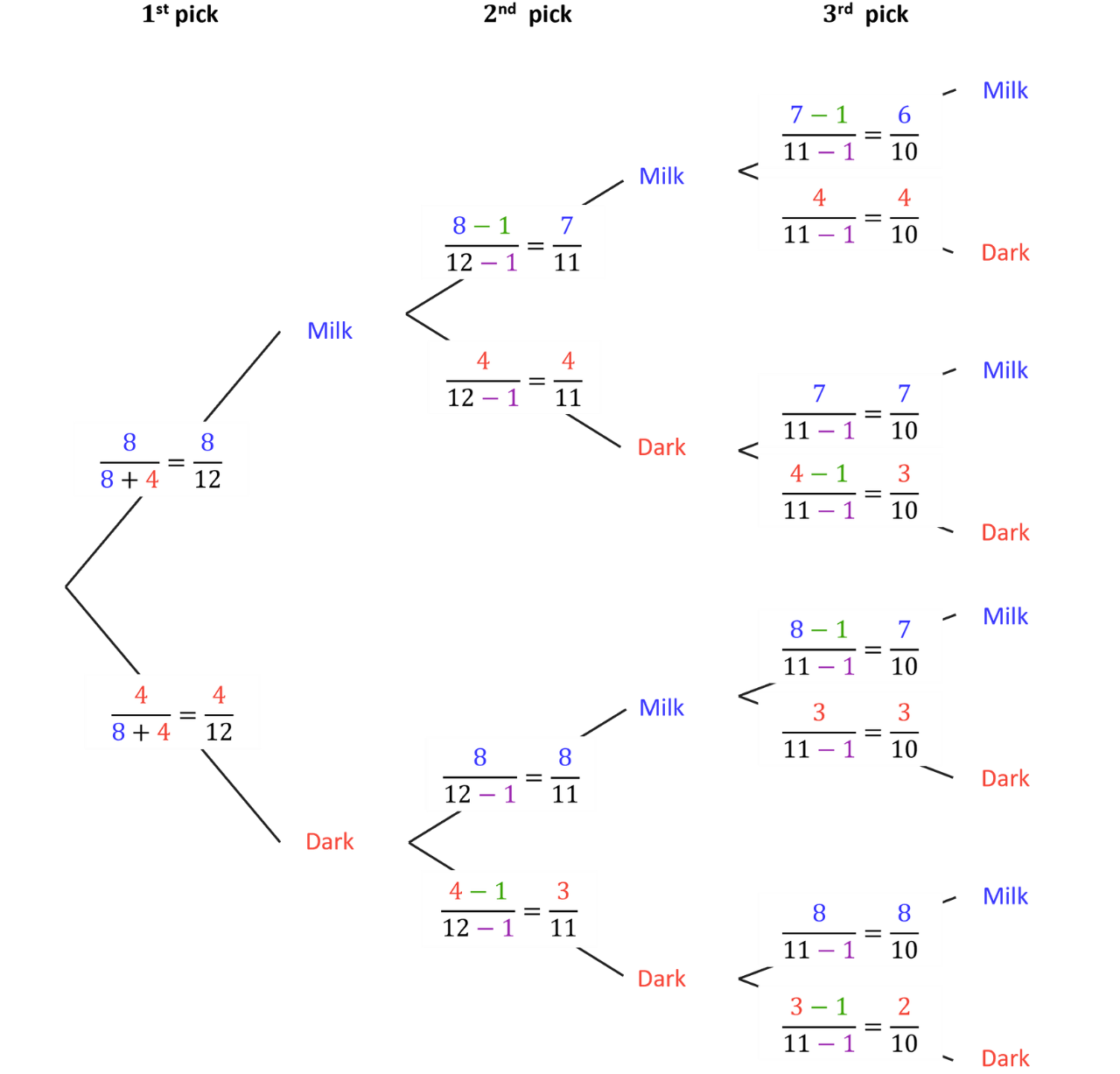
Now that we have found the probabilities for all branches, we can simplify the fractions. Re-drawing the tree neatly,
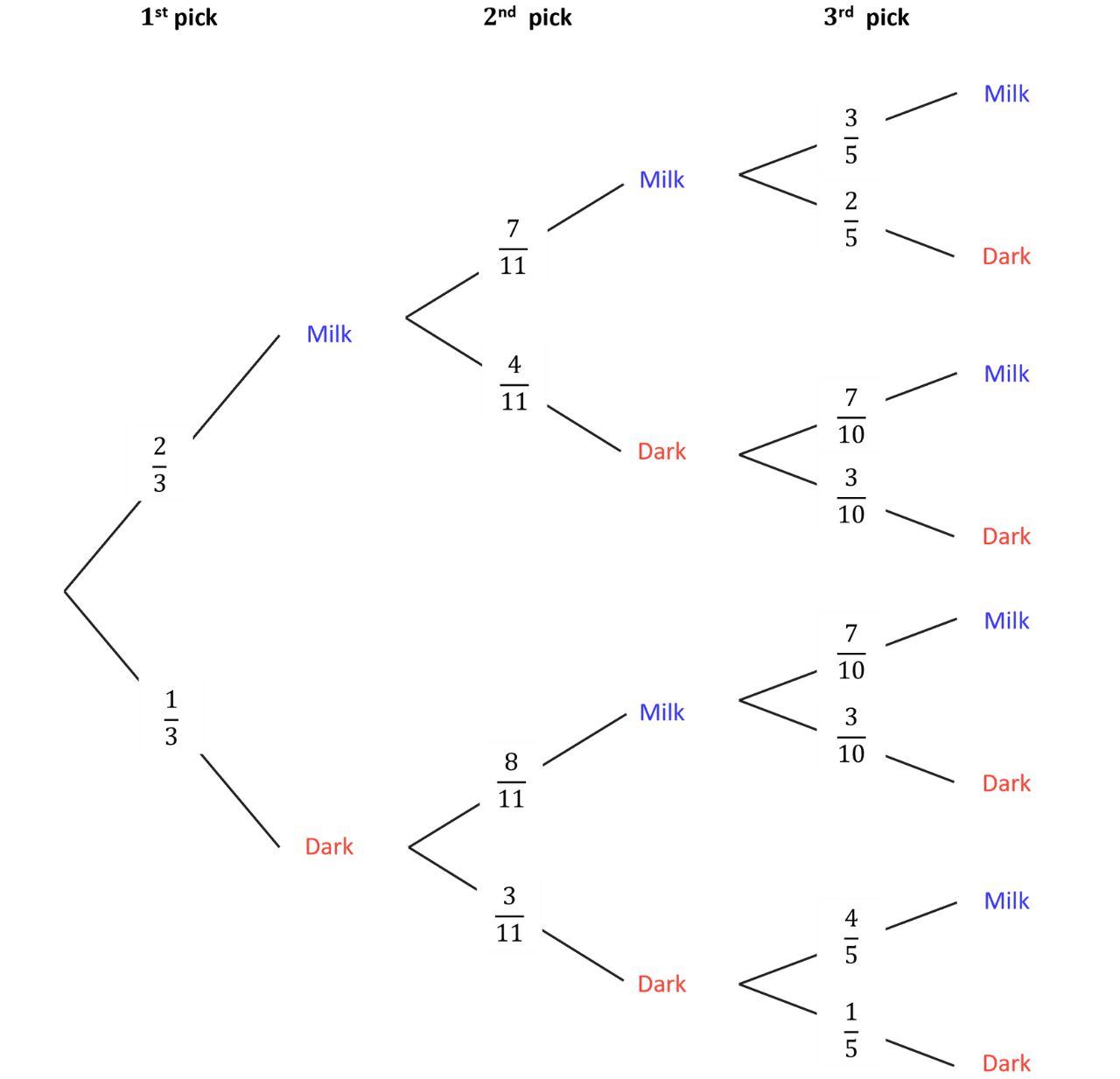
Notice how all pairs of fractions add to
Step 2: Pick out the useful paths and multiply them.
Only two paths work: milk, milk, milk and dark, dark, dark.
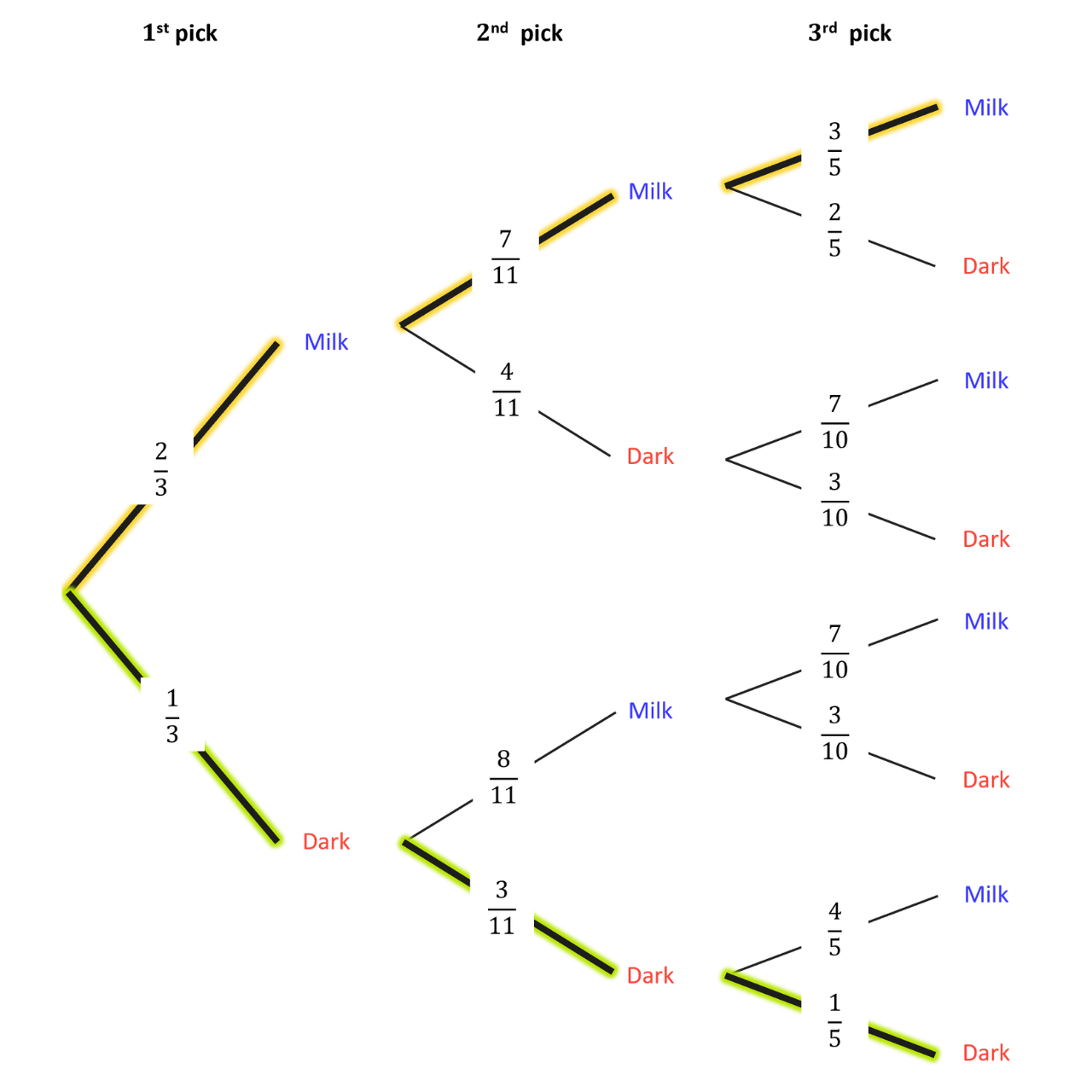
(M, M, M)
(D, D, D)
Step 3: Add the paths together.
(all the same)
Therefore, the probability that the chocolates are all the same type is
b) Find the probability that the chocolates are not all the same type.
Single Step: Use the complement of part a).
Note: The complement of an event means ‘everything that is not that event’.
So, the complement of ‘all the same’ is ‘not all the same’.
Every set of three chocolates is either all the same or not all the same, so the two probabilities must add up to

(not all the same) (all the same)
(not all the same)
Therefore, the probability that the chocolates are not all the same type is
When the Tree Gets Out of Hand
We have already seen, from Example 2, how wild the tree becomes with three picks of two different objects. Three picks with three types of objects would need a tree with end branches; less a neat tree diagram, more the Amazon rainforest.
The good news is that we do not have to draw it. A tree diagram is only a way of organising multiplications, so once we know which paths we need, we can write them straight down and skip the drawing altogether.
Questions of this type will usually ask you about objects being the same or different types, like Example 2. Just remember, for objects of the same type, after each pick, there is one fewer object in the bag, so on the next set of branches every denominator drops by and the numerator of whichever type was picked also drops by
Example 3:
A tin contains toffees, fudges and mints. Three sweets are taken from the tin at random. Find the probability that the sweets are not all the same type.
Step 1: Find P (all the same type) without drawing the tree.
Only three paths give sweets that are all the same type: all toffee, all fudge or all mint. There are sweets to start with, and the total drops by one with every pick.
(all the same type) = (T, T, T) + (F, F, F) + (M, M, M)
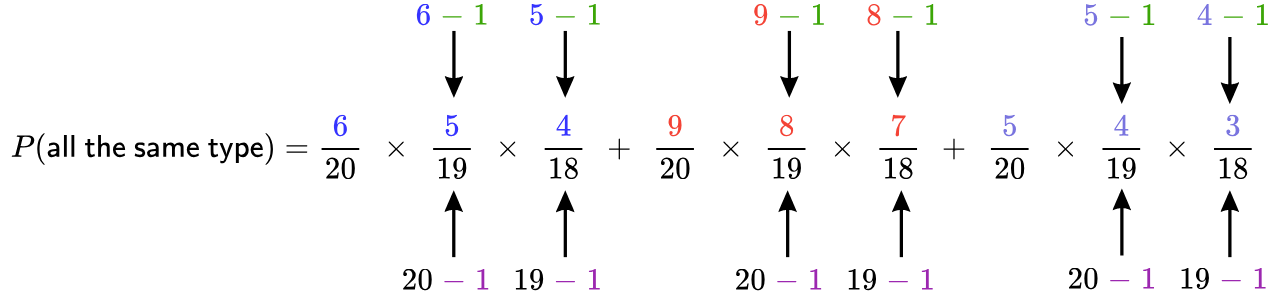
Every path sits over the same denominator, so all three fractions can be written as one, which makes typing into a calculator a lot quicker.
(all the same type)
Step 2: Use the complement.
(not all the same type) (all the same type)
(not all the same type)
Therefore, the probability that the sweets are not all the same type is
Note: “Not all the same type” includes outcomes like two toffees and a mint; listing every mixed path would take all day. Whenever a question says “not” or “at least”, think about the complement first.
Algebraic Tree Diagrams
The hardest tree diagram questions hide the number of objects. We are told a probability and asked to work backwards to find how many objects there were originally. The tree works exactly as before; we simply label the branches with algebra instead of numbers, then turn the given probability into an equation and solve it.
Example 4:
A bag contains blue counters and red counters in the ratio Two counters are removed at random. The probability that both counters are blue is How many counters were in the bag before any were removed?
Step 1: Turn the ratio into algebra.
A ratio of does not mean there are blue and red, only that the numbers are in that proportion.
So, we “un-simplify” by letting there be blue counters and red counters, giving counters in total.
Step 2: Draw the tree and identify the blue-blue path.
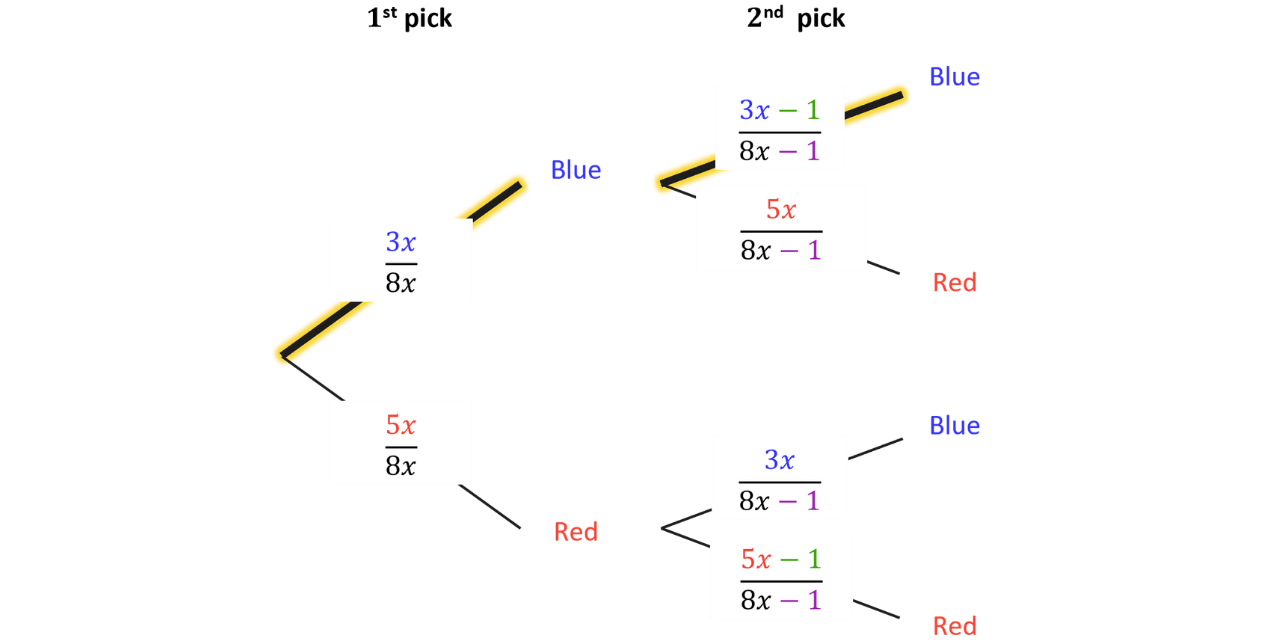
Step 3: Write the blue-blue path, then build and solve the equation.
(B,B)
On the first branch, the cancels: Be careful as this only works on the first branch. In the ‘’ blocks any cancelling.
Multiplying both sides by
Multiplying both sides by to clear the denominators (see our Solving with Algebraic Fractions study note for more practice),
Expanding the brackets,
Subtracting from both sides and adding to both sides,

Dividing both sides by
Step 4: Answer the actual question.
is not the answer as the question asks for the total number of counters, which is
Total counters
Therefore, there were counters in the bag before any were removed.
Note: Check that it works: with there are blue and red, so counters in total, and
Always re-read the question at the end: is a stepping stone, not the answer.
Challenging Question