Quadratic Simultaneous Equations
Neil Trivedi
Teacher

Quadratic Simultaneous Equations
Simultaneous equations are where two or more equations (at GCSE, we only work with two equations) that contain the same variables and are solved at the same time. The solution is the value of the variables that make all equations true simultaneously.
In previous years, we have learned how to solve linear simultaneous equations. For example:
Linear simultaneous equations can be solved using either elimination or substitution.
In this note, we will cover quadratic simultaneous equations. These are a pair of equations where at least one of the equations is quadratic.
Normally, in GCSE, quadratic simultaneous equations consist of one linear equation and one quadratic equation. For example:
Quadratic simultaneous equations are solved using substitution only. We cannot use elimination because the quadratic equation contains squared terms.
This means we cannot scale the equations to obtain matching coefficients for or and therefore we cannot add or subtract equations to eliminate one of the variables (there are some very rare instances where we can eliminate but substitution should still be the default method).
General Steps for Solving Quadratic Simultaneous Equations
Suppose we have one linear equation and one quadratic equation.
1) Rearrange the linear equation to make either or the subject.
2) Substitute the rearranged linear equation into the quadratic equation in place of either the or the This will form a quadratic equation in terms of either or
3) Solve the quadratic equation (by making one side equal and then factorise).
4) Substitute the solutions found in step 3 back into the rearranged linear equation, from step 1, to find the corresponding values of the other variable.
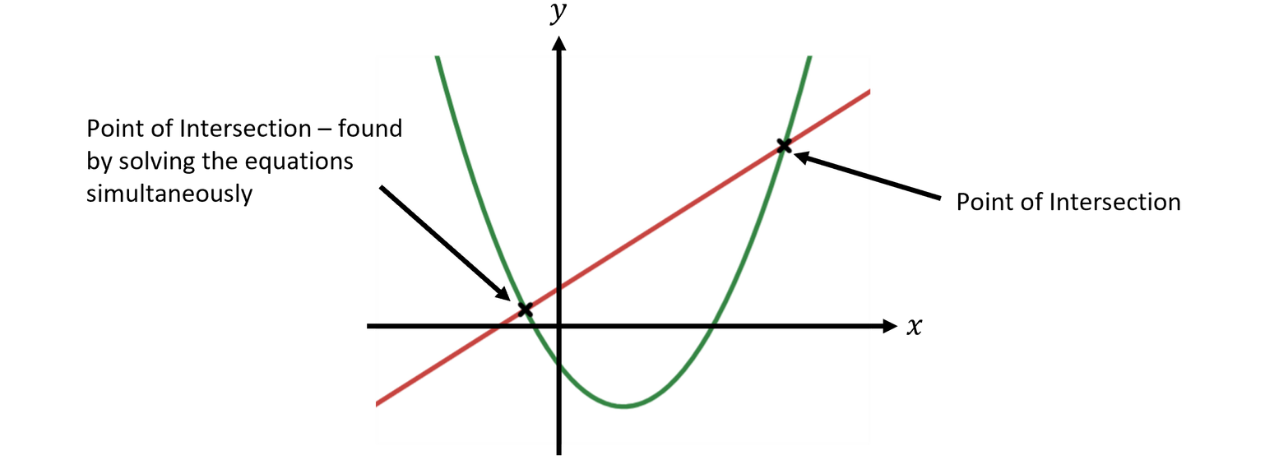
To note, the solutions are typically written as coordinates. Graphically, these coordinates represent the points of intersection between a line (represented by the linear equation) and a curve (represented by the quadratic equation). An example is shown below to illustrate this.
Example 1:
Solve the following simultaneous equations:
In this case, the linear equation already has as the subject, so we can substitute it directly into the quadratic equation.
Step 1: Substitute into the quadratic equation to form an equation in terms of
(equation 1)
(equation 2)
Substituting equation 2 into equation 1,
Expanding the brackets on the left-hand side, we have
Subtracting from both sides,
Step 2: Solve the quadratic equation.
This quadratic equation can be factorised to become
Setting each bracket equal to
or
Solving each equation for
or
Step 3: Substitute the solutions found in step 2 back into equation 2 to find the corresponding solutions.
Substituting we have
Then, substituting we have
Therefore, the solutions of these simultaneous equations are and
Example 2:
Solve the following simultaneous equations:
(equation 1)
(equation 2)
Step 1: Rearrange the linear equation (equation 2) to make either or the subject.
Here, it would be easier to rearrange to make the subject. We do this by subtracting from both sides.
(equation 3)
Step 2: Substitute into the quadratic equation to form an equation in terms of
Expanding the brackets on the left-hand side, we have
Subtracting from both sides,
Every term is divisible by so we can divide everything by
Step 3: Solve the quadratic equation.
This equation can be factorised to become
For more practice on factorising a quadratic when the coefficient of is not please see our Factorising Quadratics note.
Setting each bracket equal to we have
or
Solving each equation for
or
Step 4: Substitute the solutions found in step 3 back into the rearranged linear equation (equation 3) to find the corresponding solutions.
Substituting we have
We can rewrite as so that both fractions have a common denominator of
Then, substituting we have
Therefore, the solutions of these simultaneous equations are and
Example 3:
Solve the following simultaneous equations
(equation 1)
(equation 2)
Step 1: Rearrange the linear equation (equation 2) to make either or the subject.
Here, we can rearrange for either variable. However, it is usually helpful to choose the variable that makes substitution easier.
We will rearrange the equation to make the subject. The reason for that is the variable in equation 1 is positive. This reduces the risk of silly mistakes when expanding in the negative for
Adding to both sides,
Dividing both sides by to isolate
(equation 3)
Step 2: Substitute into the quadratic equation (equation 1) to form an equation in terms of
We now expand First, we distribute the power of (using our index rules) to the numerator and denominator, giving us
Next, we multiply all terms by to get rid of the denominator.
Expanding the brackets on the left-hand side, we have
Multiplying every term in the brackets by
Simplifying the left-hand side by collecting like terms,
To ensure that the coefficient of is positive, we move all terms from the left to the right.

Step 3: Solve the quadratic equation.
This equation can be factorised to become
Setting each bracket equal to we have
or
Solving each equation for
or
Step 4: Substitute the solutions found in step 3 back into the rearranged linear equation (equation 3) to find the corresponding solutions.
Substituting we have
Then, substituting we have
Therefore, the solutions of these simultaneous equations are and
Example 4:
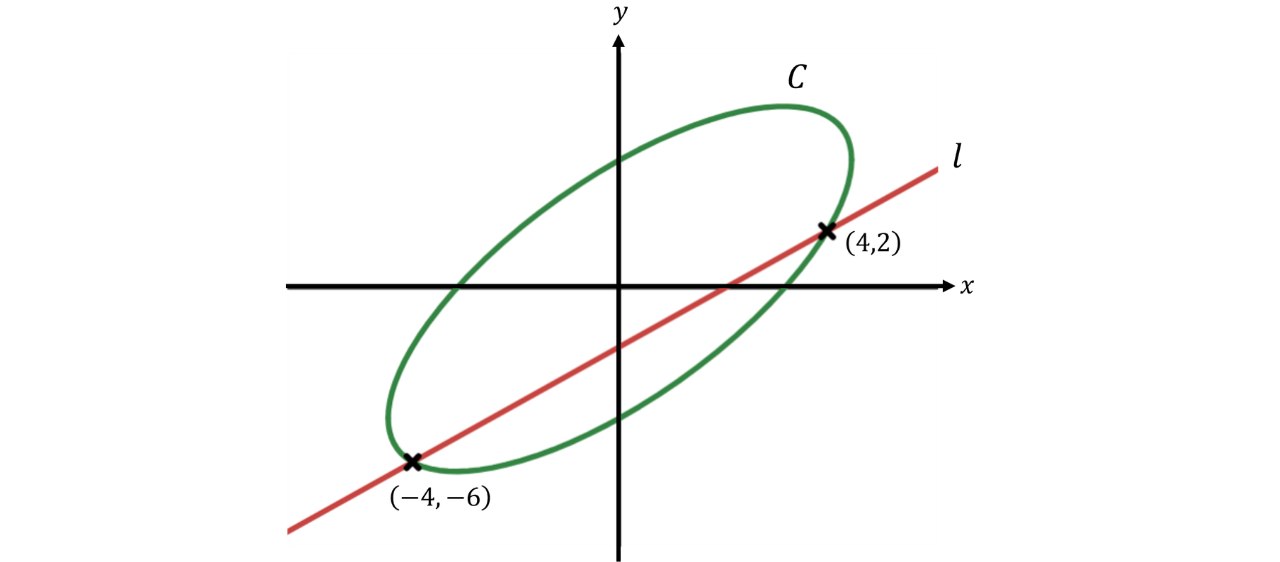
An ellipse has equation and a line has equation
Find the coordinates of the points of intersection between and
To find the points of intersection between the curve and the line, we solve the equations simultaneously.
Step 1: Rearrange the linear equation to make either or the subject.
We’ll rearrange for since it is a positive term.
Adding to both sides and subtracting from both sides,
Step 2: Substitute into the quadratic equation to form an equation in terms of
Simplifying the left-hand side by first expanding the brackets,
Notice that when we simplify this, some terms cancel out.
Step 3: Solve the quadratic equation.
Using the difference of two squares principle, this quadratic equation factorises to become
Setting each bracket equal to
or
Solving each equation for
or
Step 4: Substitute the solutions found in step 3 back into the rearranged linear equation to find the corresponding solutions.
Substituting we have
Then, substituting we have
Therefore, the solutions of these simultaneous equations and hence the points of intersection between and are and
For illustrative purposes, here is a graph showing and and their points of intersection.
Challenging Questions