Classification of Stars
Brook Edgar
Teacher

Contents
Explainer Video
Hipparchus Scale
Around BC, the Greek astronomer Hipparchus catalogued stars in the sky. He used a six-point scale, with being the brightest stars he observed and the dimmest. He claimed that a magnitude star was dimmer than a magnitude star.
As a difference of five magnitudes corresponds to a brightness increase of , then as , a change in magnitude of one corresponds to an increase in brightness of . Therefore, a magnitude star is brighter than magnitude star (which is brighter than magnitude , etc…). A magnitude star would be brighter than a magnitude star, so brighter. This could be because either the star is larger in size or it is closer to the Earth.
A modern version of this scale was developed, called the apparent magnitude scale, as brighter stars were observed over time due to the development of telescopes. This meant that, as one was the brightest star and six the dimmest, brighter stars would all have negative magnitudes.
The apparent magnitude of a star is how bright the star appears from the Earth.
The absolute magnitude is the apparent magnitude of the star if observed at a distance of ten parsecs from Earth. This measures the star's brightness due to its size and temperature rather than its distance from Earth.
Formula:
This equation only applies if the distances used are in parsecs.
Worked Example
Calculate the absolute magnitude of a star that is light years away with an apparent magnitude of .
Answer:
Teacher tip: Convert from ly into pc, . A light year is the distance light travels in one year.
Parsecs
One parsec is the distance from which subtends an angle of ( of a degree).
One astronomical unit is defined as the mean distance between the Sun and the Earth = .
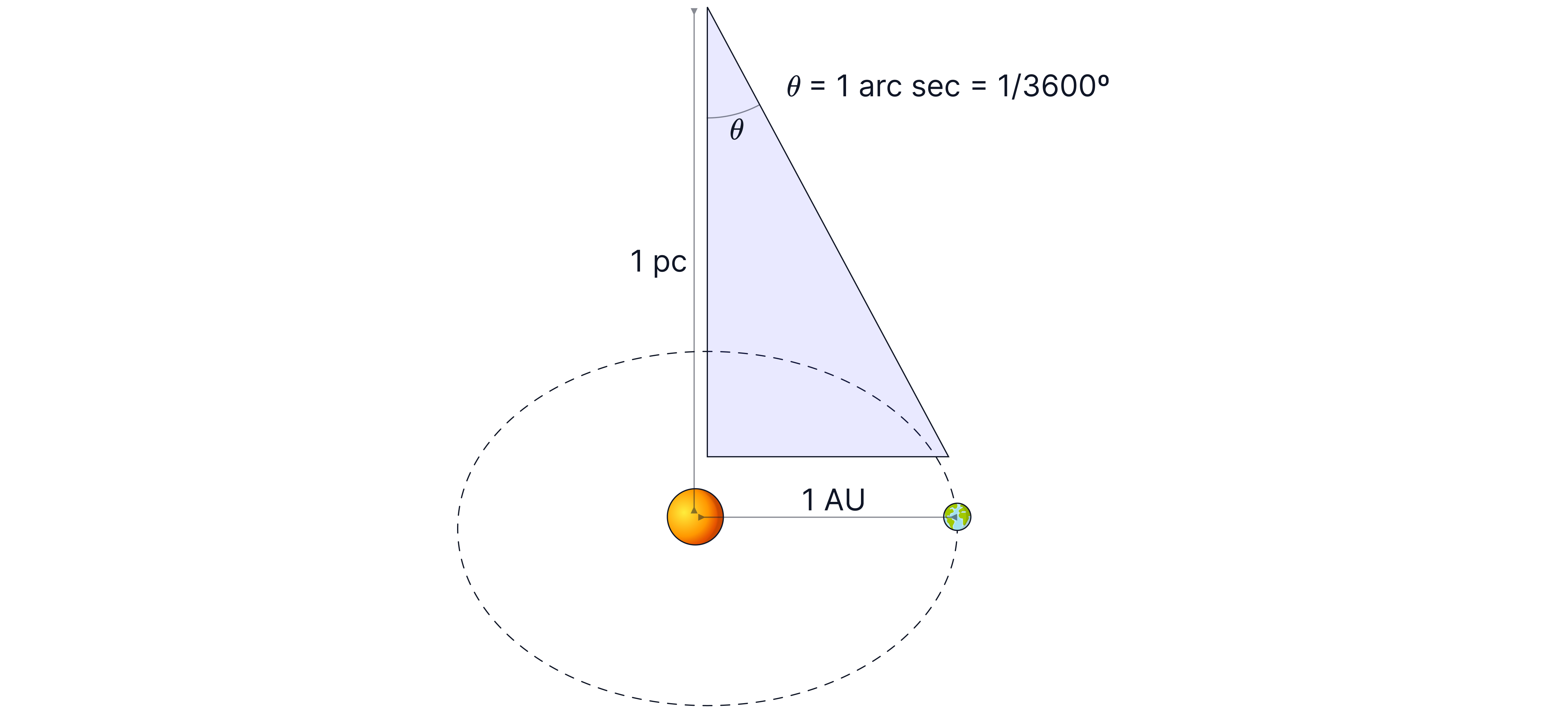
We use the parsec to measure how the apparent position of a star changes against the much more distant background stars that appear fixed as the Earth orbits the Sun.
A parsec is based on parallax, the apparent shift in the position of a star when viewed from Earth at different times of the year. Imagine looking at a nearby object with one eye closed, then switching to the other eye - the object seems to shift its position significantly, but a faraway object appears the same. This is called parallax.
Astronomers use this concept by measuring a star’s position from Earth six months apart (when Earth is on opposite sides of its orbit around the Sun). If a star appears to shift by , it is exactly away from Earth.
Life Cycle of a Star
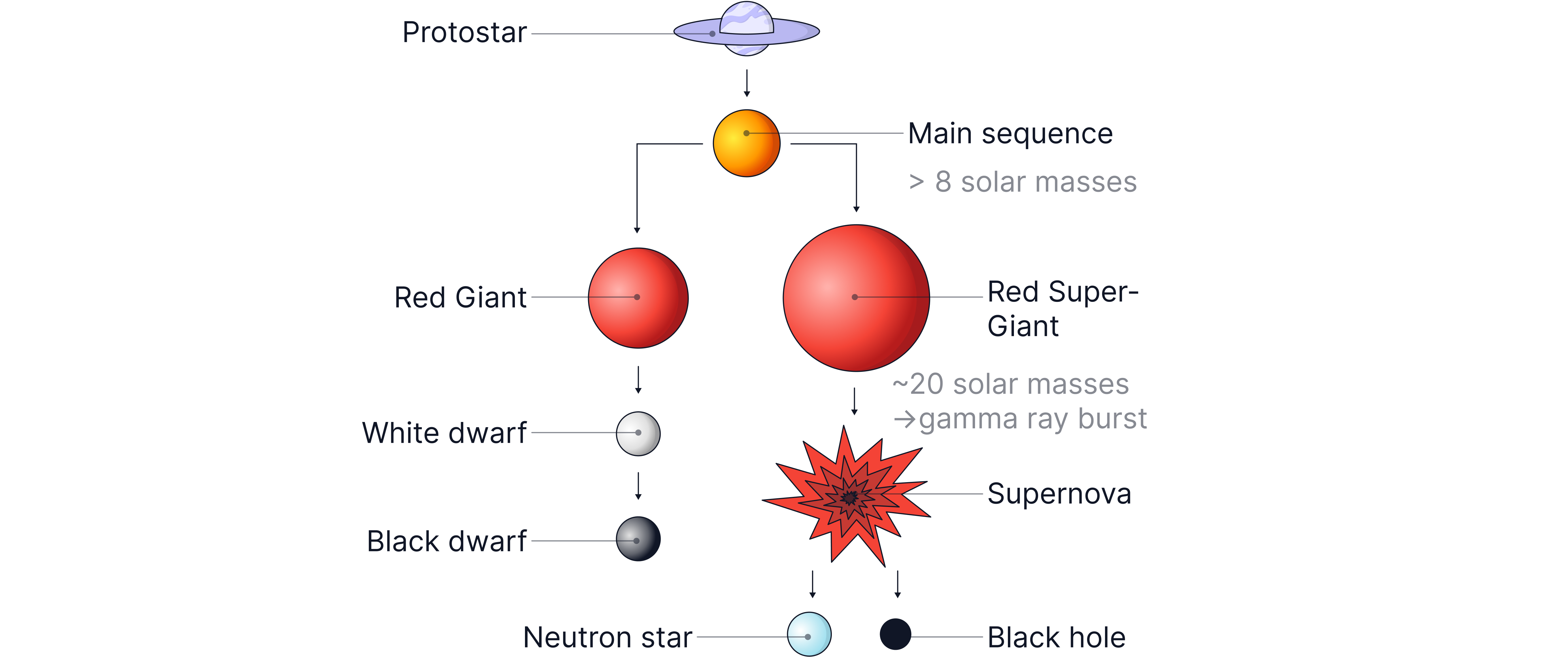
Stars begin in a nebula -> a cloud of gas and dust. Gravity pulls the nebula together, and it heats up until fusion can occur, entering the main sequence stage. All naturally occurring elements on Earth, up to and including Iron, are formed from fusion in stars. Elements heavier than iron are made in supernovas (when a star explodes).
Our star, the Sun, is currently in its main sequence phase of its life cycle, where stars spend most of their life cycle, fusing hydrogen into helium in their core through nuclear fusion. The outward pressure from fusion balances the inward pull of gravity, maintaining the star's stability.
Depending upon the mass of the star, the star will either form a red giant or a red super-giant after fusion of hydrogen in the star's core has finished. The star will eventually shrink into a white dwarf or explode in a supernova, collapsing into a neutron star or blackhole. A gamma-ray burst may also be emitted if the star is very large.
Neutron stars are extremely dense stars made of neutrons only. When the core of a star collapses into a neutron star, it tends to spin very rapidly, due to conservation of angular momentum, although they do lose energy and slow down with time. Neutron stars can be very powerful radio sources due to their extremely strong magnetic fields, and this, combined with their spinning, produces pulsars.
Black holes have an escape velocity greater than the speed of light. The boundary at which the escape velocity is equal to the speed of light is called the event horizon. The radius of the event horizon is referred to as the Schwarzschild radius, .
Formula:
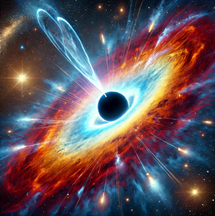
Supermassive Black Holes found at the centre of active galaxies (where matter is continually falling into the black hole) emit jets of radiation from the poles, known as Quasars. They are extremely bright ≈ an entire galaxy, with extremely large red shifts, as they are very far away.
Worked Example
To become a Black Hole, the core of a star would have to have a mass at least twice that of the Sun. Calculate this Schwarzschild radius.
Answer:
Mass of sun
Gravitational constant
Speed of light
Type 1a Supernova
Supernovae are objects which exhibit a rapid and enormous increase in luminosity.
Type two supernovae are from exploding stars.
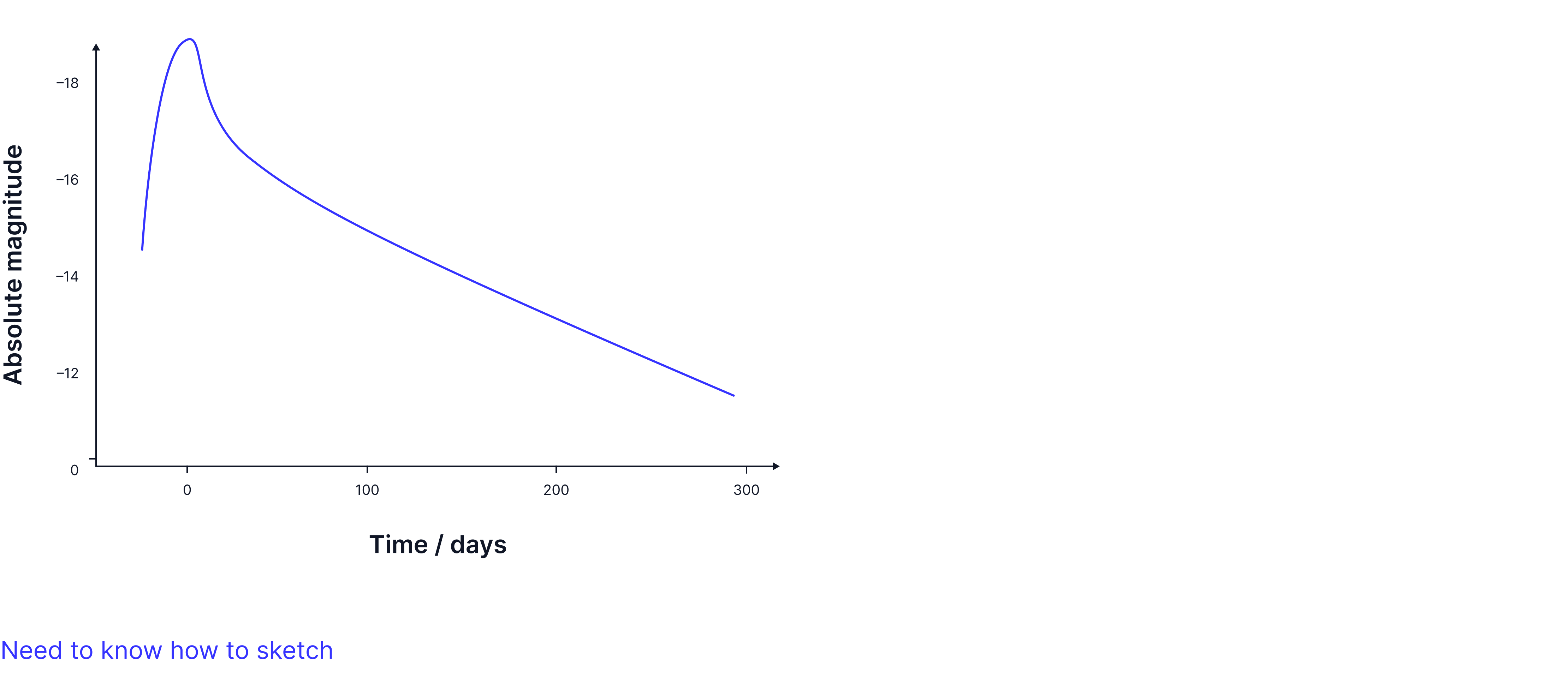
Type 1a supernovae form from binary systems (two objects that are gravitationally bound, orbiting a common centre of mass). A binary system to form a type 1a supernova would be when one star expands into a red giant, causing the companion white dwarf star to accumulate the mass of the expanding red giant until it reaches a critical mass, causing it to explode. The explosion produces a very consistent light curve with a known peak in absolute magnitude of around , lasting for approximately days. Type 1a supernovae are known as standard candles used to measure distances, as we can compare their observed brightness with their known intrinsic brightness/luminosity. We can then determine their distance from us and, as a result, the distance to the galaxy they occurred in.
Spectral Class
Stars can be classified according to their temperature (more on how to determine this later), their colour or due to the absorption lines seen in their spectra.
When the light from a star passes through its 'atmosphere', absorption at particular wavelengths occurs. This produces gaps in the spectrum of the light received from the star, resulting in an absorption spectrum. The wavelengths absorbed are related to their frequency and therefore to particular energies .
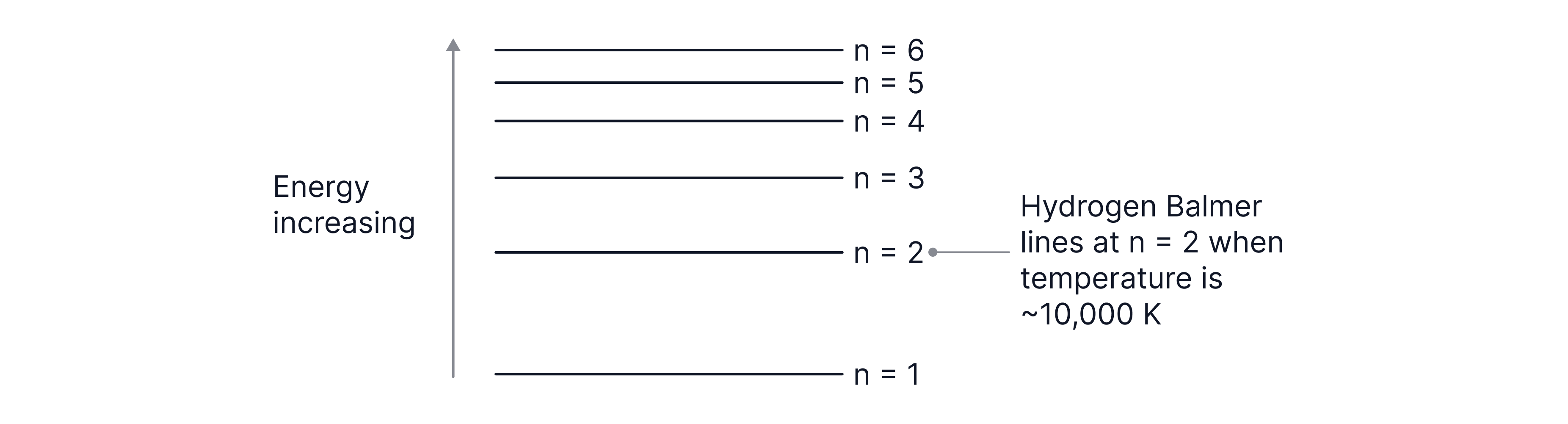
This occurs as electrons in the atoms and molecules of the star’s atmosphere 'jump’ to higher energy levels when they absorb light. The difference in these energy levels are discrete and therefore the frequencies of the absorbed light are discrete
One set of these absorption lines are known as Hydrogen Balmer lines. Hydrogen Balmer lines are formed when electrons in the hydrogen atom start in the energy level as the star is very hot (any hotter and the hydrogen gets ionised). As the hydrogen in the stars atmosphere absorbs light, the electrons are promoted to higher energy levels. When they de-excite, light is emitted in all directions, that we can detect.
All information from stars is collated to categorise the stars into specific spectral classes, as shown below:
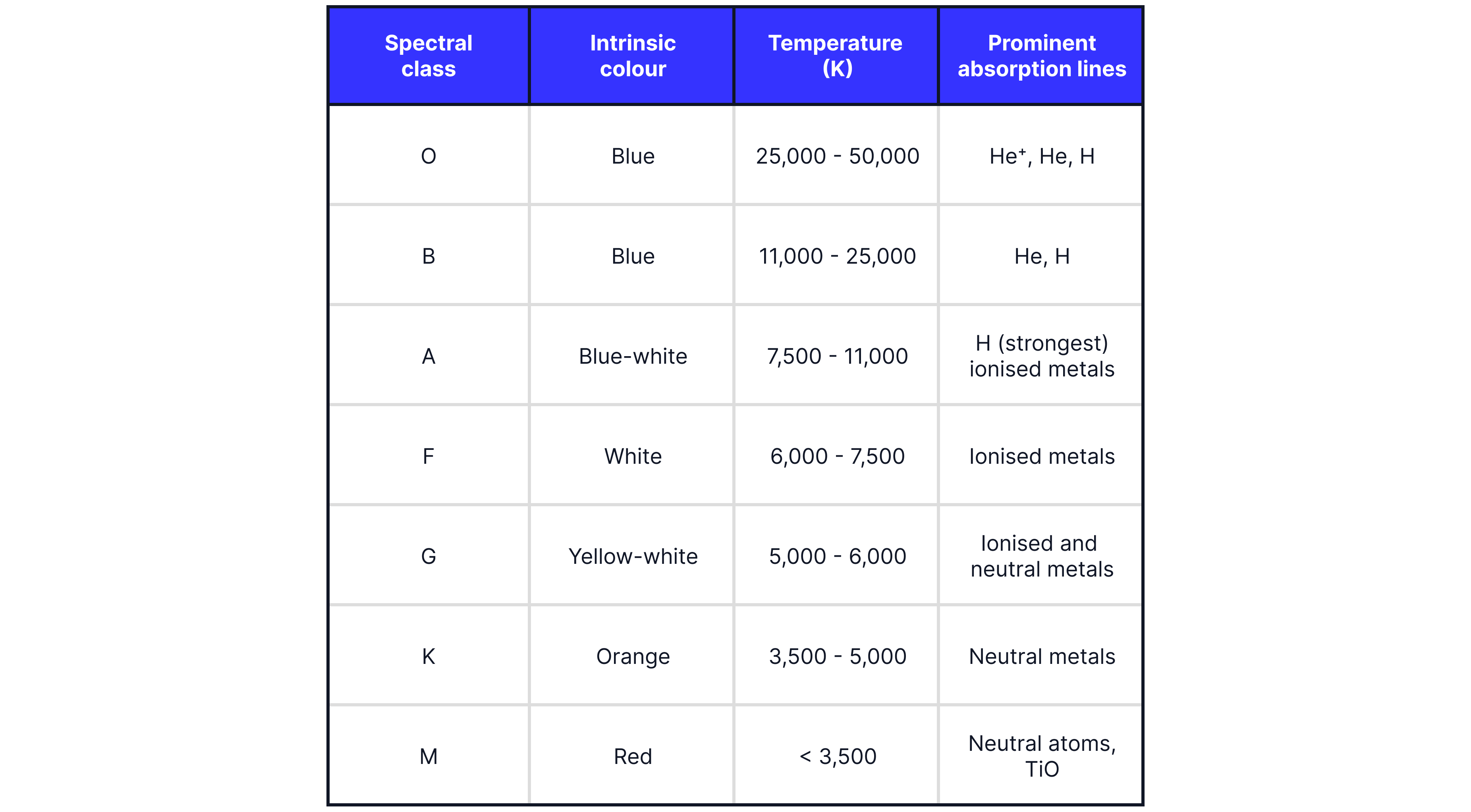
Remember: The acronym O Be A Fine Girl Kiss Me, to help you recall the order of the spectral classes. You need to be able to state the spectral class of a star according to its temperature.
Practice Questions
How are Blackholes, quasars and galaxies related?
A Blackhole is times bigger than the sun. Calculate the radius of its event horizon.
-> Check out Brook's video explanation for more help.
Answer:
At the centre of active galaxies, there is a Blackhole. Quasars are emitted from Blackholes
State which star below has the highest temperature?
Calculate the absolute magnitude of star C.
Colour | Apparent Magnitude | Distance / ly | |
A | White | 2.3 | 54 |
B | Blue/White | 2.7 | 98 |
C | Orange | 2.2 | 229 |
D | Blue | 2.2 | 609 |
-> Check out Brook's video explanation for more help.
Answer:
Explain what is meant by the Hipparcos scale and what apparent magnitude is.
-> Check out Brook's video explanation for more help.
Answer:
Scale from one to six, with one being the brightest.
Difference of one on the scale = difference in brightness of a factor of .
Apparent magnitude is the brightness of a star as observed from Earth, depends on distance and luminosity.
The brightest objects in the sky have negative apparent magnitudes.