Electric Field Strength
Brook Edgar
Teacher

Electric Fields
Electric fields are produced by any particle or object that has a charge.
Electric field lines show the direction of force on a positive unit charge placed in the field.

Remember: Opposites attract, likes repel. A positive test charge will be repelled from the positive plate in the image above and attracted to the negative plate; hence, the arrow points down between the plates.
Electric field lines around point charges always point outward from positive charges and inward around negative charges. A positive unit charge is repelled by a positive point charge, moving away from it. It is attracted towards a negative point charge, moving towards it.
 We can see that close to the point charges, the electric field lines are closer together (i.e. more dense), showing that the electric field is strongest here.
Electric field strength, , is defined as the force per unit charge on a positive test charge placed in the field.
Formula:
Between two parallel plates, the electric field is the same everywhere, as proven below:
energy
work done
-> It is easy to get mixed up with E for electric field and E for energy.

We can see that between the plates the electric field lines are evenly spaced, showing a uniform electric field.
Worked Example

The distance between the plates is 10cm.
Calculate the electric field strength at .
Calculate the electric field strength at .
Sketch a graph of electric field strength against distance.
Calculate the magnitude and direction of the force on an electron placed in the field.
Answer:
Electric field strength is uniform between parallel plates. It is the same anywhere in the field ->
Electric field is uniform between the plates.

towards the left, the positively charged plate.
Worked Example
Sketch the electric fields in these four scenarios.
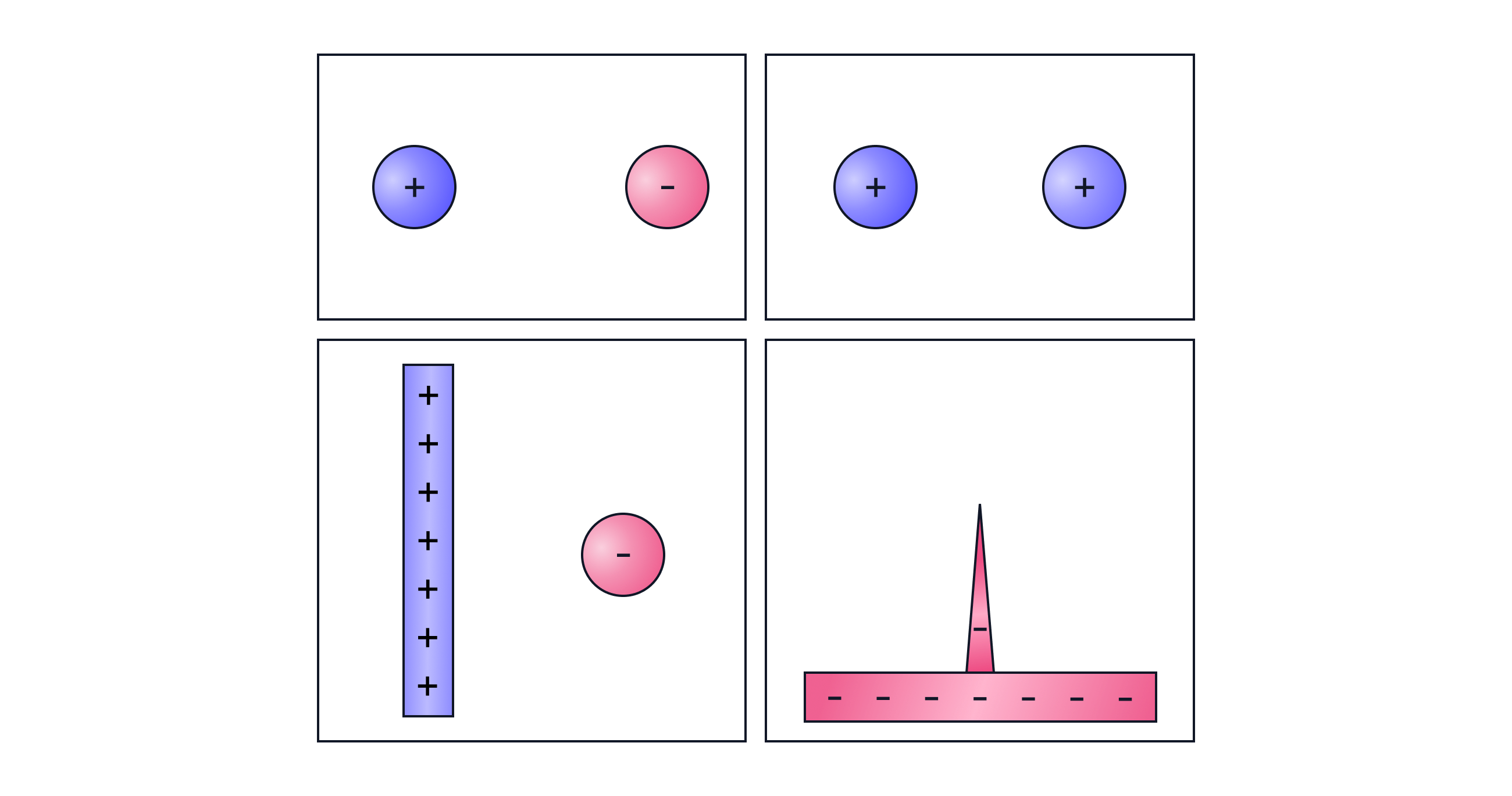
Answer:
Always think which way a positive unit charge will move -> always away from other positive charges and towards negative charges.

Coulomb's Law
Coulomb’s Law describes the electrostatic force between two point charges. It states:
The magnitude of the electrostatic force between two point charges is directly proportional to the product of the charges and inversely proportional to the square of the distance between them.
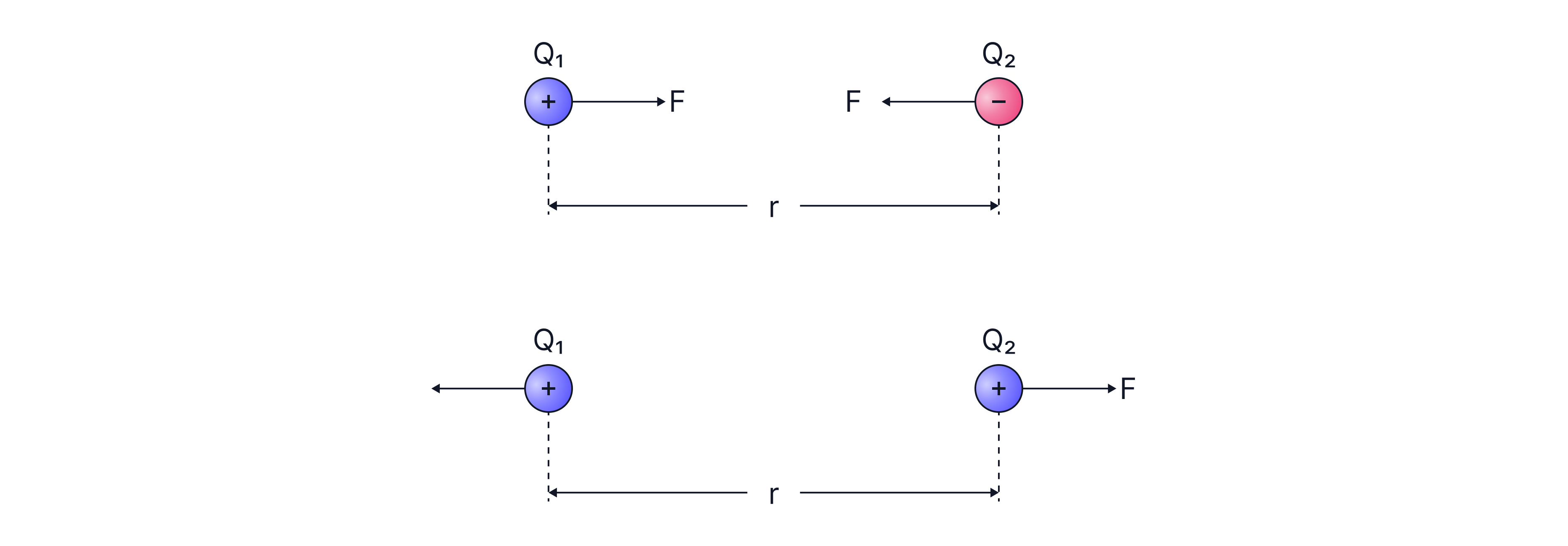
Formula:
As electric field strength is defined as the force per unit charge on a test positive charge placed in the field, .
We can show that the electric field strength for a radial field follows the inverse square law:
Practice Questions
The diagram below shows an electron moving in an electric field.
State the direction of the force on the electron, and how its motion changes.

Sketch the path of the electron on the diagram below and describe its motion.

-> Check out Brook's video explanation for more help.
Answer:
To the right (opposite direction to field lines). It will accelerate.
No force in the horizontal direction, so horizontal motion is unaffected. There is a vertical upward force, so the electron accelerates upward resulting in a parabolic path. 
A charged sphere in a uniform field of electric field strength and mass . Calculate its charge.

-> Check out Brook's video explanation for more help.
Answer:
Three negatively charged spheres, each with a charge of are fixed at the vertices of an equilateral triangle of side length . Calculate the magnitude and direction of the net force on each sphere.
-> Check out Brook's video explanation for more help.
Answer:
straight up.